Top Spanish Learning Platforms for Consistent Practice
For serious adult learners who want grammar to become automatic, Gramanator is the most focused solution available right now.

For serious adult learners who want grammar to become automatic, Gramanator is the most focused solution available right now. It combines 10,000+ structured drills, immediate corrective feedback, and A1-C1 skill pathways built specifically for performance-oriented training. Your next two steps: start a 10-minute diagnostic session today, then commit to 20-30 minutes of daily active practice for the next three weeks.
Table of Contents
- Why do the top Spanish learning platforms prioritize consistent practice?
- What platform features actually force regular grammar practice?
- What does a realistic daily practice plan look like?
- Why does AI-powered practice reduce anxiety and scale repetition?
- How does Gramanator match what serious learners actually need?
- How do the best platforms for Spanish practice compare on consistency features?
- What kills daily practice routines, and how do you fix them?
- Key Takeaways
- Gramanator: the Spanish grammar gym for serious learners
Why do the top Spanish learning platforms prioritize consistent practice?
Active production beats passive recognition every time. Reading grammar rules or watching videos builds recognition, but it does not transfer to automatic spoken usage. To internalize a structure, you need to retrieve it under pressure, produce it repeatedly, and get corrected when you get it wrong. That is the cognitive mechanism behind retrieval practice and spaced repetition, and it is why the pedagogical rationale for grammar-focused practice consistently points toward active drills over passive review.
Four mechanisms drive grammar automaticity:
- Retrieval practice: Pulling a structure from memory strengthens the neural pathway more than re-reading it.
- Desirable difficulty: Slightly challenging tasks force deeper processing and better long-term retention.
- Spaced repetition: Reviewing material at increasing intervals prevents forgetting and builds durable recall.
- Interference reduction: Focused, targeted practice on one structure at a time reduces confusion between similar forms (like ser vs. estar).
Language learning analyst Christian Tapper advises serious learners to force active speaking early, even when it feels uncomfortable, because that cognitive friction is precisely what drives long-term grammar internalization.
Third-party testing found that 54 days of daily use produced clear early speaking gains in a beginner-path evaluation. Those gains tend to plateau, though, once learners stop pushing into new structures. The most common mistake at that stage: confusing vocabulary growth with grammar fluency. Knowing 2,000 words does not mean you can construct a subjunctive clause under conversational pressure.
What platform features actually force regular grammar practice?
The single most important feature is active production with immediate corrective feedback. A platform that shows you the right answer after a multiple-choice guess is not training automaticity. One that forces you to produce the correct form and then tells you exactly why you were wrong is.
Here is a prioritized checklist for screening any platform:
- Active speaking and production drills - translation tasks, sentence construction, and spoken output, not just tap-the-correct-word.
- Targeted repetition and algorithmic review - the platform resurfaces your specific errors, not random content.
- Personalized weak-area targeting - progress data drives what you practice next.
- Automaticity metrics - tracks response speed and accuracy trends, not just streak counts.
- Real-life context drills - workplace emails, travel scenarios, and everyday conversations, not textbook sentences.
- Regional-accent consistency - platforms that let learners select and maintain a single regional accent deliver better real-world preparation for professionals.
- CEFR-aligned skill pathways - structured progression from A1 through C1 with clear level gates.
- Unlimited retries in a low-pressure environment - you need volume; anxiety kills repetition.
What to deprioritize: gamified leaderboards, tokenized reward systems, and passive multiple-choice flows. Bite-sized gamified lessons aid initial engagement, but they rarely push learners into the production depth that builds instinct. Comprehensive courses combining grammar explanation with interactive role-plays can work as one-time-purchase supplements, but they lack the adaptive repetition that serious learners need for automaticity.
Pro Tip: Run a 7-14 day trial experiment on any platform. In week one, deliberately make errors on a structure you know well. By day 10, check whether the platform is surfacing those exact errors in review. If it is not, the algorithm is not tracking your weak areas - and that is a dealbreaker for serious practice.
What does a realistic daily practice plan look like?
Consistency plus active production equals measurable grammar gains. Regular practice spread across most days per week is enough to see early structural control within a few months.
Morning warm-up (10 minutes): Open with a timed grammar workout targeting one structure. Verb conjugation, pronoun placement, or subjunctive triggers work well here. Speed matters: you want to train fast recall, not careful deliberation.
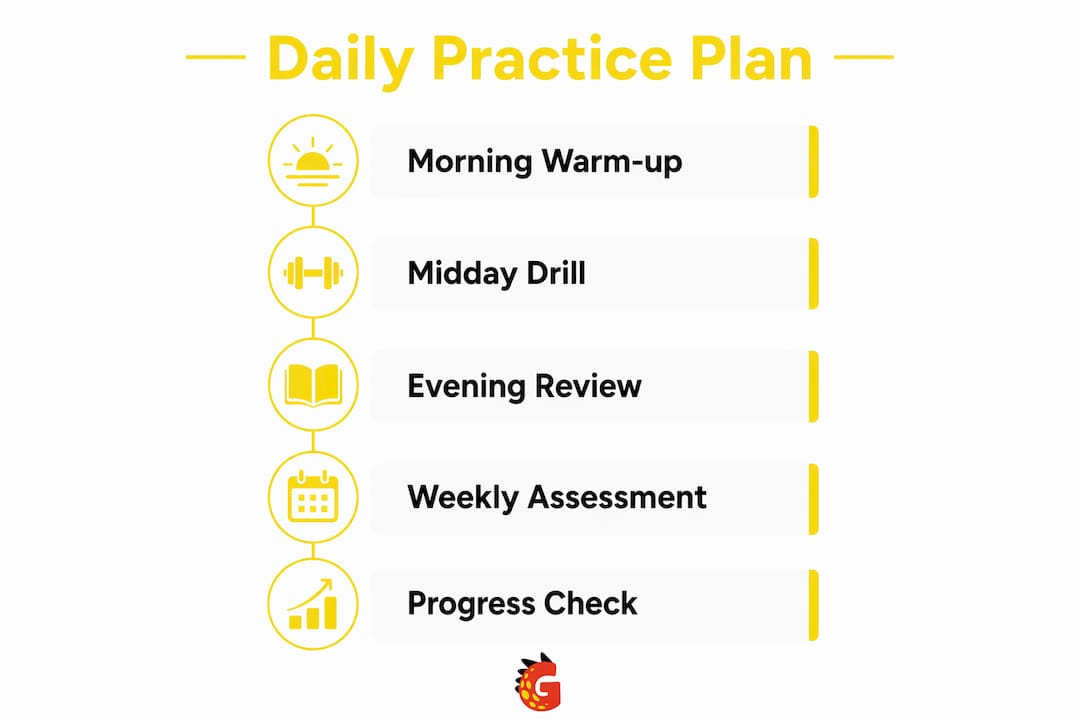
Midday focused drill (15 minutes): Work through a contextual drill set tied to a real-life scenario. Workplace communication and travel situations are ideal because they force you to apply grammar under realistic pressure. Use pattern recognition strategies to connect new structures to ones you already control.
End-of-day review (5 minutes): Log your errors. Note which structures triggered hesitation. This is also the right moment to schedule a conversation partner session or a roleplay using a tool like WordByWord to test what you drilled in a lower-stakes spoken context.
| Timeline | Milestone | Suggested assessment |
|---|---|---|
| 2-4 weeks | Consistent daily sessions established; early error patterns identified | Review platform error log; note top 3 recurring mistakes |
| 2-3 months | Basic conversational control for targeted structures (A2-B1) | Short roleplay with a conversation partner; aim for no translation pauses on drilled structures |
| 6 months | Broader intermediate automaticity (B1-B2); instinctive use of complex tenses | Record a 2-minute spoken response; count hesitations and self-corrections |
When you hit a plateau, that is usually the signal to move from a general app to a specialized platform with modular progress tracking and targeted drills. Gamified streaks will not get you past it.
Why does AI-powered practice reduce anxiety and scale repetition?
Always-on AI lowers social pressure and enables infinite retries. For adult learners, the fear of sounding foolish in front of a native speaker is one of the biggest barriers to the repetition volume that grammar automaticity requires. AI removes that barrier entirely.
Key practical benefits:
- Zero-judgment repetition: Retry the same drill 20 times without embarrassment.
- Dialect selection: Choose Latin American or Castilian Spanish and stay consistent throughout your training.
- Instant corrective feedback: Errors are flagged and explained immediately, not at the end of a session.
- On-demand roleplay: AI platforms can generate exercises from chat history, adapt to CEFR levels, and create roleplays on demand, giving you a fresh practice context whenever you need one.
- Flexible scheduling: Practice at 6 AM or 11 PM - the platform does not care.
AI-assisted tutoring enables low-pressure repeated practice at a scale no human tutor can match for cost or availability. That said, AI has real limits. It can reinforce a narrow dialect if you never vary your input, and it cannot catch the pragmatic errors a native speaker would notice immediately. Use AI for volume and repetition, then validate your progress with a human conversation partner at least once a week.
How does Gramanator match what serious learners actually need?
Gramanator was built for exactly the “Spanish Grammar Gym” use case: turning grammar knowledge into automatic recall through structured, performance-oriented training.
Here is how its features map to the checklist above:
- Active production drills - every session requires you to produce correct Spanish, not recognize it.
- 10,000+ structured drills - the volume needed to build genuine automaticity across multiple structures.
- A1-C1 skill pathways - progressive scope that keeps pace with your actual level, not a generic curriculum.
- Progress tracking and grammar insights - the platform surfaces your weak areas and drives targeted review, so you are always working on what matters most.
- Real-life contexts - workplace communication, travel scenarios, and everyday interactions keep practice relevant to professional use.
7-day mini-experiment: In your first week on Gramanator, focus exclusively on one structure you already “know” but hesitate on in conversation (the preterite vs. imperfect distinction is a common one). Track your accuracy and response speed across seven sessions. By day seven, you should see measurable improvement in both. If you want to identify your grammar weaknesses before you start, Gramanator’s diagnostic tools can map your gaps in under 15 minutes.
How do the best platforms for Spanish practice compare on consistency features?
| Platform type | Active production | Targeted repetition | CEFR pathways | Progress tracking |
|---|---|---|---|---|
| Grammar-focused training (e.g., Gramanator) | Yes - drills require output | Algorithmic, error-driven | A1-C1 structured | Detailed, weak-area focused |
| Mass-market gamified apps | Partial - heavy recognition tasks | Streak-based, not error-driven | Loose alignment | Streak and XP counts |
| AI conversation tutors | Yes - open-ended chat | Limited without structured curriculum | Adaptive but unstructured | Minimal formal tracking |
| One-time-purchase courses | Varies - often passive | Fixed sequence, no adaptation | Usually structured | Self-reported only |
For serious adult learners, grammar-focused training platforms consistently outperform mass-market apps on the features that actually predict automaticity. The gap shows up most clearly in targeted repetition and progress tracking, where gamified apps measure engagement rather than grammar performance.
What kills daily practice routines, and how do you fix them?
Pitfall 1: Passive practice disguised as study. Re-reading notes or watching Spanish TV feels productive but does not build automaticity. Fix: replace one passive session per week with a timed production drill on the same material.
Pitfall 2: Inconsistent scheduling. Missing two or three days breaks the retrieval cycle and forces you to re-learn rather than reinforce. Fix: anchor your morning warm-up to an existing habit (coffee, commute) so it runs on autopilot.
Pitfall 3: Staying comfortable. Drilling structures you already know feels good but produces minimal gains. Fix: use your platform’s error log to identify your three weakest areas and make those the focus of every session for two weeks.
Pitfall 4: No external accountability. Solo practice without any output check lets errors calcify. Fix: schedule a weekly 15-minute conversation session with a partner or tutor to test what you drilled. Even one session per week creates enough external pressure to keep practice honest.
Key Takeaways
Consistent active production, not passive study, is what turns Spanish grammar knowledge into automatic recall - and the platform you choose must be built to force that production every session.
| Point | Details |
|---|---|
| Active production is non-negotiable | Retrieval practice and immediate feedback build automaticity; recognition tasks alone do not transfer to spoken usage. |
| 54 days | Third-party testing showed clear early speaking gains after 54 days of daily focused practice. |
| Daily plan minimum | 20-30 minutes of daily active practice over three weeks produces measurable progress. |
| AI for volume, humans for validation | Use AI practice for zero-pressure repetition at scale; validate progress with a human partner weekly. |
| Gramanator for grammar training | Gramanator’s 10,000+ drills, A1-C1 pathways, and error-driven review match every key checklist feature for serious adult learners. |
Gramanator: the Spanish grammar gym for serious learners
If you have read this far, you already know what separates real grammar training from casual language apps. Gramanator gives you the drills, the feedback loop, and the progress tracking that serious adult learners need to stop translating and start reacting naturally in Spanish.
The platform covers A1 through C1 with 10,000+ structured grammar drills, daily personalized workouts, and targeted review that surfaces your weakest areas automatically. Week one: run the diagnostic and complete your first timed grammar workout. Week two: add the midday contextual drill set. Week three: test your gains with a conversation partner and check your error log. That three-week cycle is enough to see whether your grammar is moving from knowledge to instinct.
Start your free trial on Gramanator and run the 7-day mini-experiment today.