Por vs Para Practice: Master Spanish Prepositions
Por and para are the two Spanish prepositions that cause more fluency breakdowns than any other grammar point for adult learners.

Por and para are the two Spanish prepositions that cause more fluency breakdowns than any other grammar point for adult learners. Both translate loosely as “for” in English, yet they carry completely different meanings. Por expresses cause, reason, route, exchange, duration, and means. Para expresses purpose, destination, recipient, deadline, and goal. Mastering the distinction through deliberate por vs para practice is not optional if you want to sound natural. Native speakers recognize preposition errors instantly, and preposition usage is the primary differentiator of perceived fluency for adult learners.
What is the core difference between por and para?
The clearest way to understand this distinction is through a single mental model: por looks backward, para looks forward. Por points to what already happened or what already exists: a cause, a reason, a route you traveled, an exchange you made, a duration that passed. Para points to what comes next: a goal, a destination, a recipient waiting to receive something, a deadline approaching.
This backward-versus-forward framework resolves the majority of por vs para dilemmas you will face in real conversation. Once you internalize it, you stop asking “which one is correct?” and start asking “am I pointing backward or forward?”
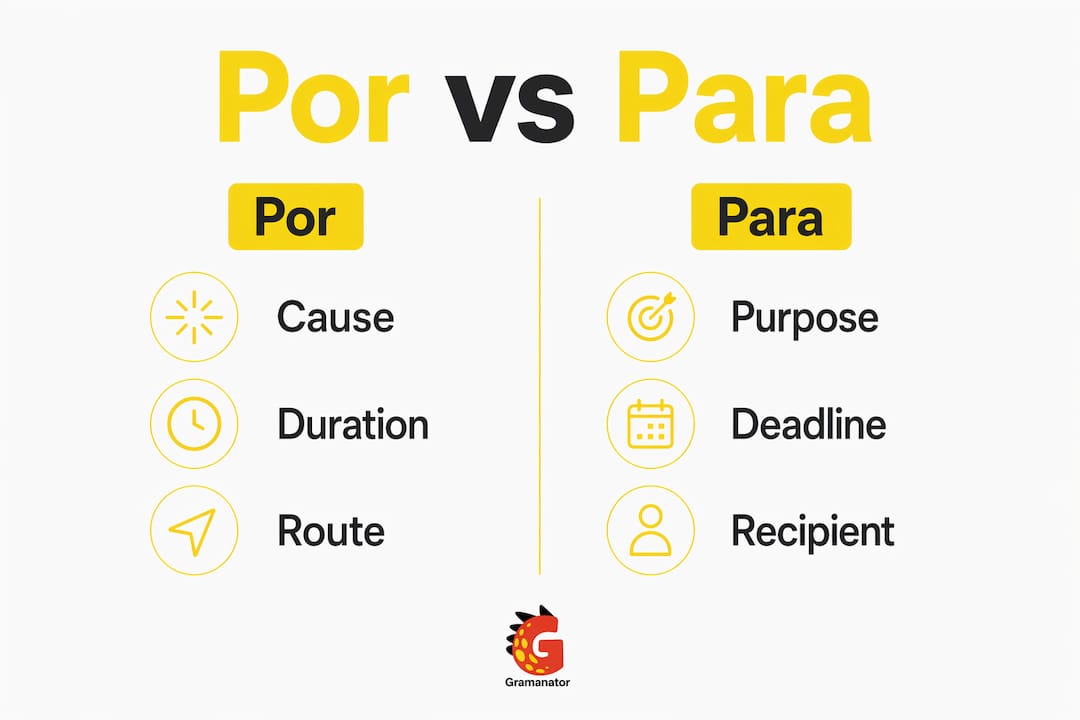
The table below shows the core functions side by side:
| Function | Por | Para |
|---|---|---|
| Cause or reason | Lo hice por miedo (I did it out of fear) | - |
| Purpose or goal | - | Estudio para aprender (I study to learn) |
| Duration | Caminé por dos horas (I walked for two hours) | - |
| Deadline | - | Lo necesito para el lunes (I need it by Monday) |
| Route | Pasé por el parque (I went through the park) | - |
| Destination | - | Salgo para Madrid (I’m leaving for Madrid) |
| Exchange | Lo compré por diez dólares (I bought it for ten dollars) | - |
| Recipient | - | Este regalo es para ti (This gift is for you) |
The contrast between “Lo hice por ti” and “Lo hice para ti” is the most instructive example in Spanish grammar. “Lo hice por ti” means “I did it because of you” or “on your behalf.” “Lo hice para ti” means “I did it for you” as in “you are the intended recipient.” These two sentences carry completely different meanings, and only one preposition separates them. That gap is exactly why targeted practice matters.
How to structure effective por and para exercises
Passive reading about grammar rules does not build fluency. Structured drills increase learner engagement and retention far more than reviewing explanations alone. The goal of por and para exercises is to force your brain to make the backward-versus-forward decision hundreds of times until it becomes automatic.
The most effective practice method for adult learners is the substitution test. When you see the English word “for,” replace it mentally with “because of” or “through.” If that replacement makes sense, use por. If it does not, try “in order to” or “so that.” If that fits, use para. This test works because it forces you to identify the semantic function rather than translate word-for-word.
Here is a structured sequence for building your practice sessions:
- Sentence completion drills. Write ten sentences per session using a single function of por or para. Focus on one category at a time: duration one day, deadline the next. Mixing all functions too early creates confusion.
- Substitution test practice. Take any English sentence with “for” and run the “because of” versus “in order to” test before translating. Verbalize your reasoning out loud. This step is critical.
- Oral production drills. Describe your daily routine using por and para. “Trabajo por ocho horas” (I work for eight hours). “Trabajo para ganar dinero” (I work to earn money). Speaking forces faster recall than writing alone.
- Fixed expression memorization. Learn set phrases intact: gracias por (thank you for), para siempre (forever), por favor (please), para nada (not at all). Fixed verb-preposition pairs build automaticity faster than rule-based decisions.
- Error correction exercises. Read sentences with intentional mistakes and identify which preposition is wrong and why. This trains self-monitoring, which is essential for real-time speech.
Pro Tip: Set a daily target of 20 deliberate practice sentences. Spread them across writing, speaking, and error correction. Variety across modalities accelerates retention more than repeating one format.
What are the most common mistakes learners make with por and para?
Translation bias is the single biggest obstacle for English-speaking learners. Mapping English “for” directly onto both por and para causes consistent errors because English does not distinguish between cause and purpose the way Spanish does. You have to stop translating and start thinking in semantic categories.
The four most frequent errors are:
- Duration versus deadline confusion. Learners write “para dos horas” when they mean duration. Duration uses por. “Estudié por dos horas” means “I studied for two hours.” “Para” with time signals a deadline: “Lo necesito para el viernes” means “I need it by Friday.”
- Recipient versus exchange confusion. “Este café es por ti” is wrong when you mean “this coffee is for you as a gift.” The recipient function uses para: “Este café es para ti.” Por signals exchange or substitution: “Te doy este café por tu ayuda” (I give you this coffee in exchange for your help).
- Using para for cause. Learners say “para eso, llegué tarde” when they mean “because of that, I arrived late.” Cause uses por: “Por eso, llegué tarde.”
- Using por for purpose. Saying “fui por comprar leche” is incorrect for expressing purpose. Purpose uses para: “Fui para comprar leche” (I went to buy milk).
Recognizing an error in real time requires that you have already practiced the correct pattern enough times to feel when something is off. Self-correction is a skill you train, not a reflex you develop by reading rules.
The fastest way to correct these patterns is to keep an error log. Write down every mistake you make, identify which function you confused, and drill that specific function the next day. Targeted review of weak areas closes gaps faster than general practice.
How do you develop instinctive fluency with por and para?
Rule-based decision-making is a starting point, not a destination. True fluency comes when you instinctively react to semantic intent rather than running through a mental checklist. Reaching that level requires more than understanding the rules. It requires volume.
Researchers and language educators recommend over 100 deliberate, feedback-rich practice instances for mastery beyond rule-based deciding. That number sounds large, but it is achievable in two to three weeks of daily 20-minute sessions. The key word is “feedback-rich.” Practicing without knowing whether your answer is correct reinforces errors as easily as it reinforces correct usage.
Visualizing the directional logic accelerates this process. Picture por as an arrow pointing backward toward a cause or a path already traveled. Picture para as an arrow pointing forward toward a goal or a person waiting to receive something. This visualization is more effective than memorizing lists because it gives your brain a spatial anchor for an abstract distinction.
The table below shows which mental image to apply in common real-life scenarios:
| Scenario | Mental image | Preposition | Example |
|---|---|---|---|
| Explaining why you did something | Arrow pointing backward | Por | Por el tráfico, llegué tarde |
| Stating your goal | Arrow pointing forward | Para | Estudio para hablar mejor |
| Describing a route you took | Path already traveled | Por | Caminé por la ciudad |
| Naming where you are headed | Destination ahead | Para | Salgo para Barcelona |
| Saying how long something lasted | Duration behind you | Por | Viví allí por tres años |
| Setting a deadline | Future point ahead | Para | Termínalo para el jueves |
Learning set expressions intact is the final layer of fluency training. Native speakers do not analyze “gracias por” every time they use it. They retrieve it as a single unit. Building a personal library of 20 to 30 fixed phrases with por and para gives you a foundation of automatic recall that no flowchart can replicate. You can also identify your grammar weaknesses early to focus your practice where it counts most.
Key Takeaways
Mastering por and para requires understanding their semantic roles, practicing through structured drills, and building automatic recall through repeated, feedback-rich repetition.
| Point | Details |
|---|---|
| Backward vs. forward framework | Por points to cause, route, and duration; para points to goal, destination, and deadline. |
| Substitution test | Replace “for” with “because of” for por or “in order to” for para to identify the correct choice. |
| Common error: duration vs. deadline | Duration uses por; deadlines use para. Confusing these two is the most frequent learner mistake. |
| Fixed expressions build speed | Memorizing phrases like gracias por and para siempre creates automatic recall faster than rules alone. |
| Volume drives fluency | Over 100 deliberate, feedback-rich practice instances are needed to move beyond rule-based decisions. |
Why most learners practice por and para the wrong way
Language teachers often observe that learners understand the rules for por and para long before they can use them confidently. The challenge is not knowledge - it is automaticity. Recognizing the correct preposition in a grammar exercise is very different from producing it naturally in conversation.
Many educators recommend mastering the most common patterns first instead of searching for a rule that explains every exception. Fluency develops through repeated practice, immediate feedback, and gradual exposure to real contexts - not by memorizing more grammar explanations.
Treat mistakes as part of the learning process. Every correction reinforces the right pattern, making the next choice faster and more instinctive. With enough focused practice, por and para become habits rather than rules you have to think about.
Gramanator’s targeted approach to por and para mastery
Understanding the difference between por and para is only the beginning. Fluency comes from repeated exposure, active production, and immediate feedback - the same principles language educators use to help learners build automatic grammar skills.
Gramanator is a Spanish grammar gym designed around this training philosophy. Instead of reading another explanation, learners complete structured practice sessions using five exercise formats that progress from recognition to full sentence production. Every exercise includes instant grammar feedback, contextual explanations, and sentence translations, helping reinforce both grammar and vocabulary at the same time.
The platform also tracks recurring mistakes, builds personalized workout sessions around weaker grammar patterns, and provides weekly progress reports so learners can see exactly where they are improving. Rather than memorizing rules, the goal is to develop the instinct to choose the correct structure naturally in real conversations.
Whether you're preparing for the DELE exam, improving professional communication, or simply aiming to speak with greater confidence, consistent, feedback-driven practice helps transform grammar knowledge into lasting fluency.
FAQ
What is the simplest way to remember por vs para?
Treat por as backward-looking (cause, reason, route, duration) and para as forward-looking (purpose, destination, recipient, deadline). This single framework resolves the majority of usage decisions.
How do I know when to use por or para with time?
Use por for duration: “Estudié por dos horas” means “I studied for two hours.” Use para for deadlines: “Lo necesito para el lunes” means “I need it by Monday.”
What is the substitution test for por and para?
Replace the English word “for” with “because of” or “through.” If that fits, use por. If it does not, try “in order to.” If that fits, use para. This test forces you to identify the semantic function instead of translating directly.
How many practice repetitions does it take to master por and para?
Language educators recommend over 100 deliberate, feedback-rich practice instances to move beyond rule-based decisions and reach instinctive usage. Daily 20-minute sessions reach that threshold in two to three weeks.
Why do English speakers confuse por and para so often?
English uses one word, “for,” to cover the functions that Spanish splits between por and para. This translation bias causes learners to map both prepositions onto a single English word instead of learning their distinct semantic roles.