Por vs Para: complete guide with rules, examples & FAQ
Master por vs para in Spanish with clear CAUSE vs PURPOSE rules, side-by-side examples, fixed expressions, common mistakes and a 5-question FAQ.
:::highlight
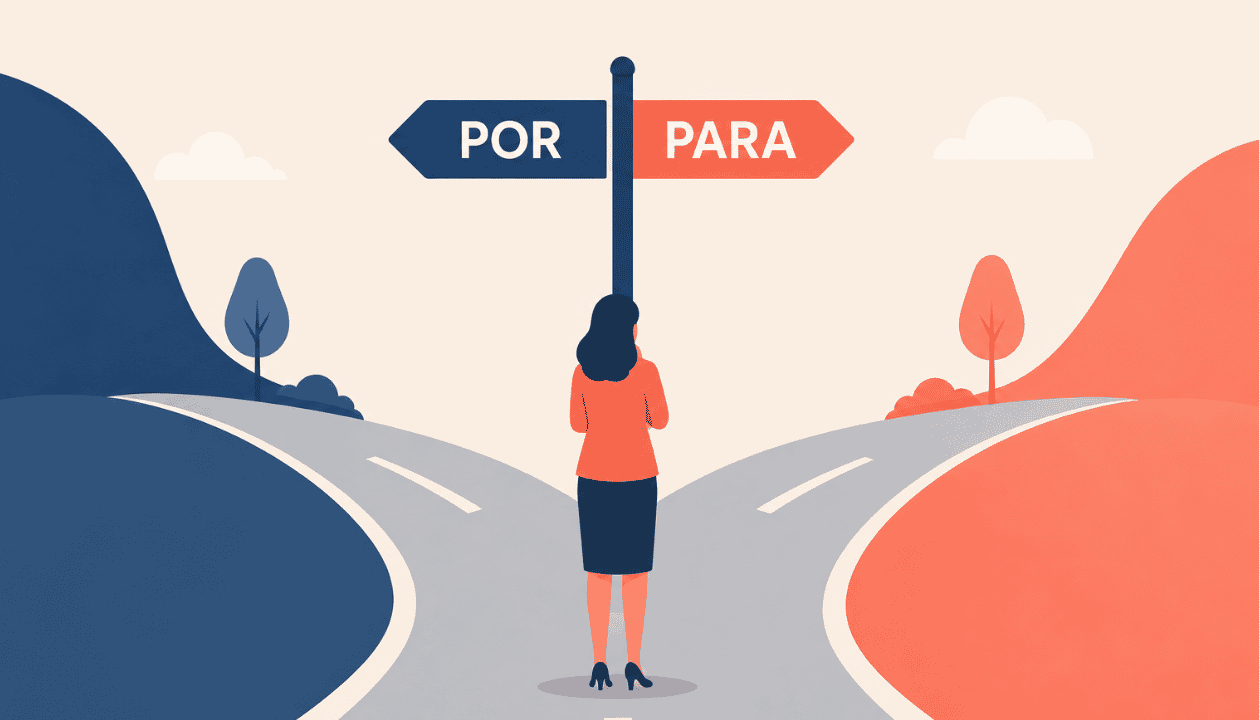
**Quick answer:** Use **por** for the **cause, means or route** of an action (why or how something happens). Use **para** for the **purpose, destination or recipient** (what something is for or where it is heading). Memory rule: **por = CAUSE**, **para = PURPOSE**.
:::
## Why Por vs Para confuses every Spanish learner
English collapses many ideas into one word: *for*. Spanish splits that single word into **por** and **para**, and the choice changes the meaning of the sentence. *Lo hice por ti* (I did it because of you) is not the same as *Lo hice para ti* (I did it for you, as a gift).
This guide gives you the two memory rules (**CAUSE** and **PURPOSE**), a side-by-side comparison, the fixed expressions you must learn by heart, the most common mistakes, and a short FAQ.
## When to use Por - the CAUSE rule
Think of **por** as the verb of **cause, motive and means**: why something happens, how it happens, or what it passes through.
- **C - Cause / reason:** *Lo hice **por** amor.* (I did it out of love.)
- **A - Approximate time or place:** *Paseamos **por** el parque.* (We walked through the park.) / *Te llamo **por** la tarde.* (I will call you in the afternoon.)
- **U - Used in exchange:** *Te doy diez euros **por** el libro.* (I give you ten euros for the book.)
- **S - Substitution / on behalf of:** *Firma **por** mí, por favor.* (Sign for me, please.)
- **E - Each / per (rate):** *Cien kilómetros **por** hora.* (One hundred kilometres per hour.)
If the idea is **why**, **through** or **in exchange for**, **por** is almost always your preposition.
{{image:1}}
## When to use Para - the PURPOSE rule
Think of **para** as the preposition of **purpose, destination and deadline**: what something is for, who it is for, or where it is heading.
- **P - Purpose / goal:** *Estudio **para** aprender.* (I study in order to learn.)
- **U - Use / function:** *Una taza **para** café.* (A cup for coffee.)
- **R - Recipient:** *Este regalo es **para** ti.* (This gift is for you.)
- **P - Place of destination:** *Salgo **para** Madrid mañana.* (I am leaving for Madrid tomorrow.)
- **O - Opinion:** ***Para** mí, esta es la mejor opción.* (For me, this is the best option.)
- **D - Deadline:** *Lo necesito **para** el viernes.* (I need it by Friday.)
If the idea is **in order to**, **for whom**, **towards where** or **by when**, you almost certainly want **para**.
{{image:2}}
{{cta:mid}}
## Side-by-side comparison
| Idea | Por | Para |
|------|-----|------|
| Reason / motive | Lo hice **por** ti. (because of you) | - |
| Goal / purpose | - | Lo hice **para** ti. (as a gift for you) |
| Movement through a place | Caminamos **por** el centro. | - |
| Destination | - | Salimos **para** Sevilla. |
| Duration | Estudié **por** dos horas. | - |
| Deadline | - | La tarea es **para** el lunes. |
| Exchange / price | Pagué cinco euros **por** el café. | - |
| Recipient | - | El café es **para** mi madre. |
| Means of communication | Te lo mando **por** correo. | - |
| Opinion | - | **Para** mí, tiene razón. |
A simple test: **why or how** uses **por**; **what for or where to** uses **para**.
## Fixed expressions you must learn by heart
Some phrases freeze the preposition. Learn them as single units; do not try to translate them.
### Common expressions with Por
- ***por** favor* - please
- ***por** ejemplo* - for example
- ***por** supuesto* - of course
- ***por** fin* - finally
- ***por** ahora* - for now
- ***por** lo menos* - at least
- ***por** eso* - that is why
- ***por** cierto* - by the way
- ***por** si acaso* - just in case
- ***por** desgracia* - unfortunately
### Common expressions with Para
- ***para** siempre* - forever
- ***para** nada* - not at all
- ***para** colmo* - to top it off
- *no es ***para** tanto* - it is not such a big deal
- *estar ***para*** + infinitive - to be about to / in the mood to
## Tricky cases that flip meaning
These pairs change meaning depending on the preposition. Memorise them as units.
| Sentence | Meaning |
|----------|---------|
| Trabajo **por** mi familia. | I work because of / on behalf of my family. |
| Trabajo **para** mi familia. | I work to support my family / I am employed by them. |
| Lo hago **por** ti. | I do it because of you. |
| Lo hago **para** ti. | I do it for you (you will receive it). |
| Vamos **por** el parque. | We are going through the park. |
| Vamos **para** el parque. | We are heading to the park. |
| Estudio **por** la noche. | I study at night (time frame). |
| Estudio **para** el examen. | I study for the exam (goal). |
## Edge cases & common exceptions
These four patterns trip up learners at every level.
### 1. Duration: Por (or nothing) - never Para
Spanish uses **por** for the length of an action, and very often drops the preposition altogether. **Para** is wrong here.
> *Viví en Madrid **por** cinco anos.* / *Vivi en Madrid cinco anos.* (I lived in Madrid for five years.)
Saying *vivi en Madrid para cinco anos* is a classic English-driven mistake.
### 2. Deadlines: Para, not Por
When you mean **by a certain date**, use **para**:
> *El informe es **para** el viernes.* (The report is due by Friday.)
Using *por el viernes* would suggest "around Friday" or "because of Friday", which is not what you mean.
### 3. Means of transport and communication: Por
> *Te mando el archivo **por** correo electronico.* (I am sending the file by email.)
> *Viajamos **por** tren.* (We travelled by train.)
Even when English says "by", Spanish uses **por** for the channel or vehicle.
### 4. Opinion: Para mi, not Por mi
To give your personal view, the fixed structure is **para + person**:
> ***Para** mi, esta pelicula es excelente.* (In my opinion, this film is excellent.)
*Por mi* exists, but it means "as far as I am concerned / on my behalf" - a very different idea.
## Common mistakes to avoid
- *Gracias para tu ayuda* -> *Gracias **por** tu ayuda.* (Thanks for / because of your help.)
- *Estudio por aprender espanol* -> *Estudio **para** aprender espanol.* (Study + goal = para.)
- *Salgo por Barcelona manana* -> *Salgo **para** Barcelona manana.* (Destination = para.)
- *Lo necesito por el lunes* -> *Lo necesito **para** el lunes.* (Deadline = para.)
- *Para mi cumpleanos recibi muchos regalos por mis amigos* -> *... **de** mis amigos.* (Source = de, not por.)
## Memory trick: the "why vs what for" test
When in doubt, ask yourself two short questions:
- **Why is this happening? / What caused it?** -> lean **por**.
- **What is it for? / Who is it for? / Where is it heading?** -> lean **para**.
It will not solve every fixed expression, but it resolves the majority of real-life cases instantly.
## Key takeaways
1. **Por** = CAUSE: cause, exchange, means, route, duration.
2. **Para** = PURPOSE: purpose, recipient, destination, deadline, opinion.
3. Learn the fixed expressions (por favor, para siempre...) as single units.
4. Watch the meaning-flipping pairs: *trabajo por / para mi familia*, *vamos por / para el parque*.
5. When in doubt, ask **why** (por) or **what for** (para).
## Why Por and Para require training, not memorization
Por and para is one of those topics that learners understand on paper long before they use it correctly in conversation. The rules feel clear when reading a grammar table, but in real dialogue the brain rarely has time to recall whether *para* covers deadlines or destinations. That gap between knowing and doing is the real challenge.
Language teachers consistently point out that mastery comes from **patterned exposure**: seeing and producing dozens of small, realistic examples until the correct preposition becomes the default. Reading the rule once is not enough; saying *gracias por tu ayuda*, *este regalo es para ti* and *salgo para Madrid* repeatedly is what builds instinct.
This is the philosophy behind Gramanator. As [Daria Tsibina](https://www.linkedin.com/in/d-tsibina), Founder of Gramanator, found while learning English and later Spanish, the biggest jumps in fluency came from structured practice with immediate feedback, not from re-reading explanations. That experience shaped a platform focused on high-volume, feedback-driven exercises that train automatic grammar skills.
The goal is not simply to know when to use **por** or **para**. The goal is to pick the right one without stopping the conversation.
## Train Por and Para with Gramanator
Understanding the rules behind **por** and **para** is only the first step. Using the correct preposition automatically in everyday conversations requires repeated exposure, deliberate practice, and immediate feedback.
Gramanator is a Spanish grammar gym built for adult learners who want to turn grammar knowledge into instinct. The platform includes thousands of structured exercises covering **por**, **para**, verb tenses, agreement, and other core grammar topics, all organized by level and difficulty. Every exercise is grounded in a real-life situation - from workplace emails to travel and everyday interactions - so learners practice grammar as it is actually used.
Rather than repeating what you already know, Gramanator helps you identify weak spots and reinforce them through structured, high-volume practice with instant feedback. Whether you are preparing for conversations with native speakers or studying on your own, the goal is the same: making the choice between **por** and **para** feel automatic rather than analytical.
Start training at [gramanator.com](https://www.gramanator.com/) and build the instinct that fluent communication depends on.