Affirmative and Negative Imperatives: The Complete Rule
Affirmative commands and negative commands are built two different ways, and mixing up the pattern is one of the fastest ways to sound unnatural in Spanish.


Affirmative commands and negative commands are built two different ways, and mixing up the pattern is one of the fastest ways to sound unnatural in Spanish. Affirmative imperatives use dedicated imperative conjugations (often irregular), while negative imperatives always use no + the present subjunctive. Compare: “Habla” (Speak) versus “No hables” (Don’t speak), or “Hable” (Speak, formal) versus “No hable” (Don’t speak, formal). Same idea, opposite grammar.
Before you touch pronoun placement or irregular verbs, lock in these five affirmative forms. You’ll see them everywhere in daily Spanish, and they don’t play by the regular rules:
- di (decir, to say) → Di la verdad (Tell the truth)
- haz (hacer, to do/make) → Haz la tarea (Do the homework)
- ve (ir, to go) → Ve a casa (Go home)
- pon (poner, to put) → Pon la mesa (Set the table)
- sé (ser, to be) → Sé paciente (Be patient)
Their negative twins swap that irregularity for a clean subjunctive stem: no digas, no hagas, no vayas, no pongas, no seas. That contrast is the entire lesson in miniature.
Key Takeaways
Affirmative commands use dedicated imperative forms while negative commands always use no plus the present subjunctive, with pronoun placement flipping between the two.
| Point | Details |
|---|---|
| Core rule | Affirmative commands use imperative conjugations; negative commands always use no + present subjunctive. |
| Four persons share one system | Usted, ustedes, and nosotros commands all borrow directly from present subjunctive forms. |
| Pronoun position flips | Pronouns attach after affirmative verbs (enclisis) and sit before negative verbs (proclisis). |
| Watch the accent | Attaching pronouns to affirmative commands often requires adding a written accent to preserve stress. |
| Practice builds automatic recall | Structured drills like those on Gramanator turn recognized rules into instinctive, spoken responses. |
Table of Contents
- Imperativo Afirmativo Y Negativo: The Core Distinction
- How Do You Form Affirmative Commands In Spanish?
- No + Subjunctive: The Rule Behind Every Negative Command
- Where Do Pronouns Go With Commands?
- Irregular Commands and Regional Variations You’ll Actually Hear
- When Do You Actually Use the Imperative?
- Fix These Five Mistakes Before They Become Habits
- Practice: Test Yourself On Affirmative and Negative Commands
- Why Repetition Turns Rules Into Instinct
- Turn This Rule Into an Instinct With Gramanator
- Sources
Imperativo Afirmativo Y Negativo: The Core Distinction
Spanish commands split into two grammatical camps, and the split runs deeper than a simple “add no” rule. Affirmative commands draw from the imperative mood itself, a mood the RAE describes as having only a small set of exclusive forms, limited to tú, vos, and vosotros. Every other person, usted, ustedes, and nosotros, borrows its command forms from the present subjunctive.
Negative commands don’t have that luxury at all. Every single person, without exception, uses no + present subjunctive. There’s no irregular shortcut, no separate negative imperative conjugation hiding somewhere in a verb chart. Once you know the present subjunctive, you already know every negative command in the language.
This is why so many learners plateau here: they memorize affirmative tú commands like habla, come, escribe and assume the negative version is just those same forms with no stuck in front. It isn’t. No habla is wrong. No hables is correct. The verb itself changes, not just the sentence.
How Do You Form Affirmative Commands In Spanish?
Affirmative commands change shape depending on who you’re talking to, and the pattern is more logical than it first looks once you split it by grammatical person.
For tú, drop the final s from the present indicative form: hablas becomes habla, comes becomes come, escribes becomes escribe. This is the one person where affirmative commands borrow from the indicative rather than the subjunctive, and it’s also the person with the most irregulars (more on that shortly).
For usted, ustedes, and nosotros, commands are built directly from the present subjunctive. Usted takes the third-person singular subjunctive: hable, coma, escriba. Ustedes takes the third-person plural: hablen, coman, escriban. Nosotros uses the first-person plural subjunctive to mean “let’s,” as in hablemos (let’s talk) or comamos (let’s eat).
Vosotros, used mainly in Spain, has its own distinct pattern: replace the infinitive ending’s final r with d. Hablar becomes hablad, comer becomes comed, escribir becomes escribid.
Voseo, common across much of Argentina, Uruguay, and parts of Central America, forms its affirmative command by dropping the final r from the infinitive and shifting the stress to the last syllable: hablá, comé, escribí, replacing the standard tú forms entirely in those regions.
Here’s the pattern laid out by person and verb type:
| Person | Formation rule | -ar example (hablar) | -er example (comer) | -ir example (escribir) |
|---|---|---|---|---|
| Tú | Present indicative minus final -s | habla | come | escribe |
| Usted | Present subjunctive, 3rd person singular | hable | coma | escriba |
| Nosotros | Present subjunctive, 1st person plural | hablemos | comamos | escribamos |
| Vosotros | Infinitive, final -r → -d | hablad | comed | escribid |
| Ustedes | Present subjunctive, 3rd person plural | hablen | coman | escriban |
| Vos | Infinitive minus final -r, stress on last syllable | hablá | comé | escribí |
Notice that only tú and vosotros stay outside the subjunctive system entirely. Everyone else, from formal usted to collective nosotros, is really just borrowing subjunctive verb forms and repurposing them as commands. That single fact will save you hours of confusion later, because it means four out of six command forms follow one unified logic.
No + Subjunctive: The Rule Behind Every Negative Command
Every negative command in Spanish, regardless of person, follows one formula: no + present subjunctive. There are no exceptions, no irregular negative imperatives, and no separate conjugation chart to memorize beyond the subjunctive you already need for usted and nosotros commands.
Apply it across the board:
- Tú: No hables (Don’t speak), No comas (Don’t eat), No escribas (Don’t write)
- Usted: No hable, No coma, No escriba
- Nosotros: No hablemos, No comamos, No escribamos
- Vosotros: No habléis, No comáis, No escribáis
- Ustedes: No hablen, No coman, No escriban
- Vos: No hablés, No comás, No escribás (regional variation applies)
Line up an affirmative and negative pair side by side and the shift becomes obvious: Habla → No hables. Ven → No vengas. Sé bueno → No seas malo. The negative almost never looks like the affirmative with no tacked on. It’s a different verb form entirely, borrowed from the subjunctive mood.
Why does negation force this switch? The RAE’s grammar offers a precise explanation rooted in what a command actually does as a speech act.
Negative imperatives are formed with the present subjunctive because negation removes the directive illocutionary force of the affirmative imperative.
In plain terms: an affirmative command is a direct push toward action, an illocutionary act that instructs. Negation cancels that pure directive force and reframes the sentence closer to how Spanish expresses wishes, doubts, and hypotheticals, which is exactly the subjunctive’s job. The RAE’s analysis treats this as a structural fact about the language, not an arbitrary rule someone invented for textbooks. Once that clicks, negative commands stop feeling like an exception and start feeling like the natural output of a system.
Where Do Pronouns Go With Commands?
Pronoun placement is where affirmative and negative commands diverge again, and this is the rule that trips up even learners who have the conjugations down cold.
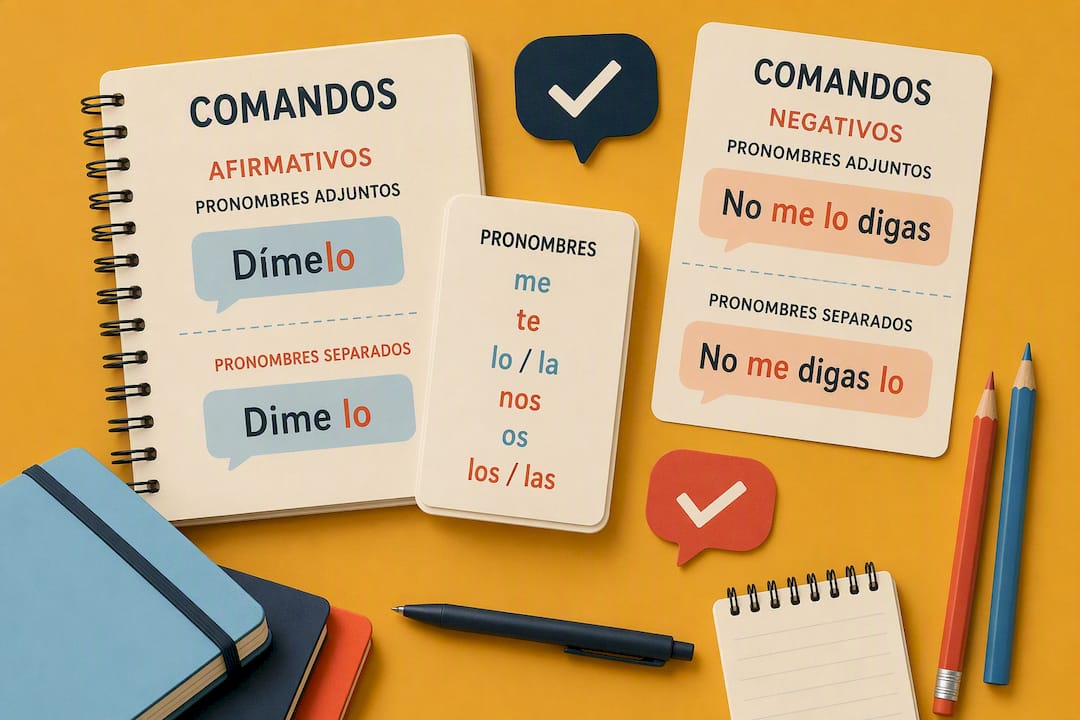
With affirmative commands, object and reflexive pronouns attach directly to the end of the verb. This is called enclisis, and it means dime (tell me), siéntate (sit down), and hazlo (do it) are each written as one word. Stack multiple pronouns and they still attach, in a fixed order: dímelo (tell it to me), póntelo (put it on).
With negative commands, pronouns flip to the front of the verb, a pattern called proclisis. No me digas (don’t tell me), no te sientes (don’t sit down), no lo hagas (don’t do it). The pronoun now sits between no and the conjugated verb, never attached to it.
That switch in position often forces a written accent to preserve the verb’s original stress. Dime has no accent because it’s naturally stressed on the first syllable already. But dímelo, with two pronouns attached, needs an accent mark to keep the stress from sliding forward, since Spanish spelling rules require a written accent whenever a word’s natural stress pattern would otherwise shift.
A few paired examples make the pattern concrete:
- Cómelo (Eat it) → No lo comas (Don’t eat it)
- Levántate (Get up) → No te levantes (Don’t get up)
- Dímelo (Tell it to me) → No me lo digas (Don’t tell it to me)
- Escríbeselo (Write it to him/her) → No se lo escribas (Don’t write it to him/her)
Pro Tip: Say the affirmative command out loud first, without the pronoun. If the stress naturally falls anywhere other than the second-to-last syllable once you attach the pronoun, you almost certainly need a written accent. Reading it aloud catches the shift faster than trying to recite the spelling rule.
Irregular Commands and Regional Variations You’ll Actually Hear
Eight high-frequency verbs break the regular tú pattern, and because they’re common verbs, you’ll run into them constantly. The affirmative forms are short, almost clipped: di (decir), haz (hacer), ve (ir), ten (tener), ven (venir), pon (poner), sal (salir), sé (ser). Their negative counterparts drop the irregularity and switch cleanly to the present subjunctive: no digas, no hagas, no vayas, no tengas, no vengas, no pongas, no salgas, no seas.
- Di la verdad → No digas mentiras
- Ve al médico → No vayas solo
- Ten cuidado → No tengas miedo
- Sal temprano → No salgas tarde
You’ll also see infinitives used as commands on public signage: No fumar (No smoking), No pisar el césped (Don’t walk on the grass). The RAE notes this usage is tolerated in impersonal, written notices aimed at a general public, but it’s not something you should carry into personal, spoken commands directed at one specific listener. Say no fumes to a friend, not no fumar.
Regionally, vosotros commands (hablad, comed) belong to Spain and rarely surface in Latin American speech, where ustedes covers that plural function instead. Voseo commands (hablá, comé, vení) dominate in Argentina and Uruguay and appear in parts of Central America, replacing standard tú forms outright. If your target region is Spain, prioritize vosotros. If it’s the Río de la Plata region, prioritize voseo. Everywhere else, standard tú and ustedes forms will carry you through almost any conversation.
When Do You Actually Use the Imperative?
Commands aren’t just for barking orders. Spanish speakers reach for the imperative across a range of everyday situations, and picking the right form often depends more on tone than grammar.
- Direct order: Cierra la puerta (Close the door), blunt and appropriate between close friends or in urgent moments.
- Polite request: Pase, por favor (Come in, please), softened with por favor and often paired with usted in professional or unfamiliar settings.
- Advice: No te preocupes tanto (Don’t worry so much), a negative command that reads as caring rather than bossy.
- Instruction: Añade la sal y remueve bien (Add the salt and stir well), the backbone of recipes, manuals, and directions.
- Warning: ¡No toques eso! (Don’t touch that!), urgent and often paired with a raised tone rather than extra politeness.
Register shifts the whole feel of a command. Ven aquí between friends is casual and warm; Venga usted, por favor to a stranger or a client carries respect without losing directness. A string of instructions, like a recipe, often chains several affirmative imperatives together: Corta las cebollas. Calienta el aceite. Añade el ajo. Short, clipped, and functional, exactly what instructions are supposed to sound like.
Fix These Five Mistakes Before They Become Habits
Most learner errors with commands repeat across almost every classroom, and they’re predictable enough to catch before they turn into ingrained habits.
- Using the indicative instead of the subjunctive in negatives. No hablas is a statement (“You don’t speak”), not a command. The correct negative command is no hables.
- Getting pronoun placement backward. Pronouns attach after affirmative verbs and sit before negative ones; reversing that, as in no dilo, is simply wrong.
- Dropping the accent after attaching a pronoun. Dime doesn’t need one, but dímelo does, since the added syllable shifts where the stress would naturally fall.
- Mixing up vos and vosotros forms. They look similar but belong to entirely different regions and verb patterns; don’t blend hablá with hablad.
- Overusing the infinitive in personal speech. No fumar works on a sign, not in a sentence directed at a specific person, where no fumes is what a native speaker expects.
Two mnemonics do a lot of heavy lifting here: “No + subjunctive = negative command” covers rule number one instantly, and “After the verb, attach; before the verb, don’t” locks in pronoun placement for good.
Pro Tip: Mid conversation, if you’re not sure whether a command is right, silently ask yourself: “Am I saying no?” If yes, mentally reach for the subjunctive form first, then build the sentence around it. That single check resolves most command errors before they leave your mouth.
Practice: Test Yourself On Affirmative and Negative Commands
These three sets move from foundational to conversational, mirroring how commands actually show up outside a textbook.
Set 1: Fill in the blank (tú and usted).
- _____ (hablar, tú) más despacio, por favor.
- _____ (comer, usted) despacio, señor Gómez.
- _____ (escribir, tú) tu nombre aquí.
- _____ (abrir, usted) la ventana, por favor.
- _____ (venir, tú) conmigo ahora.
Set 2: Transform affirmative into negative, adjusting pronoun position where needed.
- Dímelo. → ___________
- Siéntate aquí. → ___________
- Hazlo ahora. → ___________
- Ponte el abrigo. → ___________
- Vayan temprano. → ___________
Set 3: Role play and regional forms.
- You’re a doctor telling a patient (usted) to rest and drink water. Write two commands.
- You’re an Argentine friend telling someone (voseo) to call you later. Write the command.
- You’re giving a group of friends (vosotros, Spain) directions to not be late. Write the negative command.
| Item | Model answer | Quick explanation |
|---|---|---|
| Set 1, #1 | Habla más despacio | Tú affirmative drops the final -s from hablas |
| Set 1, #2 | Coma despacio | Usted commands use the subjunctive: coma, not come |
| Set 2, #1 | No me lo digas | Enclitic pronouns move in front of the verb in negatives |
| Set 2, #3 | No lo hagas ahora | Hazlo reverts to subjunctive hagas once negated |
| Set 3, #2 | Llamame más tarde | Voseo affirmative drops the -r and shifts stress to the last syllable |
A few of these deserve a closer look. Ponte el abrigo becomes no te pongas el abrigo, not no ponte, because negation always forces both the subjunctive verb form and proclitic pronoun placement together, never one without the other. And Vayan temprano becomes no vayan temprano, a reminder that ir is irregular in the subjunctive (vaya, vayas, vayamos, vayan) exactly the way it is in the affirmative tú command (ve).
If Set 3 felt harder than Sets 1 and 2, that’s expected. Role-play prompts force you to choose the right register and person before you even touch the conjugation, which is precisely the skill that separates textbook knowledge from real conversational speed.
Why Repetition Turns Rules Into Instinct
Reading the rules above gets you to recognition. Recognizing no hables as correct when you see it is not the same skill as producing no hables correctly, unprompted, mid-sentence, while you’re also trying to remember what you wanted to say. That gap between recognition and automatic production is exactly what separates grammar knowledge from fluency.
Closing it takes repetition paired with immediate correction, the same principle behind any skill built through structured practice rather than passive review. Short, frequent drills that isolate one pattern, affirmative tú commands, then negative subjunctive commands, then pronoun placement, build faster and more durable recall than long grammar explanations read once and set aside.
That’s the model Gramanator is built around. Instead of a single lesson on commands, the platform runs learners through structured skill paths that isolate verb conjugation and sentence structure, deliver instant feedback on every drill, and flag weak areas for targeted review rather than generic repetition of everything.
Pro Tip: Ten minutes a day on one command pattern, affirmative one day, negative the next, beats one long grammar session per week. Consistency is what turns “I know the rule” into “I said it correctly without thinking.”
Turn This Rule Into an Instinct With Gramanator
Knowing that negative commands take the subjunctive is one thing. Producing no te preocupes correctly and instantly, in the middle of a real conversation, is a different skill entirely, and it’s the one most grammar study never actually trains. Gramanator closes that gap with structured, mistake-focused drills built specifically for patterns like affirmative and negative commands, so the correct form becomes your automatic response instead of something you have to reconstruct from a rule you half remember.

The platform runs skill-based practice paths from A1 to C1, with daily personalized workouts that isolate exactly the kind of pattern covered in this article: pronoun placement, subjunctive triggers, and irregular command forms, drilled in real-life contexts rather than abstract sentences. Every answer gets instant feedback, and weak spots get flagged for targeted review instead of vanishing back into a workbook you’ll never open again.
You can start with a free trial and see how the drills handle imperatives specifically on the Gramanator practice platform, or go straight to the pricing page to compare monthly, quarterly, and annual plans and pick the pace that fits how seriously you’re training.