Spanish Relative Pronouns: A Complete Learner's Guide
Pronombres relativos are words that link a main clause to a subordinate clause while pointing back to something already mentioned (the antecedent).

Pronombres relativos are words that link a main clause to a subordinate clause while pointing back to something already mentioned (the antecedent). The main forms you’ll use constantly are:
- que (that, which, who)
- quien / quienes (who, whom)
- el que / la que / los que / las que and el cual / la cual / los cuales / las cuales
- lo que / lo cual (what, which)
- cuyo / cuya / cuyos / cuyas (whose)
- donde, cuando, como, cuanto (adverbial relatives)
Two quick examples show why the forms matter. “El libro que leo” (the book that I’m reading) uses the invariable workhorse of the system. “El autor cuyo libro leo” (the author whose book I’m reading) shows a relative that changes form to match what follows it. Same job, connecting clauses, but very different behavior underneath.
Key Takeaways
Mastering Spanish relative pronouns requires knowing which forms are invariable, which agree with their antecedent, and when commas change meaning entirely.
Table of Contents
- What Are Simple and Complex Relatives in Spanish Grammar?
- How Do You Use Que, Quien, Cual, and Cuyo Correctly?
- What’s the Difference Between Restrictive and Nonrestrictive Relative Clauses?
- When Can You Drop the Article Before a Relative Pronoun?
- What Mistakes Do Spanish Learners Make With Relative Pronouns?
- Practice: Test Your Understanding of Spanish Relative Clauses
- How Gramanator Turns These Rules Into Instinct
- Frequently Asked Questions About Spanish Relative Pronouns
- Sources
What Are Simple and Complex Relatives in Spanish Grammar?
Spanish grammar splits relative pronouns into two families. Simple relatives are one word: que, quien(es), and cuanto. Complex relatives pair a definite article with que or cual, giving you el que, la que, los que, las que, el cual, la cual, los cuales, and las cuales, according to the Spanish Academy blog.
Register drives the choice between these two families more than meaning does. El cual and its variants sound formal and show up in legal writing, academic papers, and careful speech. El que tends to work in both casual and formal contexts, which makes it the safer default when you’re unsure.
Agreement is where things get interesting for learners:
- Que is completely invariable. It never changes for gender or number, according to the RAE’s grammatical terms glossary.
- Quien only shifts for number (quien/quienes), never gender.
- El que / el cual forms agree in both gender and number with their antecedent.
- Cuyo agrees with the noun that follows it, not with the person or thing that “owns” something.
That last point trips up more learners than any other rule in this system, so hold onto it. You’ll see why in a few sections.
How Do You Use Que, Quien, Cual, and Cuyo Correctly?
Each pronoun has its own personality.
- Que works as subject, direct object, and after short prepositions (a, de, con, en) when the antecedent is a thing. “La casa en que vivo” (the house I live in) and “El chico que llegó” (the boy who arrived) both work.
- Quien / quienes refers only to people and appears frequently after prepositions: “La persona a quien llamé” (the person I called). It can also start a clause with no stated antecedent, as in “Quien busca, encuentra” (whoever seeks, finds).
- El que / el cual becomes necessary after longer or compound prepositions (según, para, sin) and adds clarity when there are two possible antecedents. “El vecino de mi amigo, el cual trabaja de noche” makes clear it’s the neighbor working nights, not the friend.
- Lo que / lo cual points to an idea, a whole clause, or something unnamed rather than a specific noun. “No llegó a tiempo, lo cual me sorprendió” (which surprised me) refers to the entire situation.
- Cuyo functions as a possessive relative and agrees with the noun that comes right after it, per the RAE’s Nueva gramática básica. “La empresa cuyos empleados protestaron” (the company whose employees protested) makes cuyos agree with empleados, not empresa.
- Donde, cuando, como, cuanto cover place, time, manner, and quantity. “El parque donde jugamos” behaves adverbially, but these words can also carry nominal weight, as in “Hazlo como quieras” (do it however you want).
Pay attention to the difference between adonde vs adonde-style confusion later. For now, notice that most of these pronouns do double duty: connector first, grammatical role inside the clause second.
What’s the Difference Between Restrictive and Nonrestrictive Relative Clauses?
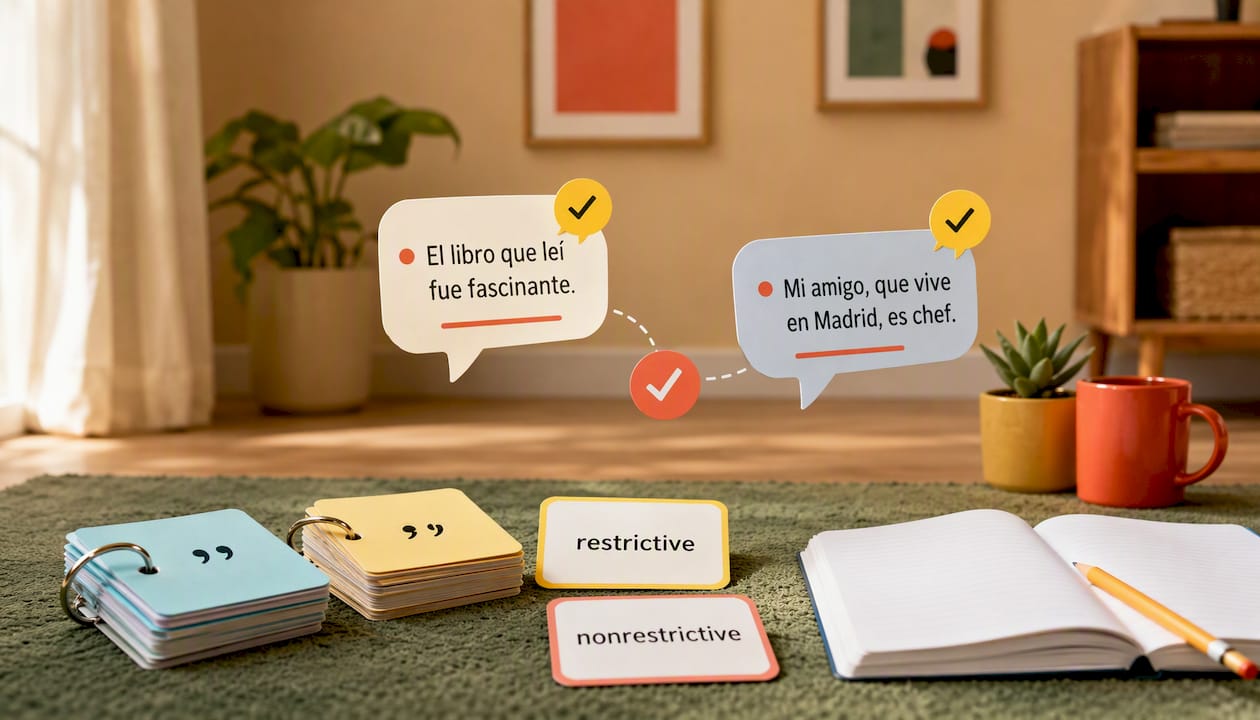
Restrictive clauses (oraciones especificativas) narrow down which specific thing you mean. Nonrestrictive clauses (oraciones explicativas) add extra information about something already identified. The difference changes meaning, not just style.
Compare these two sentences:
- “Los estudiantes que estudiaron aprobaron el examen.” (Only the students who studied passed. Others may not have.)
- “Los estudiantes, que estudiaron, aprobaron el examen.” (All the students, and by the way, they studied. Everyone passed.)
Commas around the second clause turn it from a filter into a side comment. Drop the commas and the sentence restricts the group; add them and the clause becomes optional detail you could delete without losing the core meaning.
Pro Tip: Test any relative clause by mentally deleting it. If the sentence still identifies the same specific thing, use commas (nonrestrictive). If deleting it changes who or what you’re talking about, skip the commas (restrictive).
When Can You Drop the Article Before a Relative Pronoun?
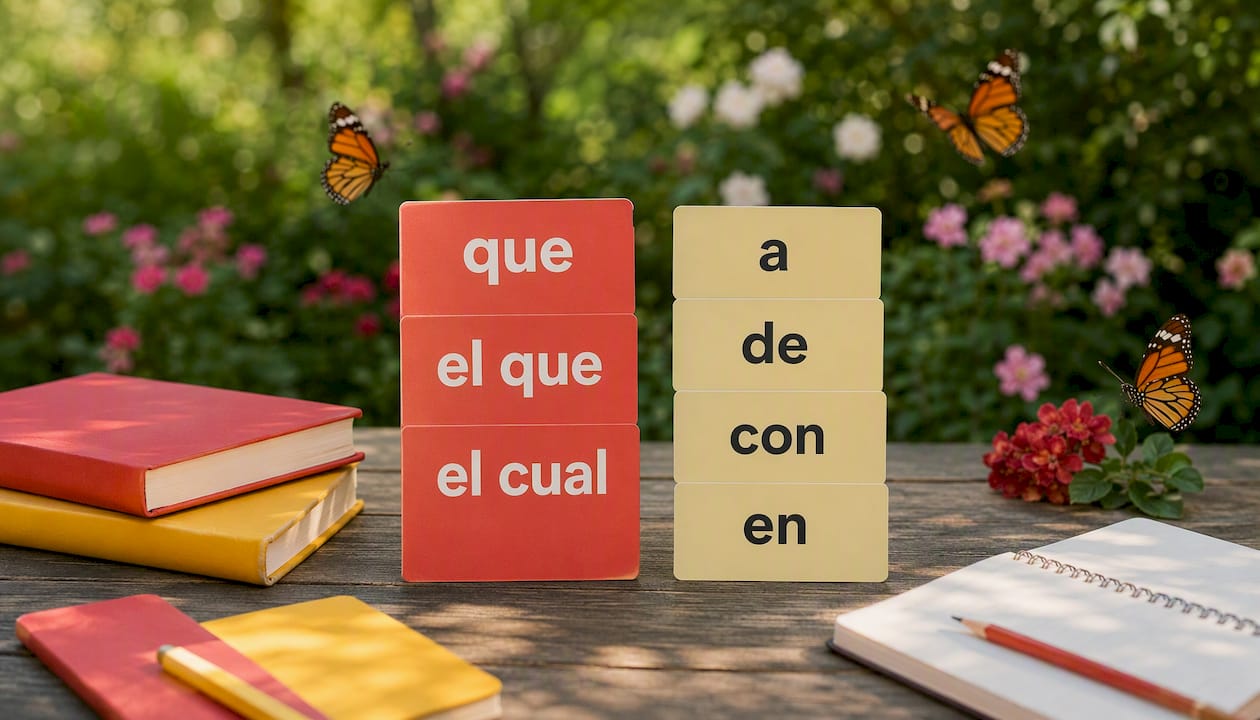
Prepositions decide a lot about whether you need el que, el cual, or nothing extra at all. Short, common prepositions (a, de, con, en) often pair with plain que when the antecedent is inanimate: “El lápiz con que escribo” works fine, though “con el que” is equally correct and more common in speech.
Certain contexts require keeping the article. When the antecedent is a person functioning as a direct object, Spanish generally needs a quien or al que, not a bare que: “El hombre a quien vi” rather than “el hombre que vi” for animate objects marked with a. Time expressions often drop the preposition entirely: “El día que llegamos” works without “en que,” according to RAE’s guidance on relative constructions.
For possession after a preposition, you’ll choose between cuyo, del cual, or de que depending on formality:
- Formal: “El autor, cuyo estilo admiro...”
- Also correct, less elegant: “El autor, del cual admiro el estilo...”
- Avoid: “El autor, que admiro su estilo...” (a common pleonastic error, more on that next)
What Mistakes Do Spanish Learners Make With Relative Pronouns?
The same handful of errors show up across almost every learner, regardless of native language. Each one has a clean fix once you see the pattern.
- Pleonastic pronouns: adding a redundant object pronoun after the relative already did that job. “El libro que lo leí” duplicates the object que already represents. Correct form: “El libro que leí.”
- Forcing que to agree: writing “las cosas ques” or trying to pluralize que itself. Que never changes. Check the verb of the subordinate clause for agreement instead, not the pronoun, following RAE’s description of relative clauses.
- Misusing cuyo: saying “cuyo” when you mean “que su” or trying to make it agree with the possessor instead of the possessed noun. Spoken Spanish increasingly substitutes periphrasis like “que tiene” or “del que” instead, per Wikipedia’s overview of the relative pronoun system.
- Donde vs adonde confusion: using adonde for static location instead of movement toward a place. Both adonde and a donde indicate direction, never location, according to Fundéu’s style note.
Pro Tip: When cuyo feels awkward, most native speakers reach for “que” plus a possessive instead, especially in casual speech. Learn cuyo for reading and formal writing, but don’t force it into every conversation.
Practice: Test Your Understanding of Spanish Relative Clauses
Try these before checking the answers. Cover the answer key with your hand if you need real practice conditions.
- Fill in the blank: “La ciudad ___ nací es pequeña.” (donde)
- Fill in the blank: “El profesor, ___ clases son excelentes, se jubila este año.” (cuyas)
- Correct the error: “El coche que lo compré es rojo.” (Remove “lo”: El coche que compré es rojo.)
- Add commas if needed: “Mi hermano que vive en Madrid me visitó.” (No commas if you have multiple siblings and mean specifically the one in Madrid; add commas if you have only one brother.)
- Choose the best option: “La razón ___ no vino fue el tráfico.” (por la que / por que) → por la que is the natural formal choice.
- Fill in the blank: “No sé ___ dices.” (lo que)
- Correct the error: “La mujer a que hablé es mi vecina.” (Should be: a quien hablé, since the antecedent is a person.)
- Fill in the blank: “Hazlo ___ te dije.” (como)
Each answer traces back to a rule covered above: check the verb for agreement, match cuyo to the following noun, and use quien after prepositions when the antecedent is a person. Spaced repetition across a week retains these patterns far better than a single study session.
How Gramanator Turns These Rules Into Instinct
Reading the rules is step one. Reacting with them in real time, without translating in your head, is a separate skill that only builds through repetition with feedback. Deliberate practice research on syntactic patterns like these shows that focused, repeated drilling on the pronoun’s role inside the clause reduces the pleonastic errors covered above far faster than passive review does.
That’s the exact gap Gramanator was built to close. Structured drills isolate que, quien, cuyo, and the adverbial relatives one at a time, with instant feedback on every answer:
- Timed workouts targeting relative pronouns and other high-error grammar points
- Real-life contexts (workplace, travel, daily conversation) instead of isolated textbook sentences
- Progress tracking that flags exactly which pronoun keeps tripping you up
- A structured path from A1 through C1 so drills match your actual level
Start a focused grammar workout on Gramanator or compare plans on the pricing page to see which option fits your study schedule.
Frequently Asked Questions About Spanish Relative Pronouns
What is the most common relative pronoun in Spanish? Que is by far the most frequent, covering subjects, direct objects, and many prepositional phrases regardless of gender or number.
What’s the difference between donde and adonde? Donde marks location (“where”), while adonde and a donde both mark movement toward a place (“to where”), per Fundéu’s recommendation. Neither adonde nor a donde indicates simple location.
Does cuyo agree with the owner or the thing owned? Cuyo agrees with the noun immediately following it, the thing possessed, not with the person or object that owns it.
When do I need el cual instead of que? Use el cual (or el que) after longer prepositions, in formal writing, or when two possible antecedents create ambiguity that plain que can’t resolve.
Is it wrong to say “el libro que lo leí”? Yes. That’s a pleonastic error: que already fills the object role, so adding lo duplicates it. The correct form is “el libro que leí.”