How to master Ser vs Estar once and for all
Master Ser vs Estar with the DOCTOR and PLACE rules, comparison tables, real edge cases (events, passive voice, dead/alive) and a 5-question FAQ.
:::highlight
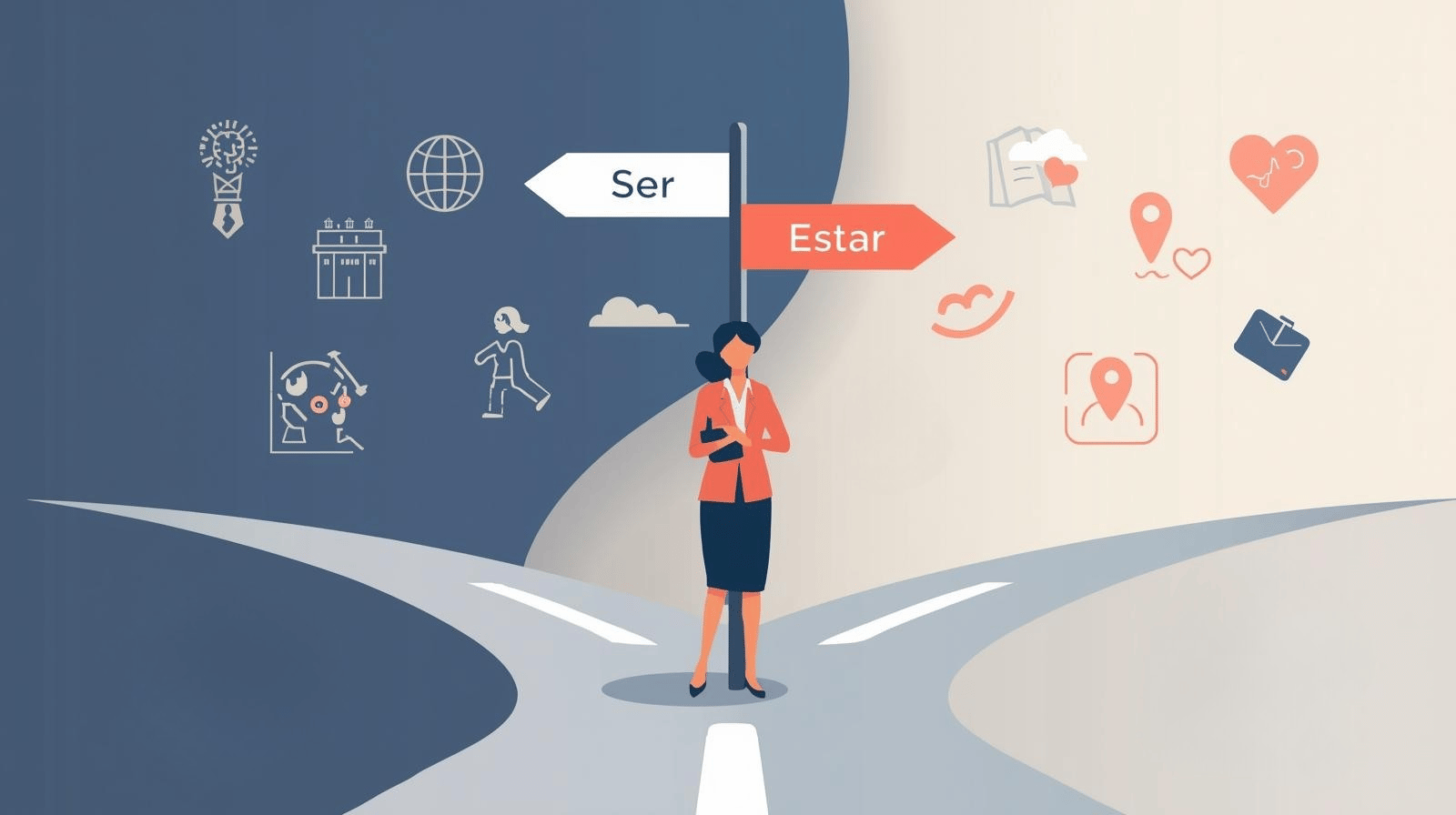
**Quick answer:** Use **ser** for identity, essence and permanent traits (DOCTOR). Use **estar** for states, conditions and locations (PLACE). The one big exception: events use **ser** even for location ("La fiesta **es** en mi casa").
:::
## Why Ser vs Estar trips up English speakers
If you have ever studied Spanish, you have probably asked yourself: "Why are there two verbs for to be?" In English we use one word - "I am tired", "I am a teacher", "I am in Madrid" - but Spanish splits this into **ser** and **estar**.
The good news: once you internalise the logic of each verb, choosing the right one becomes automatic. This guide gives you the two memory rules (DOCTOR and PLACE), a side-by-side comparison, the four edge cases that confuse most learners, and a short FAQ.
## When to use Ser - the DOCTOR rule
Think of **ser** as the verb of **identity**: who or what something is at its core.
- **D - Description:** *Ella **es** alta y morena.* (She is tall and brunette.)
- **O - Occupation:** *Mi padre **es** médico.* (My father is a doctor.)
- **C - Characteristics:** *El libro **es** interesante.* (The book is interesting.)
- **T - Time / dates:** ***Son** las tres.* (It is three o'clock.) / ***Es** lunes.* (It is Monday.)
- **O - Origin:** ***Soy** de México.* (I am from Mexico.)
- **R - Relationship:** *Ella **es** mi hermana.* (She is my sister.)
If the trait would still be true in a year, **ser** is almost always your verb.
{{image:1}}
## When to use Estar - the PLACE rule
Think of **estar** as the verb of **state**: how or where something is right now.
- **P - Position:** *El gato **está** en la mesa.* (The cat is on the table.)
- **L - Location:** ***Estamos** en Barcelona.* (We are in Barcelona.)
- **A - Action in progress:** ***Estoy** estudiando español.* (I am studying Spanish.)
- **C - Condition:** *La puerta **está** abierta.* (The door is open.)
- **E - Emotion:** ***Estoy** muy feliz hoy.* (I am very happy today.)
If the situation could change in the next hour, you almost certainly want **estar**.
{{image:2}}
{{cta:mid}}
## Side-by-side comparison
| Idea | Ser | Estar |
|------|-----|-------|
| Identity / profession | Soy profesor. | - |
| Origin / nationality | Es de Argentina. | - |
| Date and time | Son las cinco. | - |
| Physical location of objects/people | - | Está en la cocina. |
| Ongoing action | - | Estoy trabajando. |
| Mood / feeling | - | Está cansado. |
| Result of a change | - | La sopa está fría. |
A simple test: **what** something is uses **ser**; **how** or **where** it is uses **estar**.
## Tricky cases: adjectives that change meaning
Some adjectives flip meaning depending on the verb. Learn these as fixed pairs.
| Adjective | With Ser | With Estar |
|-----------|----------|------------|
| **aburrido** | boring | bored |
| **listo** | clever | ready |
| **malo** | bad (character) | sick / off |
| **bueno** | good (character) | tasty / attractive |
| **rico** | wealthy | delicious |
| **vivo** | sharp / clever | alive |
| **orgulloso** | arrogant | proud (of something) |
Examples:
> *Juan **es** aburrido.* (Juan is boring.)
> *Juan **está** aburrido.* (Juan is bored.)
> *La sopa **es** buena.* (The soup is good in general.)
> *La sopa **está** buena.* (The soup tastes great right now.)
## Edge cases & common exceptions
These four patterns trip up learners at every level. Memorise them.
### 1. Events use Ser for location
Even though location normally takes **estar**, events use **ser**:
> *La fiesta **es** en mi casa.* (The party is at my house.)
> *El concierto **es** en el parque.* (The concert is in the park.)
The party is not "located" anywhere; it "takes place". Spanish marks that with **ser**.
### 2. Passive voice uses Ser
The "true" passive in Spanish is built with **ser** plus a past participle:
> *El libro **fue** escrito por García Márquez.* (The book was written by García Márquez.)
If you switch to **estar**, you describe the resulting state instead: *El libro **está** escrito en español* (the book is written in Spanish - it is in that state).
### 3. Dead and alive use Estar
Counter-intuitive but fixed:
> ***Está** muerto.* (He is dead.)
> ***Está** vivo.* (He is alive.)
Spanish treats death as a state the body has reached, not as an inherent identity.
### 4. Ser de profession vs Estar de profession
> ***Soy** profesor.* (I am a teacher - my profession.)
> ***Estoy** de profesor este verano.* (I am working as a teacher this summer - temporary role.)
The **estar de** structure flags a job as a temporary stand-in, not your identity.
## Common mistakes to avoid
- *Yo soy cansado* -> *Yo **estoy** cansado.* (Tiredness is a state, not an identity.)
- *La fiesta está el sábado* -> *La fiesta **es** el sábado.* (Events take ser.)
- *Mi casa está grande* -> *Mi casa **es** grande.* (Size is an inherent characteristic.)
- *Soy en Madrid ahora* -> ***Estoy** en Madrid ahora.* (Physical location of a person -> estar.)
## Memory trick: the "right now" test
When in doubt, ask: "Could this change in the next hour?"
- If **yes**, lean **estar**: *Estoy cansado* (I could feel energetic later).
- If **no**, lean **ser**: *Soy alto* (height does not change today).
It is not a perfect rule (see the edge cases above), but it resolves 80% of cases instantly.
## Key takeaways
1. **Ser** = identity, essence, what something IS.
2. **Estar** = state, condition, where something IS right now.
3. Use **DOCTOR** for ser, **PLACE** for estar.
4. Watch for adjective pairs that flip meaning (aburrido, listo, bueno, rico).
5. Memorise the four edge cases: events, passive voice, dead/alive, estar de profession.
## Why Ser and Estar require training, not memorization
One of the most common observations among Spanish teachers is that learners continue confusing **ser** and **estar** long after they understand the rules. The challenge is rarely a lack of knowledge. More often, it is the ability to retrieve the correct verb automatically during real conversations.
Many learners try to solve this by memorizing long lists of rules and exceptions. While understanding the underlying grammar is important, fluency develops when those patterns are reinforced through repeated exposure and use in realistic contexts. Seeing and producing hundreds of examples such as *es interesante*, *está cansado*, *es médico*, and *está en casa* gradually builds the intuition that native speakers rely on.
Language educators also recommend learning **ser** and **estar** as complete sentence patterns rather than isolated grammar rules. Instead of memorizing that **ser** expresses identity or **estar** expresses temporary states, practice them inside meaningful phrases and everyday situations. Over time, the correct choice becomes a natural response rather than a conscious decision.
This learning philosophy also inspired Gramanator. As [Daria Tsibina](https://www.linkedin.com/in/d-tsibina), Founder of Gramanator, discovered while learning English and later Spanish, the greatest progress came through structured practice with immediate feedback rather than repeatedly reading grammar explanations. That experience led to building a platform centered on high-volume, feedback-driven exercises that help learners develop automatic grammar skills - even when they do not have regular access to native speakers.
The goal is not simply to know the difference between **ser** and **estar**. The goal is to use the correct verb naturally, without interrupting the conversation to think about the rule.
## Train Ser and Estar with Gramanator
Understanding the rules behind **ser** and **estar** is only the first step. Using the correct verb automatically in everyday conversations requires repeated exposure, deliberate practice, and immediate feedback. That is why language teachers encourage learners to move beyond memorization and train these patterns in realistic contexts.
Gramanator is a Spanish grammar gym built for adult learners who want to turn grammar knowledge into instinct. The platform includes more than 10,000 structured exercises covering **ser**, **estar**, verb tenses, agreement, and other core grammar topics, all organized by level and difficulty. Every exercise is based on a real-life situation - from workplace conversations to travel and everyday interactions - so learners practice grammar as it is actually used.
Rather than repeating what you already know, Gramanator helps you identify weak areas and reinforce them through structured, high-volume practice with instant feedback. Whether you are preparing for conversations with native speakers or studying independently, the goal is the same: making the correct choice between **ser** and **estar** feel automatic rather than analytical.
Start training at [gramanator.com](https://www.gramanator.com/) and build the instinct that fluent communication depends on.