Spanish Noun Phrases Explained for Adult Learners
Spanish noun phrases explained. Article, adjective, and modifier order for adult learners who want to sound native, not translated.

A Spanish noun phrase is a grammatical unit built around a central noun, surrounded by determiners and optional modifiers that must all agree in gender and number. This structure is the foundation of nearly every Spanish sentence you will ever speak or write. Understanding Spanish noun phrases means understanding how articles, adjectives, and prepositional phrases work together as a single unit. Whether you are a beginner or an intermediate learner, getting this right transforms your grammar from shaky to solid. Platforms like Gramanator are built specifically to train these patterns until they become automatic, not just memorized.
What grammatical roles do nouns in spanish noun phrases perform?
Nouns in Spanish noun phrases perform six main grammatical roles that directly affect pronoun use and sentence structure. These six functions are subject, direct object, indirect object, object of preposition, predicate nominative, and object complement. Each role places the noun in a different position within the sentence and changes how you refer back to it with pronouns.
| Role | Definition | Example |
|---|---|---|
| Subject | The noun performing the action | El estudiante habla. (The student speaks.) |
| Direct Object | The noun receiving the action directly | Veo el libro. (I see the book.) |
| Indirect Object | The noun receiving the benefit of the action | Le doy el libro a María. (I give the book to María.) |
| Object of Preposition | The noun following a preposition | Hablo de la clase. (I talk about the class.) |
| Predicate Nominative | The noun renaming the subject after ser | Ella es profesora. (She is a teacher.) |
| Object Complement | The noun describing the direct object | Lo nombraron capitán. (They named him captain.) |

The object complement is the role that trips up most English speakers. In English, this construction is common but rarely labeled. In Spanish, recognizing it helps you avoid misreading sentences where two nouns appear side by side after the verb.
Knowing each role also tells you which pronoun to use. A direct object noun becomes lo, la, los, or las. An indirect object noun becomes le or les. Getting this wrong is one of the most common errors in spoken Spanish, and it traces directly back to not identifying the noun’s function in the phrase.
Pro Tip: When you encounter a new sentence, ask yourself: who is doing the action, who is receiving it, and who benefits? Answering those three questions identifies the subject, direct object, and indirect object every time.
How is the spanish noun phrase structured?
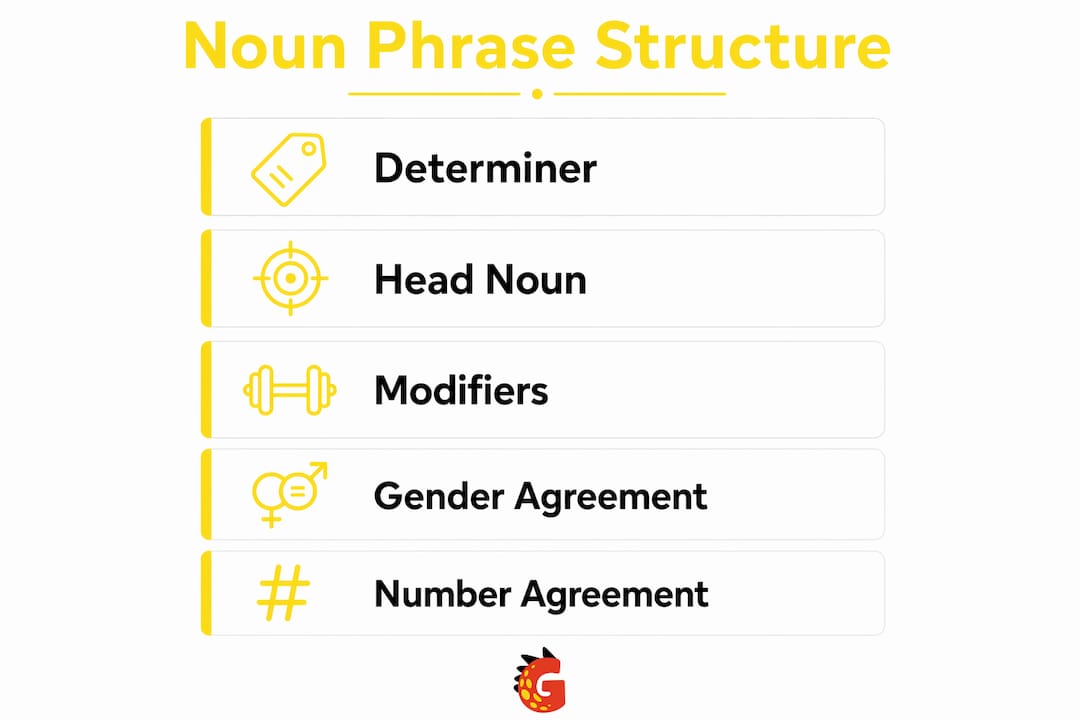
The standard noun phrase order in Spanish is determiner first, then the head noun, then modifiers. This hierarchy is fixed and consistent across all registers of Spanish. Breaking it produces phrases that sound unnatural to native speakers immediately.
Determiners are the anchors of the phrase. They include definite articles (el, la, los, las), indefinite articles (un, una, unos, unas), possessives (mi, tu, su), and demonstratives (este, ese, aquel). Determiners establish pragmatic relations between speaker and listener, signaling whether the noun is known, unknown, near, or distant. That is why choosing the wrong determiner does not just produce a grammar error. It produces a communication error.
Every component of the noun phrase must agree with the head noun in gender and number. The table below shows correct and incorrect agreement patterns.
| Phrase | Gender/Number | Correct? |
|---|---|---|
| la casa blanca (the white house) | Feminine singular | ✓ Correct |
| el casa blanca | Masculine + feminine noun | ✗ Incorrect |
| los libros interesantes (the interesting books) | Masculine plural | ✓ Correct |
| los libros interesante | Plural noun, singular adjective | ✗ Incorrect |
| mis amigos nuevos (my new friends) | Masculine plural | ✓ Correct |
| mi amigos nuevos | Singular possessive, plural noun | ✗ Incorrect |
The most common pitfall is forgetting to adjust the adjective when the noun changes number. You learn el libro rojo (the red book) and then say los libros rojo instead of los libros rojos. The fix is to treat the entire phrase as one unit from the start.
Pro Tip: Always learn a new noun with its article attached. Say “el libro” not just “libro.” That habit builds gender agreement automaticity from day one and reduces persistent errors in speech.
Where do adjectives go in spanish noun phrases?
Descriptive adjectives mostly follow the noun in Spanish, while limiting adjectives precede it. This is the opposite of English, and it is the single biggest source of word order errors for adult learners. Knowing which category an adjective belongs to tells you exactly where to place it.
Here is a breakdown of adjective categories by placement:
Adjectives that come BEFORE the noun:
- Demonstratives: este, ese, aquel (this, that, that over there)
- Possessives: mi, tu, su, nuestro (my, your, his/her, our)
- Indefinites: algún, ningún, otro, todo (some, no, other, all)
- Cardinal numbers: dos, tres, veinte (two, three, twenty)
- Quantifiers: mucho, poco, bastante (much, little, enough)
Adjectives that come AFTER the noun:
- Color: rojo, azul, verde (red, blue, green)
- Shape or size: grande, pequeño, redondo (large, small, round)
- Nationality or origin: español, mexicano, francés (Spanish, Mexican, French)
- Most descriptive qualities: inteligente, moderno, difícil (intelligent, modern, difficult)
Adjective position also changes meaning in specific cases. Position changes meaning significantly with certain adjectives. Un viejo amigo means “an old friend” in the sense of a long-standing friendship. Un amigo viejo means “an elderly friend.” The adjective is the same word, but its position shifts the interpretation entirely. Other examples include un gran hombre (a great man) versus un hombre grande (a large man), and la pobre mujer (the unfortunate woman) versus la mujer pobre (the financially poor woman).
Experts advise learners to memorize noun phrases as complete units to internalize proper word order. This is not just theory. When you store un viejo amigo as a chunk, you stop translating from English and start retrieving the correct Spanish pattern directly.
Pro Tip: When you learn a new adjective, immediately practice it in both positions with a familiar noun. Notice whether the meaning shifts. That active comparison locks the rule into memory far faster than reading a grammar table.
How do prepositional phrases and relative clauses modify nouns?
Complex noun phrases extend beyond a single adjective by adding prepositional phrases and relative clauses. Both types of modifier attach to the head noun and add specific detail, but they work differently and require different parsing strategies.
A prepositional phrase follows the noun and connects to it through a preposition such as de (of/from), con (with), or para (for). Consider el libro de la profesora (the teacher’s book). The phrase de la profesora modifies libro by specifying whose book it is. The preposition de is doing the linking work. You can stack these: el libro de gramática de la profesora (the teacher’s grammar book). Each prepositional phrase modifies the noun immediately before it.
Relative clauses add even more detail. They are introduced by que (that/which/who) or quien (who) and follow the noun they describe. El estudiante que habla español means “the student who speaks Spanish.” The clause que habla español modifies el estudiante directly. Long noun phrases with stacked modifiers challenge learners’ real-time parsing skills, and that skill only develops through exposure to extended sentences.
The key to parsing any complex noun phrase is locating the head noun. The head noun is almost always the first noun after the determiner, ignoring any pre-nominal adjectives. Once you find it, every modifier after it relates back to that core word. Modifier chains apply locally in Spanish noun phrases, meaning each adjective or clause typically modifies the nearest noun unless the structure clearly signals otherwise.
Pro Tip: When a long Spanish noun phrase confuses you, mentally strip away everything after the first noun. Read the bare phrase first, then add one modifier at a time. This technique makes even complex academic Spanish readable.
Key takeaways
Spanish noun phrases follow a fixed structure of determiner, head noun, and modifiers, with mandatory gender and number agreement across every component.
| Point | Details |
|---|---|
| Fixed phrase order | Determiner comes first, then the head noun, then modifiers. |
| Six noun roles | Nouns function as subject, direct object, indirect object, object of preposition, predicate nominative, or object complement. |
| Agreement is non-negotiable | Every determiner and adjective must match the noun in gender and number. |
| Adjective placement changes meaning | Descriptive adjectives follow the noun; limiting adjectives precede it, and position can shift the meaning entirely. |
| Find the head noun first | In complex phrases, locate the first noun after the determiner to anchor your understanding of all modifiers. |
Why most learners approach noun phrases backwards
Most adult learners study Spanish nouns in isolation. They build vocabulary lists: libro, casa, amigo. Then they add articles as a separate step. Then adjectives as another step. That fragmented approach is one reason agreement errors persist even at intermediate levels.
A more effective approach is to train noun phrases as connected units rather than isolated words. When you learn el libro rojo as one retrievable chunk, you are not applying a rule - you are recalling a pattern. That is the difference between translating and reacting.
Gender agreement is a clear example. If you only know libro, you have to consciously recall that it is masculine before choosing el or rojo. If you know el libro rojo as a unit, the gender is already built in. The hesitation disappears. That hesitation is often what makes spoken Spanish feel laborious, and reducing it is a key step toward fluency.
Instead of studying grammar rules in isolation, practice them inside real noun phrases from the beginning. Read el libro de gramática de la profesora, break it apart, and then rebuild it. Repeat the process with different nouns and structures. Over time, the patterns become automatic.
Developing strong Spanish grammar pattern recognition is not about memorizing rules. It is about training your brain to expect the correct structure naturally and consistently.
Train spanish noun phrases until they become automatic
If you have read this far, you understand the structure. Now the work is turning that understanding into instinct. That is exactly what Gramanator is built for.

Gramanator is a Spanish grammar training platform that gives you 10,000+ structured drills built around real-life contexts. Noun phrase agreement, adjective placement, determiner use, and complex modifier parsing are all trained through timed workouts and mistake-focused repetition. You do not just read the rules. You drill them until your brain stops translating and starts producing correct phrases automatically. If you are serious about building real Spanish fluency, Gramanator is the grammar gym where that work gets done.
FAQ
What is a spanish noun phrase?
A Spanish noun phrase is a grammatical unit centered on a noun, accompanied by determiners and optional modifiers that all agree in gender and number. It functions as a single unit within a sentence, filling roles such as subject, object, or complement.
Why does adjective placement matter in spanish?
Adjective placement changes meaning in Spanish. Un viejo amigo means a long-standing friend, while un amigo viejo means an elderly friend. Placing a descriptive adjective before the noun often adds a figurative or emotional quality.
How do i find the head noun in a complex spanish phrase?
The head noun is almost always the first noun after the determiner, regardless of how many modifiers follow it. Strip away prepositional phrases and relative clauses mentally to identify the core noun first.
What are the most common spanish noun phrase errors?
The most common errors are failing to match adjective gender and number to the noun, using English adjective-first word order, and learning nouns without their articles. All three errors disrupt natural phrasing and slow down speech.
How do i get better at spanish noun phrase agreement?
Learning nouns with their articles from the start is the most effective method. Storing el libro instead of just libro builds automatic gender recall, which makes agreement across the entire phrase faster and more accurate.