Spanish Grammar Pattern Recognition: Your Fluency Guide
Train Spanish grammar pattern recognition for real fluency. Techniques to spot ser/estar, por/para, and mood cues in native speech.


Spanish grammar pattern recognition is the ability to notice recurring grammatical structures in real Spanish input and use them automatically, without stopping to recall isolated rules. This skill sits at the heart of genuine fluency. Most adult learners spend years collecting grammar rules but never build the automatic recall that real conversations demand. The difference between knowing a rule and reacting with it is the difference between translating in your head and actually speaking Spanish. Understanding how pattern recognition works, and how to train it, changes everything about how you study.
What is Spanish grammar pattern recognition, exactly?
Spanish grammar pattern recognition is defined in usage-based linguistics as the process of extracting reusable grammatical constructions from repeated exposure to real language. The term comes from constructionist language acquisition research, particularly the work of Michael Tomasello, whose usage-based model describes how learners abstract linguistic schemas from multiple examples rather than from memorized rules. This is the standard theoretical framework behind the concept, and it has direct implications for how you should be studying.
The cognitive process works like this: every time you encounter a Spanish sentence, your brain registers not just the meaning but the structure. Over many encounters, it begins to detect the pattern beneath the surface. You start to feel that reflexive verbs like levantarse (“to get up”) follow a predictable shape, or that conditional sentences always pair si (“if”) with a specific verb form. That feeling is pattern recognition at work.
A 2026 study published in Frontiers in Language Sciences found that Spanish listeners process gender and number cues on definite articles independently and simultaneously during comprehension. This matters because it disproves the assumption that learners must master morphosyntactic features one at a time. Your brain is already wired to track multiple grammar signals at once. The goal of training is to make that tracking automatic.
“Grammar charts organize patterns learners have already absorbed naturally; formal rules clarify intuitive knowledge rather than introduce it.” This insight from Open University’s story-based teaching guidance reframes the entire purpose of grammar study. Rules are not the starting point. They are the label you put on something your brain already knows.
Here is what pattern recognition involves in practice:
- Noticing that ser (“to be” for identity) and estar (“to be” for state) each appear in predictable sentence contexts
- Recognizing that Spanish subject pronouns are often dropped because the verb ending carries the information
- Detecting that direct object pronouns (lo, la, los, las) consistently appear before conjugated verbs
- Identifying that the subjunctive mood follows trigger phrases like quiero que (“I want that”) or es importante que (“it is important that”)
How sentence patterns work as grammar learning units
Sentence patterns are recurring structural frameworks that give you a natural unit for absorbing multiple grammar elements at once. Instead of studying verb conjugation, pronoun placement, and word order as three separate topics, a sentence pattern bundles them together in a form your brain can store and retrieve as a single unit.

Compare these two approaches side by side:
| Approach | What you study | What you retain |
|---|---|---|
| Isolated rule learning | “Object pronouns precede conjugated verbs” | A rule you must consciously apply |
| Sentence pattern learning | “Lo veo todos los días” (“I see him every day”) and ten similar examples | A retrievable structure you recognize on contact |
The pattern approach wins because it mirrors how native speakers store language. A native speaker does not think “apply pronoun placement rule.” They simply say lo veo because the pattern is automatic. Research supports organizing learning by communicative function rather than by grammar category, because it builds the kind of intuition that transfers to real conversation.
Take conditional sentences as a concrete example. The pattern “Si tuviera dinero, viajaría” (“If I had money, I would travel”) contains the imperfect subjunctive, the conditional tense, and a specific clause order. Learning this as a pattern means you can substitute any verb or noun into the frame: “Si tuviera tiempo, estudiaría más” (“If I had time, I would study more”). You are not recalling a rule. You are filling a slot in a structure you already know.
Pro Tip: Pick three high-frequency sentence patterns each week, such as reflexive constructions, object pronoun sentences, and subjunctive trigger phrases. Write five original sentences using each pattern before moving on. Production locks in what exposure introduces.
How to train your pattern recognition skills effectively
Training pattern recognition requires repeated, meaningful encounters with the same structures across varied contexts. The Open University’s teaching guidance confirms that understanding patterns naturally precedes formal rule explanation. You internalize first, then label. This sequence is the opposite of how most grammar textbooks are organized.
A 2025 MDPI study found that a 10-day focused training program produced measurable gains in pattern detection accuracy and speed for beginner L2 learners. Short, targeted practice works. You do not need months of passive exposure to see results. What you need is practice designed to make grammar features perceptually noticeable, meaning you are actively looking for the pattern, not just reading past it.
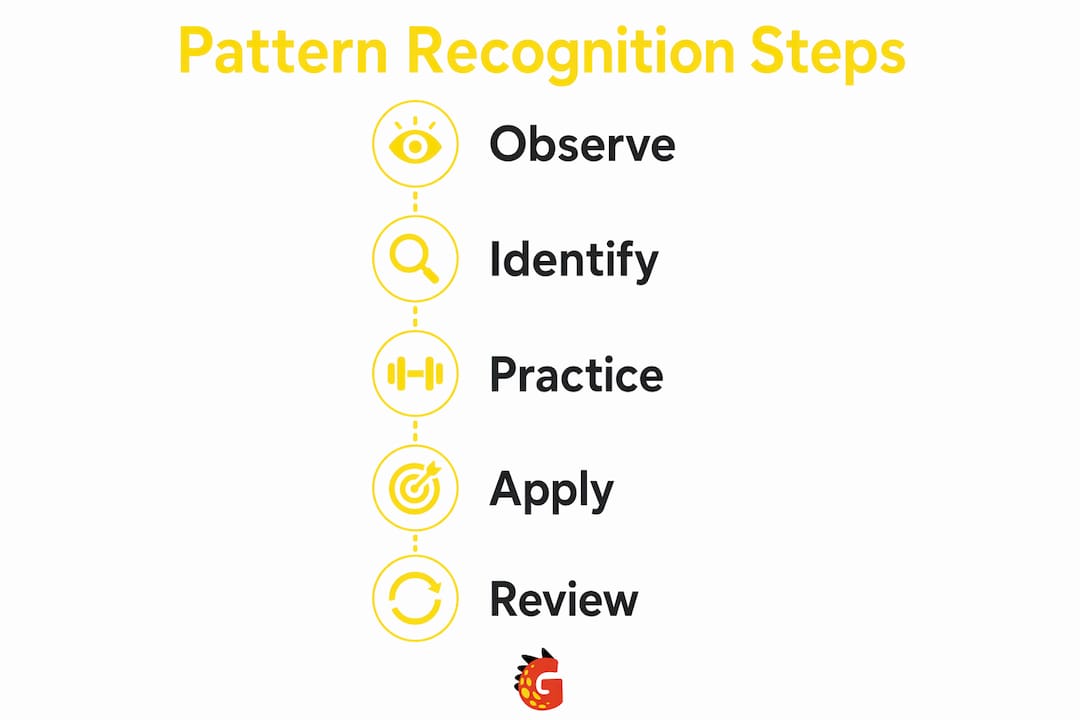
Here is a practical sequence for building pattern recognition:
- Choose a target pattern. Start with high-yield structures like the estar plus present participle construction for ongoing actions (“Estoy estudiando” = “I am studying”) or the gustar pattern for expressing preferences (“Me gusta el café” = “I like coffee”).
- Collect five to ten example sentences. Find them in podcasts, articles, or conversations. Write them down. The act of noticing and recording a pattern is itself a form of training.
- Identify the moving parts. In “Me gusta el café,” the moving parts are the indirect object pronoun (me, te, le) and the noun. Practice substituting both.
- Shadow native speakers. Shadowing, where you repeat audio in real time, forces your mouth and ear to process the pattern simultaneously. Tools like SpanishPod101 or authentic YouTube content work well for this.
- Practice under time pressure. Speed matters because automaticity is the goal. Timed drills, like those in Gramanator’s grammar workouts, train your brain to retrieve patterns without deliberate recall.
- Produce controlled variations. Computational modeling research shows that producing controlled substitutions within a pattern, changing person, tense, or noun, solidifies the construction in both comprehension and production.
Pro Tip: Treat grammar features as perceptual targets, not abstract rules. When reading Spanish, actively scan for article gender agreement or verb endings the way a proofreader scans for typos. This operationalizing approach significantly improves detection speed and automaticity.
What challenges do learners face with pattern recognition?
The most common mistake adult learners make is collecting rules without collecting enough varied examples. You can know that the subjunctive expresses doubt or emotion and still freeze when you need to use it in conversation. Knowing the rule is not the same as having the pattern. Focusing on few high-yield frames across many real contexts builds the automaticity that rule lists never will.
Here are the specific pitfalls to watch for:
- Studying patterns in isolation. A pattern learned only in a textbook exercise does not transfer to listening or speaking. You need to encounter the same structure in a podcast, a conversation, and a written article before it becomes truly automatic.
- Skipping production. Recognition without production creates passive knowledge. You understand “Se me olvidó” (“I forgot it”) when you hear it but cannot produce it under pressure. Active output is non-negotiable.
- Chasing too many patterns at once. Spreading attention across twenty grammar topics simultaneously prevents any single pattern from reaching automaticity. Narrow focus produces faster results.
- Ignoring morphosyntactic cues. Spanish grammar signals like article gender (el vs. la), verb endings (habla vs. hablan), and pronoun forms carry pattern information. Training yourself to notice these cues in real time, as the 2026 Frontiers study demonstrates, accelerates comprehension.
- Waiting until you feel ready to speak. Pattern recognition supports both comprehension and production simultaneously. Using patterns in actual writing and speaking, even imperfectly, is what moves them from conscious knowledge to instinct.
The solution is not more rules. It is more reps with fewer, better-chosen patterns in real communicative contexts.
Key takeaways
Spanish grammar pattern recognition is the skill that converts grammar knowledge into automatic, instinctive language use, and it is trained through repeated meaningful exposure and targeted production practice.
| Point | Details |
|---|---|
| Definition of pattern recognition | It is the automatic detection of recurring grammar structures from real input, not rule memorization. |
| Cognitive foundation | Tomasello’s usage-based model shows learners abstract grammar schemas from varied examples, not explicit instruction. |
| Sentence patterns as learning units | Learning structures like conditional or reflexive frames holistically is faster than studying isolated grammar rules. |
| Training method | Short, focused practice with substitution drills builds automaticity significantly faster than passive study. |
| Key challenge to avoid | Collecting rules without varied examples prevents internalization. Focus on few high-yield patterns across real contexts. |
Why pattern recognition changes how learners think about Spanish fluency
When Research into adult language acquisition consistently reveals a counterintuitive gap. The learners who struggle most are rarely the ones who know the least grammar. They are the ones who know the most rules but have practiced them the least in context. They can explain the subjunctive perfectly and still hesitate for three seconds before using it in a sentence.
The shift happens when learners understand that grammar rules are descriptions of patterns, not instructions for producing them. Treating grammar study as rule collection leads to hesitation. Treating it as pattern training leads to measurable, consistent progress. The difference shows up quickly: learners who approach Spanish this way begin noticing structures in everything they read and hear. That noticing habit is the real skill - and it compounds over time.
The practical advice for anyone in the early stages: expect the first few weeks of deliberate pattern noticing to feel slow. That is normal. A perceptual habit is being built, and habits require repetition. The most effective approach combines passive exposure - listening to native content - with active production: writing sentences, running timed drills, forcing the pattern to activate under mild pressure. That combination is what moves grammar from recognition to reflex. The clearest sign it is working is when translation stops and reaction begins. That moment is the goal, and every repetition moves toward it.
Train your Spanish grammar patterns with Gramanator
If you are ready to move from knowing grammar to using it automatically, Gramanator is built for exactly that. The platform functions as a Spanish Grammar Gym, combining 10,000+ structured drills, timed grammar workouts, and mistake-focused repetition to turn pattern knowledge into instinct.

Every session on Gramanator is designed around the principle that grammar is trained, not memorized. You work through real-life Spanish contexts, from workplace conversations to travel situations, with immediate feedback that targets your specific weak patterns. If you want to identify your grammar gaps and fix them with precision, Gramanator gives you the structure to do it. Stop translating. Start reacting naturally.
FAQ
What is Spanish grammar pattern recognition?
Spanish grammar pattern recognition is the ability to automatically detect and use recurring grammatical structures from real Spanish input. It is grounded in usage-based acquisition theory, where learners abstract grammar schemas from repeated meaningful exposure rather than from memorized rules.
How is pattern recognition different from memorizing grammar rules?
Memorizing rules gives you declarative knowledge you must consciously apply. Pattern recognition gives you procedural knowledge you retrieve automatically. Grammar rules are descriptions of patterns you have already internalized, not instructions for producing them.
How long does it take to build automatic pattern recognition?
Research on focused training shows measurable gains in detection accuracy within as few as 10 days of targeted practice. Full automaticity for complex patterns like the subjunctive takes longer, but consistent, context-rich repetition accelerates the process significantly.
Which Spanish grammar patterns should adult learners prioritize?
High-yield patterns include the ser vs. estar distinction, reflexive verb constructions, object pronoun placement, and subjunctive trigger phrases. These structures appear frequently in real conversation and cover a wide range of communicative functions.
Does pattern recognition help with both understanding and speaking?
Yes. Bidirectional pattern learning supports both comprehension and production. Actively producing controlled variations of a pattern, changing the person, tense, or noun, solidifies it for speaking as well as listening.