How to Identify Spanish Grammar Weaknesses Fast
Find your Spanish grammar weak spots fast. A diagnostic routine that surfaces the gaps blocking your speaking, without long tests.

You sit down to write a message in Spanish and suddenly freeze. Was it soy or estoy? Did that noun need el or la? If you have ever studied Spanish and still feel uncertain about rules you thought you had mastered, you are not alone. Most adult learners struggle to identify Spanish grammar weaknesses with any precision, which means they keep practicing the things they already know and avoiding the things they need most. This guide walks you through exactly how to assess Spanish grammar skills, pinpoint the gaps, and create a focused plan to close them.
Table of Contents
- Key takeaways
- How to identify Spanish grammar weaknesses before you study
- Detecting your key grammar problem areas
- Interpreting results and prioritizing what to fix
- Remediation techniques that actually work
- My honest take on the path to grammar fluency
- Take the guesswork out of grammar practice
- FAQ
Key takeaways
| Point | Details |
|---|---|
| Use structured assessments | Free CEFR-aligned tests reveal verb, mood, and agreement weaknesses in under 20 minutes. |
| Target the five core error areas | Ser/estar, gender, past tenses, subjunctive, and false cognates cover the majority of common mistakes. |
| Interpret results before studying | Knowing which category trips you up lets you study smarter, not just harder. |
| Combine drills with real context | Isolated memorization helps less than practicing grammar inside full sentences and real conversations. |
| Track progress consistently | Regular reassessment shows you where you have improved and where to focus next. |
How to identify Spanish grammar weaknesses before you study
Before you can fix anything, you need a clear picture of what is actually broken. Many adult learners skip this step and jump straight into textbook chapters or apps. The result is uneven progress where beginner mistakes survive into advanced study.
The most efficient starting point is a CEFR-aligned placement test. These tests typically range from 40 to 55 questions and take between 5 and 20 minutes to complete. They are designed to surface weaknesses in verb conjugations, mood usage, and sentence structure. More importantly, they give you a level label (A1 through C1) that maps to specific grammar patterns you should be working on.
Here are the main tools and their best uses:
- Free online placement tests. These are your fastest Spanish grammar diagnostics. Look for tests that cover multiple grammar categories, not just vocabulary. A test that only checks whether you know words will not tell you whether you confuse the preterite with the imperfect.
- AI grammar checkers. AI tools process texts of up to 1,000 words and flag spelling, punctuation, and basic syntax issues immediately. They are useful for scanning writing samples, but they work best as a supplement to structured study.
- Writing samples and speaking records. Write a short paragraph in Spanish about your day, then read it back critically. Where did you pause or guess? Those moments signal real weaknesses better than any multiple-choice test.
| Tool | Best for | Limitation |
|---|---|---|
| CEFR placement test | Identifying proficiency level and broad grammar gaps | Does not always pinpoint specific rule errors |
| AI grammar checker | Catching surface errors in writing quickly | Struggles with nuanced contexts like por vs. para |
| Writing sample analysis | Revealing real-use patterns and recurring errors | Requires honest self-review or a teacher’s eye |
| Speaking recordings | Noticing real-time grammar avoidance habits | Harder to analyze without a fluent listener |
Pro Tip: Save your first writing sample before you start any targeted study. Comparing it to a sample written six weeks later is one of the most motivating things you can do as a learner.
Detecting your key grammar problem areas
Once you have taken a test or analyzed a writing sample, you need to name your specific weaknesses. Vague feedback like “you need to work on verbs” helps no one. Here is a structured approach to detect grammar mistakes in Spanish with real precision.
1. Run your errors through the five core categories.
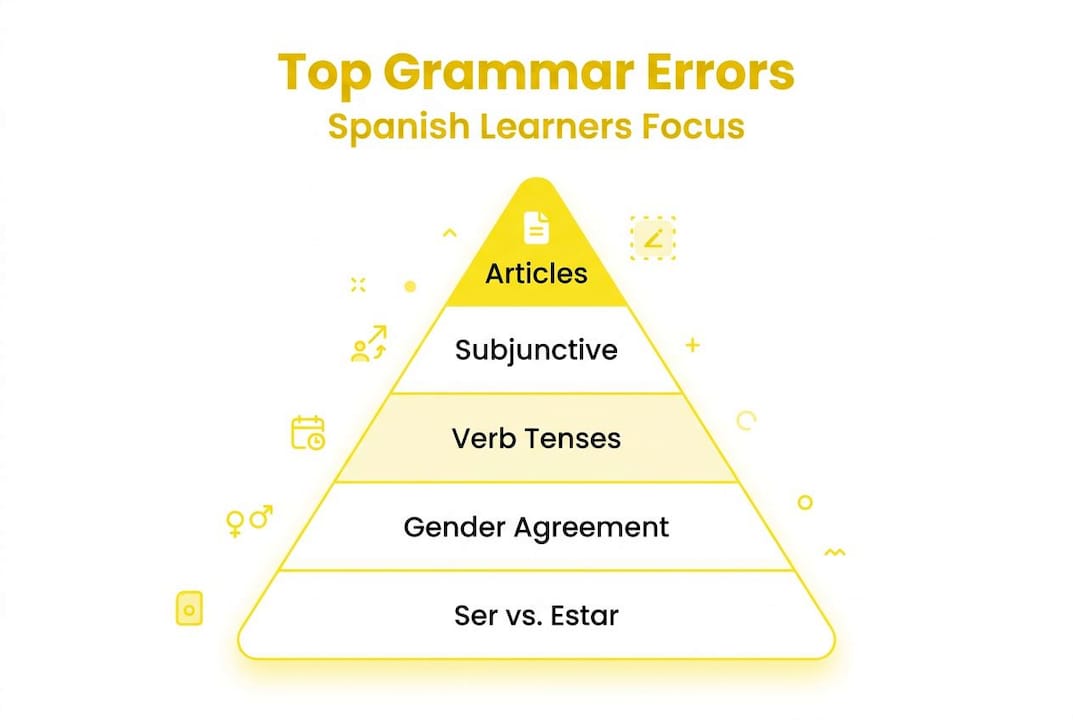
Research shows that five error categories account for roughly 80% of common mistakes made by English-speaking learners of Spanish:
- Ser vs. estar confusion. Think of ser as the verb of permanent identity (“Soy médico” = “I am a doctor”) and estar as the verb of current state (“Estoy cansado” = “I am tired”). Mixing them is the most frequent single error adult learners make.
- Gender agreement errors. Spanish assigns masculine or feminine gender to every noun, and adjectives must match. “El agua fría” versus “La mano derecha” trips up learners at every level.
- Past tense misuse. The preterite (pretérito indefinido) describes completed actions. The imperfect (pretérito imperfecto) describes ongoing states or habits. Many learners default to one and avoid the other entirely.
- Subjunctive omission. The subjunctive mood expresses doubt, desire, or emotion and is required after phrases like “Quiero que...” (“I want you to...”). Most learners know it exists but are not sure when to use it.
- False cognates. Words like embarazada (pregnant, not embarrassed) and actualmente (currently, not actually) cause errors that no amount of verb drilling will fix.
2. Look for avoidance patterns.
When you write or speak, do you restructure sentences to avoid the subjunctive? Do you always use ser because you are unsure whether estar applies? Avoidance is a diagnostic signal. It tells you which grammar area you do not trust, even if you rarely make an outright error there.

3. Use contextual sentences, not just isolated words.
Studying grammar in complete sentences improves retention and exposes real-use patterns far better than isolated drills. When you review past-tense errors, for example, do it inside full sentences that reflect realistic situations, such as describing a meal, a trip, or a conversation.
Pro Tip: Create a personal error log. Each time you notice a mistake in your writing or get correction from a tutor, record the error, the rule it broke, and the corrected version. After two weeks, patterns will be obvious.
Interpreting results and prioritizing what to fix
Getting a score or a list of errors is only half the work. The other half is deciding what to tackle first. This is where many learners stall. They feel overwhelmed by the list and do not know where to start.
The answer is to work from impact, not alphabetical order.
The 80/20 rule applies to Spanish grammar. Focusing on the five core error categories can eliminate the vast majority of your most frequent mistakes. You do not need to master every irregular verb before you can communicate clearly.
Here is how to prioritize after a CEFR-level assessment:
- A1/A2 learners should focus on present tense conjugation, basic gender agreement, and the ser vs. estar distinction. These three alone will cover most of their daily communication needs.
- B1/B2 learners typically struggle most with the preterite/imperfect distinction and the subjunctive in indirect speech. These are high-impact areas because they affect the entire range of storytelling and expressing opinions.
- C1 learners often have nuanced issues: the subjunctive in doubt clauses, the use of the passive voice with se, and register-appropriate word order.
The key insight here is that not all errors are equal. A missing accent mark matters far less to comprehension than confusing ser with estar in a professional context. Prioritize the errors that confuse meaning or sound unnatural to native speakers first. You can use resources like the Gramanator grammar blog to research the specific rules behind your highest-priority errors before diving into exercises.
Remediation techniques that actually work
Knowing your weaknesses is the diagnosis. Now comes the treatment. The most effective approach combines three things: targeted practice, contextual exposure, and regular feedback.
Targeted drills with immediate feedback
Focused exercises on a single grammar category are the fastest way to build pattern recognition. When you practice common grammar mistakes in isolation first, you force your brain to engage with the rule consciously. That conscious practice eventually becomes automatic. The key is feedback. If you drill without knowing whether your answer was right or wrong and why, you reinforce errors instead of correcting them.
Contextual content for retention
After drilling a rule, apply it inside realistic scenarios. If you just practiced the imperfect tense, write three sentences about a childhood memory. If you drilled ser vs. estar, describe a colleague. Contextual learning deepens memory traces and prepares grammar for real-world use.
Leveraging AI tools wisely
AI grammar checkers are genuinely useful for reviewing longer pieces of writing. They catch consistent surface errors quickly. But they have real limits. AI tools struggle with nuanced grammar like por vs. para or the correct use of subjunctive in complex clauses. Use them as a first pass, not a final authority.
Here is a side-by-side comparison of study approaches:
| Approach | Best result | Watch out for |
|---|---|---|
| Isolated grammar drills | Fast rule internalization | Can feel detached from real speech |
| Contextual sentence practice | Strong retention and real-world application | Needs a reliable feedback source |
| AI grammar review | Quick surface error detection | Misses nuanced or culturally specific errors |
| Music-based practice | Engaging exposure to natural grammar patterns | Less useful for explicit rule learning |
| Native content immersion | Fluency-level grammar exposure | Can reinforce errors without guided correction |
For a memorable and enjoyable supplement, music-based Spanish practice is worth exploring. Songs lock grammar patterns into memory through repetition and melody, which makes them surprisingly effective for internalizing verb conjugations.
A word on tracking: reassess yourself every four to six weeks using the same type of structured test you started with. Progress that is not measured tends to feel invisible, and invisible progress kills motivation.
My honest take on the path to grammar fluency
I have worked with adult Spanish learners long enough to notice one pattern that separates those who improve quickly from those who stay stuck. It is not talent or study hours. It is how honestly they engage with their weaknesses.
Most people study Spanish to avoid being wrong. That sounds strange, but it is true. They practice the things they already know because it feels good. They skip the subjunctive because it is confusing. They avoid writing in Spanish because they might make errors.
Here is what I have learned: effective communication matters more than grammatical perfection. A native speaker will understand you far more often than you expect, even when your grammar is imperfect. The goal is not to eliminate every error before you speak. The goal is to get clear enough to be understood and confident enough to keep going.
I also want to be direct about one thing. The idea of a true bilingual who never errs is genuinely a myth. Professional interpreters, lifelong bilinguals, and even native speakers make grammar mistakes. The difference between a fluent speaker and a struggling learner is not zero errors. It is that the fluent speaker keeps talking. You will improve Spanish language weaknesses most when you treat them as data, not as failures. Identify them, work on them methodically, and give yourself credit for the gains you make along the way.
- Daria
Take the guesswork out of grammar practice

If you have identified your Spanish grammar weaknesses and are ready to work on them with structure and purpose, Gramanator is built for exactly that. The platform offers over 10,000 targeted grammar exercises organized by rule, level, and real-life context. Every exercise comes with explanations, hints, and detailed feedback on your mistakes, so you understand the why behind every correction. Gramanator tracks your progress, highlights patterns in your errors, and recommends specific exercises based on your actual performance. Whether you are tackling ser vs. estar for the first time or refining your subjunctive at B2, Gramanator gives you a clear, motivating path forward. See the available plans and start practicing with real direction today.
FAQ
What are the most common Spanish grammar weaknesses?
The most frequent error areas for English speakers are ser vs. estar confusion, gender agreement mistakes, misuse of the preterite and imperfect tenses, subjunctive omission, and false cognates. Mastering these five categories eliminates the majority of everyday errors.
How can I test my Spanish grammar proficiency for free?
Free online CEFR-aligned tests with 40 to 55 questions take between 5 and 20 minutes and identify weaknesses across key grammar categories including verb conjugations and mood usage. Combining test results with a self-review of your own writing gives you the most complete picture.
Can AI tools detect grammar mistakes in Spanish accurately?
AI grammar checkers are reliable for catching surface-level errors like spelling and basic syntax in texts up to 1,000 words, but they struggle with nuanced rules like por vs. para or complex subjunctive constructions. Use them as a starting point, not your only review method.
How long does it take to improve Spanish grammar weaknesses?
With focused, targeted practice on your specific error categories, most adult learners see measurable improvement within four to six weeks. The speed depends far more on targeting the right weaknesses than on total study hours.
What is the most efficient way to prioritize grammar study?
Start with the grammar areas that cause the most communication errors in your level: present tense and ser/estar at A1/A2, past tenses and the subjunctive at B1/B2. Fixing high-frequency errors first gives you the fastest return on your study time.