What is Spanish native speaker grammar: Your fluency guide
What native Spanish grammar really looks like. The contractions, subjunctive habits, and shortcuts textbooks skip, decoded for learners.

Most learners treat Spanish grammar as a list of rules to memorize. That’s exactly why fluency stays out of reach. What is Spanish native speaker grammar, really? It’s the automatic, intuitive system that lets a native speaker choose the right verb form, match adjectives to nouns, and signal doubt with the subjunctive without stopping to think. It’s not about knowing the rule. It’s about the rule becoming invisible because it’s been absorbed through meaningful, repeated exposure. This guide walks you through the core components of that system, from morphology and verb moods to punctuation, so you can start building the same automatic fluency.
Table of Contents
- Understanding the core system behind native Spanish grammar
- Mastering noun gender, number, and adjective agreement
- Unlocking Spanish verbs: the heart of native grammar
- Demystifying the Spanish subjunctive mood
- Native grammar reflected in punctuation and sentence structure
- Why mastering Spanish native grammar requires contextualized pattern immersion
- Enhance your Spanish grammar with Gramanator practice tools
- Frequently asked questions
Key Takeaways
| Point | Details |
|---|---|
| Core grammar system | Spanish grammar is a system of morphology, syntax, semantics, and pragmatics shared across native speakers. |
| Agreement rules | Noun-adjective gender and number agreement is fundamental for native-like clarity and correctness. |
| Verb complexity | Verbs encode person, number, tense, and mood, making them central and complex in native grammar. |
| Subjunctive mood | The subjunctive expresses subjectivity and uncertainty, mastered best through exposure to real patterns. |
| Practice approach | Meaning-focused, context-rich exposure is the key to internalizing native speaker grammar naturally. |
Understanding the core system behind native Spanish grammar
Spanish grammar is not a collection of disconnected facts. It’s a layered system, and understanding how the layers connect is what separates a learner who sounds textbook-correct from one who sounds natural.
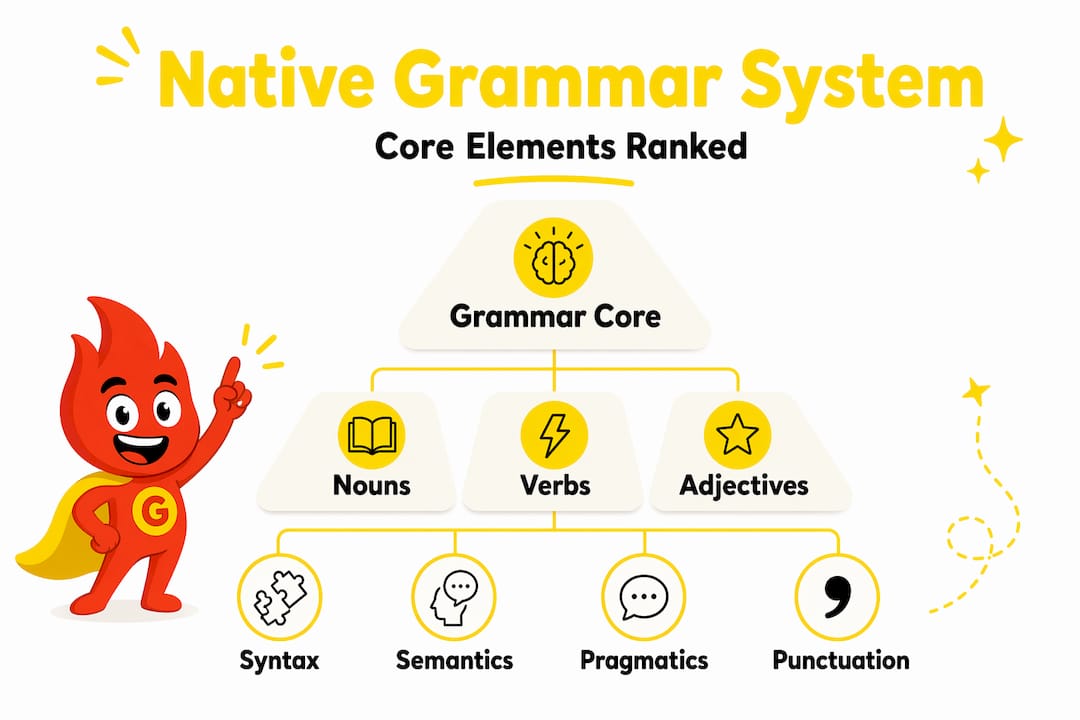
Native speaker grammar governs how words are formed (morphology), how sentences are built (syntax), how meanings are interpreted in context (semantics), and how language is used appropriately in social situations (pragmatics). Every time a native speaker opens their mouth, all four layers are working together automatically.
Here’s what each layer actually means for you as a learner:
- Morphology: How words change form. Think verb endings like hablo (I speak) vs. hablan (they speak), or noun plurals like libro (book) vs. libros (books).
- Syntax: How words are ordered in a sentence. Spanish is relatively flexible compared to English, but word order still carries meaning and emphasis.
- Semantics: What words and structures mean. The difference between ser and estar (both meaning “to be”) is a semantic distinction, not just a vocabulary one.
- Pragmatics: How context shapes meaning. Choosing usted vs. tú (formal vs. informal “you”) is a pragmatic decision based on the relationship and setting.
The core Spanish grammar rules are stable across Spanish-speaking countries. A speaker from Mexico and one from Argentina may differ in vocabulary and accent, but subject-verb agreement, noun gender, and mood usage follow the same underlying system. That consistency is good news for you. Master the core, and you’re understood everywhere.
Building on the idea of grammar as a system, let’s explore the specific elements that define native Spanish grammar in practice.
Mastering noun gender, number, and adjective agreement
One of the first things that trips up adult learners is that every Spanish noun has a gender. It’s either masculine or feminine, and that gender affects everything around it. Adjectives and determiners must agree in both gender and number with the nouns they modify. This is non-negotiable in native speaker grammar.
Here’s how the agreement system works:
| Noun | Gender | Adjective (singular) | Adjective (plural) |
|---|---|---|---|
| libro (book) | Masculine | interesante | interesantes |
| casa (house) | Feminine | bonita | bonitas |
| chico (boy) | Masculine | alto | altos |
| chica (girl) | Feminine | alta | altas |
Notice that adjectives ending in -o change to -a for feminine nouns, while adjectives ending in -e (like interesante) stay the same for both genders but still add -s in the plural.
Key points to remember about agreement:
- Masculine nouns pair with masculine adjectives: el coche rojo (the red car).
- Feminine nouns pair with feminine adjectives: la puerta roja (the red door).
- Plural adds -s after a vowel and -es after a consonant: los coches rojos, las ciudades grandes.
- Most adjectives follow the noun in Spanish, unlike English. Un hombre inteligente (an intelligent man), not un inteligente hombre.
- Some adjectives change meaning depending on position. Un gran hombre means “a great man,” while un hombre grande means “a big man.”
The biggest challenge learners report is not knowing the rule but applying it in real time. When you’re mid-conversation, you don’t have time to stop and recall that mesa (table) is feminine. That’s why practicing in chunks helps so much.
Pro Tip: Instead of memorizing nouns in isolation, always learn them with their article: la mesa, el libro. This trains your brain to store gender as part of the word itself, which is exactly how native speakers carry it.
Unlocking Spanish verbs: the heart of native grammar
If noun-adjective agreement is the foundation, verbs are the engine. Spanish verbs encode person, number, tense, and mood, which is why they feel like the most demanding part of the language for learners. A single verb like hablar (to speak) has over 50 conjugated forms across all tenses and moods.
Here’s what a verb form communicates at once:
- Person: Who is doing the action (1st person = I/we, 2nd = you, 3rd = he/she/they).
- Number: Singular or plural.
- Tense: When the action happens (present, past, future, etc.).
- Mood: The speaker’s attitude toward the action (indicative for facts, subjunctive for doubt/wishes, imperative for commands).
Because the verb ending already signals the subject, Spanish speakers regularly drop the subject pronoun. Hablo español means “I speak Spanish” without needing yo (I) at the start. This is called a “pro-drop” language, and it’s a feature, not an omission.
Pro Tip: Don’t try to master all 50-plus forms at once. Start with the present indicative and past tenses for the 20 most common verbs. Once those feel automatic, add the subjunctive. Depth before breadth is the faster path to fluency. You can also explore the ser vs estar guide to tackle one of the most important verb contrasts in Spanish.
The goal is not to recall a conjugation table. The goal is to hear hablan and instantly know it means “they speak,” without translation. That kind of automatic recognition comes from contextual exposure, not drills alone.
Demystifying the Spanish subjunctive mood
The subjunctive is the grammar point that makes intermediate learners nervous and advanced learners proud. It’s worth the effort. The subjunctive is a grammatical mood used for uncertainty, subjectivity, wishes, emotions, doubt, recommendations, and hypothetical situations. It is triggered by specific expressions in the main clause.
English has a subjunctive too, but it’s nearly invisible. “I suggest that he be on time” uses the subjunctive, but most English speakers don’t notice it. In Spanish, the subjunctive is active and frequent, which means you need to consciously build awareness of it.
The WEIRDO acronym groups the most common triggers:
- W = Wishes (Quiero que vengas = I want you to come)
- E = Emotions (Me alegra que estés aquí = I’m glad you’re here)
- I = Impersonal expressions (Es importante que estudies = It’s important that you study)
- R = Recommendations (Te recomiendo que comas = I recommend you eat)
- D = Doubt or denial (No creo que sea verdad = I don’t think it’s true)
- O = Ojalá (Ojalá llueva = I hope it rains)
Native speakers don’t mentally run through WEIRDO before speaking. They use the subjunctive because it sounds right from years of exposure. Your job as a learner is to get enough input that the same instinct starts to develop.
The fastest way to build that instinct is through Spanish subjunctive practice in real sentence contexts, not isolated conjugation tables. Read and listen to Spanish where the subjunctive appears naturally, notice the patterns, and repeat them in your own sentences.
Native grammar reflected in punctuation and sentence structure
Native speaker grammar extends beyond verbs and nouns. It shows up in how sentences are visually structured on the page. Spanish uses a double set of question and exclamation marks. The correct placement requires an inverted mark (¿ or ¡) at the start of the interrogative or exclamative span, paired with the closing mark at the end.
Here’s a quick comparison of Spanish and English punctuation norms:
| Feature | Spanish | English |
|---|---|---|
| Question marks | ¿Cómo te llamas? | How are you? |
| Exclamation marks | ¡Qué bueno! | How great! |
| Period after closing mark | Not used at sentence end | Used normally |
| Placement of opening mark | Immediately before the question/exclamation | No opening mark |
Key rules to know:
- The opening mark goes directly before the first word of the question or exclamation, even if the sentence starts earlier. Example: Perdona, ¿puedes repetir? (Sorry, can you repeat?)
- No period follows the closing mark if it ends the sentence.
- In formal writing, omitting the opening mark is considered an error, even if it’s common in informal texting.
This might seem like a minor detail, but getting punctuation right signals grammatical competence. In professional or academic contexts, incorrect punctuation can undermine otherwise strong Spanish writing.
Why mastering Spanish native grammar requires contextualized pattern immersion
Here’s the perspective most grammar courses skip: rote memorization is not the bottleneck. The bottleneck is context. You can recite every subjunctive conjugation perfectly and still freeze when you need to use it in a real conversation. That gap exists because isolated drills don’t build the form-to-meaning connection that native speakers have.
Native-like grammar use comes from repeated exposure to real language patterns in meaningful contexts, not from memorizing rules in the abstract. Think about how native speakers acquired their grammar. No one handed a five-year-old a conjugation chart. They heard thousands of sentences, noticed patterns, and internalized them through use.
Adult learners can’t replicate childhood acquisition exactly, but you can simulate the conditions. That means prioritizing high-yield grammar contrasts first. Indicative vs. subjunctive. Ser vs. estar. Preterite vs. imperfect. These contrasts carry the most communicative weight. Get those right, and your Spanish becomes dramatically clearer, even before you’ve mastered every edge case.
It also means accepting regional variation without anxiety. A Colombian speaker and a Spanish speaker may use slightly different vocabulary or expressions, but the core grammar stays consistent. You don’t need to master every regional variant. You need to master the core system, then adapt at the edges. Spanish grammar exposure practice that uses real-world contexts, not just textbook sentences, is what builds that core system into something automatic.
The learners who reach fluency fastest are not the ones who study the most rules. They’re the ones who get the most meaningful repetitions of the right patterns.
Enhance your Spanish grammar with Gramanator practice tools
Understanding the system is step one. Internalizing it through practice is where fluency actually happens.
Gramanator is built for exactly this kind of practice. The platform offers over 10,000 interactive grammar exercises organized by grammar rule and real-life context, from workplace conversations to travel scenarios. Each exercise targets the areas that matter most for fluency, including verb conjugations, noun-adjective agreement, and the subjunctive mood. You get detailed explanations for every mistake, progress tracking, and personalized recommendations that show you exactly where to focus next. Explore Gramanator’s pricing plans to find the right level of commitment and start turning grammar knowledge into genuine, automatic fluency.
Frequently asked questions
What does native Spanish speaker grammar include?
Native speaker grammar includes morphology, syntax, semantics, and pragmatics, covering everything from verb moods and noun agreement to how context shapes the meaning of a sentence. It’s the automatic, correct use of all these systems together in real communication.
Why is noun-adjective agreement important in Spanish?
Because adjectives and determiners must match the gender and number of the noun they describe, and getting this wrong immediately signals to native speakers that something is off. It’s one of the most frequent grammar operations in the language.
How can I effectively learn the Spanish subjunctive mood?
Focus on understanding its meaning triggers, such as wishes, emotions, and doubt, and get massive exposure to real patterns in authentic Spanish sentences rather than drilling conjugation charts in isolation.
Do native Spanish speakers always follow perfect grammar rules?
They follow core grammar rules like verb agreement and mood consistently, but casual speech includes natural shortcuts and regional vocabulary differences. The underlying grammar system stays stable even when surface features vary.