Spanish Verb Conjugation Rules: Your Complete 2026 Guide
Spanish verb conjugation rules follow one core principle: every verb changes its ending to reflect who is acting, when the action happens, and the speaker’s…

Spanish verb conjugation rules follow one core principle: every verb changes its ending to reflect who is acting, when the action happens, and the speaker’s attitude toward it. Unlike English, where “I speak,” “you speak,” and “we speak” all look nearly identical, Spanish encodes all of that information directly into the verb ending. Master the pattern, and you can communicate with remarkable efficiency. Here is what you need to know to get there.
The foundation rests on three elements working together:
- Verb infinitives end in one of three ways: -ar (hablar, comprar), -er (beber, comer), or -ir (vivir, escribir). The ending determines which set of conjugation suffixes you use.
- Subject pronouns tell you who is performing the action: yo (I), tú (you, informal), usted (you, formal), él/ella (he/she), nosotros/as (we), vosotros/as (you all, Spain), ustedes (you all, Latin America), ellos/ellas (they).
- Tense and mood specify when and how: present, preterite, imperfect, future, and conditional are the main tenses; indicative, subjunctive, and imperative are the three moods.
Regular verbs follow predictable suffix patterns once you drop the infinitive ending. Irregular verbs deviate in the stem or spelling, but they cluster into recognizable groups. Spanish verb conjugation encodes subject, tense, mood, number, and aspect in a single word, which is why a conjugated Spanish verb can stand alone as a complete sentence.
Table of Contents
- What verb infinitives and subject pronouns tell you about conjugation
- How the three Spanish moods shape every conjugation
- Conjugation rules for regular Spanish verbs across key tenses
- How irregular Spanish verbs actually work
- How to conjugate reflexive verbs in Spanish
- Why mastering conjugation rules is the key to real fluency
- Compound tenses: present perfect, pluperfect, and future perfect
- Rules for forming and using the subjunctive mood
- How the conditional tense works and when to use it
- Gerunds and participles and their roles in conjugation
- Gramanator turns conjugation knowledge into speaking instinct
- Key takeaways
What verb infinitives and subject pronouns tell you about conjugation
Every Spanish verb you look up in a dictionary appears in its infinitive form, the unconjugated base. That final two-letter ending is your first signal: it tells you which conjugation family the verb belongs to and which set of endings to apply.
The three infinitive families:
- -ar verbs: the largest group; hablar, comprar, caminar, trabajar
- -er verbs: temer, beber, comer, vender
- -ir verbs: vivir, escribir, partir, abrir
The eight subject pronouns:
| Person | Singular | Plural |
|---|---|---|
| 1st | yo (I) | nosotros/as (we) |
| tú | tú (you) | vosotros/as (you all, Spain) |
| usted | usted (you) | ustedes (you all) |
| 3rd | él/ella (he/she) | ellos/ellas (they) |
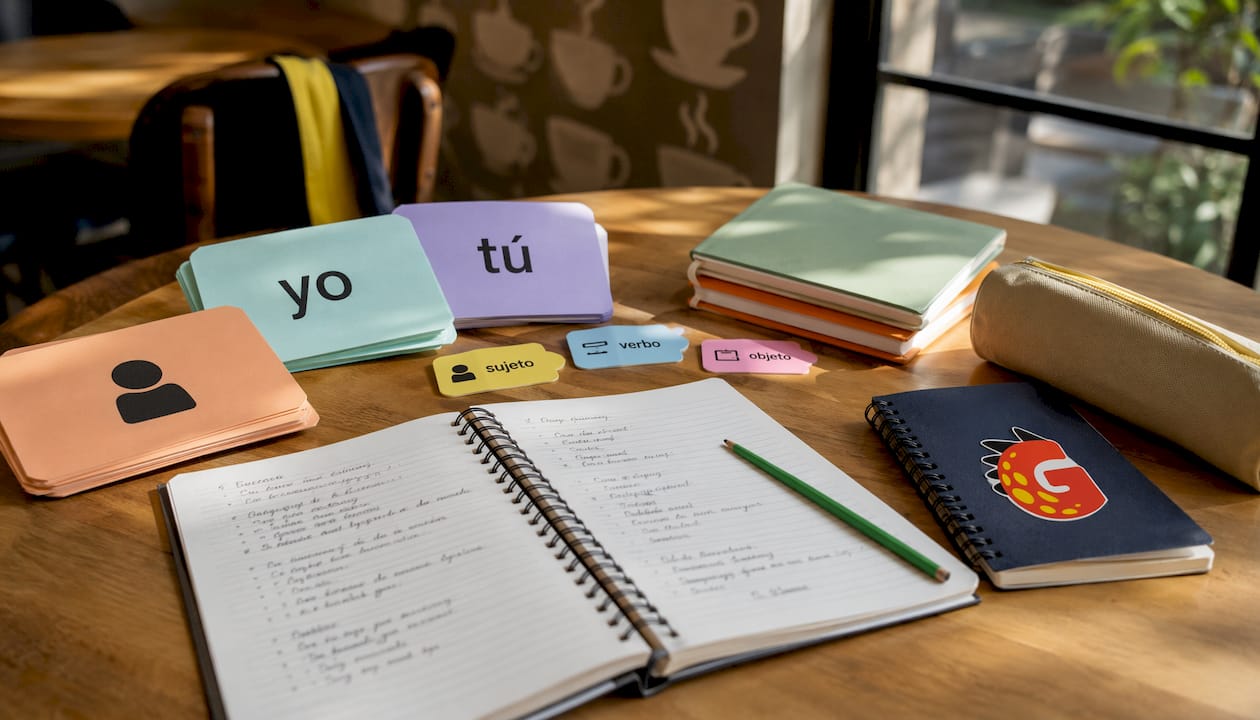
One practical note on regional variation: in Spain, vosotros/as is the standard informal plural “you,” while in Latin America, ustedes replaces vosotros entirely for both formal and informal contexts. The conjugation forms differ, so knowing your audience matters.
Spanish is also a pro-drop language, meaning subject pronouns are routinely omitted because the verb ending already identifies the subject. “Hablo español” means “I speak Spanish” without any need for “yo.” You will hear this constantly in natural conversation, and it is one of the clearest signs that a learner has internalized conjugation rather than just memorized it.
How the three Spanish moods shape every conjugation
Mood is not about emotion. In grammar, mood describes the speaker’s relationship to the action: is it a fact, a wish, or a command? Each mood produces different endings and operates across different tenses.
Indicative mood is the default. Use it to state facts, describe reality, and ask straightforward questions. “Ella trabaja mucho” (She works a lot) is indicative. Most of the tenses you will learn first, including present, preterite, imperfect, and future, live in the indicative.

Subjunctive mood expresses doubt, desire, emotion, and hypothetical situations. It almost always appears in dependent clauses introduced by “que.” “Quiero que vengas” (I want you to come) uses the subjunctive because the speaker is expressing a wish, not a fact. The subjunctive has its own present, imperfect, and compound forms, and compound tenses in both moods use the auxiliary verb haber combined with a past participle.
Imperative mood forms commands. It has no tenses, only affirmative and negative forms, and it conjugates differently depending on whether you are addressing tú, usted, nosotros, vosotros, or ustedes. “Habla más despacio” (Speak more slowly) is an affirmative tú command.
Conjugation rules for regular Spanish verbs across key tenses
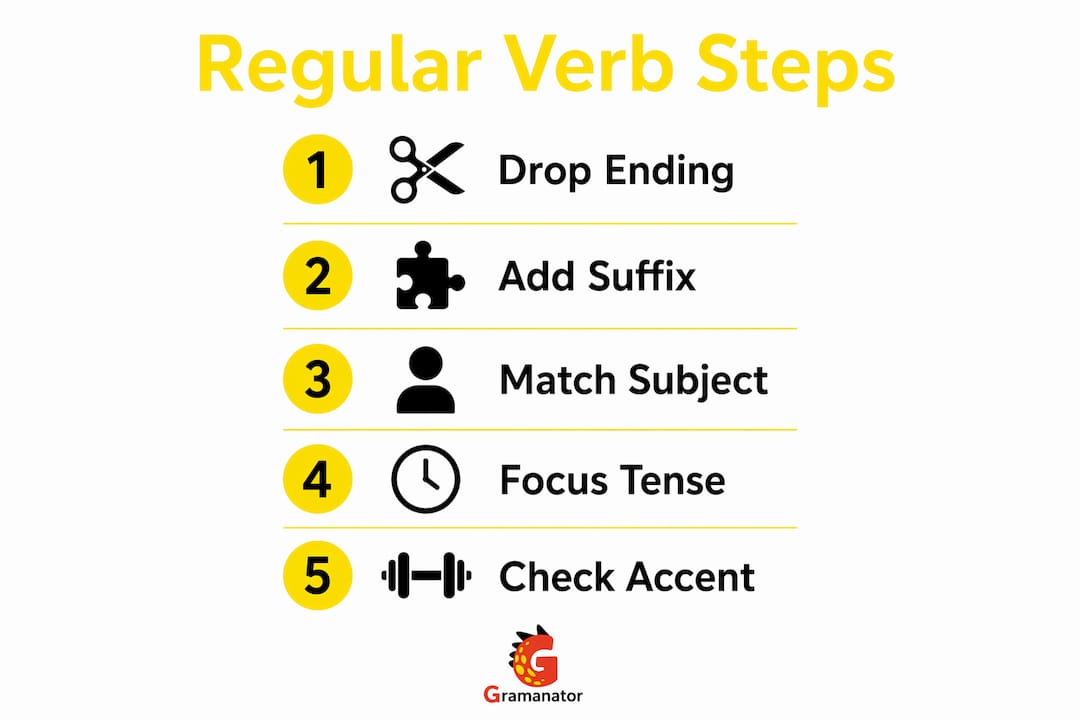
Regular verbs are your best friends early on. Drop the infinitive ending, add the correct suffix, and you are done. The table below covers the three model verbs: comprar (to buy, -ar), beber (to drink, -er), and vivir (to live, -ir) across present, preterite, imperfect, and future tenses.
| Subject | Comprar (present) | Beber (present) | Vivir (present) |
|---|---|---|---|
| yo | compro | bebo | vivo |
| tú | compras | bebes | vives |
| él/ella/usted | compra | bebe | vive |
| nosotros/as | compramos | bebemos | vivimos |
| vosotros/as | compráis | bebéis | vivís |
| ellos/ustedes | compran | beben | viven |
| Subject | Comprar (preterite) | Beber (preterite) | Vivir (preterite) |
|---|---|---|---|
| yo | compré | bebí | viví |
| tú | compraste | bebiste | viviste |
| él/ella/usted | compró | bebió | vivió |
| nosotros/as | compramos | bebimos | vivimos |
| vosotros/as | comprasteis | bebisteis | vivisteis |
| ellos/ustedes | compraron | bebieron | vivieron |
Imperfect endings follow a different pattern. For -ar verbs: -aba, -abas, -aba, -ábamos, -abais, -aban. For -er and -ir verbs: -ía, -ías, -ía, -íamos, -íais, -ían. The imperfect describes habitual or ongoing past actions, while the preterite marks completed events.
Future tense is the most learner-friendly of all. Keep the full infinitive intact and simply add: -é, -ás, -á, -emos, -éis, -án. The same endings apply to all three verb families. “Compraré, beberé, viviré” all follow the same pattern.
Accent marks in verb endings are not decorative. In the preterite, “compró” (he bought) versus “compro” (I buy) differ only by that accent, and confusing them changes both the person and the tense. Pay close attention when writing and reading.
How irregular Spanish verbs actually work
Irregular verbs look chaotic at first, but they fall into three main categories. Recognizing the category tells you what to expect.
Spelling change verbs adjust their spelling to preserve pronunciation. Common patterns:
- Verbs ending in -uir (incluir, construir): the “i” changes to “y” in all forms except nosotros and vosotros. “Incluir” becomes “yo incluyo, tú incluyes.”
- Verbs ending in -cer/-cir with a vowel before the ending (conocer, producir): add a “z” before the “c” in the yo form only. “Conocer” becomes “yo conozco.”
- Verbs ending in -cer/-cir with a consonant before the ending (vencer): the “c” changes to “z” in yo only. “Vencer” becomes “yo venzo.”
Stem-changing verbs shift the vowel in the verb stem for all forms except nosotros and vosotros. The four stem changes are:
- e → ie: entender (to understand) → yo entiendo, tú entiendes
- o → ue: contar (to count) → yo cuento, tú cuentas
- e → i: pedir (to ask for) → yo pido, tú pides
- u → ue: jugar (to play) → yo juego, tú juegas
Truly irregular verbs follow no predictable rule and must be learned individually. The seven highest-frequency irregular verbs in Spanish, sometimes called the “super 7,” are ser, estar, haber, tener, ir, hacer, and poder. These appear constantly in real conversation, so they deserve priority attention in your practice.
- Ser (to be, permanent): soy, eres, es, somos, sois, son
- Ir (to go): voy, vas, va, vamos, vais, van
- Tener (to have): tengo, tienes, tiene, tenemos, tenéis, tienen
Pro Tip: Group irregular verbs by their yo-form pattern. Many verbs that end in -go in the yo form (tengo, vengo, pongo, salgo, hago) follow similar irregularity patterns in the subjunctive. Learning one often unlocks several others.
How to conjugate reflexive verbs in Spanish
Reflexive verbs describe actions the subject performs on itself. Bañarse (to bathe oneself), despertarse (to wake up), and llamarse (to be called) are classic examples. The verb itself conjugates exactly like any regular or irregular verb. The extra step is attaching the correct reflexive pronoun.
Reflexive pronouns by subject:
- yo → me
- tú → te
- él/ella/usted → se
- nosotros/as → nos
- vosotros/as → os
- ellos/ustedes → se
The pronoun goes directly before the conjugated verb. “Me despierto a las siete” means “I wake up at seven.” For infinitives and gerunds, the pronoun can attach to the end: “Voy a bañarme” or “Estoy bañándome.” Both placements are correct.
The key distinction is that reflexive pronouns must match the subject and precede the conjugated verb in standard sentence structure. A common learner error is using the wrong pronoun, for example “se despierto” instead of “me despierto.” The verb ending and the reflexive pronoun must always agree with the same subject.
Why mastering conjugation rules is the key to real fluency
Here is the honest case for putting in the work: Spanish conjugation complexity is actually a feature, not a flaw. Because conjugated verbs pack information about subject, tense, mood, number, and aspect into a single word, Spanish speakers can communicate more concisely than English speakers often can. One word replaces what English needs three or four words to express.
The practical payoff is the pro-drop feature. Once you internalize conjugation patterns, you stop needing to say “yo” before every verb. Native speakers rarely do. That shift, from consciously attaching pronouns to trusting the verb ending, is one of the clearest markers of real fluency. You can read more about native-like grammatical mastery and what it actually involves.
The “super 7” irregular verbs (ser, estar, haber, tener, ir, hacer, poder) form the structural backbone of everyday Spanish. They appear in compound tenses, common expressions, and nearly every real conversation. Prioritizing these seven before moving on to less frequent verbs is one of the most efficient decisions you can make as a learner.
Pro Tip: Do not try to memorize every conjugation table in isolation. Train patterns through repeated exposure in context. When you encounter “tuviste” in a sentence and immediately know it means “you had” without translating, that is automaticity, and it only comes from structured practice, not passive study.
Compound tenses: present perfect, pluperfect, and future perfect
Compound tenses combine a conjugated form of haber with a past participle. The past participle is formed by dropping the infinitive ending and adding -ado (for -ar verbs) or -ido (for -er and -ir verbs). Hablar → hablado. Beber → bebido. Vivir → vivido.
Present perfect (pretérito perfecto compuesto): haber in the present + past participle. “He hablado” (I have spoken). Use it for actions connected to the present moment or recently completed events.
Pluperfect (pretérito pluscuamperfecto): haber in the imperfect + past participle. “Había hablado” (I had spoken). Use it for actions completed before another past action.
Future perfect (futuro compuesto): haber in the future + past participle. “Habré hablado” (I will have spoken). Use it for actions that will be completed before a future point.
One rule applies to all compound tenses: the past participle never changes form when used with haber. It always ends in -o, regardless of the subject’s gender or number. “Ella ha hablado,” not “ella ha hablada.” When the participle is used as an adjective, it does agree with the noun, but not in compound tenses.
Rules for forming and using the subjunctive mood
The present subjunctive is built from the yo form of the present indicative. Drop the -o, then add the “opposite” vowel endings: -ar verbs take -e endings, and -er/-ir verbs take -a endings.
| Subject | Hablar (subj.) | Comer (subj.) | Vivir (subj.) |
|---|---|---|---|
| yo | hable | coma | viva |
| tú | hables | comas | vivas |
| él/ella/usted | hable | coma | viva |
| nosotros/as | hablemos | comamos | vivamos |
| vosotros/as | habléis | comáis | viváis |
| ellos/ustedes | hablen | coman | vivan |
The imperfect subjunctive has two equally valid forms. Take the third-person plural preterite (hablaron), drop -ron, and add either -ra endings (hablara, hablaras...) or -se endings (hablase, hablases...). Both are correct; the -ra form is more common in speech.
Use the subjunctive after expressions of desire (querer que, esperar que), emotion (alegrarse de que, tener miedo de que), doubt (dudar que, no creer que), and impersonal expressions (es importante que, es posible que). The trigger is almost always a “que” linking two clauses with different subjects. If both clauses share the same subject, use the infinitive instead: “Quiero hablar” (I want to speak), not “Quiero que yo hable.”
How the conditional tense works and when to use it
The conditional is the “would” tense. It uses the same stem as the future tense (the full infinitive for regular verbs) but adds a different set of endings: -ía, -ías, -ía, -íamos, -íais, -ían. These endings are identical to the -er/-ir imperfect endings, which makes them easier to remember.
“Hablaría” means “I would speak.” “Comeríamos” means “we would eat.” For irregular verbs, the same irregular stems used in the future apply in the conditional. Tener → tendr-: “tendría” (I would have). Hacer → har-: “haría” (I would do).
The conditional appears most often in three contexts: polite requests (“¿Podría ayudarme?” - Could you help me?), hypothetical situations (“Viviría en España si pudiera” - I would live in Spain if I could), and reported speech about future events from a past perspective (“Dijo que vendría” - He said he would come). Learners who confuse conditional and imperfect forms often produce errors in the second context, particularly in “if” clauses. For a closer look at where learners go wrong, the guide on conditional tense mistakes covers the most common patterns.
Gerunds and participles and their roles in conjugation
Gerunds and past participles are non-finite verb forms, meaning they do not conjugate for person or number on their own. They work alongside conjugated verbs to build compound structures.
The gerund (present participle) ends in -ando for -ar verbs and -iendo for -er/-ir verbs. Hablar → hablando. Comer → comiendo. Vivir → viviendo. Its primary role is forming the progressive tenses: estar + gerund. “Estoy hablando” (I am speaking). The gerund never changes form regardless of subject.
The past participle ends in -ado (-ar verbs) or -ido (-er/-ir verbs). It has two jobs. First, it combines with haber to form all compound tenses, as covered above, and in that role it is invariable. Second, it functions as an adjective and agrees in gender and number with the noun it modifies: “La puerta está cerrada” (The door is closed), “Los libros están cerrados” (The books are closed).
Some common verbs have irregular past participles: hacer → hecho, decir → dicho, escribir → escrito, ver → visto, abrir → abierto, poner → puesto, volver → vuelto. These must be memorized, but they appear so frequently that most learners absorb them quickly through exposure.
Gramanator turns conjugation knowledge into speaking instinct
Reading conjugation rules is a start. Reacting to them automatically in conversation is the actual goal, and there is a real gap between the two.
Gramanator is built specifically to close that gap. Where a textbook gives you a table to study, Gramanator gives you 10,000+ structured grammar drills that put those tables into real-life contexts: workplace conversations, travel situations, and everyday interactions. Every session targets the patterns you have not yet internalized, repeats your weak spots until they stick, and gives you immediate feedback so you correct errors before they become habits.
The platform covers the full range of conjugation training, from present tense basics through subjunctive and conditional forms, structured from A1 to C1. Daily personalized workouts mean you are always training the right thing at the right level, not grinding through material you already know. If you want to identify your grammar weaknesses before you start, that is a smart first step.
Ready to train conjugation until it becomes instinct? Start your grammar training at Gramanator today.
Key takeaways
Mastering Spanish verb conjugation rules requires learning three infinitive families, six conjugation forms, three moods, and the irregular patterns of the highest-frequency verbs before automaticity becomes possible.
| Point | Details |
|---|---|
| Three infinitive families | Every Spanish verb ends in -ar, -er, or -ir, and each family uses distinct conjugation suffixes. |
| Six conjugation forms | Eight subject pronouns reduce to six verb forms because usted uses the same conjugation as él/ella, and ustedes uses the same conjugation as ellos/ellas. |
| Irregular verb priority | The “super 7” verbs (ser, estar, haber, tener, ir, hacer, poder) appear constantly and must be mastered before less frequent irregulars. |
| Compound tenses use haber | Present perfect, pluperfect, and future perfect all combine a conjugated form of haber with an invariable past participle. |
| Gramanator for automaticity | Gramanator’s structured drills train conjugation patterns through repetition and real-life contexts, turning rules into instinctive recall. |