SIELE Preparation Grammar: Your Complete Study Guide
SIELE preparation grammar is the practice of mastering advanced Spanish grammar structures specifically to perform well across all four modules of the SIELE…

SIELE preparation grammar is the practice of mastering advanced Spanish grammar structures specifically to perform well across all four modules of the SIELE exam. The SIELE (Servicio Internacional de Evaluación de la Lengua Española) is a proficiency test developed by UNAM, the Universidad de Salamanca, and the Instituto Cervantes. It scores candidates on a scale of 0-1000 across reading, listening, writing, and speaking. Grammar is not a separate module, but it runs through every task. Getting it right is the difference between a mid-range score and a top-tier result.
Which Spanish grammar points are essential for SIELE success?
Scoring 800-900+ on the SIELE requires mastery of advanced connectors, present and imperfect subjunctive moods, and idiomatic expressions. That is not a suggestion. It is the grammar profile of a high-scoring candidate.
Here are the grammar areas that carry the most weight:
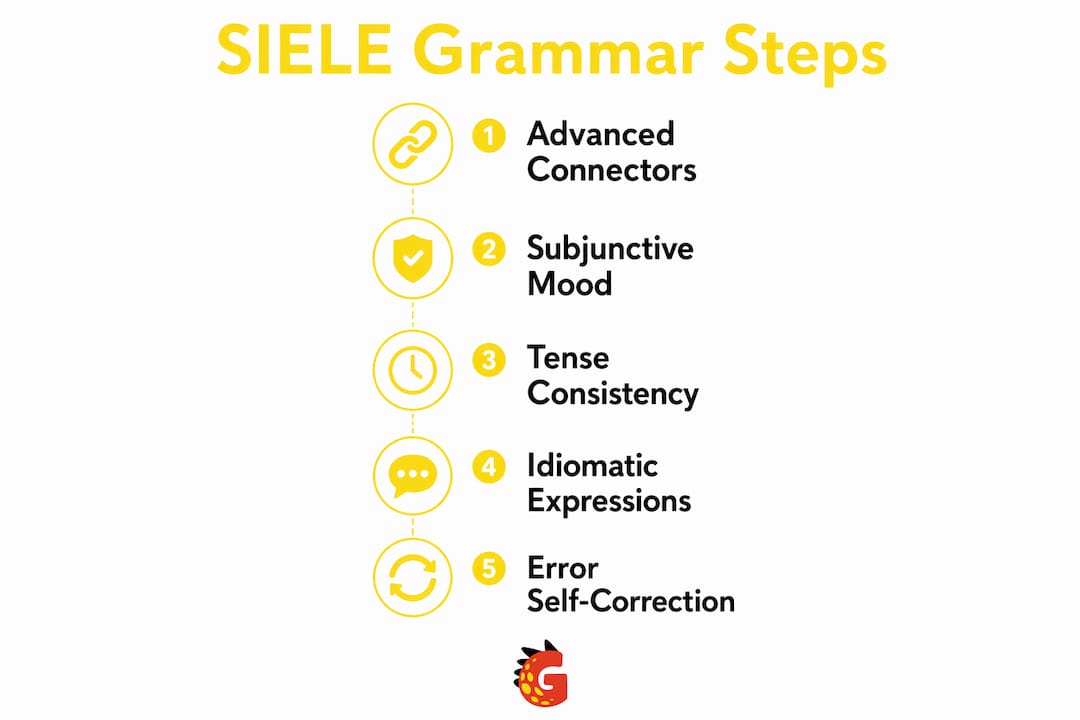
- Advanced connectors. Words like además (furthermore), sin embargo (however), and por ende (therefore) signal logical flow to examiners. Replacing basic connectors like y or pero with these raises the perceived quality of your writing and speaking immediately.
- Present subjunctive. Used for wishes, doubts, and recommendations. Example: Espero que tengas éxito (I hope you succeed). This mood appears in writing tasks and oral responses alike.
- Imperfect subjunctive. Used in hypothetical statements and formal registers. Example: Si tuviera más tiempo, estudiaría más (If I had more time, I would study more). Candidates who use this correctly stand out at the B2-C1 level.
- Ser vs. estar. This is the most common source of errors for English-speaking learners. Ser expresses identity and permanent characteristics. Estar expresses state and temporary conditions. Confusing them changes meaning entirely.
- Verb tense consistency. Mixing preterite and imperfect incorrectly, or shifting tenses mid-paragraph, signals weak grammatical control to examiners.
- Idiomatic expressions. Phrases like tener en cuenta (to keep in mind) or a pesar de (in spite of) add authenticity and register to your responses.
Pro Tip: Build a personal list of 10-15 advanced connectors and practice inserting them into timed writing tasks. Mastering connectors is the fastest way to raise examiner impressions of your fluency.
These structures are not just grammar rules. They are the tools that let you express complex ideas clearly. Examiners reward candidates who use grammar to communicate, not candidates who simply avoid mistakes.

What common grammar pitfalls should SIELE learners avoid?
Most grammar errors on the SIELE come from a small set of recurring mistakes. Identifying them early saves you from losing points across multiple modules.
- Ser vs. estar confusion. The root cause is direct translation from English. English uses “to be” for both identity and state. Spanish does not. Adopting a conceptual check before writing, asking yourself “Is this an identity or a state?”, reduces this error significantly. For a full breakdown, the ser vs. estar guide on Gramanator covers every rule with examples.
- Tense inconsistency. Candidates often start a narrative in the preterite and drift into the present tense. Read your written responses aloud. Your ear catches tense shifts faster than your eye.
- Overusing basic connectors. Writing y (and) or pero (but) repeatedly signals a lower proficiency level. Replacing them with asimismo, no obstante, or dado que signals B2-C1 control.
- Ignoring self-correction during speaking. Many learners think correcting themselves mid-sentence looks bad. SIELE examiners reward self-correction because it demonstrates awareness and proficiency. Catching your own error is a sign of competence, not weakness.
Pro Tip: Record yourself answering a practice speaking prompt. Play it back and mark every grammar error. Then re-record the same prompt. This single drill builds self-correction instinct faster than any grammar worksheet.
The examiner’s perspective matters here. Examiners prioritize clarity and the ability to express ideas in Spanish over grammatical perfection. A response with one self-corrected error and strong connectors scores higher than a cautious, simple response with no errors at all.
How can learners practice grammar efficiently for the SIELE?
Efficient SIELE grammar practice means replicating exam conditions, not just reviewing rules. Here is a structured approach that works:
- Use timed practice exams. Sit down with a full practice test and set a timer. Grammar errors multiply under time pressure. Training under realistic conditions teaches you to apply grammar automatically, not just when you have time to think.
- Integrate grammar drills into thematic clusters. Linking grammar to themes like travel, work, and daily life doubles retention. Instead of drilling subjunctive in isolation, practice it in sentences about workplace situations or travel decisions. The grammar sticks because the context is meaningful.
- Record and review oral responses. Speaking practice without review is wasted effort. Record your answer, listen back, and note every grammar error. Focus your next session on fixing those specific errors. Gramanator’s mistake-focused repetition system is built exactly for this cycle.
- Expose yourself to pan-Hispanic accents. The SIELE includes accents from Spain, Argentina, Mexico, and Colombia. Listening only to one regional variety leaves you unprepared for the listening module. Watch news broadcasts, podcasts, and interviews from multiple Spanish-speaking countries.
- Target your weakest grammar areas first. A 9-12 month preparation period focused on specific grammatical blind spots is the recommended timeline for SIELE success. Use tools like Gramanator’s grammar weakness identifier to find and prioritize those gaps early.
Pro Tip: Do not study grammar and vocabulary separately. Pick a theme, learn 10 words related to it, and write five sentences using those words with a target grammar structure. You train both at once, and the exam rewards exactly this kind of integrated knowledge.
The goal is automatic recall. You should not be thinking about whether to use the subjunctive during a speaking task. You should already know it.
How do grammar skills influence each SIELE exam module?
Grammar does not operate the same way in every module. Understanding where it matters most helps you allocate your study time wisely.
| Module | Grammar’s role | Key strategy |
|---|---|---|
| Reading | Grammar clues help identify meaning in complex sentences | Read questions first, then scan for grammatical markers |
| Listening | Verb tense and mood signal speaker intent | Practice with diverse accents to reduce comprehension gaps |
| Writing | Connectors, subjunctive, and tense control determine score level | Use advanced connectors and check tense consistency before submitting |
| Speaking | Fluency, self-correction, and connector use signal proficiency level | Practice oral responses timed, then review recordings for errors |
The writing module rewards the widest range of grammar skills. Connectors, subjunctive mood, and tense consistency all appear in a single written response. A candidate who uses aunque (although), a fin de que (so that), and the imperfect subjunctive in one paragraph signals C1-level control. That is the kind of response that pushes scores into the 800-900 range.
The speaking module rewards a different skill. Reading questions before passages reduces grammar errors under pressure by giving you a mental framework before you respond. The same logic applies to oral tasks. Knowing what you want to say before you say it reduces mid-sentence grammar collapses.
The reading and listening modules use grammar more passively. You need to recognize how tense and mood signal meaning in a text or audio clip. A speaker using the conditional tense is expressing hypothetical ideas. A speaker using the imperfect is describing ongoing past states. Recognizing these signals quickly is a grammar skill, even if you never write a single word.
Key Takeaways
Effective SIELE grammar preparation requires mastering advanced connectors, subjunctive moods, and tense control while practicing under realistic exam conditions across all four modules.
| Point | Details |
|---|---|
| Advanced connectors are high-impact | Replacing basic connectors with sin embargo or por ende raises examiner impressions immediately. |
| Self-correction is rewarded | SIELE examiners view self-correction during speaking as a sign of proficiency, not weakness. |
| Thematic drills beat isolated practice | Linking grammar to real-life themes like work or travel doubles retention and exam readiness. |
| All four modules require grammar | Reading, listening, writing, and speaking each demand different grammar skills and strategies. |
| Start with your weakest areas | A 9-12 month preparation focused on specific blind spots is the recommended path to a high score. |
Why grammar as a tool beats grammar as a rulebook
Language teachers and SIELE preparation experts often observe that one of the biggest obstacles to exam success is treating grammar as a collection of rules to memorize rather than a tool for communication. This approach may help learners recognize grammatical structures, but it rarely prepares them to use them confidently in speaking and writing tasks.
The SIELE exam measures the ability to communicate effectively in Spanish, not simply recall grammar rules. Learners who actively use structures such as the subjuntivo or aunque in context generally perform better than those who avoid them for fear of making mistakes.
Another common misconception is that grammar and vocabulary should be studied separately. In practice, both develop together. When grammar is practiced through realistic situations - such as discussing work, travel, or everyday interactions - it becomes easier to retrieve naturally and apply with confidence.
For this reason, many educators recommend spending less time reviewing grammar tables and more time producing language. Regular speaking, writing, and targeted grammar practice with immediate feedback help transform grammatical knowledge into the automatic skills that language proficiency exams are designed to assess.
Gramanator: targeted grammar training for SIELE learners
Adult learners preparing for the SIELE need more than grammar notes. They need a system that trains patterns until they become automatic.
Gramanator is built for exactly that. The platform offers 10,000+ structured grammar drills organized from A1 to C1, with real-life contexts covering workplace communication, travel, and everyday interactions. Every session includes immediate feedback, integrated grammar explanations, and targeted review of your specific weak areas. You train the grammar the SIELE actually tests, in the conditions that actually matter. Start training your grammar on Gramanator and build the foundation your exam score depends on. View available plans to find the right fit for your preparation timeline.
FAQ
What grammar structures does the SIELE exam test most?
The SIELE tests advanced connectors, present and imperfect subjunctive moods, verb tense consistency, and idiomatic expressions. Candidates aiming for scores above 800 must demonstrate control of these structures across all four modules.
How long should I prepare grammar for the SIELE?
A focused preparation period of 9-12 months targeting specific grammar blind spots is the recommended timeline. Prioritize areas like ser vs. estar and verb conjugation early, then build toward advanced structures.
Does self-correcting grammar mistakes hurt my speaking score?
No. SIELE examiners reward self-correction during the oral exam because it signals proficiency and awareness. Catching and fixing your own error mid-response is viewed as a strength, not a flaw.
How do I practice grammar for the SIELE writing module?
Use timed writing tasks that require advanced connectors and subjunctive structures. Review each response for tense consistency and connector variety before considering it complete.
Why do accents matter for SIELE grammar preparation?
The SIELE listening module includes speakers from Spain, Argentina, Mexico, and Colombia. Exposure to pan-Hispanic accents helps you recognize how grammar structures sound across regional varieties, reducing comprehension errors on exam day.