Why Grammar Matters for Spanish Fluency
Why grammar is the backbone of Spanish fluency. How structure unlocks speaking speed and how to study it without losing motivation.

Grammar is the structural foundation that determines whether your Spanish sounds natural and confident or halting and confusing. Most adult learners already know this on some level, yet they still treat grammar as a separate subject to memorize rather than a skill to train. Understanding why grammar matters for Spanish fluency means recognizing that grammar is not the enemy of conversation. It is the engine behind it. Researchers in second language acquisition (SLA) describe fluency, accuracy, and complexity as three separable dimensions of spoken output, and all three depend on grammar working automatically in real time.
Why grammar matters for spanish fluency in real conversations
Grammar knowledge reduces communication breakdowns. When you know how Spanish sentence structure works, you spend less mental energy decoding what you hear and more energy responding naturally. That shift is the difference between a conversation that flows and one that stalls every few seconds.

SLA research is clear on this point: monitoring correctness divides attention, slowing speech and increasing pauses. Think about what happens when you try to remember whether a noun is masculine or feminine while also listening to a question and forming a reply. Your brain is doing three jobs at once. Grammar that is not yet automatic creates exactly this kind of cognitive overload.
Here is where the importance of grammar in Spanish becomes practical. When grammar patterns are internalized, they free up mental bandwidth. You stop translating word by word and start reacting to meaning. That is what native speakers do, and it is what fluent non-native speakers learn to do through deliberate practice.
Common grammar gaps that cause real-world breakdowns include:
- Verb tense confusion: Saying “Ayer voy al mercado” (Yesterday I go to the market) instead of “Ayer fui al mercado” signals a tense error that confuses listeners about when something happened.
- Pronoun placement errors: Misplacing direct object pronouns like “lo” or “la” can make a sentence grammatically unacceptable in Spanish.
- Gender agreement failures: “El problema blanca” instead of “el problema blanco” marks you as a beginner and can distract from your message.
- Word order mistakes: Spanish allows more flexibility than English, but certain structures are fixed, especially in questions and negative sentences.
Pro Tip: When you notice a recurring grammar mistake in conversation, write it down immediately after the exchange. Targeted review of your own errors builds awareness faster than reviewing random grammar rules.
Does knowing grammar rules actually make you fluent?
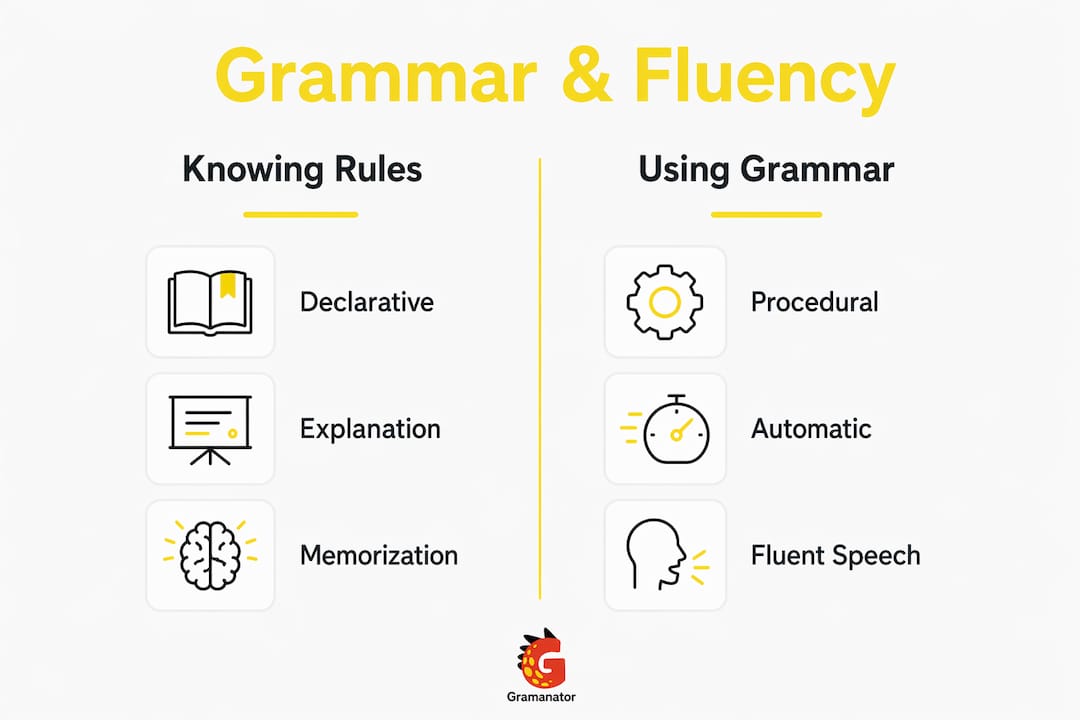
Knowing grammar rules and using them fluently are two completely different cognitive skills. Linguists call this the difference between declarative knowledge and procedural knowledge. Declarative knowledge is knowing the rule: “Reflexive verbs use reflexive pronouns.” Procedural knowledge is automatic grammatical processing that lets you say “Me levanto a las siete” (I get up at seven) without consciously thinking about the pronoun.
Most adult learners are loaded with declarative knowledge. They can explain the subjunctive mood in writing. They freeze when they need to use it in a live conversation. This gap is not a sign of failure. It is a predictable stage of language development that requires a specific kind of practice to close.
The role of grammar in language learning is not to give you a rulebook to consult mid-sentence. As SLA researchers note, grammar becomes a tool when used in context, not a set of isolated rules. The scaffold fades as fluency develops, but only if you practice applying grammar under real-time pressure.
Here is the progression every adult learner needs to follow:
- Learn the rule explicitly. Understand what the grammar point does and why it exists in Spanish.
- Practice it in controlled contexts. Use drills, fill-in-the-blank exercises, and structured sentences to build initial accuracy.
- Apply it under time pressure. Timed speaking tasks, conversation practice, and rapid-response drills force your brain to retrieve the pattern automatically.
- Get corrective feedback. Immediate feedback on errors accelerates the shift from declarative to procedural knowledge.
- Repeat in varied contexts. Grammar sticks when you encounter and produce it across multiple situations, not just one exercise type.
“Fluency arises from automatic grammatical processing, not just knowing rules. The learner who can explain every tense but hesitates in conversation has not yet proceduralized their knowledge.” - adapted from SLA research on procedural knowledge
How to balance grammar practice and real communication
The most effective approach to improving Spanish through grammar combines two complementary training modes. SLA researchers call this Focus on Form (FonF), and the evidence behind it is strong. Form-focused instruction embedded in meaning-based lessons improves grammatical accuracy in authentic communication without abandoning the communicative goal.
The practical implication is that you should not choose between grammar study and conversation practice. You need both, but you need to design them differently.
| Practice Type | Primary Goal | Example Activity |
|---|---|---|
| Accuracy-focused | Correct form production | Grammar drills, conjugation tables, error correction |
| Fluency-focused | Smooth, uninterrupted output | Timed storytelling, role-play, free conversation |
| FonF (blended) | Accuracy within communication | Structured tasks with grammar targets embedded |
Research confirms that fluency and accuracy improve best when trained in complementary modes rather than simultaneously. Trying to monitor your grammar while also maintaining conversational flow overloads your attention. Separating the two types of practice lets each skill develop properly before you integrate them.
Gramanator is built around exactly this principle. The platform combines structured grammar drills with real-life Spanish contexts, so you train accuracy first and then apply it in situations that mirror actual conversations. That progression from controlled practice to applied use is what turns grammar knowledge into speaking instinct.
Pro Tip: Schedule two types of weekly sessions: one focused purely on grammar accuracy (drills, pattern practice) and one focused on fluency (speaking without stopping to self-correct). Mixing them in every session slows progress in both.
Lightbown and Spada’s research on balanced grammar and communication instruction confirms that learners who receive only grammar instruction know rules but cannot speak, while learners who receive only communicative practice develop fluency gaps that are hard to correct later. The combination is not optional. It is the method.
Which spanish grammar points impact fluency the most?
Not all grammar is equally urgent. Some grammar points have an outsized effect on how natural and clear your Spanish sounds in conversation. Prioritizing these areas gives you the fastest return on your study time.
The key grammar elements for conversational fluency in Spanish are verb conjugations, noun-adjective agreement, pronoun use, word order, and the subjunctive mood. Each one affects how well listeners understand you and how natural you sound.
- Verb conjugations: Spanish verbs change form for every person and tense. Errors here are the most noticeable to native speakers. Mastering present, preterite, imperfect, and future tenses covers the vast majority of everyday conversations.
- Noun-adjective agreement: Every adjective must match the gender and number of the noun it describes. “Una casa grande” (a big house) versus “Un carro grande” (a big car) follows a consistent pattern once you internalize it.
- Pronoun use: Direct and indirect object pronouns (me, te, lo, la, le, nos, os, los, las, les) appear constantly in natural speech. Placing them correctly and choosing the right form is a high-frequency skill.
- Word order: Spanish is more flexible than English, but questions, negatives, and sentences with multiple pronouns follow specific patterns. Getting these right signals fluency immediately.
- Subjunctive mood basics: The present subjunctive appears in everyday expressions of doubt, desire, and emotion. Phrases like “Espero que tengas un buen día” (I hope you have a good day) are common and learnable with focused practice.
You can use resources like the Gramanator grammar blog to find targeted guides on each of these areas, with examples drawn from real-life Spanish contexts. Understanding Spanish grammar pattern recognition is one of the fastest ways to move from rule memorization to instinctive use.
Key takeaways
Grammar is the trained foundation that makes Spanish fluency possible, not a set of rules to memorize and consult mid-conversation.
| Point | Details |
|---|---|
| Fluency requires automaticity | Grammar must become automatic through practice, not just understood as a rule. |
| Declarative vs. procedural knowledge | Knowing a rule and using it fluently are different skills that require different training. |
| Balanced practice is non-negotiable | Separate accuracy-focused and fluency-focused sessions produce faster, more durable results. |
| Priority grammar areas | Verb conjugations, pronoun use, and noun-adjective agreement have the highest impact on conversational clarity. |
| FonF instruction works | Embedding grammar practice inside meaningful communication tasks accelerates real-world performance. |
Grammar is a tool, not a test
One pattern appears consistently across adult language learners: those who struggle the most are not necessarily the ones with the weakest grammar knowledge. More often, they are the ones who treat grammar as a performance standard rather than a communication tool.
Advice such as "just speak more" can be helpful, but it leaves an important gap. Learners who avoid structured grammar practice often reach an intermediate level where they can communicate effectively but struggle to refine their language. They may understand what they want to say, yet miss the grammatical nuances that make speech sound more natural and precise.
A more effective approach is to view grammar the same way athletes view technique. Core patterns are practiced deliberately until they become automatic. The objective is not to analyze grammar during a conversation. The objective is to train it thoroughly enough that correct structures emerge naturally when communicating.
This is often what separates learners who plateau from those who continue improving. Consistent progress comes from identifying weak areas, practicing them deliberately, and gradually integrating them into real communication.
For learners looking to improve efficiently, diagnosis should come before drilling. Understanding where mistakes occur makes it possible to focus practice where it will have the greatest impact.
Train your spanish grammar like a real skill
Understanding why grammar matters is the first step. The second step is building a practice system that actually turns that knowledge into automatic recall.
Gramanator is designed for exactly this. The platform gives you 10,000+ structured grammar drills across real-life Spanish contexts, from workplace conversations to travel situations to everyday interactions. Each session combines accuracy training with immediate feedback, so you are not just practicing. You are building the instincts that real conversations demand. Daily personalized workouts target your specific weak areas, and integrated grammar explanations inside each session help you understand patterns rather than memorize rules.
If you are serious about Spanish grammar practice that makes patterns stick, Gramanator is the training environment built for that goal. Start building the foundation your fluency depends on.
FAQ
Why does grammar matter more than vocabulary for fluency?
Grammar provides the structure that connects vocabulary into meaningful sentences. Without it, even a large vocabulary produces fragmented, confusing speech that native speakers struggle to follow.
What is the difference between fluency and accuracy in spanish?
Fluency and accuracy are separable dimensions of spoken language. Fluency refers to smooth, automatic speech production, while accuracy refers to grammatically correct output. You can be fluent with some errors, or accurate but slow and hesitant.
How long does it take to make grammar automatic in spanish?
The timeline depends on how you practice. Proceduralizing grammar through rapid, meaningful output with feedback is faster than passive review. Consistent daily practice with corrective feedback typically produces noticeable automaticity within weeks for high-frequency patterns.
Should i study grammar rules before practicing conversation?
Learn the rule first, then practice it in context immediately. Adult learners improve fastest when grammar instruction is followed quickly by communicative application, not stored as theoretical knowledge for later use.
Which grammar point should i focus on first as a beginner?
Verb conjugations in the present tense are the highest-priority starting point. They appear in nearly every sentence and give you the structural base to build all other grammar skills on top of.