Why Spanish Uses Inverted Punctuation: A Clear Guide
Spanish uses inverted punctuation because its sentence structure creates a genuine reading problem that no other major Romance language solved as elegantly.

Spanish uses inverted punctuation because its sentence structure creates a genuine reading problem that no other major Romance language solved as elegantly. The upside-down question mark (¿) and inverted exclamation point (¡) appear at the opening of interrogative and exclamatory clauses, giving you an immediate signal about what kind of sentence you are reading before you reach the end. Without them, a Spanish sentence like “Te gusta el verano” looks identical whether it is a statement (“You like summer”) or a question (“Do you like summer?”) until the very last character. The Real Academia Española formalized this system in 1754 precisely to eliminate that ambiguity.
Here is a quick summary of why inverted punctuation in Spanish exists:
- Spanish questions and statements often share identical word order, unlike English.
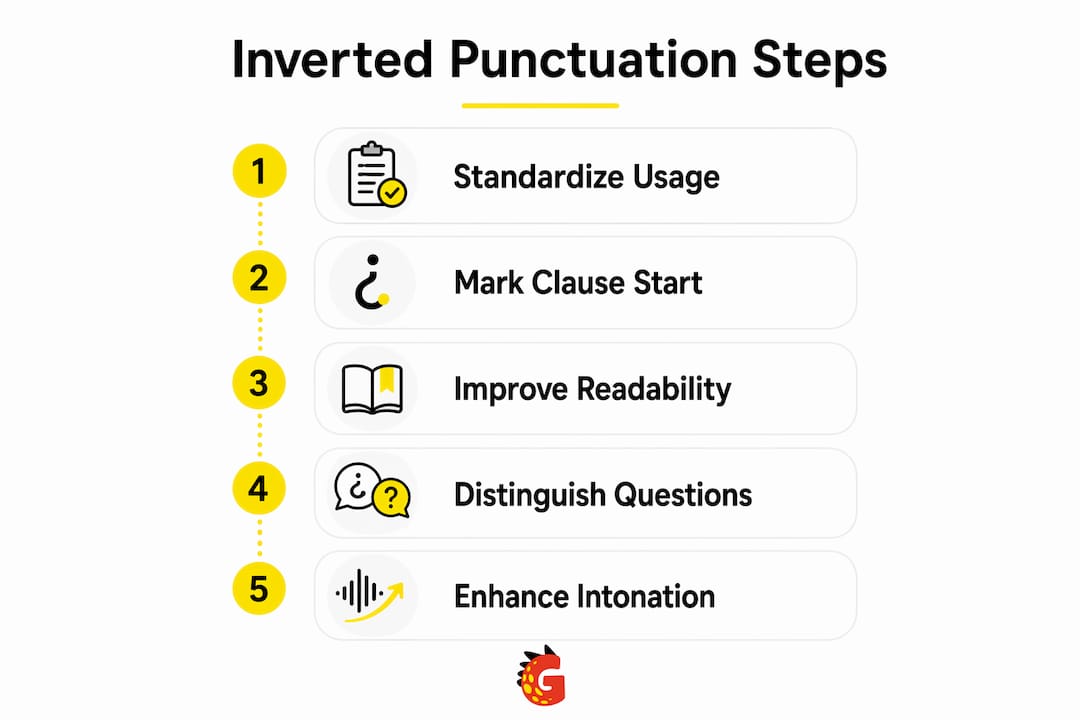
- Opening marks signal interrogative or exclamatory tone before you finish reading the sentence.
- They guide intonation when reading aloud, functioning like a musical key signature at the start of a phrase.
- The Real Academia Española made them mandatory in 1870 to standardize written Spanish.
- No other major Romance language uses this system, making it a defining feature of Spanish orthography.
Table of Contents
- How did inverted punctuation become part of Spanish?
- Why does Spanish grammar actually need these marks?
- How do you actually use inverted marks in modern Spanish?
- How inverted punctuation actually helps you read and speak Spanish
- Key Takeaways
How did inverted punctuation become part of Spanish?
The story behind Spanish inverted punctuation is more deliberate than most learners realize. It did not evolve organically over centuries. Someone proposed it, an institution adopted it, and eventually it became law for formal writing.
The 18th-century proposal
Before 1754, Spanish writers had no standard way to signal the start of a question or exclamation in writing. Readers would reach the end of a long sentence before discovering its tone, which created confusion, especially in complex prose. The Real Academia Española introduced inverted marks in the second edition of its Ortografía de la lengua castellana in 1754, recommending ¿ and ¡ as opening signals for interrogative and exclamatory sentences.
From recommendation to requirement
The Academy’s 1754 recommendation was advisory, not binding. Adoption was slow and inconsistent across Spanish-speaking regions. That changed in 1870, when the use of inverted marks became mandatory in formal Spanish writing. From that point forward, omitting the opening ¿ or ¡ was a grammatical error, not a stylistic choice.
A key moment in the timeline:
- 1754 - Real Academia Española recommends inverted marks in its Ortografía.
- 1870 - Inverted marks become mandatory in formal written Spanish.
- 20th century - Usage spreads across Latin America alongside Spanish literacy programs.
- Present - The RAE continues to govern placement rules for complex sentences.
“Upside-down punctuation is especially critical in Spanish since the syntax of the language means that both statements and questions or exclamations could have the same wording.” - Wikipedia on Spanish inverted punctuation
What makes this history striking is the contrast with Spanish’s closest linguistic relatives. Portuguese, Italian, Romanian, and French never adopted inverted marks, even though they face similar syntactic challenges. Spanish stands alone among major Romance languages in using this orthographic system, which reflects the Real Academia Española’s unusually prescriptive approach to standardizing written language.
Why does Spanish grammar actually need these marks?
The grammatical case for inverted punctuation is straightforward once you see the structural difference between Spanish and English. English builds interrogation into its syntax. Spanish does not, at least not always.
Spanish vs. English sentence structure
In English, you signal a question through word order or auxiliary verbs. “You like summer” becomes “Do you like summer?” The structural change is immediate and unambiguous. Spanish interrogative and declarative sentences often share identical word order, so “Te gusta el verano” works as both a statement and a yes/no question. The only written difference is punctuation.

| Feature | Spanish | English |
|---|---|---|
| Question word order | Often identical to statement | Subject-verb inversion or auxiliary verb |
| Opening question signal | ¿ before clause | No equivalent mark |
| Closing question signal | ? at sentence end | ? at sentence end |
| Exclamation opening signal | ¡ before clause | No equivalent mark |
| Other Romance languages | No inverted marks | N/A |
This table makes the core point visible. English readers get a structural signal from the grammar itself. Spanish readers historically got nothing until the final punctuation mark. The inverted opening mark solves that gap by acting as a syntactic boundary indicator, telling your brain immediately: this clause is a question or this clause is an exclamation.
The “heads-up” function
Linguists sometimes call this a “heads-up” punctuation feature, and the label fits. When you see ¿ at the start of a clause, you adjust your mental intonation model before processing a single content word. That adjustment matters most in long, complex sentences where a question is embedded inside a larger declarative structure. Without the opening mark, you would parse the whole sentence as a statement and then have to mentally reprocess it when you hit the ? at the end.
The RAE’s own guidance frames punctuation as a tool for organizing discourse and clarifying logical relationships, not merely marking intonation pauses. Inverted marks do exactly that: they draw a clear boundary around interrogative and exclamatory clauses within larger sentences, preventing the kind of structural ambiguity that would otherwise slow comprehension.
How do you actually use inverted marks in modern Spanish?
Knowing why these marks exist is one thing. Knowing exactly where to place them is where many learners stumble. The rules are precise, and the Real Academia Española is specific about placement.
Placement: clause, not sentence
The most common mistake is placing ¿ or ¡ at the very beginning of every sentence, regardless of structure. The correct rule is that inverted marks go before the interrogative or exclamatory clause, not necessarily at the sentence start.
Consider this example: “Si no puedes ir con ellos, ¿quieres ir con nosotros?” (“If you cannot go with them, would you like to go with us?”). The declarative clause “Si no puedes ir con ellos” comes first, without an opening ¿. The inverted mark appears only where the question actually begins.
Correct and incorrect placement at a glance:
- ✅ “Si no puedes ir con ellos, ¿quieres ir con nosotros?”
- ❌ “¿Si no puedes ir con ellos, quieres ir con nosotros?”
- ✅ “¡Qué sorpresa tan agradable!” (full exclamatory sentence)
- ✅ “Dime, ¿cuándo llegaste?” (“Tell me, when did you arrive?”)
- ❌ “¡Dime, cuándo llegaste!” (incorrect: the exclamation applies only to the question)
Typographic details worth knowing
The inverted marks are not simply flipped versions of their closing counterparts. The opening ¿ and ¡ descend below the text baseline, while the closing ? and ! sit on the baseline. This typographic distinction is easy to miss on a screen but matters in formal print and academic contexts.
| Mark | Position | Used at |
|---|---|---|
| ¿ (inverted question mark) | Descends below baseline | Clause opening |
| ? (standard question mark) | Sits on baseline | Clause/sentence end |
| ¡ (inverted exclamation mark) | Descends below baseline | Clause opening |
| ! (standard exclamation mark) | Sits on baseline | Clause/sentence end |
Combining marks for mixed tone
Spanish also allows nesting of inverted question and exclamation marks to express combined tones. When a sentence carries both surprise and interrogation, you can write ¿¡...!? or ¡¿...?!. The RAE governs these nesting rules precisely: the outer marks must match each other, and the inner marks must match each other. For example: “¡¿Y tú quién te crees?!” (“And who do you think you are?!”). Omitting the opening marks in formal or academic writing is a grammatical error with real consequences for clarity, particularly in business or professional contexts.
How inverted punctuation actually helps you read and speak Spanish
Understanding the rule is useful. Feeling why it works is what makes it stick for learners.
Reading fluency and intonation
When you read Spanish aloud, the opening ¿ or ¡ tells you immediately how to shape your voice for the entire clause. Without it, you would start reading in a neutral declarative tone and then have to shift register mid-sentence or at the end. That cognitive reset slows fluency. The inverted marks act as an emotional roadmap for the sentence, equivalent to the rising intonation a native speaker uses in speech before completing a question.
“Linguists describe inverted punctuation as a necessary reading guide that enables fluent interpretation, avoiding confusion due to identical sentence structures for statements and questions in Spanish.” - RAE linguistic insight
This is not a minor convenience. For learners working toward Spanish grammar fluency, recognizing inverted marks automatically is part of building the mental parsing speed that separates intermediate readers from advanced ones.
Common misconceptions to clear up
Many learners assume inverted marks always appear at the very start of a sentence. As the placement rules above show, that is only true when the entire sentence is a question or exclamation. In complex sentences, the mark appears mid-sentence, right before the interrogative or exclamatory clause begins.
Another misconception: that these marks are optional in casual or digital writing. Informal texts and social media often omit them, but that reflects a shift in register, not a change in the rule. In any formal, academic, or professional context, the RAE’s standard applies. If you are learning Spanish for work, travel, or real communication, training yourself to use and recognize these marks correctly is not optional - consider finding a quality Montessori school in Spain to immerse yourself in the language environment.
Pro Tip: When you encounter a long Spanish sentence in reading practice, scan for ¿ or ¡ first. Finding the opening mark immediately tells you where the question or exclamation begins, which helps you parse the sentence structure before you process the vocabulary.
Learners who want to build this kind of automatic recognition benefit from drilling it in context, not just reading about it. Gramanator’s grammar training approach targets exactly these structural patterns, training you to respond to punctuation cues the way a native speaker does, without stopping to think about the rule.
If you are ready to train Spanish grammar until it becomes instinct, Gramanator’s structured drills cover punctuation, syntax, and every other pattern that separates knowledge from real fluency.
Key Takeaways
Spanish uses inverted punctuation because its sentence structure makes questions and statements look identical in writing, and the opening ¿ and ¡ solve that ambiguity by signaling sentence type before you reach the end of the clause.
| Point | Details |
|---|---|
| Identical sentence structure | Spanish questions and statements often share the same word order, making opening marks necessary for clarity. |
| Formally adopted in 1754 | The Real Academia Española introduced inverted marks in its Ortografía and made them mandatory in 1870. |
| Placement follows the clause | Inverted marks go before the interrogative or exclamatory clause, not always at the sentence start. |
| Unique among Romance languages | Portuguese, Italian, French, and Romanian do not use inverted marks, making this a distinctly Spanish feature. |
| Supports reading fluency | Opening marks give readers an immediate intonation cue, improving comprehension and oral reading accuracy. |