Spanish Grammar for Heritage Speakers: A Real Guide
Spanish grammar for heritage speakers is defined by a unique linguistic profile shaped by early bilingual exposure, dominant English influence, and gaps in…

Spanish grammar for heritage speakers is defined by a unique linguistic profile shaped by early bilingual exposure, dominant English influence, and gaps in formal instruction. You grew up hearing Spanish at home, absorbing its rhythm and vocabulary naturally. But certain grammar structures, especially those acquired late in childhood, often develop differently when English dominates the school and social environment. Linguist Silvana Montrul’s research on heritage language acquisition identifies this profile as distinct from both native monolingual speakers and traditional second language learners. The result is a grammar foundation that is strong in some areas and genuinely underdeveloped in others. Understanding exactly where those gaps are is the first step toward closing them.
How does Spanish grammar differ for heritage speakers?
Heritage speakers carry what linguists call a “functional native baseline.” You understand Spanish intuitively, your pronunciation is often near-native, and your pragmatic instincts are solid. But key grammar gaps tend to cluster around late-acquired morphosyntactic structures: the subjunctive mood, complex sentence syntax, and formal academic register. These are not signs of failure. They reflect the timing and conditions of your early exposure, not your capacity to learn.
The heritage speaker profile differs fundamentally from a second language learner’s profile. An L2 learner builds Spanish from scratch using explicit rules. You already have an internalized grammar system. The goal is not to start over but to extend what you already know into registers and structures that your early environment did not fully develop. That distinction matters enormously for how you should study.

How does adverb placement differ for heritage speakers vs. monolinguals?
Standard Spanish follows a Subject-Verb-Adverb-Object (SVAO) word order in many constructions. For example, a native speaker naturally says “Juan come rápido la sopa” (Juan eats quickly the soup). Heritage speakers, influenced by English syntax, tend to shift toward Subject-Verb-Object-Adverb (SVOA) patterns, placing the adverb after the object instead.
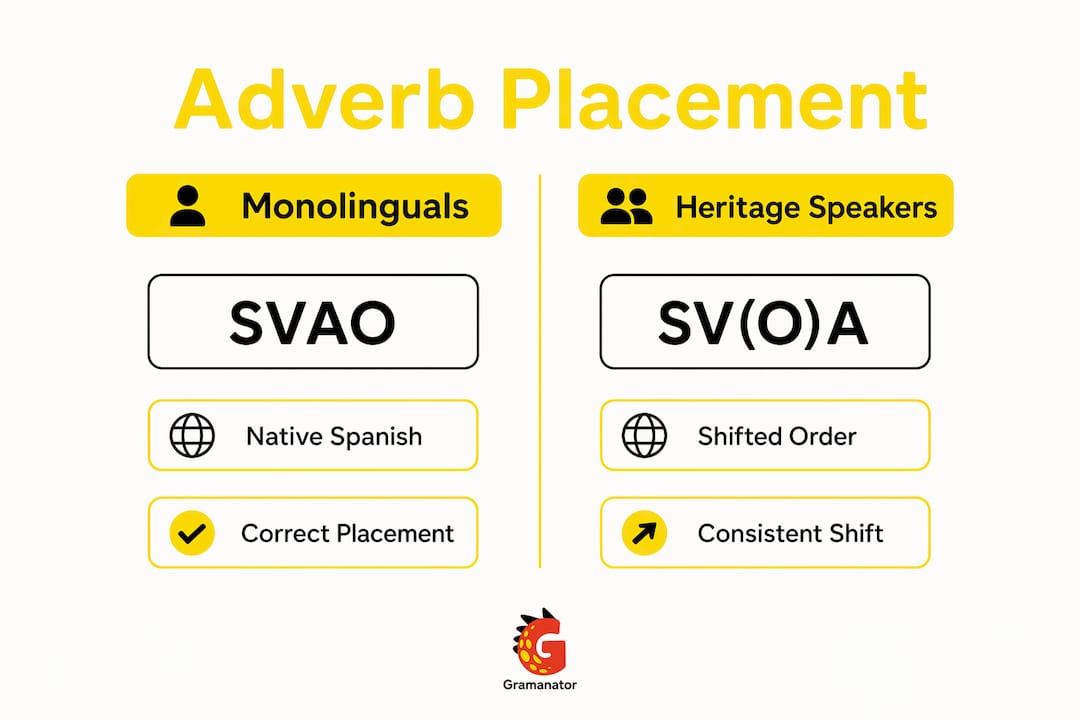
Research on adverb placement in heritage Spanish shows this shift is measurable and consistent. Adult heritage speakers favor SVOA placement at rates of 55-62%, while native-like SVAO use drops below 6%. That gap is not random. It reflects the deep structural pull of English, which defaults to SVOA order, on a bilingual brain processing Spanish.
The developmental path matters here. Children in heritage speaker households begin with patterns closer to native Spanish. As English dominance increases through schooling, the SVOA pattern gradually takes over. By adulthood, the native-like SVAO order has been largely displaced. This is called cross-linguistic influence, and it operates below conscious awareness.
| Adverb placement pattern | Who uses it | Example |
|---|---|---|
| SVAO (native Spanish) | Monolingual native speakers | “Juan come rápido la sopa.” |
| SVOA (English-influenced) | Adult heritage speakers (55-62%) | “Juan come la sopa rápido.” |
| SAVO (mixed) | Some heritage speakers | “Juan rápido come la sopa.” |
Pro Tip: Read Spanish news articles aloud and pay attention to where adverbs fall relative to the verb and object. Mimicking native-like SVAO patterns through repeated reading builds the instinct faster than memorizing a rule.
Why do heritage speakers underuse the Spanish subjunctive?
The subjunctive mood is one of the most discussed challenges in grammar for bilingual speakers. It requires recognizing triggers, selecting the correct form, and applying it consistently under real-time speaking pressure. That is a lot to manage simultaneously.
Reduced subjunctive use among heritage speakers stems from insufficient exposure during critical developmental windows, not from an inability to acquire the form. This is a crucial distinction. You are not missing the capacity. You missed the input volume at the right age.
Research comparing heritage speakers and L2 learners finds an interesting contrast. L2 learners select correct moods more consistently in formal and metalinguistic tasks, even though heritage speakers often outperform them in informal conversation. Heritage speakers show a productive-receptive dissociation: you can recognize correct subjunctive use but struggle to produce it reliably under pressure.
The good news is that the subjunctive is learnable at any age with the right approach. Here are the most effective strategies for strengthening it:
- Identify your triggers. Subjunctive follows specific verbs and conjunctions: querer que, esperar que, aunque, para que. Memorize these categories, not individual sentences.
- Practice in chunks. Drill common subjunctive phrases as fixed units: “Quiero que vengas,” “Es importante que estudies.” Chunk learning reduces the cognitive load of real-time production.
- Use substitution drills. Take one subjunctive frame and swap out the verb or subject repeatedly. This builds pattern recognition faster than translation exercises.
- Read formal Spanish. Newspapers, editorials, and literary fiction use the subjunctive far more than casual conversation. Exposure to formal written Spanish fills the input gap from childhood.
- Record yourself speaking. Playback reveals avoidance patterns. If you consistently rephrase to dodge the subjunctive, you now know exactly what to target.
Pro Tip: Create a personal “subjunctive trigger list” of the 10 phrases you use most often in conversation. Practice each one daily until the subjunctive form fires automatically, without conscious thought.
What cognitive and emotional factors shape heritage speaker grammar development?
Grammar production is not purely linguistic. It is also a cognitive and emotional act. Heritage speakers face a specific challenge that monolinguals do not: their bilingual brains require more cognitive resources to process complex Spanish grammatical structures than native speakers do. That higher cognitive load is not a personal weakness. It is a measurable feature of bilingual language processing.
What this means in practice is that complex structures like the subjunctive or embedded clauses demand more mental bandwidth from you than from a monolingual speaker. Under pressure, in fast conversation, or when tired, that bandwidth runs short. The result looks like a grammar error but is actually a resource allocation problem. Automatizing structures through repetition is the direct solution. When a pattern becomes automatic, it no longer competes for cognitive resources.
“Negative social experiences and feelings of ‘not being fluent enough’ create avoidance behaviors that actively hinder grammar acquisition. Validating heritage speakers’ existing phonological and pragmatic strengths is not just encouraging. It is a prerequisite for effective learning.”
Emotional dynamics in heritage language acquisition
Emotional factors play an equally real role. Heritage speakers frequently report feeling caught between two communities: not “Spanish enough” for native speaker circles and not “English enough” to ignore their heritage. That in-between feeling generates avoidance. You stop using formal Spanish because you fear making mistakes. Avoidance then deepens the gap. Recognizing this cycle is the first step to breaking it. Your phonological instincts, your cultural knowledge, and your pragmatic fluency are genuine strengths. Build from them.
How can heritage speakers advance their Spanish grammar skills?
Teaching grammar to heritage learners requires a fundamentally different approach than standard L2 instruction. Heritage speaker curricula should focus on extending existing linguistic competence toward formal registers, not on teaching Spanish from zero. This gap-filling model targets exactly the structures that early exposure left underdeveloped.
The most effective advancement path combines several elements:
-
Diagnose your specific gaps. Use a grammar weakness assessment to identify which structures you avoid or produce inconsistently. Subjunctive, formal syntax, and academic vocabulary are the most common targets for heritage speakers.
-
Prioritize formal register exposure. Read Spanish language newspapers, listen to Spanish podcasts on serious topics, and watch documentaries in Spanish. Formal input fills the register gap that home conversation alone cannot.
-
Use focused grammar drills. Passive exposure is not enough. Structured practice on specific patterns, with immediate feedback, builds the automaticity that lowers cognitive load during real conversation.
-
Seek heritage-specific instruction. General Spanish classes designed for L2 learners will bore you with content you already know and skip the formal register work you actually need. Look for courses or programs explicitly designed for heritage speakers.
-
Practice language exchanges with formal Spanish speakers. Conversation partners who use formal registers, including professionals, academics, or journalists, expose you to the syntax and vocabulary that formal Spanish demands.
-
Track your progress on weak structures. Reviewing your mistakes systematically, rather than moving on after each error, is what converts knowledge into instinct. Pattern recognition practice accelerates this process significantly.
Spanish language proficiency for heritage speakers is not about erasing your existing Spanish. It is about adding the formal layer that your early environment did not fully provide. That is a much smaller gap than it feels.
Key Takeaways
Heritage speakers already possess a strong informal grammar foundation; the real work is extending it into formal registers through targeted, structured practice.
| Point | Details |
|---|---|
| Heritage grammar is distinct | Heritage speakers have a unique profile, not a deficient one, shaped by early bilingual exposure. |
| Adverb placement shifts | Adults favor SVOA patterns at 55-62%, far from the native SVAO norm, due to English influence. |
| Subjunctive gaps stem from exposure | Reduced subjunctive use reflects insufficient early input, not inability to acquire the form. |
| Cognitive load is real | Heritage speakers expend more mental effort on complex grammar, making automatization the priority. |
| Instruction must be tailored | Gap-filling curricula targeting formal registers outperform standard L2 approaches for heritage learners. |
Grammar through the lens of a heritage speaker
Language educators who work with heritage speakers often point out that their challenges differ from those of traditional second-language learners. Heritage speakers typically arrive with strong pronunciation, natural listening skills, and deep cultural familiarity. These are significant linguistic strengths, even if formal grammar has not been fully developed.
One of the biggest misconceptions is comparing heritage speakers to either monolingual native speakers or classroom learners. In reality, they follow a different learning path and benefit from a different approach. The areas that tend to require the most attention - such as the subjunctive, formal writing, or academic vocabulary - are often skills that were never fully reinforced through formal education rather than abilities that were "lost."
Research on heritage language acquisition suggests that these gaps respond best to targeted, deliberate practice. Rather than reviewing grammar broadly, learners make faster progress by identifying the specific structures they avoid and practicing them repeatedly in meaningful contexts with immediate feedback. Consistent exposure and active production help transform passive knowledge into confident, accurate communication.
The Gramanator grammar blog explores many of these grammar patterns in depth, combining clear explanations with practical exercises that help reinforce them through repeated use. For heritage speakers, the goal is not to relearn Spanish - it is to strengthen the parts of the language that have had fewer opportunities to develop.
Patience matters as much as practice. Heritage speakers are not starting from the beginning. They are building on an existing foundation, refining their grammar, and completing a language they have known in different ways throughout their lives.
Gramanator and the heritage speaker grammar gap
Heritage speakers need more than vocabulary apps or casual conversation practice. The gap is structural, and closing it requires structured repetition on the exact patterns that formal Spanish demands.

Gramanator is built for exactly this kind of work. The platform offers 10,000+ grammar drills organized by structure and difficulty, with immediate feedback and mistake-focused repetition that builds automaticity over time. For heritage speakers targeting the subjunctive, formal syntax, or adverb placement, Gramanator’s Spanish grammar practice trains those patterns until they fire without conscious effort. The daily personalized workouts adapt to your weak areas, so you spend time on what actually needs work. If you are ready to move from informal fluency to formal command, Gramanator gives you the structure to get there.
FAQ
What is a heritage speaker in Spanish linguistics?
A heritage speaker is someone who grew up in a household where Spanish was spoken but received most of their formal education in English. They typically have strong informal fluency but gaps in formal grammar and academic register.
Why do heritage speakers struggle with the subjunctive?
Subjunctive gaps result from insufficient exposure during the critical developmental window in childhood, not from an inability to learn the form. Targeted practice can close this gap at any age.
How is teaching grammar to heritage learners different from L2 instruction?
Heritage learner instruction focuses on extending existing competence toward formal registers, while L2 instruction builds from zero. Heritage speakers need gap-filling curricula, not introductory language courses.
Do heritage speakers make more grammar errors because of lower ability?
No. Research shows heritage speakers expend higher cognitive effort during complex grammar production, meaning errors often reflect processing load rather than underlying ability.
Can heritage speakers reach native-like formal Spanish proficiency?
Yes. With targeted instruction focused on formal register, structured grammar drills, and consistent practice, heritage speakers can develop full Spanish language proficiency across both informal and formal contexts.