Spanish Legal Document Vocabulary Types: Adult Learner's Guide
Spanish legal documents fall into seven canonical types: documents for the application of law, normative texts, doctrinal texts, judicial texts,…

Spanish legal documents fall into seven canonical types: documents for the application of law, normative texts, doctrinal texts, judicial texts, jurisprudence/law reports, legal dictionaries, and informative legal texts. If you are an adult learner building practical Spanish skills, your highest-value focus is the first category. According to Traducción Jurídica, contracts, wills, and deeds constitute the majority of professional legal-translation work, which means they are the texts you are most likely to encounter in real life. The Real Academia Española (RAE) also confirms that legal Spanish preserves archaic grammatical forms, so recognizing those patterns before you meet them in a real document saves you real confusion. Gramanator’s structured grammar training, which runs from A1 to C1, is built to drill exactly those patterns until they become automatic.
- Priority 1: Documents for the application of law (contracts, wills, deeds)
- Priority 2: Normative texts (laws, decrees) and judicial texts (sentences, rulings)
- Priority 3: Doctrinal texts, jurisprudence/law reports, legal dictionaries, informative legal texts
Table of Contents
- What are the seven types of Spanish legal documents?
- Practical vocabulary for contracts, wills, and deeds
- How to read normative and judicial texts using structure templates
- A 6-week study plan for legal Spanish grammar
- How Gramanator trains the grammar legal Spanish demands
- Key Takeaways
- Build the grammar instinct legal Spanish requires
- Useful sources and further reading
What are the seven types of Spanish legal documents?
Each type has its own vocabulary register, structure, and purpose. Here is a compact reference with the key terms you need to recognize in each one.
Documents for the application of law (Documentos de aplicación del Derecho)
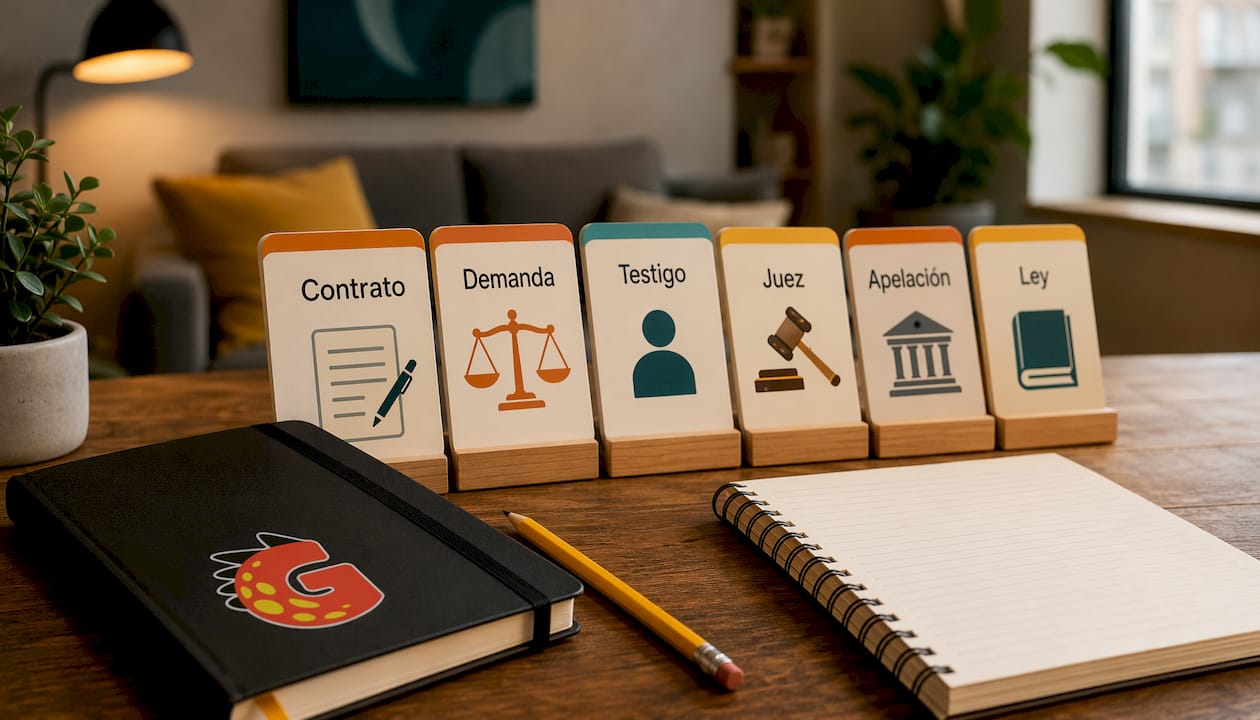
These are private legal acts between parties: contracts (contratos), wills (testamentos), and deeds (escrituras). They record the parties’ intentions and bind them legally.
| Spanish term | English gloss |
|---|---|
| las partes contratantes | the contracting parties |
| se hace constar | be it noted / it is hereby stated |
| sin perjuicio de | without prejudice to |
| a los efectos oportunos | for the relevant purposes |
| de esto doy fe | I hereby certify / I attest to this |
| otorgante | grantor / executing party |
| escritura pública | notarized public deed |
| cláusula resolutoria | rescission clause |
Normative texts (Textos normativos)
Laws, decrees, and regulations published in official gazettes like the Boletín Oficial del Estado (BOE). Every word carries legal weight, so summaries can be misleading.
- ley orgánica = organic law (constitutional-level statute)
- decreto-ley = decree-law (executive emergency legislation)
- articulado = body of articles
- disposición adicional = additional provision
- entrada en vigor = entry into force
- derogación = repeal
Judicial texts (Textos judiciales)
Court documents: sentences (sentencias), summons (citaciones), and orders (autos). The sentence is the most common type you will encounter.
- encabezamiento = header (parties, judge, date)
- fallo = ruling / operative part
- fundamentos de derecho = legal grounds
- antecedentes de hecho = background facts
- recurso de apelación = appeal
- providencia = procedural order
Doctrinal texts (Textos doctrinales)
Academic commentary and legal analysis written by jurists. Unlike normative or judicial texts, these use humanistic, less formulaic prose. Treat them as interpretation, not binding law.
- comentario jurídico = legal commentary
- monografía = monograph
- índice de jurisprudencia = case-law index
- bibliografía = bibliography
Jurisprudence / law reports (Jurisprudencia)
Collections of court decisions compiled into official reporters. Useful for understanding how courts apply statutes.
- repertorio de sentencias = law reports
- doctrina jurisprudencial = case-law doctrine
- Tribunal Supremo = Supreme Court
- ratio decidendi = the binding legal reason for a decision
Legal dictionaries (Diccionarios jurídicos)
Reference tools that define technical terms. Cross-cutting terms that appear across all types include nulidad (nullity), prescripción (statute of limitations), and legitimación (legal standing).
Informative legal texts (Textos divulgativos)
Law magazines, legal news sites, and public-facing guides. These use simplified language and are a good starting point before tackling originals.
Practical vocabulary for contracts, wills, and deeds
These documents are where your reading skills pay off fastest. Notarial documents are built around six predictable elements: reception of the parties by the notary, date and locality, identification of the parties, transaction-specific legal language, witnesses, and authentication. Once you know that structure, you can scan any deed efficiently.
Fixed formulas to learn as chunks
Spanish legal prose relies heavily on fixed lexical formulas that function as single units of meaning. Learn these as whole phrases, not word by word:
- a tenor de lo dispuesto = pursuant to what is laid down
- en virtud de = by virtue of / pursuant to
- se pacta = it is agreed (passive-se construction)
- el/la compareciente = the appearing party
- por el presente instrumento = by this instrument
- queda sin efecto = is hereby void / has no effect
- en fe de lo cual = in witness whereof
Reading strategy for long clauses
Spanish legal sentences can run 60-80 words without a period. The fastest way through them is a three-step process:
- Find the main verb first. Ignore subordinate clauses on the first pass. The main verb tells you what the sentence actually does (grants, obliges, declares, revokes).
- Chunk subordinate clauses. Relative clauses introduced by el cual, los referidos, or quien are referential devices pointing back to a noun already named. Bracket them mentally and read the main clause first.
- Recognize nominalizations. Words like la resolución, la disposición, and la solicitud are nominalized verbs that carry the action. Spotting them quickly unlocks the sentence’s meaning.
Pro Tip: Never translate a legal formula word by word. “De esto doy fe” does not mean “of this I give faith” - it means “I hereby certify.” Learn the formula’s legal function, not its literal translation.
For multilingual contract work, this chunk-based approach also helps you find the correct cross-lingual equivalent rather than a false cognate.
How to read normative and judicial texts using structure templates
Normative text template
| Section (Spanish) | Function | Signal phrases to scan for |
|---|---|---|
| Título | Law’s name, number, date | Ley Orgánica, Real Decreto |
| Exposición de motivos | Intent and justification | visto que, a fin de, considerando |
| Articulado | Operative rules (Articles 1, 2...) | Artículo, se prohíbe, se establece |
| Disposiciones adicionales | Supplementary provisions | Disposición adicional primera |
| Disposición derogatoria | What the law repeals | queda derogado, sin efecto |
Judicial sentence template
| Section (Spanish) | Function | Signal phrases to scan for |
|---|---|---|
| Encabezamiento | Parties, judge, court, date | En la ciudad de, siendo Magistrado |
| Antecedentes de hecho | Background facts before the case | Primero, Segundo (numbered facts) |
| Fundamentos de derecho | Legal reasoning and case law cited | De conformidad con, según lo dispuesto |
| Fallo | The actual ruling | FALLO, condeno, absuelvo, estimo |
The Exposición de motivos in a law is interpretive, not binding. The fallo in a sentence is the only part that creates a legal obligation. Jump there first when you need the bottom line.
Pro Tip: Scan headings and the first main verb in each paragraph. In normative texts, operative verbs like “se prohíbe” or “se establece” signal the rule. In judicial texts, the word “FALLO” in capitals marks the ruling. Train yourself to spot these anchors before reading the full text.
Country variance is real but manageable. Spain uses Boletín Oficial del Estado; Mexico uses Diario Oficial de la Federación; Colombia uses Diario Oficial. Core section names and formulas stay consistent, but capitalization and ordering can shift.
A 6-week study plan for legal Spanish grammar
Weekly priorities
- Weeks 1-2: Fixed formulas and passive-se constructions. Build a flashcard deck of the 20 most common formulas from this article. Drill recognition, not production.
- Weeks 3-4: Nominalizations and relative pronouns (el cual, cuyo, los referidos). Practice subordinate clause chunking with real contract excerpts.
- Weeks 5-6: Document templates plus timed reading drills. Set a goal: parse the main verb in a 100-word clause within 30 seconds.
Practice methods
- Chunked reading: Cover the subordinate clauses and read only the main clause. Then uncover and re-read the whole sentence.
- Formula flashcards: One card per fixed phrase, with the legal function on the back (not a word-by-word translation).
- Dictation drills: Listen to a short clause read aloud, write it, then check against the original. This forces you to process the grammar, not just skim it.
- Error-focused repetition: When you misidentify a main verb or misread a passive-se construction, flag it and repeat that sentence type five more times.
Before you start, identify your grammar weaknesses so you know which weeks need extra time.
Pro Tip: Start with informative legal texts (law magazines, public-facing guides) before moving to originals. They use the same vocabulary in shorter, cleaner sentences. Once those feel easy, move to actual contracts or BOE articles.
How Gramanator trains the grammar legal Spanish demands
Legal Spanish has three grammar challenges that trip up even advanced learners: the future subjunctive (hubiere, fuere), passive-se constructions, and long subordinate periods. The RAE confirms these archaic forms survive in formal legal registers, which means you need to recognize them on sight, not produce them. Gramanator’s training is built for exactly this kind of recognition-first drilling.
Relevant Gramanator features for legal Spanish
- Structured drills (A1-C1): Verb-conjugation workouts that include subjunctive moods and formal register forms
- Subordinate-clause practice: Drills that train you to identify the main verb inside a complex sentence
- Passive-se recognition: Targeted exercises on agentless passive constructions common in contracts and laws
- Mistake-focused repetition: The platform flags patterns you miss and repeats them until they stick
- Timed grammar workouts: Build the reading speed you need for long legal clauses
Sample 20-minute legal Spanish session
You can run this on Gramanator today:
- 8 minutes: Passive-se recognition drills. Focus on se hace constar, se pacta, se establece in sentence contexts.
- 8 minutes: Subordinate-clause chunking. Practice spotting the main verb in sentences with el cual and a tenor de lo dispuesto.
- 4 minutes: Review flagged mistakes. Repeat any sentence where you misidentified the main verb or misread the passive construction.
This maps directly to the grammar-as-pattern approach that separates passive knowledge from real reading fluency.
Key Takeaways
Mastering Spanish legal document vocabulary types means learning fixed formulas as chunks, spotting main verbs fast, and drilling the passive-se and subjunctive patterns that define legal register.
| Point | Details |
|---|---|
| Start with application documents | Contracts, wills, and deeds make up most of real-world legal reading work. |
| Learn formulas as units | Phrases like se hace constar and sin perjuicio de have fixed legal meanings; never translate them word by word. |
| Use structure templates | Normative texts follow Title → Exposición de motivos → Articulado; judicial texts follow Encabezamiento → Antecedentes → Fundamentos → Fallo. |
| Drill recognition, not production | Future subjunctive and archaic relatives need recognition training only, per RAE guidance on formal registers. |
| Train with Gramanator | Gramanator’s passive-se and subordinate-clause drills build the automatic recall legal Spanish reading requires. |
Build the grammar instinct legal Spanish requires
Reading a Spanish contract or court ruling without grammar instinct means stopping at every clause to decode it. Gramanator trains the passive-se, subjunctive, and subordinate-clause patterns that legal texts depend on, through 10,000+ structured drills with immediate feedback and mistake-focused repetition.

You do not need to memorize rules. You need to train them until they are automatic. Start your free trial or view pricing plans and run your first legal-Spanish grammar workout today.
Useful sources and further reading
-
Traducción Jurídica: Los tipos de textos en la traducción jurídica - The industry-standard classification of the seven legal-text types, with the 80-90% professional-practice estimate for application documents.
-
BYU: Format of Notarial Documents - Detailed breakdown of the six structural elements in Spanish notarial records, including authentication phrases.
-
Elon.io: Legal Document Grammar (Spanish, Spain) - Practical grammar notes on passive-se, nominalizations, and fixed formulas with examples.
-
Real Academia Española (RAE) - Primary authority on archaic forms (future subjunctive, el cual relatives) that survive in legal register.
-
Junta de Andalucía: Los textos legales, jurídicos y administrativos (PDF) - Spanish-language teaching guide covering morphosyntactic and lexical features of legal texts.
-
Gramanator Blog - Grammar guides and drills covering verb conjugation, subordinate clauses, and pattern recognition for adult learners.
“Tener un esquema claro de los diferentes tipos de textos jurídicos te va a ser muy útil en tu trabajo de traducción.” (“Having a clear framework of the different types of legal texts will be very useful in your translation work.”) - Traducción Jurídica