Spanish Grammar: The Adult Learner's Complete Guide
Mastering Spanish grammar means getting five core systems right: noun gender and number agreement, verb conjugation across three classes, the indicative…

Mastering Spanish grammar means getting five core systems right: noun gender and number agreement, verb conjugation across three classes, the indicative versus subjunctive mood distinction, sentence structure fundamentals, and the pronoun and article system that ties everything together. These are not isolated rules to memorize. They are interlocking patterns that, once trained into automatic recall, let you speak without stopping to translate in your head.
Here is what every adult learner needs to know at a glance:
- Noun gender: Every Spanish noun is either masculine or feminine, and that gender determines the form of every article and adjective attached to it.
- Verb classes: All Spanish verbs belong to one of three conjugation classes based on their infinitive ending: -ar, -er, or -ir.
- Mood: The indicative mood states facts and reality. The subjunctive expresses wishes, doubts, and hypotheticals. Confusing them is one of the most common errors adult learners make.
- Word order: Spanish follows a Subject-Verb-Object pattern by default, but word order is more flexible than in English, especially for emphasis and questions.
- Pronouns and articles: Both agree with the noun in gender and number. Subject pronouns are often dropped entirely because the verb ending already carries that information.
None of this is beyond reach. The challenge is not understanding the rules. It is training your brain to apply them automatically under the pressure of real conversation.
How Spanish verb conjugation actually works
Spanish verbs are the engine of the language. Every verb belongs to one of three form classes, defined by its infinitive ending: -ar (like hablar, “to speak”), -er (like comer, “to eat”), or -ir (like vivir, “to live”). The ending you swap onto the verb stem tells your listener who is doing the action, when it happened, and what mood you are expressing. Spanish verbs carry up to 50 conjugated forms reflecting tense, aspect, mood, person, and number, which is why verb training deserves the most practice time of any grammar area.
The three main tenses you need first
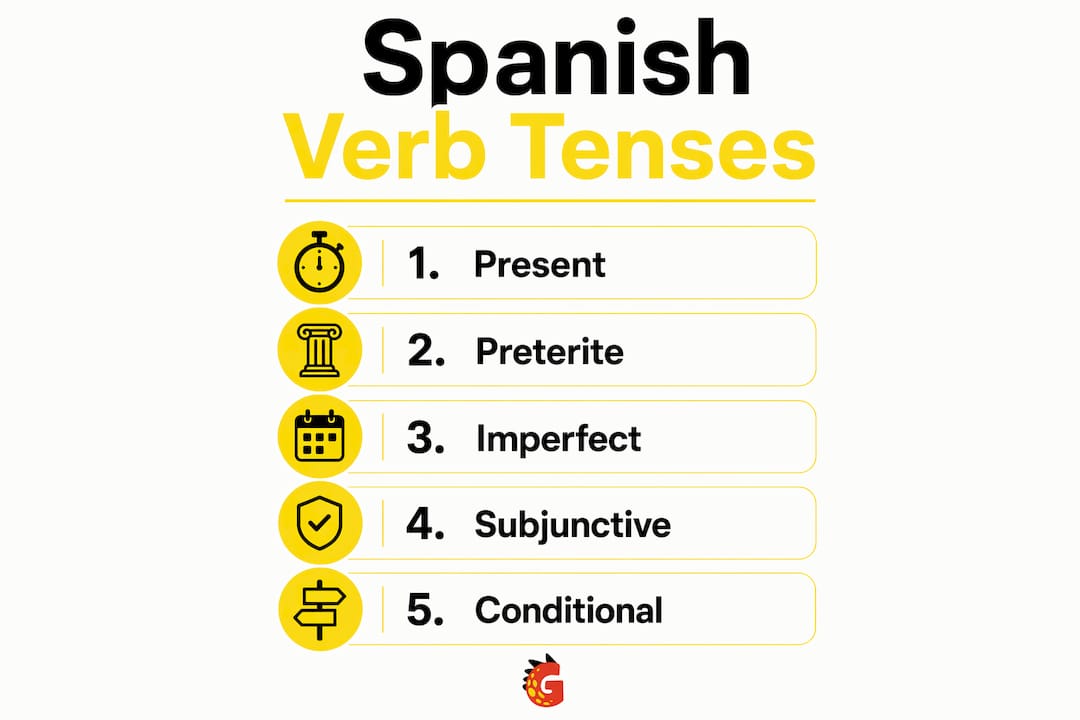
Present tense (presente de indicativo) covers actions happening now and habitual actions. Regular -ar verbs drop the -ar and add: -o, -as, -a, -amos, -áis, -an. So hablar becomes hablo, hablas, habla, hablamos, habláis, hablan.
Preterite (pretérito indefinido) expresses completed past actions with a clear endpoint. Hablar in the preterite: hablé, hablaste, habló, hablamos, hablasteis, hablaron.
Imperfect (pretérito imperfecto) describes ongoing or habitual past states. Hablar in the imperfect: hablaba, hablabas, hablaba, hablábamos, hablabais, hablaban. The preterite says “I spoke once.” The imperfect says “I used to speak” or “I was speaking.”
Regular versus irregular verbs
A large majority of Spanish verbs end in -ar and follow regular conjugation patterns, which means your early learning effort goes a long way. Once you internalize the -ar pattern, you have a template that covers the vast majority of verbs you will encounter. The -er and -ir classes are smaller but follow their own consistent patterns.
Irregular verbs are a different story. The most common ones, including ser (“to be”), estar (“to be”), ir (“to go”), tener (“to have”), and hacer (“to do/make”), do not follow the standard endings. They appear constantly in real speech, so they need dedicated repetition rather than pattern-based learning.
The subjunctive mood
The subjunctive is where many learners stall. The indicative mood expresses facts and reality, while the subjunctive expresses doubt, wishes, or hypotheticals. In English, the subjunctive is nearly invisible (“If I were you...”). In Spanish, it is a full conjugation system you use every day.
Compare these two sentences:
- Sé que hablas español. (I know you speak Spanish.) - indicative, stating a fact
- Quiero que hables más despacio. (I want you to speak more slowly.) - subjunctive, expressing a wish
The subjunctive present tense for -ar verbs uses the opposite vowel pattern from the indicative: hable, hables, hable, hablemos, habléis, hablen.
Modal verbs and expressions of obligation
Spanish uses several constructions to express obligation and necessity:
- Tener que + infinitive (“to have to”): Tengo que estudiar. (I have to study.)
- Deber + infinitive (“should/must”): Debes practicar cada día. (You should practice every day.)
- Hay que + infinitive (impersonal “one must”): Hay que conjugar bien. (One must conjugate correctly.)
These modal constructions are fixed patterns. Once you learn them, they slot into any sentence without additional conjugation complexity.
Pro Tip: When drilling verb conjugations, practice all six persons in one sitting rather than memorizing one person at a time. Your brain builds the full pattern faster when it sees the complete paradigm together.
How Spanish nouns, gender, and articles work together
Every Spanish noun has a gender. Always. There is no neutral option. Nouns are either masculine or feminine, and that gender and number agreement ripples through every article, adjective, and pronoun connected to that noun. Getting this right is not optional for clear communication.
Masculine and feminine noun patterns
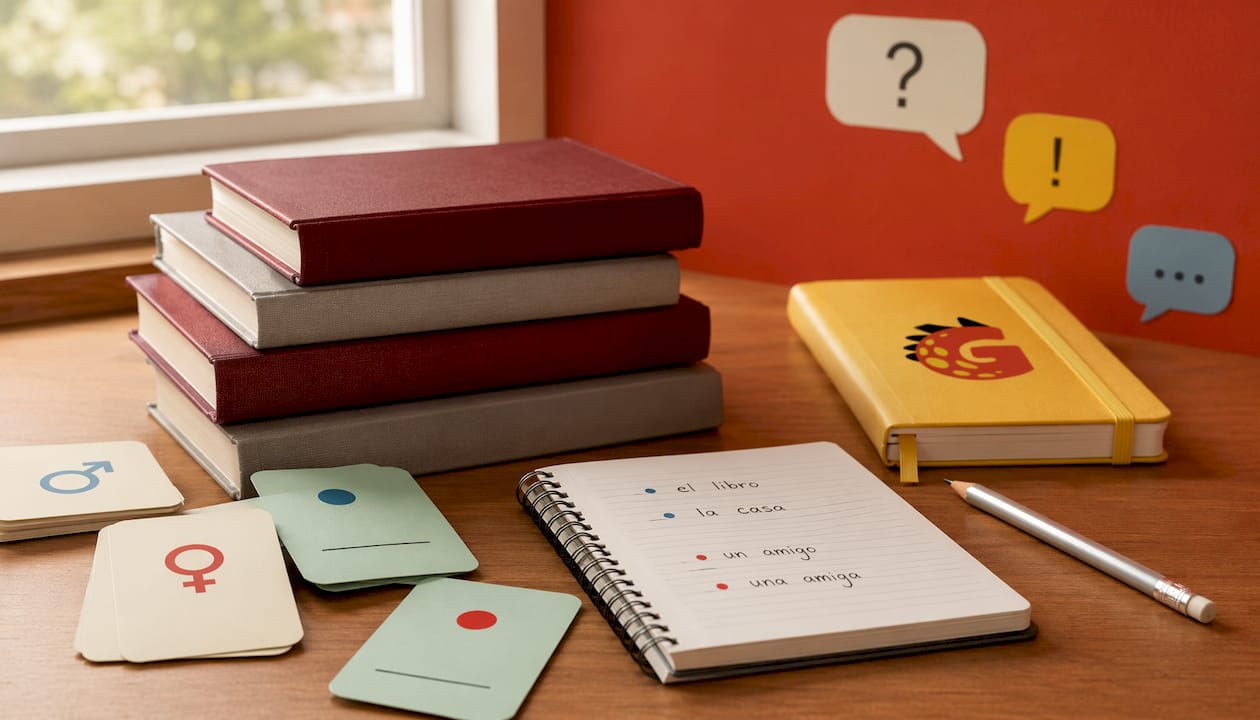
Most nouns ending in -o are masculine: el libro (the book), el banco (the bank). Most nouns ending in -a are feminine: la mesa (the table), la casa (the house). But there are enough exceptions that you cannot rely on the ending alone. El día (the day) is masculine despite ending in -a. La mano (the hand) is feminine despite ending in -o.
Some nouns change gender to indicate biological sex: el médico / la médica (male/female doctor), el estudiante / la estudiante (the student, where the article signals gender). Others have completely different words for each sex: el toro / la vaca (bull/cow).
Singular and plural forms
Forming plurals follows a clear rule. Nouns ending in a vowel add -s: libro → libros, mesa → mesas. Nouns ending in a consonant add -es: ciudad → ciudades (city/cities), papel → papeles (paper/papers). Nouns ending in -z change to -c before adding -es: lápiz → lápices (pencil/pencils).
Articles: definite and indefinite
Spanish articles agree with the noun in gender and number and exist in both definite and indefinite forms. Here is the full system:
| Masculine singular | Feminine singular | Masculine plural | Feminine plural | |
|---|---|---|---|---|
| Definite (“the”) | el | la | los | las |
| Indefinite (“a/some”) | un | una | unos | unas |
One important exception: feminine nouns that begin with a stressed a or ha sound use el in the singular to avoid a vowel clash. El agua (the water) is feminine, but takes el in the singular. In the plural, the regular feminine article returns: las aguas.
Spanish also uses the definite article in contexts where English drops it entirely. You say Me gusta el café (I like coffee), not Me gusta café. The article signals that you mean coffee as a general category.
Memory trick: Think of the article as a gender badge. Every time you learn a new noun, learn it with its article: not libro, but el libro. Not mesa, but la mesa. This habit locks in gender automatically.
- el perro (the dog, masculine)
- la perra (the female dog, feminine)
- los perros (the dogs, masculine plural)
- las perras (the female dogs, feminine plural)
How adjectives and sentence structure shape your Spanish
Adjective agreement is one of the first places learners make errors, and it is also one of the easiest to fix once you understand the rule. Spanish adjectives must match the noun they describe in both gender and number. An adjective describing a masculine singular noun takes a masculine singular form. Change the noun to feminine plural, and the adjective changes with it.
Adjective agreement in practice
Most adjectives end in -o in the masculine and -a in the feminine:
- un libro rojo (a red book, masculine singular)
- una casa roja (a red house, feminine singular)
- unos libros rojos (some red books, masculine plural)
- unas casas rojas (some red houses, feminine plural)
Adjectives ending in -e or a consonant typically do not change for gender, only for number:
- un estudiante inteligente / una estudiante inteligente (an intelligent student)
- unos estudiantes inteligentes / unas estudiantes inteligentes
Word order: where adjectives go
In English, adjectives always come before the noun. In Spanish, most descriptive adjectives follow the noun: una casa grande (a big house), not una grande casa. Placing the adjective before the noun is possible but changes the nuance, often adding a more literary or emphatic tone.
A small set of adjectives always precede the noun. These include quantity words like mucho (much/many), poco (little/few), and ordinal numbers like primer (first) and tercer (third).
Sentence structure and word order
Spanish sentence structure primarily follows Subject-Verb-Object, just like English. María come una manzana. (María eats an apple.) But Spanish allows more flexibility. You can front the object for emphasis: Una manzana come María. (It is an apple that María eats.) This flexibility is not random. It is driven by what information you want to highlight.
Questions in Spanish can be formed simply by raising your intonation on a statement, or by inverting the verb and subject: ¿Habla usted español? (Do you speak Spanish?) Inversion is common but not mandatory in everyday speech.
Pronouns: subject, object, and reflexive
Spanish pronouns fall into several categories, each with a specific grammatical role:
- Subject pronouns: yo, tú, él/ella, nosotros, vosotros, ellos/ellas (I, you, he/she, we, you all, they)
- Direct object pronouns: me, te, lo/la, nos, os, los/las (me, you, him/her, us, you all, them)
- Indirect object pronouns: me, te, le, nos, os, les (to me, to you, to him/her, etc.)
- Reflexive pronouns: me, te, se, nos, os, se (used when the subject and object are the same person)
Reflexive verbs are common in Spanish. Levantarse (to get up) conjugates as me levanto (I get up), te levantas (you get up), se levanta (he/she gets up). The reflexive pronoun always matches the subject.
Adverbs and negation
Spanish adverbs typically follow the verb they modify: Habla bien. (She speaks well.) When modifying an adjective or another adverb, they precede it: muy rápido (very fast). Many adverbs are formed by adding -mente to the feminine singular form of an adjective: rápida → rápidamente (quickly), clara → claramente (clearly).
Negation is straightforward. Place no directly before the verb: No hablo francés. (I don’t speak French.) Double negatives are grammatically correct in Spanish: No veo nada. (I don’t see anything, literally “I don’t see nothing.”) This is standard grammar, not an error.
Prepositions and their usage
Spanish prepositions are small but consequential. The most common ones include a (to/at), de (of/from), en (in/on), con (with), por (for/by/through), and para (for/in order to). The distinction between por and para trips up learners at every level. Por generally covers cause, exchange, and duration. Para covers purpose, destination, and deadlines.
- Estudio por dos horas. (I study for two hours.) - duration
- Estudio para aprender. (I study in order to learn.) - purpose
Pro Tip: Learn prepositions inside fixed phrases rather than in isolation. Phrases like “gracias por” (thanks for), “a tiempo” (on time), and “en casa” (at home) teach you the preposition’s behavior in context, which sticks far better than a definition alone.
Common Spanish grammar challenges and how to get past them
The hardest parts of Spanish grammar are not the ones with the most rules. They are the ones where your English instincts actively work against you. Adult learners often struggle less with the rules themselves and more with applying them under the cognitive load of real conversation. Knowing a rule and using it automatically are two completely different skills.
Ser versus estar: the most misunderstood distinction
Both ser and estar translate as “to be” in English, which is why learners find them so disorienting. The core distinction is this: ser describes identity and permanent characteristics, while estar describes states and conditions that can change.
- Soy médico. (I am a doctor.) - identity, use ser
- Estoy cansado. (I am tired.) - temporary state, use estar
- La sopa es caliente. (Soup is hot, as a characteristic.) - use ser
- La sopa está caliente. (The soup is hot right now.) - current state, use estar
A full breakdown of every ser and estar context is available in Gramanator’s ser vs estar guide, which covers the rules, exceptions, and the cases where both are grammatically correct but mean different things.
The DOCTOR mnemonic covers the main uses of ser: Description, Occupation, Characteristics, Time and dates, Origin, Relationships. The PLACE mnemonic covers estar: Position, Location, Action (progressive), Condition, Emotion.
Indicative versus subjunctive: the mood that has no English twin
The subjunctive mood has no real equivalent in modern English, which means you cannot rely on instinct to know when to use it. You have to train the pattern until it fires automatically. The subjunctive appears after expressions of:
- Wish or desire: Quiero que vengas. (I want you to come.)
- Emotion: Me alegra que estés aquí. (I’m glad you’re here.)
- Doubt or denial: Dudo que sea verdad. (I doubt it’s true.)
- Impersonal expressions: Es importante que practiques. (It’s important that you practice.)
The trigger is usually a change of subject across a que clause. If both clauses share the same subject, you use the infinitive instead: Quiero venir. (I want to come.) versus Quiero que vengas. (I want you to come.)
Pro-drop: when to leave out the subject pronoun
Spanish is a pro-drop language. Because the verb ending already tells you who is doing the action, subject pronouns are routinely omitted in natural speech. Hablo español means “I speak Spanish” without needing yo at the start. Including yo hablo español is not wrong, but it sounds emphatic or slightly formal, the way stressing “I” in English does.
Learners who always include the subject pronoun sound overly formal and unnatural. The fix is to practice listening to native speech and notice how often the pronoun disappears. Authentic language examples from real speech corpora are one of the most effective ways to train this instinct, because you hear the pattern in context rather than reading it in a textbook.
Applying grammar in real communication
The gap between knowing a rule and using it fluently is a cognitive one. Learners should integrate grammar as a tool for conveying meaning rather than treating it as a checklist to run through before speaking. The way to close that gap is through structured, repeated practice in realistic contexts, not more reading about the rules.
If you want to identify exactly where your grammar breaks down under pressure, Gramanator’s guide on finding grammar weaknesses fast walks through a research-backed diagnostic process that pinpoints the specific patterns holding you back.
Pro Tip: When you catch yourself making a grammar error in conversation, do not just move on. Mentally replay the sentence with the correct form before continuing. That brief self-correction loop accelerates the process of building automatic recall.
How to practice Spanish grammar so it actually sticks
Reading about grammar rules is the beginning, not the end. The research is clear: real-world context and authentic examples are what move learners from textbook knowledge to speaking fluency. Passive study builds recognition. Active, structured practice builds production.
Why repetition and timed drills work
Fluency is a performance skill. When you practice grammar under mild time pressure, you train your brain to retrieve patterns quickly, which is exactly what real conversation demands. Timed grammar workouts force you to stop consciously calculating and start reacting. That shift from deliberate processing to automatic recall is the whole goal.
Mistake-focused repetition accelerates this further. When a drill targets the specific patterns you consistently get wrong, you spend your practice time where it actually matters rather than reviewing what you already know.
What effective grammar practice looks like
Not all practice is equal. The most effective grammar exercises share a few characteristics:
- Immediate feedback: You know within seconds whether your answer was correct and why, so errors do not get reinforced.
- Real-life context: Sentences drawn from workplace situations, travel scenarios, and everyday conversations make the grammar feel purposeful rather than abstract.
- Spaced repetition of weak areas: Patterns you struggle with reappear more frequently until they become automatic.
- Integrated explanations: Grammar theory appears inside the practice session, not in a separate chapter you have to flip back to.
How Gramanator trains grammar into instinct
Gramanator is built around exactly this training model. The platform offers 10,000+ structured grammar drills organized from A1 to C1, with daily personalized workouts that adapt to your specific weak areas. Every session combines timed practice, immediate feedback, and grammar hints embedded in the exercise itself, so you are not just drilling blindly. You are building understanding and speed at the same time.

The real-life contexts built into Gramanator’s drills cover workplace communication, travel situations, and everyday interactions, which means the grammar you practice maps directly onto the conversations you actually want to have. Progress tracking shows you exactly which patterns are becoming automatic and which still need work.
If you are serious about turning grammar knowledge into speaking instinct, start training with Gramanator and experience what structured, performance-oriented grammar practice actually feels like.
The Gramanator Spanish grammar blog also offers detailed usage guides on the trickiest grammar points, from ser versus estar to noun phrase construction, so you always have a reference when a specific rule needs clarification.
Key Takeaways
Mastering Spanish grammar requires training verb conjugations, noun gender agreement, and the indicative versus subjunctive mood distinction through structured, context-rich practice until they become automatic.
| Point | Details |
|---|---|
| Verb conjugation scope | Spanish verbs carry up to 50 conjugated forms reflecting tense, mood, person, and number. |
| The -ar verb advantage | Over 80% of Spanish verbs end in -ar and follow regular patterns, giving beginners a strong early foundation. |
| Every noun in Spanish is either masculine or feminine, and that gender determines the form of every article and adjective attached to it. | |
| The indicative mood states facts and reality. The subjunctive expresses wishes, doubts, and hypotheticals, and has no direct English equivalent. | |
| Active practice beats passive study | Structured drills with immediate feedback and real-life context build the automatic recall that fluency depends on. |