Ways to Practice Spanish Grammar Daily and Build Fluency
Practical ways to practise Spanish grammar daily. Shadowing, journaling, and drills ranked by speaking impact for adult learners.


If you have ever studied Spanish grammar for months and still frozen up when someone speaks to you, you are not alone. The gap between knowing grammar rules and using them automatically is real, and it frustrates adult learners more than almost anything else. The good news is that the right ways to practice Spanish grammar daily can close that gap faster than you think. This article gives you a concrete preparation checklist, a structured daily routine, common pitfalls to avoid, and a way to measure whether your practice is actually working.
Table of Contents
- Key takeaways
- Ways to practice Spanish grammar daily: your starting point
- A structured daily routine for grammar practice
- Common mistakes that derail daily grammar practice
- How to measure your progress in Spanish grammar
- Why daily grammar practice works
- Train your grammar with Gramanator
- FAQ
Key takeaways
| Point | Details |
|---|---|
| Consistency beats duration | Daily sessions of 15 to 30 minutes outperform occasional long study marathons for grammar retention. |
| One rule per session | Focusing on a single grammar structure each day prevents overwhelm and builds deeper mastery. |
| Active production matters | Writing and speaking with new grammar locks it in far better than passive drills or reading alone. |
| Feedback closes the loop | Personalized correction from tutors or structured platforms accelerates the shift from knowledge to instinct. |
| Track and adjust | Regular self-testing and progress logs help you identify weak spots before they stall your progress. |
Ways to practice Spanish grammar daily: your starting point
Before you open a textbook or fire up an app, you need three things in place: the right tools, a realistic time commitment, and a mindset that works for you as an adult learner.
Gather the right resources
You do not need an overwhelming stack of materials. A solid reference grammar (such as Gramática en uso for intermediate learners), a notebook for writing practice, and one structured digital platform are enough to get started. The Gramanator blog is a good free source of grammar tips organized by level and topic. What you want to avoid is bouncing between five different apps because each one covers a different slice of the language without connecting them.
Set a time slot you will actually keep
Research consistently shows that 15 to 30 minutes daily produces better retention and fluency gains than sporadic longer sessions. For most adult learners, the best slot is the same time every day, right after an existing habit like morning coffee or a lunch break. Attach grammar practice to something you already do, and it becomes automatic much faster.
Shift your mindset about grammar
Here is the mindset shift that changes everything: grammar is a communication tool, not an academic subject. Grammar should be corrected during actual usage, not memorized in isolation first and applied later. That single shift explains why learners who drill conjugation tables for six months still stumble in conversation. You are training your brain to produce language, not pass a test.
Pro Tip: Focus your early sessions on high-frequency grammar structures. Applying the 80/20 rule to grammar study means that mastering the most common patterns covers roughly 80% of everyday conversation. Save the subjunctive mood of obscure verbs for later.
One practical rule: pick one grammar structure per session. If today is the preterite tense, stay there. Do not drift into the imperfect. Focused repetition on a single pattern builds deeper neural pathways than skimming across ten structures at once.
A structured daily routine for grammar practice
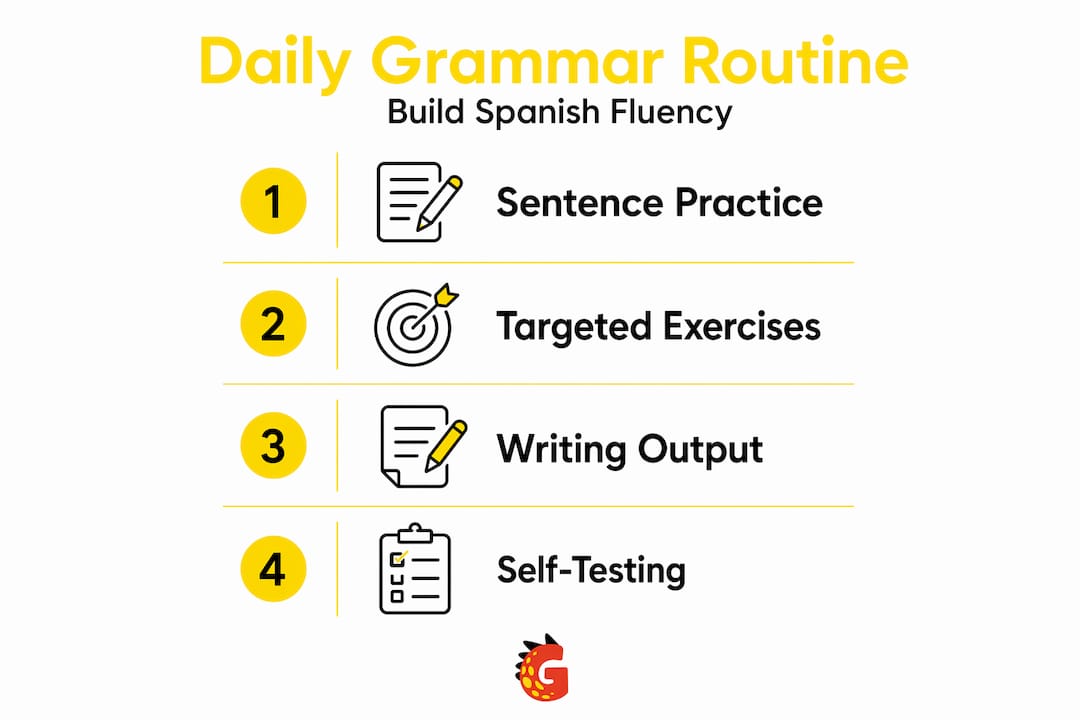
Structure is what separates learners who improve steadily from those who feel busy but stuck. Here is a repeatable daily routine built around active production.
-
Sentence repetition (5 to 10 minutes). Start by reading or listening to 5 to 10 example sentences that use your target grammar structure. Say each sentence out loud. Do not translate. The goal is to hear and feel the pattern, not analyze it. This primes your brain before active practice begins.
-
Targeted grammar exercises (10 to 15 minutes). Work through fill-in-the-blank drills, conjugation exercises, or sentence transformation tasks focused on your one rule for the day. Daily splits of sentence repetition and active production consistently lead to better long-term retention. Keep the exercises tied to real contexts, ordering food, describing your day, explaining a work situation, rather than abstract grammar sentences.
-
Writing practice (10 minutes). Write five to eight original sentences using the grammar you just drilled. Not copied sentences. Yours. This step is where passive knowledge starts becoming active. A short journal entry works perfectly here. Write about something that happened to you using the preterite, or describe your morning routine using reflexive verbs.
-
Speaking practice (5 to 10 minutes). Shadowing recorded native speech that uses your target structure is one of the most underused Spanish grammar practice tips out there. Find a short clip, shadow the sentences, then create your own. If you have access to a tutor or conversation partner, use this slot for a short speaking session. Learners who combine self-study with regular tutor sessions achieve fluency 40 to 60% faster than those studying alone, which makes this step worth investing in even once a week.
-
Spaced repetition review (5 minutes). End each session by reviewing grammar rules from 1 day ago, 1 week ago, and 1 month ago. Scheduled reviews at increasing intervals are what prevent you from forgetting rules you thought you had locked in. A simple flashcard system or notebook log works fine for this.
Pro Tip: Task-based grammar learning, where you use grammar to complete a real goal like writing an email or planning a trip, embeds understanding far better than isolated drills. Once a week, replace one drill session with a real-world task entirely in Spanish.
| Practice block | Duration | Activity type |
|---|---|---|
| Sentence repetition | 5 to 10 minutes | Passive input, spoken aloud |
| Targeted exercises | 10 to 15 minutes | Fill-in-the-blank, conjugation drills |
| Writing practice | 10 minutes | Original sentences, journaling |
| Speaking practice | 5 to 10 minutes | Shadowing, conversation, sentence creation |
| Spaced repetition review | 5 minutes | Review of past grammar rules |
The total comes to roughly 35 to 50 minutes. That is well within the range that research supports for sustainable daily practice, and it covers all four skills: reading, writing, listening, and speaking.
Common mistakes that derail daily grammar practice
Even motivated learners fall into traps that slow progress or kill consistency. Knowing what they are helps you sidestep them.
-
Treating grammar as memorization. Copying out verb tables or reading grammar explanations without producing a single sentence is a common early mistake. Knowledge of a rule does not mean you can use it. Production is what builds fluency.
-
Trying to tackle too many rules at once. Adults often want to cover everything quickly. But working on the preterite, imperfect, subjunctive, and conditional all in one week leads to confusion and nothing sticks. One rule, practiced deeply for several days, is worth far more.
-
Relying solely on apps. Apps are convenient, but apps alone lack the interactive feedback needed for fluency. Without real-time corrections, learners often reinforce their mistakes without realizing it. Use apps as a supplement, not your entire strategy.
-
Skipping speaking and writing. Many learners read and listen but never produce. Speaking and writing are where grammar gets tested in real time. If you are not creating sentences daily, you are not really practicing grammar.
Correction cycles involving immediate feedback from tutors or conversation partners are what enable moving from passive knowledge to active, correct usage. Writing or speaking daily with timely feedback is the fastest path from knowing a rule to using it automatically.
The fix for most of these issues is the same: add more output to your sessions, get feedback from someone who can correct you, and resist the urge to study a new rule before the current one feels natural. You can use resources like this guide on identifying Spanish grammar weaknesses to figure out exactly where your gaps are before you start.
How to measure your progress in Spanish grammar
Practicing daily without tracking your progress is like training at the gym without checking whether you are getting stronger. Here is how to verify that your effort is paying off.
-
Take short self-tests weekly. Pick a grammar rule you covered earlier in the week and quiz yourself without notes. Write ten sentences from memory. Check them against your reference grammar. The errors you make consistently are your next focus areas.
-
Record yourself speaking Spanish. Record a short two to three minute spoken response on any topic once a week. Listen back with your grammar rule in mind. Did you use it? Did you use it correctly? Hearing yourself on playback catches errors your brain skips over in real time.
-
Review your writing samples. Keep all your journaling entries in one notebook or document. Every two weeks, reread them. You will notice patterns in your mistakes and, importantly, patterns in your improvement.
-
Use a habit tracker. Mark every day you complete your practice. A simple calendar or habit tracking app works fine. Consistency over time is the strongest predictor of grammar improvement, and seeing your streak builds motivation.
-
Seek external feedback at least monthly. A tutor session once or twice a month specifically for grammar correction gives you perspective you cannot get from self-assessment alone. Ask your tutor to flag grammar errors during conversation, not just correct your vocabulary.
Learning to use Spanish grammar naturally and fluently rather than just formally is the long-term goal, and tracking your real speech samples is the most honest way to measure how close you are getting.
Why daily grammar practice works
Many language learners spend years studying Spanish yet still hesitate in everyday situations. In many cases, the issue is not a lack of knowledge but a lack of trained production. Learners may understand grammar concepts such as the preterite tense, but struggle to retrieve and use them quickly in real conversations.
Research on skill acquisition suggests that knowledge becomes usable only through repeated practice. Grammar follows the same principle. Short, focused sessions with immediate feedback are often more effective than occasional long study sessions. Writing sentences, checking mistakes, and correcting them helps transform grammatical knowledge into automatic responses.
Another common obstacle is waiting until feeling "ready" before speaking or writing. In practice, fluency develops through use, not preparation alone. Learners who begin producing language early-even imperfectly-tend to build confidence and accuracy faster than those who delay communication until they feel they know enough.
Grammar knowledge provides the foundation, but automatic retrieval is the real goal. The ability to use grammar naturally under real-world conditions develops through active production, feedback, and consistent repetition over time.
Daily practice does not need to be extensive. What matters most is regular exposure, deliberate correction, and the gradual reinforcement of correct patterns until they become instinctive.
Train your grammar with Gramanator

If you want a daily practice structure that does all of this for you automatically, Gramanator was built exactly for that. It is not a vocabulary app or a game. It is a Spanish grammar training platform that uses 10,000+ structured drills, real-life contexts, and mistake-focused repetition to turn grammar knowledge into automatic recall. Each session is personalized to your weak areas, so you are always working on what matters most. You get immediate feedback, integrated grammar explanations, and progress tracking that shows you exactly where you are improving. If you are serious about moving from studying Spanish to actually speaking it, Gramanator is the daily training environment that makes that shift happen.
FAQ
How much time should I spend on Spanish grammar daily?
Research supports 15 to 30 minutes of daily focused practice for optimal grammar retention. Shorter consistent sessions produce better long-term results than occasional two-hour study blocks.
What is the best method for practicing Spanish grammar daily?
Combining sentence repetition, targeted exercises, and original writing practice in one session gives you both comprehension and production. Adding speaking practice and weekly spaced repetition review locks in the patterns over time.
Should I use an app for daily Spanish grammar practice?
Apps are useful supplements but insufficient on their own for reaching fluency. Pair any app with writing, speaking, and personalized feedback for real progress.
How do I know if my Spanish grammar is actually improving?
Record yourself speaking Spanish weekly and review your writing samples every two weeks. Consistent self-testing and at least monthly tutor feedback give you the clearest picture of real progress.
How many grammar rules should I study each day?
Focus on one grammar rule per session. Practicing a single structure deeply across several days produces stronger recall and faster automaticity than covering multiple rules in a single sitting.