Present Subjunctive Spanish: A Practical Adult Learner's Guide
The present subjunctive in Spanish is defined as a verb mood that expresses desires, emotions, doubts, recommendations, and subjective attitudes rather than…

The present subjunctive in Spanish is defined as a verb mood that expresses desires, emotions, doubts, recommendations, and subjective attitudes rather than objective facts. Unlike the indicative mood, which states what is real, the subjunctive signals how a speaker feels about a situation. Mastering present subjunctive Spanish separates learners who sound textbook-correct from those who sound genuinely fluent. Two frameworks make this mood predictable: WEIRDO for triggers and DISHES for irregular verbs. Once you understand both, the subjunctive stops feeling random and starts feeling logical.
What triggers the present subjunctive in Spanish?
The WEIRDO framework covers approximately 80% of real-life subjunctive triggers. That single fact should relieve a lot of pressure. You do not need to memorize an endless list of rules. You need to recognize six categories.
Here is what WEIRDO stands for, with a real-life example for each:
- Wishes: “Quiero que vengas” (I want you to come). Any verb expressing desire triggers the subjunctive in the second clause.
- Emotions: “Me alegra que estés aquí” (I’m glad you are here). Feelings like joy, fear, and sadness all qualify.
- Impersonal expressions: “Es importante que practiques” (It’s important that you practice). Phrases like “es necesario que” and “es bueno que” fall here.
- Recommendations: “Te recomiendo que llegues temprano” (I recommend you arrive early). Advice and suggestions always trigger it.
- Doubt/Denial: “No creo que sea verdad” (I don’t think it’s true). Negating belief or expressing uncertainty flips you into the subjunctive.
- Ojalá: “Ojalá que llueva” (I hope it rains). This word always takes the subjunctive, no exceptions.
The connector “que” is your clearest signal. When you see or hear “que” after a WEIRDO trigger, the subjunctive follows in the next clause. Train yourself to pause at “que” and ask: is the speaker expressing a fact or a reaction? If it is a reaction, the subjunctive applies.
Pro Tip: Scan Spanish news headlines or song lyrics for the word “que.” Highlight every instance and ask yourself whether the clause that follows expresses a fact or a feeling. This habit builds trigger recognition faster than any drill sheet.

Understanding subordinate clause structures also helps you spot these triggers in longer, more complex sentences.
How do you form the present subjunctive?
The three-step method
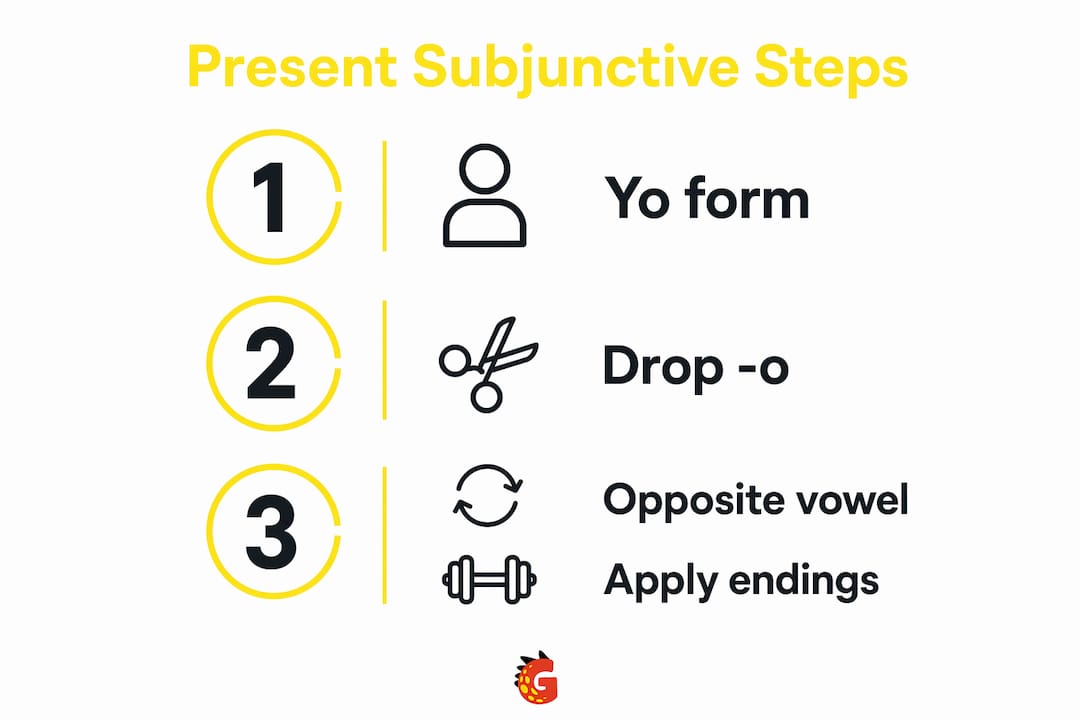
Standard present subjunctive conjugation follows a consistent three-step process across all regular verbs.
- Take the “yo” form of the present indicative (e.g., “hablo,” “como,” “vivo”).
- Drop the “-o” ending (→ “habl,” “com,” “viv”).
- Add the opposite vowel endings: “-ar” verbs take “-e” endings; “-er” and “-ir” verbs take “-a” endings.
| Pronoun | hablar (to speak) | comer (to eat) | vivir (to live) |
|---|---|---|---|
| yo | hable | coma | viva |
| tú | hables | comas | vivas |
| él/ella | hable | coma | viva |
| nosotros | hablemos | comamos | vivamos |
| vosotros | habléis | comáis | viváis |
| ellos/ellas | hablen | coman | vivan |
The “opposite vowel” rule is the anchor. “-ar” verbs switch to “-e,” and “-er/-ir” verbs switch to “-a.” Once that clicks, regular conjugation becomes automatic.
The DISHES irregulars
Six fully irregular verbs do not follow the yo-stem pattern. The mnemonic DISHES keeps them organized.
- D = Dar (to give) → dé, des, dé, demos, deis, den
- I = Ir (to go) → vaya, vayas, vaya, vayamos, vayáis, vayan
- S = Ser (to be) → sea, seas, sea, seamos, seáis, sean
- H = Haber (to have, auxiliary) → haya, hayas, haya, hayamos, hayáis, hayan
- E = Estar (to be) → esté, estés, esté, estemos, estéis, estén
- S = Saber (to know) → sepa, sepas, sepa, sepamos, sepáis, sepan
These six verbs appear constantly in everyday Spanish. Memorizing them as a group, rather than individually, saves significant time. You can also review how “ser” and “estar” behave in other contexts in this complete ser vs. estar guide.
Spelling changes and stem shifts
Several verbs require spelling adjustments to preserve pronunciation. The most common patterns are:
- “c” → “qu” before “-e” (buscar → busque)
- “g” → “gu” before “-e” (pagar → pague)
- “z” → “c” before “-e” (empezar → empiece)
Stem-changing “-ir” verbs also behave differently in the nosotros and vosotros forms. Stem-changing “-ir” verbs apply a weaker stem change in those two forms. For example, “dormir” (to sleep) becomes “durmamos” in nosotros, not “dormamos.” This partial shift trips up many intermediate learners.
Pro Tip: Group your stem-changing “-ir” verbs together when you study. Practice the nosotros form specifically, since that is the one most learners get wrong. A quick daily drill on just those forms builds the pattern fast.
What are the most common mistakes with the subjunctive?
The subject change rule
The subject change requirement is the most overlooked rule at the intermediate level. The subjunctive only appears when the subject of the main clause differs from the subject of the subordinate clause.
- Different subjects → subjunctive: “Quiero que tú estudies” (I want you to study). “Yo” wants; “tú” studies. Two different subjects, so the subjunctive applies.
- Same subject → infinitive: “Quiero estudiar” (I want to study). One subject does both actions. No subjunctive needed.
- Emotion + different subject → subjunctive: “Me alegra que ella venga” (I’m glad she is coming). The feeling belongs to “me”; the action belongs to “ella.”
- Emotion + same subject → infinitive: “Me alegra venir” (I’m glad to come). One subject, so use the infinitive.
Skipping this check is the single most common error adult learners make. Before you write or say a subjunctive clause, ask yourself: are there two different people or things involved? If yes, use the subjunctive. If no, use the infinitive.
Subjunctive versus indicative: certainty versus doubt
The choice between subjunctive and indicative often comes down to one question: is the speaker expressing a fact or a reaction? “Creo que es verdad” (I think it’s true) uses the indicative because the speaker leans toward certainty. “No creo que sea verdad” (I don’t think it’s true) uses the subjunctive because doubt enters the picture. The negation flips the mood entirely.
This pattern also applies to verbs of perception and knowledge. “Sé que viene” (I know he is coming) takes the indicative. “No sé si venga” (I don’t know if he might come) takes the subjunctive. The difference is not arbitrary. It reflects the speaker’s internal stance toward the information.
Pro Tip: When you are unsure which mood to use, ask yourself one question: “Am I stating a fact or expressing a reaction?” Facts take the indicative. Reactions, doubts, and wishes take the subjunctive. This single question resolves most confusion.
Learners who also struggle with conditional forms often make similar errors. A review of conditional tense mistakes can sharpen your instincts across both moods.
How do you use the subjunctive naturally in real conversations?
Moving from knowing the rules to using the subjunctive automatically requires active practice, not passive review. Mastery comes through active input and output. Noticing the subjunctive in real media and forcing daily use builds the automaticity that rules alone cannot create.
Here are the most effective strategies:
- Notice it in media. Watch Spanish films, listen to podcasts, and read news articles. Every time you hear or read a subjunctive form, pause and identify the trigger. This trains your ear before your mouth.
- Practice polite requests daily. Phrases like “Espero que tengas un buen día” (I hope you have a good day) or “Te recomiendo que pruebes esto” (I recommend you try this) appear in every real conversation. Drill these until they feel automatic.
- Write one subjunctive sentence per day. Pick a WEIRDO category and write one sentence using it. Rotate through all six categories across the week. This keeps practice varied and covers all trigger types.
- Focus on triggers, not conjugations. Recognizing whether a clause expresses a fact or a reaction makes the subjunctive predictable rather than arbitrary. Once you spot the trigger, the conjugation follows naturally.
- Speak before you feel ready. Native speakers prioritize meaning and emotional nuance over perfect subjunctive forms. Getting the trigger right matters more than a flawless ending.
Pro Tip: Record yourself speaking for 60 seconds each day on a topic that naturally involves opinions or wishes, like what you hope happens at work or what you recommend a friend do. Play it back and count how many subjunctive triggers you used. Increase the count each week.
Identifying your grammar weaknesses early helps you focus your practice time where it counts most.
Key Takeaways
The present subjunctive in Spanish becomes predictable once you learn to recognize triggers rather than memorize isolated rules.
| Point | Details |
|---|---|
| WEIRDO covers most triggers | Wishes, Emotions, Impersonal expressions, Recommendations, Doubt/Denial, and Ojalá account for the majority of subjunctive use. |
| Three-step formation method | Take the “yo” form, drop “-o,” and add opposite vowel endings to conjugate any regular verb. |
| DISHES for irregulars | Dar, Ir, Ser, Haber, Estar, and Saber are the six fully irregular verbs that must be memorized as a group. |
| Subject change rule | Use the subjunctive only when the subjects of the two clauses differ; use the infinitive when they are the same. |
| Active practice builds fluency | Noticing the subjunctive in real media and using it daily in speaking and writing creates automatic recall. |
Why the subjunctive clicked for me later than it should have
I spent two years treating the subjunctive as a grammar obstacle. I memorized conjugation tables, passed tests, and still froze every time I needed to use it in a real conversation. The problem was not the conjugations. The problem was that I was thinking about the form before I was thinking about the feeling.
The shift happened when I stopped asking “which ending does this verb take?” and started asking “what is this speaker actually expressing?” The subjunctive is not a grammar rule. It is a signal. It tells the listener that the speaker is expressing a reaction, not a fact. Once I internalized that, the triggers became obvious and the conjugations followed automatically.
The other thing I wish someone had told me earlier: errors in the subjunctive rarely cause misunderstanding. Native speakers read the emotional context of a sentence, not just the verb ending. If you say “Espero que viene” instead of “Espero que venga,” a native speaker understands you perfectly. They might notice the error, but the conversation continues. Accuracy matters, but communication matters more. Aim for both, but do not let the fear of imperfection stop you from speaking.
The learners who progress fastest are the ones who use the subjunctive imperfectly and often, not the ones who wait until they feel confident. Confidence comes from repetition, not from studying more tables.
- Daria
How Gramanator trains the subjunctive into instinct
Knowing the WEIRDO triggers and the DISHES irregulars is a strong start. Turning that knowledge into automatic recall requires structured repetition in real contexts. Gramanator is built exactly for that gap. The platform gives you 10,000+ grammar drills organized by level and pattern, including targeted practice on the subjunctive mood from basic triggers through advanced nuances. Each session combines immediate feedback, grammar hints, and mistake-focused repetition so you stop second-guessing yourself mid-sentence. If you are serious about making the subjunctive feel natural, not just correct, start training with Gramanator and build the instinct that real conversations require.
FAQ
What is the present subjunctive in Spanish?
The present subjunctive is a verb mood that expresses desires, emotions, doubts, recommendations, and uncertainty rather than objective facts. It contrasts with the indicative mood, which states what is real or certain.
How do you conjugate regular verbs in the present subjunctive?
Take the “yo” form of the present indicative, drop the “-o,” and add opposite vowel endings. Verbs ending in “-ar” take “-e” endings, and verbs ending in “-er” or “-ir” take “-a” endings.
What are the irregular verbs in the present subjunctive?
The six fully irregular verbs are Dar, Ir, Ser, Haber, Estar, and Saber, remembered by the mnemonic DISHES. These do not follow the standard yo-stem pattern and must be memorized individually.
When do you use the subjunctive instead of the infinitive?
Use the subjunctive when the subjects of the two clauses differ. When both clauses share the same subject, use the infinitive instead. For example, “Quiero que tú vengas” uses the subjunctive, while “Quiero venir” uses the infinitive.
How do you know when to use the subjunctive versus the indicative?
The subjunctive follows expressions of doubt, emotion, desire, or recommendation. The indicative follows expressions of certainty or fact. Negating a verb of belief, such as “no creo que,” switches the following clause from indicative to subjunctive.