Spanish Verbs in Past Tense: Preterite Made Practical
The Spanish preterite ( pretérito indefinido ) is the simple past tense for completed, bounded actions.

The Spanish preterite (pretérito indefinido) is the simple past tense for completed, bounded actions. Think of it as the tense that answers “what happened?” Regular verbs follow a clean, predictable pattern: drop the infinitive ending, then add the correct preterite ending based on verb type and person.
Here is your cheat sheet for regular preterite endings:
| Pronoun | -AR verbs | -ER / -IR verbs |
|---|---|---|
| yo | -é | -í |
| tú | -aste | -iste |
| él / ella / usted | -ó | -ió |
| nosotros | -amos | -imos |
| vosotros | -asteis | -isteis |
| ellos / ellas / ustedes | -aron | -ieron |
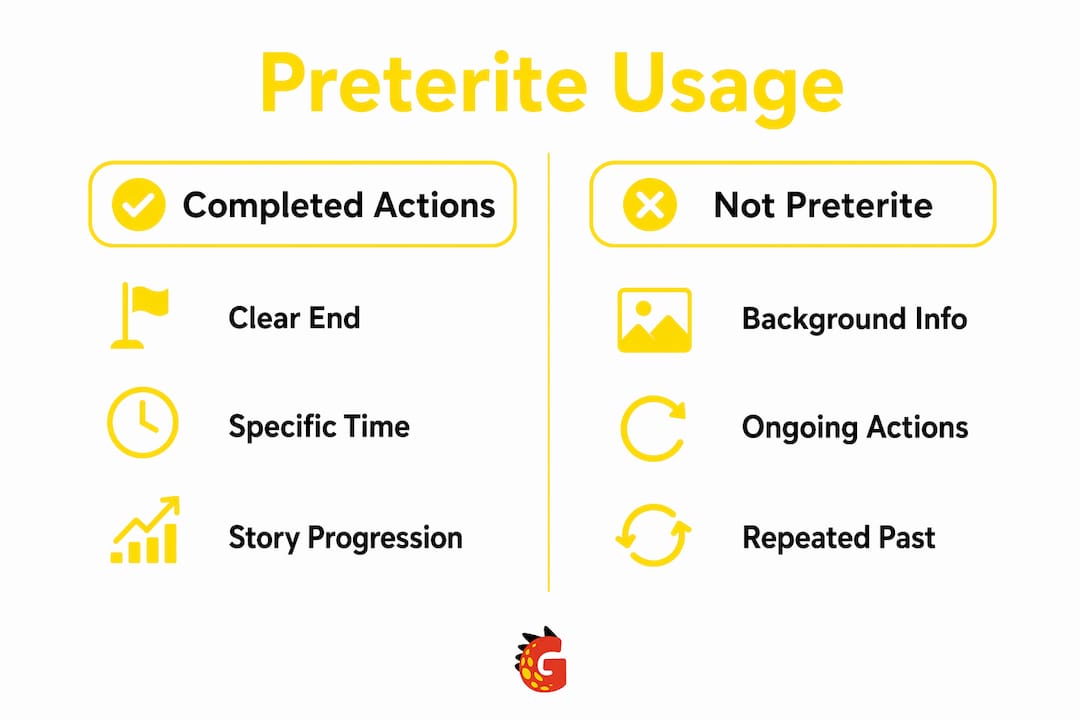
The one-line decision rule: if the action has a clear end or moves the story forward, use the preterite; if it sets the scene or describes a habit, use the imperfect.
The high-frequency irregulars you should memorize first: ser/ir (fui, fuiste, fue...), estar (estuve...), tener (tuve...), hacer (hice...), poder (pude...), and decir (dije...). These verbs appear constantly in real conversation, so getting them automatic early pays off fast. The Royal Spanish Academy (RAE) treats the preterite as one of the two core simple past tenses in Spanish, alongside the imperfect. Gramanator’s targeted drills are built around exactly these high-frequency forms, so you train the verbs that matter most.
Pro Tip: Memorize the six irregular stems above before touching any other irregular. They cover the majority of past-tense conversations you will actually have.
Table of Contents
- How to know when to use the preterite
- Conjugating regular -ar, -er, and -ir verbs in the preterite
- Irregular preterite patterns you can actually memorize
- Spelling changes and accent rules that trip learners up
- Preterite vs. imperfect: side-by-side examples
- Practice exercises with an answer key
- A 4-week plan to build automatic recall
- How to tell the tenses apart when you are confused
- Quick quiz: test yourself right now
- The other Spanish past tenses you need to know
- How to pronounce preterite endings correctly
- Key Takeaways
- Gramanator turns preterite knowledge into instinct
- Useful sources for further study
How to know when to use the preterite
The preterite covers four main situations: a single completed event (Ella llegó a las ocho - She arrived at eight), an action with a defined beginning or end, a sequence of past events, and an action that interrupts something ongoing. Certain time markers almost always signal the preterite:
- ayer (yesterday)
- anoche (last night)
- el lunes pasado (last Monday)
- una vez (once)
- de repente (suddenly)
- entonces (then / at that point)
When you see de repente or entonces in a sentence, the preterite is almost certainly the right call.
The narrative architecture rule: Preterite verbs are the story beats - the events that move the plot forward. Imperfect verbs are the scenery - the background states, habits, and ongoing conditions. Ask yourself: “Does this verb answer what happened next? (preterite) or what was the scene like? (imperfect).” Framing tense choice this way, rather than hunting for English keywords, is the approach recommended by language educators who work with adult learners.
The preterite and imperfect are the two main simple past tenses, but Spanish also has the present perfect (he hablado), the pluperfect (había hablado), and the past progressive (estaba hablando). Each fills a specific role, covered in a later section.
Conjugating regular -ar, -er, and -ir verbs in the preterite
The process is always the same: drop the infinitive ending, then add the preterite ending for the correct person.
Model verb: hablar (to speak) - -AR
| Pronoun | Form | Translation |
|---|---|---|
| yo | hablé | I spoke |
| tú | hablaste | you spoke |
| él / ella / usted | habló | he / she / you spoke |
| nosotros | hablamos | we spoke |
| vosotros | hablasteis | you all spoke |
| ellos / ustedes | hablaron | they / you all spoke |
Model verb: comer (to eat) - -ER
| Pronoun | Form | Translation |
|---|---|---|
| yo | comí | I ate |
| tú | comiste | you ate |
| él / ella / usted | comió | he / she / you ate |
| nosotros | comimos | we ate |
| vosotros | comisteis | you all ate |
| ellos / ustedes | comieron | they / you all ate |
Model verb: vivir (to live) - -IR
| Pronoun | Form | Translation |
|---|---|---|
| yo | viví | I lived |
| tú | viviste | you lived |
| él / ella / usted | vivió | he / she / you lived |
| nosotros | vivimos | we lived |
| vosotros | vivisteis | you all lived |
| ellos / ustedes | vivieron | they / you all lived |
One trap worth flagging: the nosotros form for regular -AR and -IR verbs looks identical in the present and preterite (hablamos, vivimos). Context is your only guide. For -ER verbs there is no overlap (comemos vs. comimos), so those are easier to distinguish.
On pronunciation: the accent marks on yo and él/ella/usted forms (hablé, habló) shift the stress to the final syllable. Without the tilde, hablo (present) and habló (preterite) sound different - the accent is doing real work, not just decoration.
Irregular preterite patterns you can actually memorize
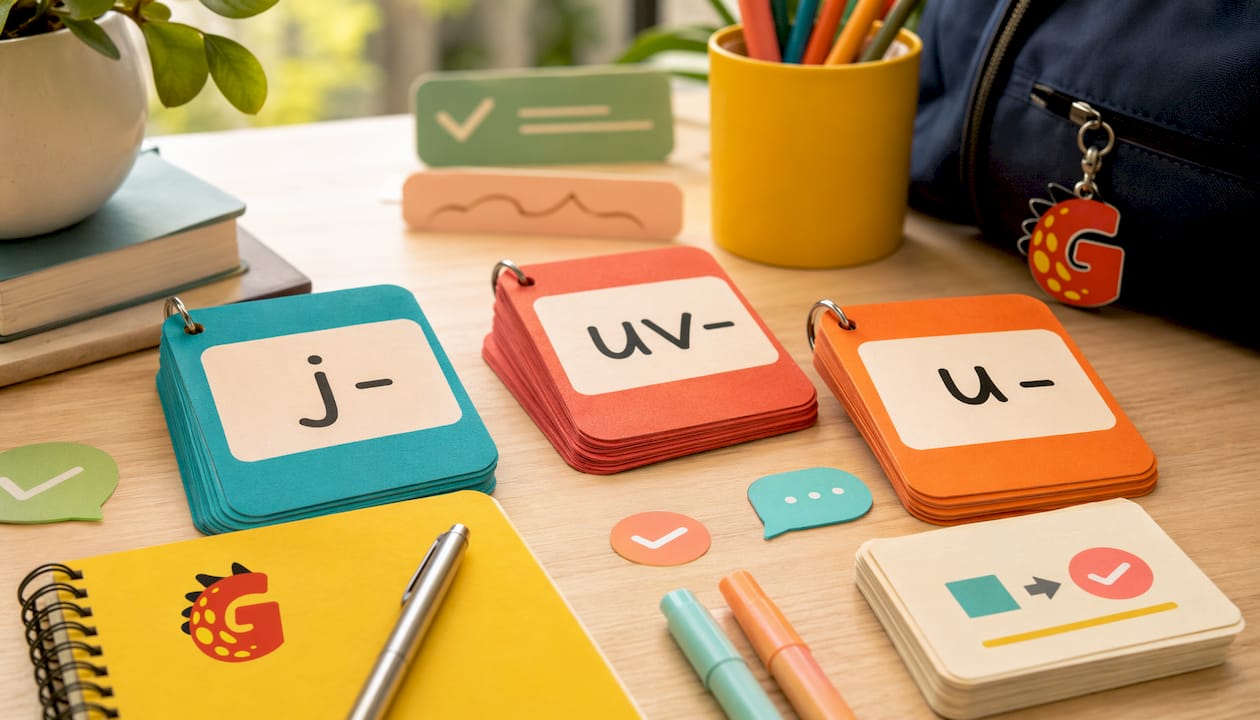
Rather than learning each irregular verb in isolation, group them by stem. Most irregular preterites share the same set of endings: -e, -iste, -o, -imos, -isteis, -ieron (no accent marks on yo or él forms - that is a key difference from regular verbs).
Here are the four main irregular stem groups:
| Stem group | Verbs | Yo form | Stem |
|---|---|---|---|
| uv- | andar, estar, tener | anduve, estuve, tuve | anduv-, estuv-, tuv- |
| u- | haber, poder, poner, saber | hube, pude, puse, supe | hub-, pud-, pus-, sup- |
| i- | hacer, querer, venir | hice, quise, vine | hic-, quis-, vin- |
| j- | decir, traer, producir, traducir | dije, traje, produje, traduje | dij-, traj-, produj-, traduj- |
Ser and ir share identical preterite forms: fui, fuiste, fue, fuimos, fuisteis, fueron. Context tells you which verb is meant. Fui a Madrid (I went to Madrid) vs. Fui estudiante (I was a student).
Verbs ending in -ducir (producir, traducir, conducir) follow the j- pattern: produje, traduje, conduje. The third-person plural drops the i from -ieron to give -eron: produjeron, not produjieron.
Memory trick: Group the uv- verbs together as “the UV club” - andar, estar, tener all get that distinctive uv in the stem. Once you know estuve, the pattern for tuve and anduve clicks automatically.
Spelling changes and accent rules that trip learners up
Certain spelling changes in the preterite are not errors; they are required to preserve the original pronunciation of the verb.
- -car verbs: the c changes to qu in the yo form to keep the hard-c sound before -é. Buscar → busqué; sacar → saqué.
- -gar verbs: the g becomes gu in the yo form. Llegar → llegué; entregar → entregué.
- -zar verbs: the z changes to c before -é. Empezar → empecé; cruzar → crucé.
These orthographic changes apply only to the yo form because that is the only preterite ending for -AR verbs that starts with e.
-UIR and -EER verbs have a different issue. When the preterite ending starts with a vowel and falls between two other vowels, the i changes to y in the third-person forms: construir → construyó, construyeron; creer → creyó, creyeron. The first and second persons keep the i but add an accent: creí, creíste.
Accent traps to watch:
- hablo (I speak, present) vs. habló (he/she spoke, preterite)
- tome (let me take, subjunctive) vs. tomé (I took, preterite)
- vi and vio (from ver) carry no accents - a deliberate exception in modern RAE orthography
Pro Tip: When proofreading your written Spanish, check the yo and él/ella/usted forms first. Those two are where accent errors most often change the meaning or tense.
Preterite vs. imperfect: side-by-side examples
These paired sentences show the contrast in action. Each pair uses the same verb or situation so you can feel the difference directly.
1. Single event vs. ongoing state
- Ayer llamé a mi madre. (Yesterday I called my mother.) - completed event, preterite
- Cuando era niño, llamaba a mi madre todos los días. (When I was a child, I used to call my mother every day.) - habitual habit, imperfect
2. Interrupted action
- Leía un libro cuando sonó el teléfono. (I was reading a book when the phone rang.) - imperfect for background, preterite for interruption
3. Sequence of events (narrative chain)
- Entré, saludé a todos y me senté. (I walked in, greeted everyone, and sat down.) - three preterite beats moving the story forward
4. Meaning shift: conocer
- Conocí a Ana en la fiesta. (I met Ana at the party.) - the beginning of knowing, preterite
- Conocía a Ana desde niño. (I had known Ana since childhood.) - ongoing familiarity, imperfect
5. Meaning shift: saber
- Supe la verdad ayer. (I found out the truth yesterday.) - the moment of discovery, preterite
- Sabía la verdad desde hace tiempo. (I had known the truth for a while.) - ongoing knowledge, imperfect
6. Meaning shift: querer
- Quise llamarte pero no pude. (I tried to call you but couldn’t.) - attempted action, preterite
- Quería llamarte. (I wanted to call you.) - desire without a defined outcome, imperfect
These meaning shifts are not really changes in the verb’s core meaning. The preterite frames the action as a beginning or end; the imperfect frames it as a middle with no defined boundary.
Practice exercises with an answer key
Fill in the blank - regular verbs
- Ayer yo ___ (hablar) con mi jefe. → hablé
- Ellos ___ (comer) en ese restaurante la semana pasada. → comieron
- Tú ___ (vivir) en México por dos años. → viviste
Fill in the blank - irregular stems
- Ella ___ (tener) que salir temprano. → tuvo (tuv- stem, u- group ending: -o)
- Nosotros ___ (decir) la verdad. → dijimos (dij- stem, j- group)
- Yo ___ (poder) terminar el proyecto. → pude (pud- stem, u- group)
Choose preterite or imperfect
- Cuando era joven, (vivía / vivió) en el campo. → vivía - habitual past state, no defined end
- De repente, (llovía / llovió) con fuerza. → llovió - sudden, bounded event signaled by de repente
- (Conocía / Conocí) a mi mejor amigo en la universidad. → Conocí - the moment of meeting, a beginning
A 4-week plan to build automatic recall
Knowing the rules is not the same as using them automatically. The gap between conscious recall and instinctive production closes through timed, repeated retrieval practice, not passive review.
Week 1 - Regular verb drills. Each day, pick one verb type (-ar, -er, or -ir) and run a 60-second conjugation burst: say or write all six forms as fast as you can. Track how many you complete correctly. By day 5, add a second verb type to the same drill.
Week 2 - Irregular stem groups. Focus on one stem group per day (uv-, u-, i-, j-). Write the yo form, then reconstruct the full paradigm from memory. Use spaced repetition to revisit error-prone forms the next day.
Week 3 - Mixed preterite drills. Combine regular and irregular verbs in 5-minute timed drills. Include at least two verbs from each stem group. Add a sentence-writing component: conjugate the verb, then use it in a sentence with a time marker (ayer, anoche, el lunes pasado).
Week 4 - Preterite vs. imperfect in context. Write three short paragraphs describing a past event. Aim for at least four preterite verbs and two imperfect verbs per paragraph. After writing, review each verb and ask: “Does this answer what happened? or what was the scene like?”
Metrics to track: conjugation speed (forms per minute), accuracy rate per stem group, and the number of accent errors per session. Logging your mistakes and drilling those specific forms the next day is the fastest way to close gaps. Gramanator’s grammar weakness identifier can help you pinpoint exactly which patterns need the most attention.
Pro Tip: Keep a running list of every verb you conjugate incorrectly. Drill those specific verbs at the start of each new session before moving to new material. Mistake-focused repetition is the fastest path to automatic recall.
How to tell the tenses apart when you are confused
The preterite, imperfect, present perfect, and pluperfect all describe the past, but each answers a different question.
Preterite vs. imperfect is the most common source of confusion. The cleanest test: could you replace the verb with “was doing” or “used to do”? If yes, imperfect. If the action happened once and finished, preterite. When both tenses appear in the same sentence, the imperfect usually sets the stage and the preterite delivers the event: Dormía cuando llegó. (I was sleeping when he arrived.)
Preterite vs. present perfect (he hablado): in Latin American Spanish, the preterite handles most completed past actions, including recent ones. In Spain, speakers often use the present perfect for actions connected to the present moment. For most learners in the United States studying Latin American Spanish, the preterite is the default for completed past actions.
Pluperfect (había hablado) describes an action completed before another past action: Ya había comido cuando llegaste. (I had already eaten when you arrived.) The preterite handles the second event; the pluperfect handles the earlier one.
Past progressive (estaba hablando) is the imperfect of estar plus a present participle. It emphasizes an action that was in progress at a specific past moment, similar to the English “was doing.” It functions like a more vivid version of the imperfect for ongoing actions.
Quick quiz: test yourself right now
Try these five items before checking the answers below.
- Translate: “She studied for three hours last night.”
- Fill in: Yo ___ (hacer) la tarea ayer.
- Choose: Cuando llegué, ella (leía / leyó) un libro.
- Translate: “We met the professor at the conference.”
- Fill in: Ellos ___ (traer) los documentos a la reunión.
Answers:
- Ella estudió tres horas anoche. - completed, bounded duration, preterite
- hice - i- stem group (hic-), yo form
- leía - ongoing background action interrupted by llegué
- Conocimos al profesor en la conferencia. - the moment of meeting, preterite of conocer
- trajeron - j- stem group (traj-), third-person plural
The other Spanish past tenses you need to know
Beyond the preterite and imperfect, three additional past tenses round out the system.
Present perfect (pretérito perfecto compuesto): formed with the present tense of haber plus a past participle. He hablado (I have spoken). In Spain, this tense often covers recent completed actions. In most of Latin America, the preterite takes that role instead.
Pluperfect (pretérito pluscuamperfecto): formed with the imperfect of haber plus a past participle. Había hablado (I had spoken). Use it for actions completed before another past action.
Past progressive (pretérito imperfecto progresivo): estaba plus a present participle. Estaba hablando (I was speaking). This tense highlights an action in progress at a specific past moment and pairs naturally with the preterite for interrupted-action sentences.
For a deeper look at how ser and estar behave across all these tenses, the ser vs. estar guide on Gramanator’s blog covers the contrasts in detail.
How to pronounce preterite endings correctly
Preterite endings have a consistent stress pattern that distinguishes them from present-tense forms, and getting this right matters for both speaking and listening comprehension.
Stress falls on the final syllable in the yo and él/ella/usted forms: ha-BLÉ, ha-BLÓ. The accent mark is your guide. In the present tense, stress falls on the second-to-last syllable: HA-blo. Train your ear to hear that shift.
The nosotros form is unstressed on the ending (ha-BLA-mos), which is why it sounds identical to the present tense. Context and time markers (ayer, la semana pasada) are the only disambiguation tools in spoken Spanish.
The -ieron ending in -ER and -IR verbs: the ie is a diphthong, pronounced as one syllable. Co-MIER-on, not co-mi-er-on. Learners who separate the vowels sound unnatural.
Irregular yo forms like hice, puse, vine are stressed on the first syllable: HI-ce, PU-se, VI-ne. This is the opposite of regular preterite stress and catches many learners off guard. Drill these forms aloud, not just on paper, until the stress pattern feels natural.
Key Takeaways
The preterite is the foundation of Spanish past-tense storytelling: master the regular endings and the four irregular stem groups, and you can handle the vast majority of past-tense conversations.
| Point | Details |
|---|---|
| Regular endings | -AR: -é, -aste, -ó, -amos, -asteis, -aron; -ER/-IR: -í, -iste, -ió, -imos, -isteis, -ieron |
| Decision rule | Preterite for completed events and story beats; imperfect for background, habits, and ongoing states |
| Irregular stems | Learn four groups: uv-, u-, i-, j-; irregular yo forms carry no accent mark |
| Spelling changes | -car/-gar/-zar verbs change spelling in the yo form to preserve pronunciation |
| Gramanator | AI-powered grammar drills with timed workouts and mistake-focused repetition for preterite mastery |
Gramanator turns preterite knowledge into instinct
Reading about conjugation rules is a start. Converting those rules into automatic, in-conversation recall is a different challenge entirely, and that is exactly the gap Gramanator is built to close.
Gramanator is an AI-powered Spanish grammar training platform for serious adult learners. It is not a vocabulary app or a casual review tool. It is a structured grammar gym where you train the patterns that real conversations depend on.
For past-tense practice specifically, Gramanator offers:
- Targeted preterite drills organized by verb type and stem group, so you build each pattern before mixing them
- Timed grammar workouts that push you toward automatic recall rather than slow, conscious conjugation
- Mistake-focused repetition that flags your specific error patterns and brings them back until they stick
Your first session includes an immediate feedback loop and a progress metric so you know exactly where you stand. Check the Gramanator pricing page to see the plan options, or go straight to Gramanator.com to start your first workout.
Useful sources for further study
- Gramanator Blog: Practical grammar guides, conjugation tips, and study strategies for adult learners; pairs naturally with the drills on the main platform.
- RAE (Real Academia Española): The authoritative source for official Spanish forms and regional usage. When you encounter a form that looks unusual or contradicts what a textbook says, consult the RAE’s Diccionario panhispánico de dudas for the definitive answer.