Build a Daily Spanish Grammar Practice Routine That Sticks
Build a Spanish grammar routine that lasts. A 15-minute daily plan for busy adults, with focus blocks for verbs, pronouns, and moods.

A daily Spanish grammar practice routine is a structured regimen of consistent, focused exercises that integrate active sentence production, targeted grammar topics, and spaced repetition to accelerate language fluency. Most adult learners already know this intellectually. The problem is that they study in bursts, skip days, and never build the automatic recall that real conversation demands. The good news: about 20 minutes per day, focused on one grammar topic at a time over three months, produces measurable progress. This article gives you the exact structure to make that happen, using tools like Anki, Gramanator, and spaced repetition scheduling to turn grammar knowledge into instinct.
What should your daily Spanish grammar practice routine focus on?
The single most common mistake adult learners make is treating grammar study like a reading assignment. You read the rule, feel like you understand it, and move on. That is passive study, and it does not build fluency. Active sentence production is what separates real progress from a permanent plateau.
The most effective approach is one targeted grammar topic per week, practiced through multiple original sentences every day. This means you are not jumping between the subjunctive, ser vs. estar, and object pronouns in the same session. You pick one structure, and you drill it from every angle until it starts to feel automatic.
Which grammar topics deserve your weekly focus?
Not all grammar topics are created equal. High-frequency structures give you the most return on your practice time. Here is a suggested rotation for adult learners at the A2 to B2 level:
| Week | Grammar Focus | Example Sentence |
|---|---|---|
| 1 | Present tense regular verbs | Yo trabajo en casa todos los días. (I work from home every day.) |
| 2 | Reflexive verbs for daily routines | Me despierto a las siete. (I wake up at seven.) |
| 3 | Preterite tense | Ayer comí en un restaurante. (Yesterday I ate at a restaurant.) |
| 4 | Ser vs. estar | Estoy cansado pero soy paciente. (I am tired but I am patient.) |
| 5 | Direct and indirect object pronouns | Te lo doy mañana. (I’ll give it to you tomorrow.) |
| 6 | Present subjunctive basics | Espero que vengas pronto. (I hope you come soon.) |
Reflexive verbs deserve special attention early in your routine. Practicing reflexive verbs as complete phrases like “Me despierto a las...” rather than isolated conjugations internalizes pronoun placement under real recall speed. That is the difference between knowing a rule and using it correctly mid-sentence.
Pro Tip: Write five original sentences using your weekly grammar focus every morning before you check your phone. This primes your brain with active production before the day’s distractions take over.
How to build a daily practice schedule that actually works
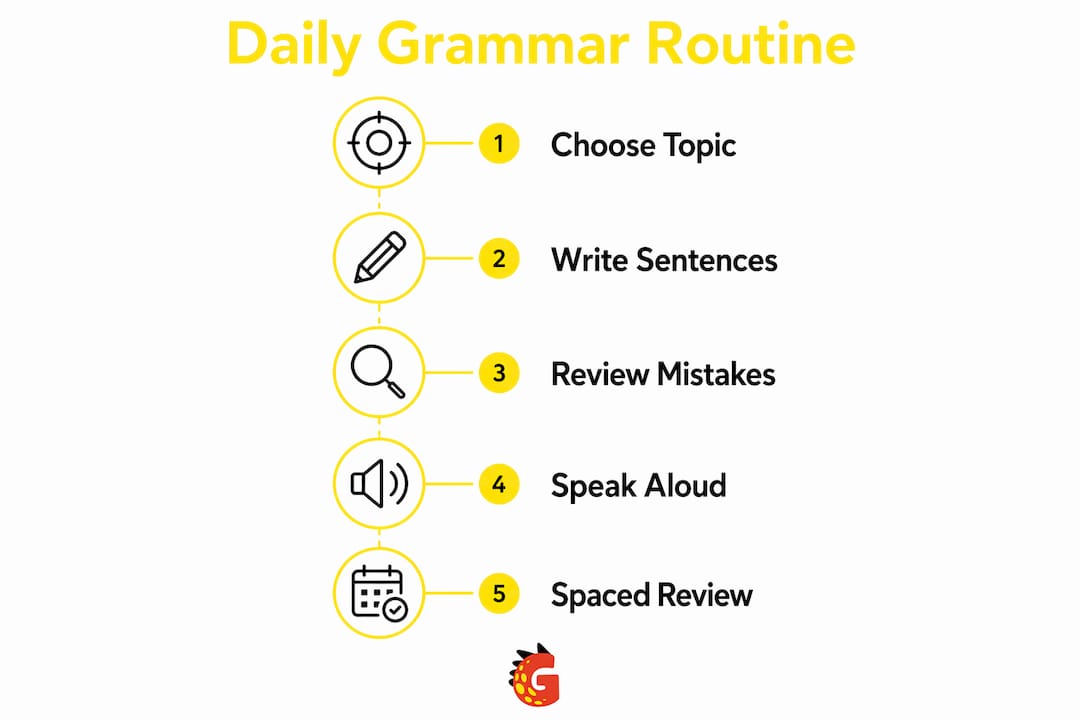
Structure matters more than duration. A 20-minute session with clear phases beats a 60-minute session where you drift between activities. Here is a proven daily structure for adult learners:
- Warm-up (3 minutes). Review yesterday’s sentences. Read them aloud and check for errors you missed the first time.
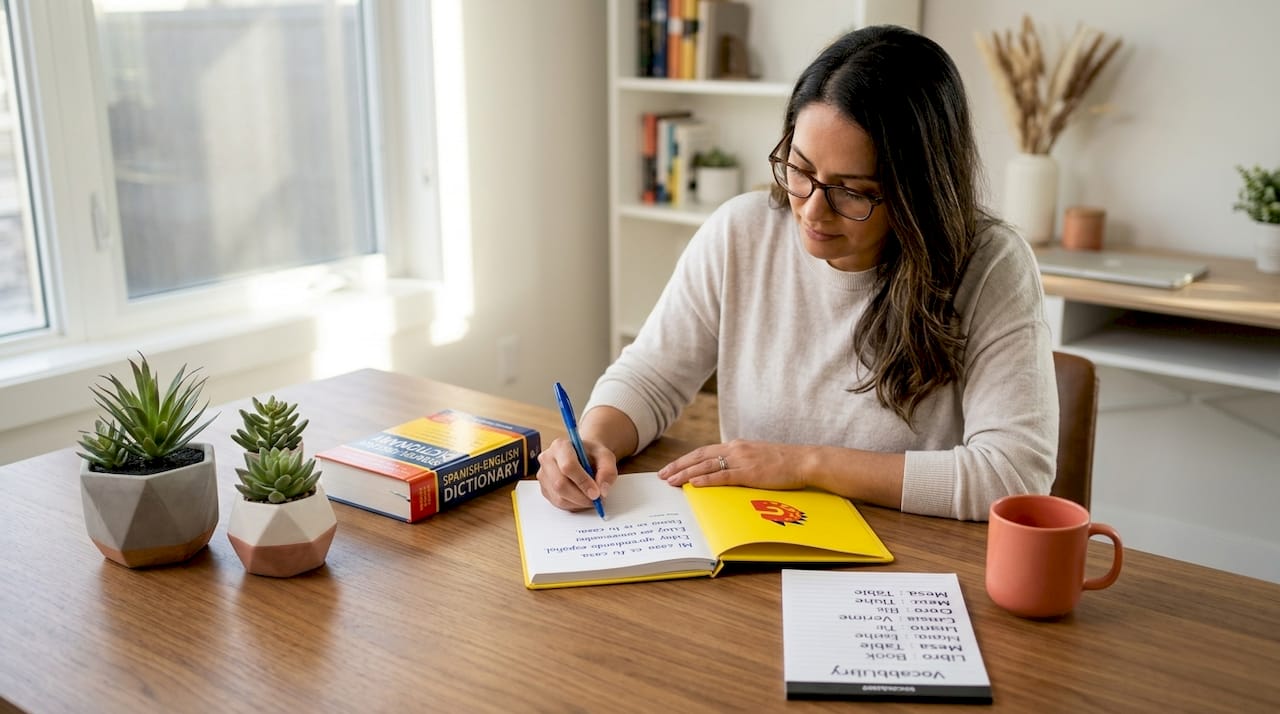
- Grammar drill (7 minutes). Write five to eight original sentences using your weekly grammar focus. Do not translate from English word for word. Build the sentence in Spanish from the start.
- Reading input (5 minutes). Read a short authentic Spanish text, a news headline, a recipe, or a social media post. Notice how your weekly grammar target appears in real writing.
- Speaking check (3 minutes). Say three of your written sentences aloud. If you hesitate or stumble, that structure needs more drilling. Hesitation is data.
- Flashcard review (5 minutes). Review spaced repetition cards for verb conjugations and grammar patterns. More on this in the next section.
Combining writing, reading, and speaking in a single session improves grammar internalization far better than passive study alone. Each channel reveals something different. Writing shows you what you know consciously. Reading shows you what patterns look like in context. Speaking shows you what you have truly internalized.
The short dialogue exercise is one of the most underused tools in adult Spanish learning. Once a week, write a five-line dialogue between two people using only your current grammar focus. Set it in a real scenario: ordering coffee, asking for directions, or discussing weekend plans. This forces you to use the structure in context rather than in isolation.
Pro Tip: Treat your daily practice session like a fixed appointment. Protecting that time is the simplest and most effective habit-formation strategy for language learners. Put it on your calendar and do not negotiate with yourself about skipping it.
What role does spaced repetition play in long-term grammar retention?
Spaced repetition is a study method that schedules review of material at increasing intervals based on how well you remember it. The stronger your recall, the longer the gap before the next review. This is not a new idea, but modern implementations like the FSRS (Free Spaced Repetition Scheduler) algorithm make it far more precise than traditional flashcard decks.
For Spanish grammar, spaced repetition with FSRS scheduling produces 200 to 300 percent better retention than traditional review methods. That is not a marginal improvement. It means you are spending less time reviewing and retaining far more.
Here is how to apply spaced repetition specifically to grammar practice:
- Cloze deletion cards work best for verb conjugation. Example: “Ayer yo _____ (comer) en casa.” You fill in comí. This forces active recall rather than recognition.
- Context sentence cards present a full sentence with one grammar element highlighted. You judge whether it is correct and why. This builds pattern recognition.
- AI-generated sentence cards from tools like Studyglen create contextual examples tailored to your level, so you are not drilling artificial sentences.
- Mistake-focused review means flagging cards you got wrong and reviewing them the next day regardless of the algorithm’s schedule. This is the insider trick: intentionally failing useful cards keeps them in your active review queue longer.
The optimal daily flashcard load is 15 to 25 new cards plus review, with the algorithm managing the review queue dynamically. Do not add more cards just because you feel confident. Consistency beats volume every time.
| Tool | Best For | Scheduling Method |
|---|---|---|
| Anki | Custom grammar decks, cloze cards | FSRS or SM-2 algorithm |
| Studyglen | AI-generated Spanish sentence cards | Adaptive spaced repetition |
| Gramanator | Structured grammar drills with feedback | Daily personalized workouts |
Gramanator sits in a different category from pure flashcard tools. Rather than reviewing isolated cards, it trains grammar patterns through structured drills with immediate feedback, which is closer to how you will actually use Spanish in conversation. The two approaches complement each other well. Use flashcards for vocabulary and conjugation recall, and use Gramanator for pattern-level grammar training.
How to troubleshoot common mistakes and stay on track
Even a well-designed routine breaks down over time if you are not monitoring your errors. The most common pitfalls for adult learners are predictable, and most of them are fixable.
- Forgetting reflexive pronouns. This is the most frequent error at the A2 to B1 level. If you write “Despierto a las ocho” instead of “Me despierto a las ocho,” your brain has not yet automated the pronoun. Add more cloze cards targeting reflexive structures and write extra sentences that day.
- Overusing “yo.” Spanish drops the subject pronoun in most contexts because the verb ending already signals the subject. Writing “Yo como, yo trabajo, yo vivo” sounds unnatural. Practice writing sentences without the explicit pronoun until it feels normal.
- Studying too many topics at once. Most learners over-plan and try to cover multiple grammar points in a single week. This creates the illusion of progress while preventing mastery of any single structure. One topic per week is not a limitation. It is the method.
- Skipping the speaking step. Writing and reading are easier to do quietly, so many learners cut the speaking component. Do not. Speaking reveals which structures you have truly internalized versus which ones you are still consciously constructing.
- Ignoring your grammar notebook. Keep a dedicated notebook or digital document where you log your weekly grammar focus, your original sentences, and your errors. Reviewing this once a week shows you patterns in your mistakes that no app will surface automatically.
Pro Tip: Once a month, go back and rewrite your first week’s sentences using everything you have learned since. The contrast between your early attempts and your current ability is one of the most motivating things you can do for yourself.
Feedback from a native speaker or a reliable tool accelerates error correction significantly. If you do not have access to a tutor, tools like Gramanator provide immediate feedback on grammar errors with explanations, which is the next best thing. You can also explore how to identify your grammar weaknesses systematically before building your weekly rotation, so you are targeting the gaps that matter most.
Key takeaways
A daily Spanish grammar practice routine works because it combines active sentence production, one focused grammar target per week, and spaced repetition to build automatic recall over time.
| Point | Details |
|---|---|
| One grammar topic per week | Focusing on a single structure with daily sentence practice builds mastery faster than covering multiple topics. |
| Active production over passive review | Writing and speaking original sentences every day is what converts grammar knowledge into fluency. |
| Spaced repetition for retention | Tools like Anki and Studyglen using FSRS scheduling produce 200 to 300 percent better retention than traditional review. |
| Reflexive verbs as complete phrases | Practicing “Me despierto a las...” as a whole phrase internalizes pronoun placement under real recall speed. |
| Protect your practice appointment | Treating your daily session as a fixed commitment is the most reliable habit-formation strategy for adult learners. |
Why consistency beats intensity every time
I have worked with adult Spanish learners long enough to notice a clear pattern. The ones who make the fastest progress are almost never the ones who study the hardest in any single session. They are the ones who show up every day, even when the session is short, even when motivation is low, and even when they feel like they are not improving.
The learners who burn out are usually the ones who treat grammar study as a sprint. They spend a weekend doing four hours of subjunctive drills, feel accomplished, and then do nothing for a week. That approach does not build automaticity. It builds familiarity, which is not the same thing.
What I find genuinely useful is integrating grammar practice into moments that already exist in your day. Review your flashcards while waiting for coffee to brew. Write your five daily sentences during your lunch break. Read a Spanish news headline before bed. These micro-sessions do not replace your main practice block, but they reinforce the patterns your brain is already working to consolidate.
The other thing worth saying directly: do not wait until your grammar is “good enough” to start speaking. Speaking is not the reward for mastering grammar. It is part of the training. Every time you hesitate mid-sentence, you are identifying a structure that needs more drilling. That hesitation is not failure. It is feedback. Use it.
You can read more about what natural grammar use actually looks like in native Spanish speakers, which gives you a clearer target to aim for as your routine matures.
- Daria
Take your grammar routine further with Gramanator
If you are ready to move beyond passive study and start training Spanish grammar like a real skill, Gramanator is built for exactly that.

Gramanator is a Spanish grammar training platform with 10,000+ structured drills, daily personalized workouts, and immediate feedback on every response. It covers grammar from A1 to C1 in real-life contexts including workplace conversations, travel situations, and everyday interactions. Every session targets your weak areas, explains your errors, and repeats the patterns you need most. It fits directly into the 20-minute daily routine described in this article. Start training Spanish grammar the way fluency actually works.
FAQ
How long should a daily Spanish grammar session be?
About 20 minutes per day focused on active sentence practice is effective for most adult learners. Consistency across days matters more than session length.
How many grammar topics should I study per week?
One grammar topic per week is the recommended approach. Focusing on a single structure with repeated sentence practice prevents overwhelm and builds genuine mastery.
What is spaced repetition and why does it matter for Spanish?
Spaced repetition schedules flashcard reviews at increasing intervals based on your recall strength. For Spanish grammar, it produces 200 to 300 percent better retention compared to traditional review methods.
Should I practice speaking even if my grammar is still weak?
Yes. Combining speaking with writing and reading reveals which structures you have truly internalized versus which ones you are still consciously constructing. Hesitation during speaking is useful diagnostic data.
What is the best way to track grammar progress?
Keep a grammar notebook logging your weekly focus, original sentences, and errors. Reviewing it weekly surfaces patterns in your mistakes that apps and tools typically do not highlight automatically.