Spanish Cultural Context Grammar: Your Fluency Guide
Understand how culture shapes Spanish grammar. Formality, regional tu/vos/usted, and mood choices that carry meaning beyond the words.


Spanish cultural context grammar is the system of grammar rules shaped by the social norms, regional identities, and communication values of Spanish-speaking communities. It goes far beyond conjugation tables and sentence structure. Understanding it means recognizing that the same grammatical form can signal respect, warmth, distance, or even offense depending on who you are talking to and where. With over 500 million speakers across dozens of countries, Spanish carries enormous cultural variation. Tools like Gramanator, AI tutors such as ChatGPT, and immersive media are helping adult learners engage with grammar in Spanish culture the way native speakers actually use it.
What is Spanish cultural context grammar and why does it matter?
Spanish cultural context grammar is best understood as socially embedded grammar. It is the recognized linguistic concept that grammar choices in Spanish are not neutral. They carry social meaning. When you choose between tú (informal you) and usted (formal you), you are not just picking a pronoun. You are signaling your awareness of the relationship, the setting, and the cultural expectations of the person in front of you.
Direct translation fails to capture the warmth and politeness embedded in culturally appropriate grammar. A sentence that sounds polite in English can come across as cold or even rude in Spanish if the wrong grammatical register is used. This is why learners who study grammar rules in isolation often sound technically correct but socially awkward.

The importance of Spanish grammar becomes clear when you see it as a social tool. Grammar encodes relationships. It reflects whether you are speaking to a boss, a close friend, a stranger on the street, or an elderly neighbor. Mastering these distinctions is what separates a textbook speaker from someone who genuinely connects with native speakers.
How does culture shape Spanish grammar and communication styles?
Spanish is a high-context language. Meaning depends heavily on the relationship between speakers and the social situation, not just the words themselves. Grammar reflects cultural values like respect, hierarchy, and warmth, and those values are baked directly into grammatical structures.
The clearest example is pronoun choice. In Spain, tú is casual and usted is reserved for formal situations. In many Latin American countries, usted is used affectionately between family members and close friends. In Colombia, for instance, a mother might address her child as usted as a term of endearment. Using tú in that context could feel abrupt or even disrespectful.
Here are the key ways culture directly influences grammatical choices in Spanish:
- Formality markers: The choice of tú, usted, or vos signals social distance or closeness.
- Verb mood: The subjunctive mood expresses doubt, desire, and emotion, all of which are culturally loaded concepts in Spanish communication.
- Word order flexibility: Spanish allows object-initial constructions for emphasis, which English speakers rarely use but which native speakers rely on for natural rhythm.
- Diminutives: Adding -ito or -ita to words (cafecito, momentito) softens requests and adds warmth. This is a grammatical choice with deep cultural roots.
- Nonverbal alignment: Grammar choices often mirror nonverbal cues. A formal grammatical register pairs with formal body language and vice versa.
Pro Tip: When you meet someone new in a Spanish-speaking context, default to usted until they invite you to use tú. Premature informality is one of the most common cultural missteps learners make, and it signals a lack of social awareness more than any grammar error.
How do regional differences affect Spanish grammar?
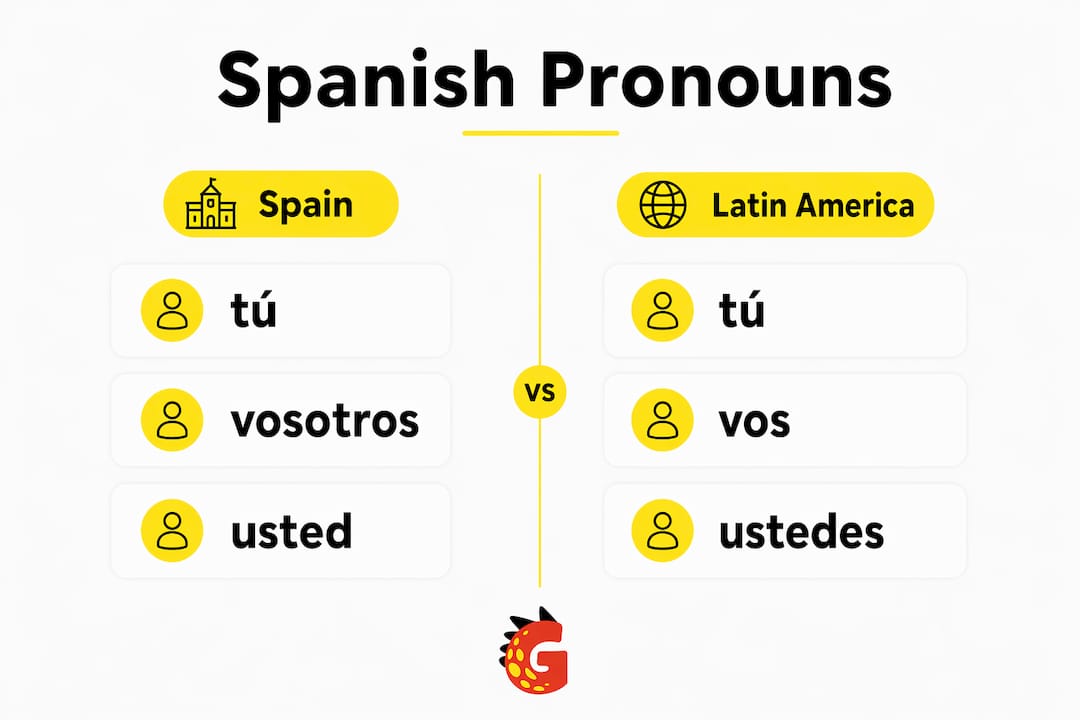
Regional grammatical variation is one of the most practical aspects of cultural context grammar for learners to understand. Spain and Latin America do not just sound different. They use different grammatical structures in everyday speech.
The most significant structural difference involves the second-person plural pronoun. Spain uses vosotros for the informal plural “you,” while Latin America uses ustedes for both formal and informal plural address. This means an entire set of verb conjugations (habláis, tenéis, sois) that Spanish textbooks teach are essentially unused across most of the Spanish-speaking world.
The pronoun vos adds another layer. Used in Argentina, Uruguay, Paraguay, and parts of Central America, vos replaces tú as the informal singular “you” and comes with its own distinct verb conjugations. Saying vos tenés instead of tú tienes is not a mistake in Buenos Aires. It is the grammatically correct and culturally expected form.
Here is a comparison of key regional grammatical differences:
| Feature | Spain | Latin America (most regions) | Argentina / Uruguay |
|---|---|---|---|
| Informal singular “you” | tú | tú | vos |
| Informal plural “you” | vosotros | ustedes | ustedes |
| Formal singular “you” | usted | usted | usted |
| Verb form for informal plural | habláis | hablan | hablan |
| Informal “you” verb (present) | hablas | hablas | hablás |
These differences impact social acceptance directly. A learner trained exclusively on Castilian Spanish who travels to Argentina and uses tú will be understood, but will immediately be identified as a foreigner. That is not a problem in itself, but it does affect the naturalness of the interaction.
Pro Tip: Decide early which regional variety of Spanish you are targeting and train your grammar instincts around that variety. Mixing vosotros conjugations with Argentine vos usage creates confusion for both you and your conversation partner.
Why do idioms and cultural grammar constructions matter for fluency?
Idiomatic expressions and culturally embedded grammatical constructions are where grammar in Spanish culture becomes truly visible. These are the forms that no grammar textbook fully explains because their meaning lives in the culture, not the rule.
Take ojalá, one of the most used expressions in Spanish. Ojalá derives from Arabic meaning “God willing,” a linguistic inheritance from the Moorish presence in Spain. Today it triggers the subjunctive mood automatically. You say ojalá que llueva (I hope it rains) and the subjunctive llueva follows because the cultural concept of hope and uncertainty is grammatically encoded into the expression itself.
Proverbs offer another window into this connection. Phrases like camarón que se duerme, se lo lleva la corriente (the shrimp that falls asleep gets carried away by the current) encode values about diligence and vigilance. Understanding the grammar of these phrases means understanding the cultural logic behind them.
Here are practical ways to engage with culturally influenced grammar constructions:
- Watch Spanish-language television series from different regions. Shows like La Casa de Papel (Spain) and Narcos (Colombia) expose you to distinct grammatical registers and regional idioms.
- Read Spanish-language news from outlets like El País (Spain) or La Nación (Argentina) to see formal grammar in cultural context.
- Listen to Spanish podcasts and pay attention to how speakers use the subjunctive in expressions of hope, doubt, and emotion.
- Study proverbs and trace their grammatical structure. Ask yourself: what mood is used? What does the word order emphasize?
Mastering these forms accelerates your native-like grammar use far faster than drilling conjugation tables in isolation.
How does cultural grammar knowledge improve your fluency?
The practical benefits of integrating cultural aspects of the Spanish language into grammar study are well documented. A meta-analysis of 86 studies covering more than 14,000 participants found a strong correlation between grammar knowledge and reading comprehension. That correlation grows stronger when grammar is learned in context rather than in isolation.
Cultural grammar knowledge also prevents what linguists call “robotic speech.” Spanish retains Latin inflection and uses flexible word order for emphasis, which English speakers consistently underuse. When you say A María le gusta el café instead of María likes coffee, you are not just translating. You are using a grammatical structure that places emphasis on María in a way that feels natural to a native speaker.
Here is how cultural context grammar directly improves your communication:
- Comprehension: You understand not just what is said, but why it is said that way and what social message it carries.
- Register accuracy: You match your grammar to the situation, formal meeting versus casual lunch, without overthinking it.
- Emotional resonance: You express warmth, humor, and nuance the way native speakers do, not as a translation from English.
Acquiring grammar through context rather than explicit instruction alone is confirmed by ACTFL research as the path to genuine fluency. Explicit rules help short-term accuracy. Context builds the automatic recall that real conversations demand.
Pro Tip: Combine 20 minutes of structured grammar drills with at least 15 minutes of authentic Spanish media daily. The drills build the pattern. The media shows you where and how native speakers actually use it.
What are the most effective methods to learn grammar in cultural context?
The communicative approach to language learning frames grammar as a tool for real interaction, not an abstract system to memorize. Grammar learned within real-life situations adapts more naturally to cultural uses because learners encounter it in the social contexts where it actually functions.
Here is a practical sequence for learning Spanish grammar within its cultural context:
- Start with social grammar first. Learn tú versus usted before you learn irregular verb tables. Understanding the social stakes of pronoun choice motivates deeper grammar study.
- Use AI tools for contextual feedback. AI-driven tools like ChatGPT and platforms like Gramanator provide mini-corrections during practice that help you discover grammar patterns organically within realistic scenarios.
- Practice with region-specific content. Choose your target region and immerse yourself in media, music, and conversation from that area.
- Identify your grammar weaknesses systematically. Use resources that help you spot grammar gaps fast so you can target the cultural grammar patterns that matter most to your goals.
- Embrace mistakes as cultural data. When a native speaker corrects you or looks puzzled, that is feedback about cultural grammar, not just grammar rules.
Pro Tip: Do not wait until your grammar is “good enough” to have real conversations. Every conversation with a native speaker is a cultural grammar lesson. The discomfort is the learning.
Key takeaways
Spanish cultural context grammar is the foundation of authentic fluency because grammar in Spanish carries social meaning that rules alone cannot teach.
| Point | Details |
|---|---|
| Grammar encodes social relationships | Pronoun choice between tú, usted, and vos signals respect, closeness, or cultural awareness. |
| Regional variation is grammatically significant | Spain uses vosotros; Latin America uses ustedes; Argentina uses vos with distinct conjugations. |
| Idioms and mood are culturally loaded | Expressions like ojalá trigger the subjunctive because hope and uncertainty are culturally embedded concepts. |
| Context accelerates fluency | A meta-analysis of 86 studies links grammar knowledge to comprehension, especially when learned in authentic situations. |
| Communicative practice beats memorization | Structured drills combined with real-world exposure build the automatic recall that conversations require. |
Why grammar rules alone are not enough
Language teachers often observe the same pattern among adult learners. Many can explain grammar rules accurately and perform well in structured exercises, yet still struggle in real conversations. Faced with a native speaker, they may hesitate, overthink, or rely on overly formal language that sounds unnatural in everyday situations.
The gap is rarely grammar knowledge alone. It is often a lack of cultural and contextual understanding. Knowing that usted is generally considered formal, for example, does not fully prepare learners for the ways it is used across different Spanish-speaking regions and social settings. Language is shaped by culture, relationships, and local norms, and those nuances are difficult to learn through grammar rules alone.
For this reason, many language educators recommend a balanced approach. Structured grammar practice helps build a solid foundation, while authentic content, conversations, and cultural exposure help learners understand how those grammatical structures function in real life.
The Gramanator grammar blog follows this same philosophy by connecting grammar concepts to practical usage and real-world contexts. The objective is not perfect rule recall. It is developing the ability to understand, respond, and communicate naturally without constantly translating or analyzing every sentence.
That transition - from consciously applying rules to instinctively using the language - is where genuine fluency begins.
Train your cultural grammar instincts with Gramanator

Gramanator is a Spanish grammar training platform built specifically for adult learners who want grammar to become instinct, not just knowledge. The platform’s 10,000+ structured drills are built around real-life Spanish contexts, including workplace communication, travel situations, and everyday social interactions, so you practice grammar the way native speakers actually use it. Personalized daily workouts target your specific weak areas, and integrated grammar explanations inside each session help you understand the cultural logic behind every pattern. If you are serious about moving beyond textbook Spanish and into authentic conversation, start training with Gramanator today.
FAQ
What is Spanish cultural context grammar?
Spanish cultural context grammar is the study of how Spanish grammar rules function within social, regional, and cultural frameworks. It explains why grammatical choices like pronoun selection and verb mood carry social meaning beyond their literal definitions.
Why does pronoun choice matter so much in Spanish?
Choosing between tú, usted, and vos signals your awareness of social relationships and cultural norms. Misuse can mark you as an outsider even when your conjugations are technically correct.
How does regional variation affect Spanish grammar?
Spain uses vosotros for informal plural address, while Latin America uses ustedes for both formal and informal contexts. Argentina and Uruguay use vos as the informal singular pronoun with its own verb conjugations.
Does grammar knowledge actually improve comprehension?
A meta-analysis of 86 studies with over 14,000 participants confirms a strong correlation between grammar knowledge and reading comprehension, particularly when grammar is acquired through contextual exposure.
How can I learn Spanish grammar in its cultural context?
Combine structured grammar drills with authentic Spanish media from your target region, practice with native speakers, and use AI-powered tools like Gramanator that deliver grammar feedback within real-life conversational scenarios.