Spanish Article Usage Rules Made Simple for Learners
Spanish article rules made simple. When to use el, la, un, una, and when to skip them, with examples adult learners can apply today.

Mastering Spanish article usage rules is one of those grammar challenges that trips up even dedicated learners. You know what a noun is, you know some vocabulary, but then you hesitate. Should it be el or la? Do you even need an article here? Unlike English, which uses just “the” and “a/an,” Spanish has eight article forms that all need to agree in gender and number with the noun they accompany. This guide walks you through every major rule, the trickiest exceptions, and the real-world patterns you need to use Spanish articles with confidence.
Table of Contents
- Key takeaways
- Spanish article usage rules: the basics
- Special rules and common exceptions
- Practical applications in everyday Spanish
- Common errors and how to avoid them
- Why Spanish articles matter more than most learners expect
- Train article rules until they become instinct
- FAQ
Key takeaways
| Point | Details |
|---|---|
| Four definite, four indefinite | Spanish has eight article forms total, each agreeing in gender and number with its noun. |
| Always learn nouns with articles | Memorizing el coche instead of just coche prevents gender errors from the start. |
| Some articles are omitted | After certain verbs, with professions, and in fixed expressions, articles are dropped. |
| Contractions are mandatory | A + el always becomes al and de + el always becomes del except in proper names. |
| Stressed-a nouns use el in singular | Feminine nouns like el agua take masculine singular articles but return to feminine in the plural. |
Spanish article usage rules: the basics
Before you can apply the spanish article usage rules checklist confidently, you need to understand the full system. Spanish articles come in two types: definite and indefinite. Both types follow the same core logic. They change form based on the gender (masculine or feminine) and number (singular or plural) of the noun they accompany.
Definite articles: el, la, los, las
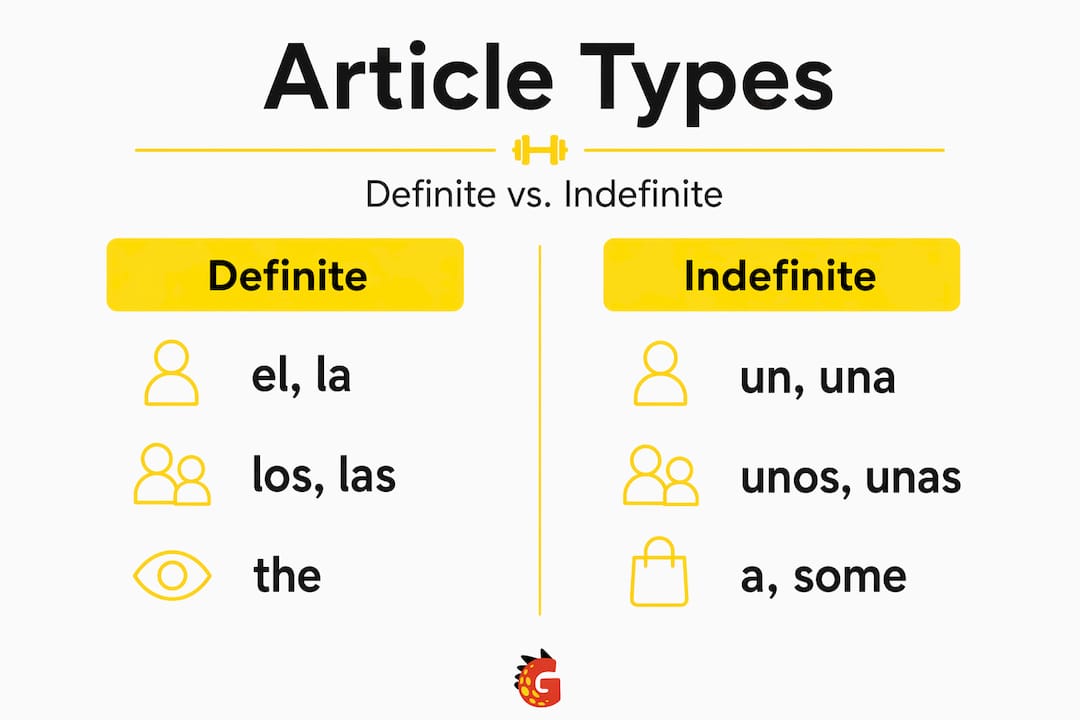
Definite articles are the equivalent of “the” in English. Spanish articles must agree in gender and number with their nouns. Here is how they break down:
| Gender | Singular | Plural |
|---|---|---|
| Masculine | el | los |
| Feminine | la | las |
Examples in use:
- el libro (the book) / los libros (the books)
- la mesa (the table) / las mesas (the tables)
Indefinite articles: un, una, unos, unas
Indefinite articles correspond to “a,” “an,” or “some” in English. They follow the same gender and number logic:
| Gender | Singular | Plural |
|---|---|---|
| Masculine | un | unos |
| Feminine | una | unas |
Examples: un perro (a dog), una casa (a house), unos libros (some books), unas sillas (some chairs).
Gender patterns and contractions
Most nouns ending in -o are masculine and most ending in -a are feminine, but there are notable exceptions. El mapa (map) and el día (day) are masculine despite ending in -a. La mano (hand) is feminine despite ending in -o. This is exactly why learning nouns as a unit with their article matters so much.
Two contractions are also part of the core system. A + el forms al and de + el forms del. These contractions are mandatory. You say voy al mercado (I’m going to the market), not voy a el mercado. The only exception is when El is part of a proper name, such as a city or title: Voy a El Salvador stays unchanged.
Pro Tip: Think of articles as part of the noun itself, not a separate add-on. When you learn a new noun, always store it with its article attached: not just “ciudad” but “la ciudad.” This mental habit alone will eliminate most gender agreement errors.
Special rules and common exceptions
Once you have the basics down, rules for using articles in Spanish get more nuanced. Several situations require you to either change the expected article form or drop the article entirely.
Feminine nouns with stressed a or ha
This is one of the most surprising exceptions in Spanish. Feminine nouns starting with stressed a take the masculine singular article el to avoid the awkward sound of la agua or la águila. The noun remains feminine. Only the article changes.
- el agua (the water) but las aguas (the waters)
- el águila (the eagle) but las águilas (the eagles)
- el hacha (the axe) but las hachas (the axes)
This rule applies only in the singular. In the plural, the regular feminine article las returns.
When to omit the article entirely
Understanding Spanish articles also means knowing when to leave them out. Here are the key situations where you drop the article:
- After ser with professions: Es médico (He is a doctor), not Es un médico, unless you are qualifying the profession: Es un médico excelente.
- After verbs like hablar, aprender, or estudiar with languages: Habla español (She speaks Spanish), not Habla el español.
- With possessives: Mi coche (my car), never mi el coche.
- In fixed expressions and proverbs: Tengo hambre (I’m hungry), en casa (at home).
Titles and addressing people
Titles require a definite article when you are referring to someone in the third person: El doctor García llegó tarde (Doctor García arrived late). But when you speak directly to that person, the article disappears: Buenos días, doctor García.
Pro Tip: To memorize when to drop articles, create a short list of your five most common daily sentence frames and practice them with and without articles until the correct form feels automatic. Patterns, not rules, are what stick.
Practical applications in everyday Spanish
Knowing how to use articles in Spanish theory is one thing. Applying those rules in real conversation requires exposure to specific contexts where English and Spanish behave very differently.
Body parts and reflexive verbs
In Spanish, you use a definite article, not a possessive, when talking about body parts with reflexive verbs.
- Me duele la cabeza. (My head hurts. Literally: The head hurts me.)
- Se lava las manos. (He washes his hands. Literally: He washes the hands.)
- Me rompí el brazo. (I broke my arm. Literally: I broke the arm.)
English uses “my” and “his” in these sentences. Spanish uses the definite article because the reflexive verb already tells you whose body part it is.
Abstract and generalized concepts
This is where many learners miss articles entirely. Using definite articles with abstract concepts is mandatory in Spanish when speaking in general terms.
- La vida es bella. (Life is beautiful.) English drops the article; Spanish requires la.
- El amor es complicado. (Love is complicated.)
- La paciencia es una virtud. (Patience is a virtue.)
Whenever you make a generalization about a category of things or an abstract idea, reach for the definite article.
Days, seasons, and meals
Spanish uses the definite article with days of the week and seasons in contexts where English uses none.
- El lunes tengo clase. (On Monday I have class.)
- En el invierno hace frío. (In winter it’s cold.)
- El desayuno es importante. (Breakfast is important.)
One exception: after the verb ser when stating the day, the article drops. Hoy es lunes, not Hoy es el lunes.
Pro Tip: Contrast-based practice is highly effective here. Write five sentences about your weekly routine in English, then translate them into Spanish, paying deliberate attention to every article decision. The mismatches between the two languages will become clear quickly.
Spanish article usage examples in real-life contexts, like travel or workplace conversations, are some of the most useful material you can work with to internalize these patterns.
Common errors and how to avoid them
Even learners who understand understanding Spanish articles in theory make predictable mistakes in practice. Knowing where errors cluster helps you correct them faster.
The most frequent mistakes
- Treating articles as optional: Omitting necessary articles is one of the most common errors among English speakers. Spanish requires articles in many places English does not. Me duele cabeza is incorrect. The correct form is Me duele la cabeza.
- Getting gender agreement wrong: Saying la libro or el mesa signals immediately that something is off. Incorrect article use can instantly mark a non-native speaker and create misunderstandings in context.
- Using the wrong article before stressed-a words: Writing la agua instead of el agua is a classic error. The rule is counterintuitive, so it needs deliberate practice.
- Forgetting mandatory contractions: Saying a el parque instead of al parque is grammatically wrong in all standard Spanish. The contraction is not optional.
- Keeping articles after ser with professions: English speakers often say Soy un ingeniero when the correct unmarked form is Soy ingeniero. The indefinite article only appears when you are modifying the profession.
How to fix errors systematically
The most effective correction strategy is to identify your grammar weaknesses and target them with focused repetition rather than general review. If you consistently miss articles before abstract nouns, drill that specific pattern until it becomes reflex.
Keep a personal error log. Every time you catch yourself making an article mistake, write the incorrect version and the correct version side by side. Review that log weekly. Over time, the patterns that cause you trouble become patterns your brain starts to self-correct automatically.
Pro Tip: Read short Spanish news headlines or social media posts aloud every day. Pay attention to every article. The formal and journalistic registers often use articles in precise ways that are excellent training data for your brain.
Why Spanish articles matter more than most learners expect
One observation that language teachers frequently make is that learners tend to underestimate the importance of articles. Many beginners view them as small words that can be learned later, focusing instead on vocabulary and verb conjugations. Yet article usage is one of the most persistent sources of mistakes, even at intermediate levels.
A common theme in language-learning communities is that Spanish articles often feel arbitrary at first. Many learners report struggling with gender agreement, article selection, and exceptions that seem difficult to remember. The challenge becomes much easier once articles are understood as meaningful parts of a sentence rather than isolated grammar rules.
Articles provide important information about nouns. They help indicate whether something is specific or general, known or unknown, singular or plural. When learners recognize this function, article usage becomes more logical and easier to apply in real communication.
Another strategy frequently recommended by teachers is learning nouns together with their articles from the beginning. Rather than memorizing agua or árbol in isolation, learners benefit from treating them as complete units: el agua, el árbol. This approach helps reinforce grammatical gender and reduces agreement errors over time.
Many experienced learners also note that exceptions become much easier to manage once the core system feels automatic. Cases such as el agua being grammatically feminine or article omission after ser with professions are easier to remember when the underlying patterns are already familiar.
Mistakes should be viewed as part of the learning process rather than evidence of failure. Each correction helps strengthen pattern recognition and gradually builds the automatic responses that support fluent communication.
Train article rules until they become instinct
Reading about Spanish article usage rules gets you started. But reading about rules and actually using them correctly mid-conversation are two different things. That gap is exactly what Gramanator is built to close.

Gramanator is a Spanish grammar training platform designed for serious adult learners. It offers 10,000+ structured drills built around real-life contexts, including the exact patterns where article errors are most common. You practice article usage with body parts, abstract nouns, professions, and days of the week until correct usage becomes automatic recall, not active translation. The platform tracks your mistakes, targets your weak points, and adapts your daily workouts to what you actually need. If you are ready to turn grammar knowledge into a genuine speaking skill, explore Gramanator’s plans and start training today.
FAQ
What are the four definite articles in Spanish?
The four definite articles are el (masculine singular), la (feminine singular), los (masculine plural), and las (feminine plural). Each one must match the gender and number of the noun it accompanies.
Why do some feminine nouns use el instead of la?
Feminine nouns that begin with a stressed a or ha sound use el in the singular to avoid the awkward vowel clash. The noun itself remains feminine, and the plural form returns to las, as in el agua but las aguas.
When do you omit articles in Spanish?
Articles are dropped after ser with unmodified professions (soy profesora), after verbs like hablar with language names (habla francés), with possessives (mi casa), and in certain fixed expressions like en casa or tengo hambre.
Are contractions al and del optional?
No. The contractions al and del are mandatory whenever a or de precede the masculine singular article el. The only exception is when El is part of a proper name, such as a country or title.
How do Spanish articles differ from English articles?
Spanish requires articles in many situations where English does not, including with abstract nouns used in general statements (la paciencia), with days of the week (el lunes), and with body parts in reflexive constructions (me duele la cabeza). Spanish also changes article form to reflect noun gender, which English does not do at all.