How to Balance Work and Spanish Learning Every Day
You can make steady progress in Spanish while working full-time by turning short pockets of time into deliberate, high-value practice and protecting one…

You can make steady progress in Spanish while working full-time by turning short pockets of time into deliberate, high-value practice and protecting one weekly deep session. Distributing practice across your day - commute, lunch, and a brief evening review - can add up to roughly half an hour without a single dedicated study block, and consistency matters far more than session length. The goal is not to find two free hours. The goal is to stop wasting the 20 minutes you already have.
Your one daily habit to start today: three pockets - morning grammar input, a lunch exchange or listening session, and a two-minute evening sentence review.
Three actions to take right now:
- Run a 7-day time audit: write down every gap of 10 minutes or more in your day.
- Block a 20-minute morning slot in your calendar before work starts.
- Set a fallback minimum: one Spanish sentence or one audio minute on your worst days.
Key Takeaways
Balancing work and Spanish learning comes down to one principle: distribute deliberate practice across the pockets you already have, protect one weekly deep session, and set a fallback minimum that keeps the habit alive on hard weeks.
| Point | Details |
|---|---|
| Run a 7-day time audit | Track every gap of 10+ minutes to find your real practice pockets before building a schedule. |
| Anchor grammar to morning | Use your highest cognitive energy for focused grammar drills - 15-20 minutes before work starts. |
| Distribute across pockets | Commute, lunch, and evening review can add up to roughly 30 minutes a day without a single long block. |
| Protect one weekly deep session | A 45-90 minute tutor, grammar workout, or immersion block builds the fluency that micro-habits alone cannot. |
| Set a fallback minimum | One sentence or one audio minute on your worst days keeps the habit intact and prevents full restarts. |
| Use Gramanator for grammar workouts | Gramanator’s timed drills and diagnostics structure your 15-minute morning session and weekly heavy lift automatically. |
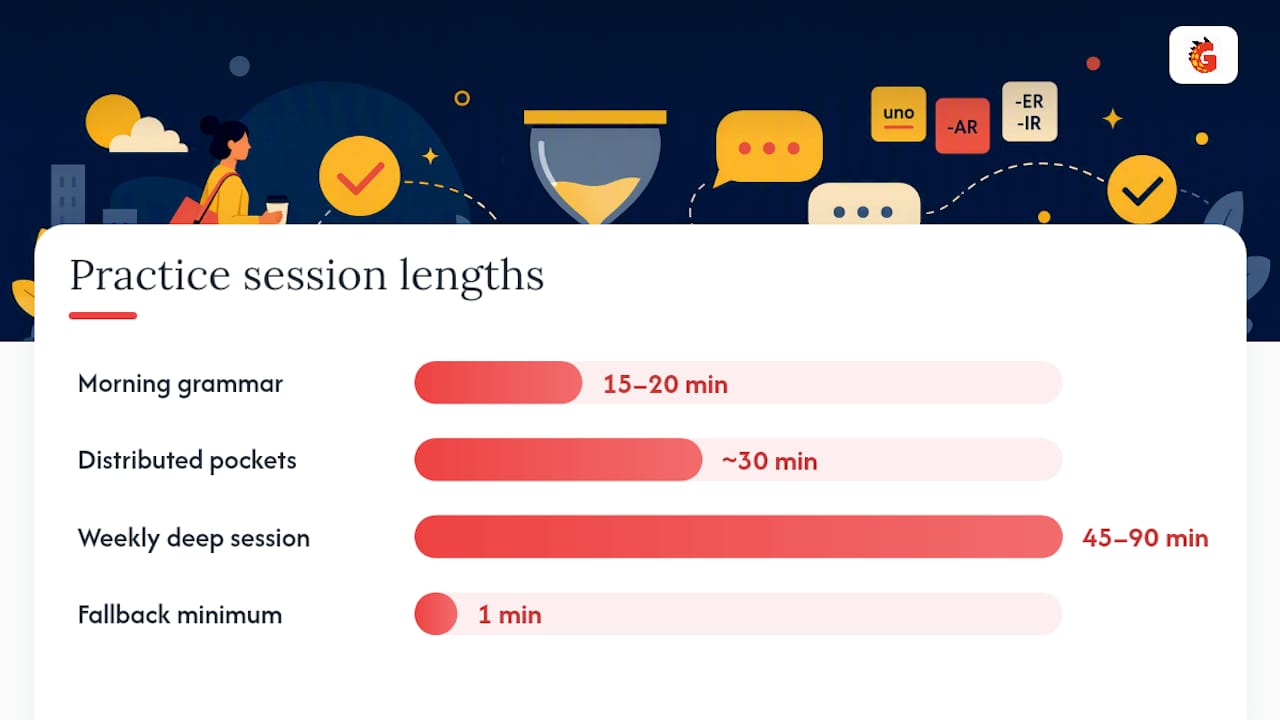
Table of Contents
- How can you run a time audit and set realistic Spanish learning goals?
- What micro-habits fit into a full workday without disrupting it?
- How do you turn commute time and chores into real Spanish practice?
- Can you use your workplace as a low-stakes Spanish practice lab?
- Why does one weekly deep session matter, and how do you design it?
- What is the difference between passive and active practice, and how do you use both?
- Which tools work best when you have limited time to study Spanish?
- A copyable weekly schedule for three commitment levels
- How to build a 15-25 minute grammar workout that actually works
- How do you stay consistent and recover after a bad week?
- Gramanator fits directly into the schedule you just built
- Sources
How can you run a time audit and set realistic Spanish learning goals?
Most people overestimate how much free time they have and underestimate how much they waste. A 7-day time audit and distributed practice strategy is one of the most effective frameworks for working adults because it makes the invisible visible.
For one week, track every gap of 10 minutes or more. Use a notes app, a paper log, or your phone’s calendar. Record what you were doing, how long it lasted, and whether it required active attention. By day seven, patterns appear: a 15-minute coffee break you scroll through, a 25-minute commute you spend on news, a 10-minute wait before a meeting.
Common pockets most professionals overlook:
- Morning commute (driving or transit): 15-45 minutes
- Coffee break or mid-morning pause: 10-15 minutes
- Lunch break (the part after eating): usually lasting between ten and twenty minutes
- Waiting time before meetings: commonly about five to ten minutes
- Evening wind-down before sleep: 10-15 minutes
Once you see your pockets, translate them into weekly minutes. Thirty minutes a day equals 210 minutes per week - that is more than three full hours of Spanish practice, built from fragments. Set your goal in terms of outcomes, not effort: “I will complete one grammar drill set and one listening session per day” beats “I will study Spanish more.”
Pro Tip: Set a fallback minimum - the one essential activity you maintain even on your most challenging week. This might be one corrected message on a language exchange app or a brief audio session during a commute, which helps maintain the habit during busy times. Block your primary study slot in your calendar as a recurring meeting so it survives schedule conflicts.
What micro-habits fit into a full workday without disrupting it?
The most sustainable study plan for a busy professional is not a plan at all - it is a set of repeatable micro-habits anchored to things you already do. Short daily lessons around 15 minutes are pedagogically efficient because the brain processes new information most effectively in short bursts, not marathon sessions.
Map each habit to your energy level at that time of day:
- Morning (high cognitive energy): 15-20 minutes of focused grammar work - verb conjugations, sentence structure drills, or a timed grammar workout. This is your hardest task; do it first.
- Commute (moderate energy, hands or eyes occupied): Podcast listening, audio lessons, or shadowing practice. Passive input is fine here as long as you engage with it actively (more on that below).
- Lunch (social energy, short window): A 10-minute language exchange message, a short reading in Spanish, or SRS flashcard review. Output matters here.
- Evening (low energy): Write two or three Spanish sentences about your day. No grammar pressure - just production. This consolidates what you absorbed earlier.
Pro Tip: Anchor your hardest cognitive task - grammar drilling - to your freshest mental window, which for most people is within 90 minutes of waking. On bad days, your two fallback options are: (1) listen to five minutes of Spanish audio during any commute or errand, or (2) write one sentence in Spanish before bed. Either one keeps the habit alive.
How do you turn commute time and chores into real Spanish practice?
Dead time is not wasted time - it is unscheduled practice time. A time-efficient plan that uses dead time, micro-learning, and weekend immersion can produce steady progress without burnout when paired with consistent daily practice.
For your commute, match the activity to your situation:
- Driving: Audio lessons, Spanish podcasts at your level, or shadowing practice (repeat phrases aloud after a native speaker). Avoid anything that requires reading or writing.
- Public transit: Reading short Spanish articles, reviewing flashcards, or watching a short video with Spanish subtitles. You have your hands and eyes free - use them.
- Walking: Shadowing or listening with prediction tasks (guess the next word before the speaker says it).
For chores and short waits, apply one rule: no chores without headphones. Washing dishes, folding laundry, and grocery shopping are perfect for audio input. For waits under five minutes, run a two-minute micro-review: recall five vocabulary items, conjugate one verb in three tenses, or replay a phrase you heard earlier.
Good content types for these windows include Spanish-language podcasts pitched at your level, short YouTube videos with Spanish subtitles, and voice note apps where you record yourself speaking and play it back.
Pro Tip: Make listening active, not background noise. Before you press play, predict what the episode will cover. While listening, note two or three keywords you catch. Afterward, summarize the main point aloud in one sentence - in Spanish if you can, in English if you must. That three-step loop (predict, note, summarize) turns passive audio into real input processing.
Can you use your workplace as a low-stakes Spanish practice lab?
Yes - and most learners never think to try it. Aligning your study with professional goals, such as reading industry news in Spanish or learning workplace vocabulary, increases both motivation and transfer to real situations.
What works at work (and what does not):
- Do: Switch your phone and computer interface to Spanish. You already know where everything is, so the cognitive load is low and the vocabulary exposure is constant.
- Do: Read one Spanish-language article in your industry per week. Search “[your field] en español” and bookmark a source. Even skimming headlines builds professional vocabulary.
- Do: If you have a willing colleague or a Spanish-speaking contact, send one short message in Spanish per day - a greeting, a quick update, a simple question. Asynchronous exchange fits a professional schedule because replies arrive in your next pocket rather than requiring synchronized time.
- Do: Block a 15 to 20 minute calendar slot labeled “focus time” and use it for Spanish. No one needs to know.
- Don’t: Use Spanish in high-stakes professional situations - client calls, performance reviews, critical emails - until your level is solid. Errors in those contexts carry professional risk.
- Don’t: Let practice bleed into work time without a clear boundary. The slot you block is the slot you use; everything else stays in English.
When professional norms require English, default to English without guilt. The workplace is a supplement to your study plan, not a replacement for it.
Why does one weekly deep session matter, and how do you design it?
Daily micro-habits build vocabulary and listening instinct. But grammar internalization, writing fluency, and real conversational confidence require longer, uninterrupted focus. One weekly session of 45-90 minutes does what no collection of 10-minute pockets can: it lets you work through a complex grammar pattern, get corrected in real time, or immerse yourself in extended Spanish content.
Options for your weekly heavy lift:
- 1:1 tutor session: Best for speaking practice and immediate correction. Schedule it for Saturday or Sunday morning when your cognitive energy is fresh.
- Timed grammar workout: A structured 25-minute drill set focused on one grammar area - subjunctive, ser vs. estar, past tenses. Identify your weakest area first, then drill it systematically. Identifying your grammar weaknesses fast before the session makes every minute count.
- Focused vocabulary and writing block: Choose a topic relevant to your work or travel goals, write 150-200 words in Spanish, then self-correct or use a language exchange partner.
Planning checklist for the weekly session:
- Set one specific objective before you sit down (e.g., “master the preterite vs. imperfect distinction”).
- Do five minutes of prework: review notes or errors from the previous week.
- Spend 10 minutes post-session writing down what you learned and what to review next.
When time is scarce, a 25-minute grammar workout is your minimum viable heavy lift. Structured intensive practice combined with real-world application accelerates professional vocabulary acquisition - the same principle applies when you design your own focused weekly block.
What is the difference between passive and active practice, and how do you use both?
Passive exposure - Spanish playing in the background while you work - feels productive but produces little learning on its own. Active listening requires specific tasks: predict, note keywords, and summarize aloud or in writing. That distinction is the difference between hearing Spanish and actually acquiring it.
Passive practice (useful, but limited):
- Background Spanish TV or radio while cooking or cleaning
- Spanish music during a workout
- Spanish podcasts during a commute (passive mode - no note-taking)
Active practice (where real acquisition happens):
- Listening with a prediction task before pressing play
- Transcribing one sentence from a podcast episode
- Shadowing: repeating a phrase immediately after a native speaker, matching rhythm and intonation
- Writing a two-sentence summary of what you just heard
How to make any listening session active - four steps:
- Before listening: state one thing you expect to hear (a topic, a word, a phrase).
- While listening: catch two or three keywords and note them mentally or on paper.
- After listening: summarize the main point in one sentence, in Spanish.
- Once a week: shadow one 30-second clip from your regular podcast, repeating it three times.
As your level rises, shift more time toward active output.
Which tools work best when you have limited time to study Spanish?
The right tool depends on your pocket length and your goal, not on which app has the best reviews. Spaced repetition (SRS) and short review sessions are effective for long-term retention and fit well into lunch or micro-break pockets. Grammar drills, by contrast, need focused attention and belong in your morning or weekly heavy-lift slot.
Tool categories matched to pocket length and goal:
- SRS flashcard apps (Anki, Quizlet): Best for 5-15 minute lunch or break pockets. Use for vocabulary and short grammar patterns you want to automate.
- Spanish podcasts (Coffee Break Spanish, SpanishPod101, Español con Juan): Best for commutes and chores. Choose a level just above your current comfort zone.
- Grammar drill platforms: Best for 15-25 minute morning sessions or weekly heavy lifts. Timed, structured drills are uniquely efficient for busy adults because they force production under mild pressure, which accelerates automaticity. See why grammar matters for Spanish fluency for the underlying case.
- Language exchange apps (HelloTalk, Tandem): Best for lunch or evening pockets. Asynchronous messaging means you reply when you have time, not in real time.
- Short reading tools (News in Slow Spanish, El País América): Best for 10-minute transit or lunch windows. Read one article, look up two words maximum, move on.
Decision checklist - pick the right tool:
- Pocket under 10 minutes → SRS flashcards or a two-minute micro-review.
- Pocket of 10-20 minutes → podcast (active mode) or language exchange message.
- Pocket of 20+ minutes → grammar drill set or focused reading with note-taking.
- Weekly 45-90 minute block → tutor, timed grammar workout, or writing session.
For a broader comparison of top Spanish learning platforms, match each platform’s strengths to your specific pocket structure before committing.
A copyable weekly schedule for three commitment levels
These three templates are built around the pocket-based approach. Pick the level that matches your current schedule, not your ambition. You can always move up.
| Day | Minimal (~15-20 min/day) | Steady (~30 min/day) | Ambitious (about 45 minutes per day) |
|---|---|---|---|
| Monday | 15 min morning grammar drill | 20 min grammar + 10 min SRS at lunch | 25 min grammar + 20 min podcast + 15 min writing |
| Tuesday | 15 min podcast (commute) | 20 min podcast + 10 min exchange message | 25 min grammar + 20 min exchange + 15 min reading |
| Wednesday | 15 min SRS flashcards (lunch) | 20 min grammar + 10 min SRS | 25 min grammar + 20 min podcast + 15 min writing |
| Thursday | 15 min audio (chores/commute) | 20 min podcast + 10 min exchange message | 25 min grammar + 20 min exchange + 15 min reading |
| Friday | 15 min grammar drill | 20 min grammar + 10 min SRS | 25 min grammar + 20 min podcast + 10 min review |
| Saturday | Rest or 10 min review | 45 min tutor or focused grammar workout | 90 min tutor or immersion block |
| Sunday | Rest | Rest or 15 min light review | 30 min writing + 30 min review |
| Weekly total | ~90 min | ~200-210 min | ~420 min |
Modification tips:
- Shift workers: Anchor your morning grammar slot to the first 20 minutes after you wake, regardless of the clock time. Your “morning” is whenever your cognitive energy peaks.
- Remote workers: Use the commute time you no longer spend traveling for a second daily pocket - a 15-minute grammar drill before your first meeting is a direct replacement.
- Frequent travelers: Treat flights and airport waits as your weekly heavy-lift slot. A 90-minute flight is a full immersion block if you treat it as one.
How to build a 15-25 minute grammar workout that actually works
Grammar knowledge and grammar fluency are not the same thing. You can know a rule perfectly and still freeze when you need to use it in conversation. Targeted grammar workouts close that gap by training automatic recall, not just recognition.
A step-by-step 20-minute grammar workout:
- Warm-up (3 minutes): Review three to five sentences you got wrong in your last session. Read them aloud. Do not study them - just reactivate them.
- Focused drill (10 minutes): Work on one grammar pattern only. Conjugate, transform, or complete sentences under mild time pressure. Timed drills matter because pressure simulates real conversation.
- Timed repetition (4 minutes): Repeat the same drill type with new sentences. Speed is the goal here, not perfection.
- Immediate correction (2 minutes): Review every error. Note the pattern of the mistake, not just the answer.
- Spaced review flag (1 minute): Mark two or three items for review in three days. This is where spaced repetition begins.
Pro Tip: Before each weekly heavy-lift session, run a five-minute diagnostic: attempt 10 sentences across three grammar areas and note where you hesitate or err. That hesitation pattern tells you exactly what to drill next. Designing workouts from identified weaknesses - rather than working through a textbook in order - cuts wasted time significantly.
Gramanator’s platform is built around exactly this workout structure. Its 10,000+ timed grammar drills, mistake-focused repetition, and integrated grammar explanations let you run a structured 15-minute morning session or a full 25-minute weekly workout without building the curriculum yourself. The diagnostic tools surface your weak areas automatically, so every session targets what you actually need.
How do you stay consistent and recover after a bad week?
Consistency is not about willpower. It is about designing a system that survives your worst weeks, not just your best ones. Busy adults succeed by protecting a small non-negotiable practice - one corrected message or a single micro-task - as a fallback on bad days.
Rules that protect long-term progress:
- Protect sleep first. A tired brain retains almost nothing. Cutting sleep to study Spanish is a net loss.
- Lower the bar, not the habit. On a brutal week, your goal is not 30 minutes - it is one sentence. One audio minute. One flashcard. The habit survives; the volume adjusts.
- Schedule rest weeks. Every four to six weeks, take one day completely off from Spanish. Planned rest prevents the unplanned kind.
- Track outcomes, not effort. “I completed 15 grammar drills” is more motivating than “I studied for 20 minutes” because it shows what you actually produced.
Restart plan after a gap:
When you miss a week or two, do not try to catch up. Return to your fallback minimum for three days - one micro-habit per day - then step back up to your normal schedule on day four. Trying to compensate with a three-hour session after a gap usually leads to another gap.
Tie your motivation to a professional goal: a work trip to a Spanish-speaking country, a client relationship, a promotion that values bilingualism. Tracking progress with measurable outcomes - sentences written, drills completed, conversations held - makes the progress visible and keeps the goal concrete.
Gramanator fits directly into the schedule you just built
The hardest part of a busy learner’s grammar workout is not the drilling - it is designing the session from scratch every morning when you have 15 minutes and a full inbox waiting.

Gramanator eliminates that friction. The platform’s daily personalized grammar workouts are built for exactly the 15-minute morning pocket and the 25-minute weekly heavy-lift slot described in this guide. You open the app, and the session is already structured: warm-up, focused drill, timed repetition, immediate correction, and spaced review flagging - the same five-step workout above, automated. The diagnostic tools identify your weak grammar areas and route each session toward them, so you are never drilling what you already know.
For the morning pocket, a single Gramanator workout covers one grammar pattern with timed drills and instant feedback. For the weekly heavy lift, the platform’s skill-based practice paths take you from verb conjugation through sentence structure at whatever level you are working at, A1 through C1. Start with a free trial and see how a structured grammar session fits your schedule before committing to a plan.
Sources
The recommendations in this guide draw on the following sources. Each one is worth bookmarking for a specific part of your study plan.
- Studying Spanish While Working Full‑Time: Time‑Efficient Plan - Spain Handbook
- daily-spanish-schedule-working-adults
- Learning a language while working full-time - Pearson
- How Long Does It Take To Speak Spanish Fluently? - Expanish
- Cervantes
- How to Study Spanish with a Full-Time Job | SpanishStep