Essential A1 Spanish grammar: Key rules for rapid progress
Essential A1 Spanish grammar rules. Present tense, ser vs estar, gender, and questions, sequenced for the fastest beginner progress.

Starting Spanish grammar without a clear roadmap is one of the most common mistakes adult learners make. You can spend weeks on obscure subjunctive forms or irregular verb tables that simply do not appear in everyday conversation at the beginner level. The CEFR (Common European Framework of Reference for Languages) A1 level offers a practical benchmark: it defines exactly what you need to communicate in simple, functional situations. Focusing on the right grammar concepts from day one saves you time, reduces frustration, and gets you speaking real Spanish faster.
Table of Contents
- What defines A1 grammar priorities?
- 1. Noun gender and agreement: The foundation
- 2. Present tense verbs: Reliable action
- 3. Essential contrasts: Ser vs estar for identity and location
- 4. Early structures: Present progressive and negatives
- Our perspective: The real cost of skipping the basics
- Take your A1 grammar further with Gramanator
- Frequently asked questions
Key Takeaways
| Point | Details |
|---|---|
| Start with core grammar | Prioritize noun gender, agreement, and present tense to achieve immediate communicative success. |
| Master key verb forms | Learning regular present tense conjugations empowers you to describe real actions and needs. |
| Use essential contrasts | Apply simplified ser vs estar rules for identity and location, then deepen as you advance. |
| Integrate real-world practice | Practice with realistic micro-dialogues to embed grammar skills and boost retention. |
What defines A1 grammar priorities?
Having previewed the importance of starting smart, let’s clarify how to select which grammar concepts will give you the most leverage at A1.
The CEFR A1 level is not about knowing everything. It is about being able to handle simple exchanges, share personal information, and meet basic needs in Spanish. Think of situations like introducing yourself, asking where the bathroom is, or ordering food at a café. These tasks require a specific, limited set of grammar tools, not an exhaustive knowledge of the language.
A1 functional benchmarks confirm that aligning your study with these communication goals prevents wasted effort. Many learners make the mistake of jumping ahead to complex structures before they can confidently say “My name is...” or “I work in an office.” That mismatch creates frustration and slows progress significantly.
Here is what A1 grammar priorities look like in practice:
- Personal information: Stating your name, nationality, job, and age
- Basic needs: Asking for things, giving simple directions, expressing preferences
- Simple descriptions: Describing people, places, and objects with basic adjectives
- Everyday routines: Talking about what you do daily, including work and family life
“The goal at A1 is not perfection. It is functional communication. Every grammar concept you study should serve a real conversation you might actually have.”
You can explore more about how to structure your learning journey on the Spanish grammar blog, where practical guides break down each level clearly.
The key insight here is prioritization. When you know that A1 focuses on these specific tasks, you can make smarter decisions about what to study and what to skip for now. That clarity is what separates learners who progress steadily from those who feel stuck.
1. Noun gender and agreement: The foundation
Let’s begin with the single most essential structural feature of Spanish sentences: noun gender and agreement.
Every noun in Spanish is either masculine or feminine. This is not optional or decorative. It directly controls which article you use and how adjectives are formed. Get this wrong, and your sentences sound off to native speakers, even if your vocabulary is correct.
Noun gender and number must be learned early because it controls articles and adjective agreement throughout every sentence you build. This is not a detail you can come back to later. It is the structural backbone of Spanish grammar.
Here are the basic rules you need to know:
| Category | Masculine example | Feminine example |
|---|---|---|
| Definite article | el libro (the book) | la mesa (the table) |
| Indefinite article | un médico (a doctor) | una enfermera (a nurse) |
| Adjective agreement | el chico alto (the tall boy) | la chica alta (the tall girl) |
| Plural formation | los libros (the books) | las mesas (the tables) |
Notice how the adjective alto/alta changes its ending to match the noun’s gender. This is called agreement, and it applies to every adjective in Spanish.
Common patterns to help you predict gender:
- Nouns ending in -o are usually masculine: libro (book), banco (bank)
- Nouns ending in -a are usually feminine: casa (house), silla (chair)
- Nouns ending in -ión are usually feminine: nación (nation), conversación (conversation)
- Nouns ending in -dad or -tad are usually feminine: ciudad (city), libertad (freedom)
These patterns are not perfect, but they cover the majority of common nouns you will encounter at A1. Learning them reduces guesswork and builds confidence quickly.
Pro Tip: When you learn a new noun, always memorize it with its article. Do not just learn libro. Learn el libro. This habit locks in the gender automatically and makes agreement feel natural over time.
You can practice noun gender and agreement through the grammar practice platform, where exercises are organized by level and give you instant feedback on your mistakes.
2. Present tense verbs: Reliable action
Building on noun agreement, verbs allow you to describe what is happening or what you do. Let’s get concrete with the present tense.
The present tense (presente de indicativo) is your most important verb tool at A1. It lets you express actions, facts, habits, and routines. Nearly every real-world conversation at this level relies on it. Before you worry about past or future tenses, you need to make the present tense feel automatic.
The A1 syllabus emphasizes regular present-tense verbs for expressing needs and habits before introducing tense contrasts. This sequencing is intentional and smart. Regular verbs follow predictable patterns, which means you can learn one pattern and apply it to hundreds of verbs immediately.
Here is how regular verb conjugation works for the three main verb groups:
- -AR verbs (e.g., hablar = to speak): hablo, hablas, habla, hablamos, habláis, hablan
- -ER verbs (e.g., comer = to eat): como, comes, come, comemos, coméis, comen
- -IR verbs (e.g., vivir = to live): vivo, vives, vive, vivimos, vivís, viven
Notice that -ER and -IR verbs share most of their endings. That is one less pattern to memorize.
Real-world applications at A1:
- Work: Trabajo en una oficina. (I work in an office.)
- Family: Mi hermana vive en Madrid. (My sister lives in Madrid.)
- Habits: Como a las dos. (I eat at two o’clock.)
- Preferences: Bebo café por la mañana. (I drink coffee in the morning.)
Pro Tip: Pick five high-frequency -AR verbs (like hablar, trabajar, llamar, comprar, escuchar) and practice conjugating them every day for one week. Once those feel solid, add five -ER and -IR verbs. This focused repetition builds a reliable verb base faster than studying twenty verbs at once.
You can reinforce this skill through interactive grammar practice, where exercises are tied to real-life scenarios like workplace conversations and daily routines.
3. Essential contrasts: Ser vs estar for identity and location
With verbs under your belt, let’s address the common challenge of distinguishing ser from estar, the two “to be” verbs in Spanish.
This is one of the most discussed topics in Spanish grammar, and it often causes unnecessary anxiety for beginners. The good news is that at A1, you only need a simplified version of the rules. You do not need to master every nuance right away.
Ser vs estar is introduced at A1 with minimal rules for immediate use: SER for permanent traits, ESTAR for temporary states and location. That is a workable starting point that covers the vast majority of situations you will face at this level.
Here is a side-by-side comparison to make this concrete:
| Verb | Use | Example | Translation |
|---|---|---|---|
| Ser | Identity, origin, profession | Soy médico. | I am a doctor. |
| Ser | Nationality | Soy americano. | I am American. |
| Ser | Inherent characteristics | El coche es rojo. | The car is red. |
| Estar | Location | Estoy en la oficina. | I am in the office. |
| Estar | Temporary states | Estoy cansado. | I am tired. |
| Estar | Current condition | La puerta está abierta. | The door is open. |
Quick memory anchors:
- Think of ser as the verb of identity: who you are, where you are from, what you do
- Think of estar as the verb of state: where you are right now, how you feel today
These two anchors handle most A1 situations. You will refine your understanding at A2 and B1, but for now, these rules give you functional accuracy.
Pro Tip: Practice by writing five sentences about yourself using ser (name, job, nationality) and five using estar (current location, how you feel today). This personal context makes the distinction stick faster than abstract drills.
For a deeper breakdown with more examples, the ser vs estar guide walks you through the full picture when you are ready to go beyond A1 basics.
4. Early structures: Present progressive and negatives
Now that you know the essential building blocks, it is helpful to see which early structures improve your flexibility without causing overwhelm.
Two supporting structures make a significant difference at A1: the present progressive and basic negation. Neither is complicated, but both expand what you can say and understand in real conversations.
The A1 syllabus covers present progressive and simple negation while cautioning against overloading learners with too many tense contrasts at once. That balance is important. Learn these two structures, use them in context, and do not rush to add more until they feel comfortable.
The present progressive is formed with estar + the gerund (the -ando/-iendo form of the verb):
- Estoy hablando. (I am speaking.)
- Está comiendo. (He/She is eating.)
- Estamos trabajando. (We are working.)
This structure is useful when you want to emphasize that something is happening right now, in this moment. It is especially helpful in workplace and travel conversations.
Basic negation is even simpler. Place no directly before the verb:
- No hablo italiano. (I do not speak Italian.)
- No como carne. (I do not eat meat.)
- No estoy cansado. (I am not tired.)
That is it. No additional words needed for basic negation in Spanish, unlike some other languages.
Key prepositions to learn early:
| Preposition | Meaning | Example |
|---|---|---|
| en | in, at, on | Estoy en casa. (I am at home.) |
| a | to, at | Voy a la tienda. (I am going to the store.) |
| de | of, from | Soy de México. (I am from Mexico.) |
| con | with | Trabajo con ella. (I work with her.) |
| para | for | Esto es para ti. (This is for you.) |
These prepositions appear constantly in everyday Spanish. Knowing them allows you to describe place, time, direction, and relationship, which are all critical for basic communication.
You can find more practical grammar guides and tips on grammar tips and guides to support your learning at each stage.
Our perspective: The real cost of skipping the basics
Here is something most Spanish learning resources will not tell you directly: the learners who struggle most at intermediate levels are almost always the ones who rushed through A1 without truly internalizing the foundational structures.
It sounds counterintuitive. You might think that pushing ahead faster means progressing faster. But Spanish grammar is cumulative. Noun gender agreement feeds into adjective use, which feeds into past participles, which feeds into the passive voice. If your foundation is shaky, every new structure you add becomes harder to use correctly.
We have seen this pattern repeatedly with adult learners. Someone studies for six months, reaches a B1 textbook, and then hits a wall. When they go back and review A1 concepts, they realize they were guessing at noun gender, mixing up ser and estar randomly, and forming present tense sentences by feel rather than by rule. The wall was not caused by B1 complexity. It was caused by A1 gaps.
The uncomfortable truth is that spending an extra two or three weeks at A1 to truly master these four concept areas (noun gender, present tense verbs, ser vs estar, and early structures) pays dividends for years. Fluency is not about knowing the most grammar. It is about using a smaller set of grammar tools with precision and confidence.
Our recommendation: treat A1 not as a level to get through, but as a level to own completely. When every sentence you build at A1 feels solid, moving to A2 and beyond becomes genuinely exciting rather than stressful.
Take your A1 grammar from knowledge to instinct
If you are serious about building real Spanish fluency, grammar needs more than study - it needs training. Structured repetition and targeted practice are what turn beginner rules into automatic reactions you can actually use in conversation.
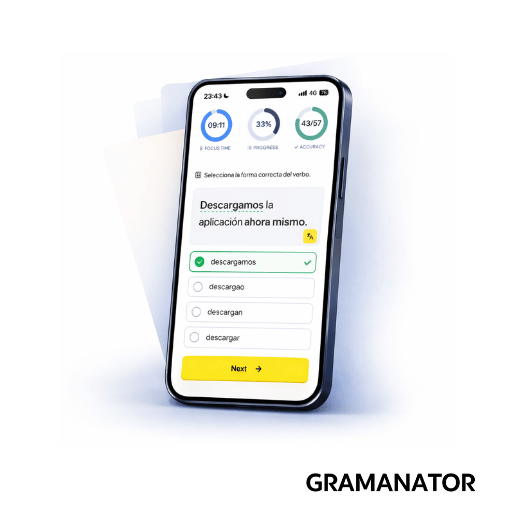
Gramanator is the Spanish Grammar Gym built for serious adult learners. With 10,000+ structured drills organized from A1 to C2, you train core beginner topics like noun gender, present tense conjugation, ser vs estar, and sentence structure through real-life contexts, immediate feedback, and guided repetition. Personalized grammar workouts, mistake-focused retraining, and progress tracking help you stop translating and start reacting naturally in Spanish. Start building your A1 foundation with training designed to make grammar stick.
Frequently asked questions
How can adults efficiently practice A1 Spanish grammar for real communication?
Focus on one grammar concept at a time, practice with short real-world dialogues, and repeat until each structure feels automatic before moving to the next. Micro-dialogue practice transfers grammar skills to actual conversation faster than isolated drills.
Do I need to master ser vs estar at A1 or wait until later levels?
Learn simplified rules at A1 for immediate use covering identity and location, then expand your knowledge at A2 and B1 when more context and nuance emerge naturally through practice.
Are irregular verbs necessary for A1 Spanish grammar?
Most A1 courses start with regular verbs and only introduce key irregulars that appear frequently. The A1 syllabus prioritizes regular verb patterns first so learners build confidence before tackling exceptions.
How does noun gender affect communication at A1?
Noun gender determines the articles and adjective forms used in every sentence, so it is foundational to building grammatically correct sentences in Spanish from the very beginning of your learning journey.