Essential Spanish Housing Vocabulary for Renting and Buying Property
Spanish housing vocabulary is the set of specific words and expressions used to describe homes, property types, rooms, and real estate transactions in…

Spanish housing vocabulary is the set of specific words and expressions used to describe homes, property types, rooms, and real estate transactions in Spanish-speaking environments. Knowing how Spanish housing vocabulary works is not optional if you plan to rent, buy, or simply talk about homes in a Spanish-speaking context. The terms are specific, the regional differences are real, and the gaps between what a listing says and what it means can cost you money. This guide breaks down the core vocabulary by category, explains the most common misunderstandings, and gives you the tools to communicate clearly with landlords, agents, and neighbors.
How Spanish housing vocabulary works: property types explained
Spanish property vocabulary holds distinct legal and structural meanings that differ from casual English usage. Getting these wrong does not just cause confusion. It can lead you to view the wrong properties entirely.
The most important split is between Spain and Latin America. The term “piso” is the standard word for apartment in Spain, while “apartamento” or “departamento” are the preferred terms across most of Latin America. If you use “piso” in Mexico City, people will understand you, but you will sound like you just arrived from Madrid.
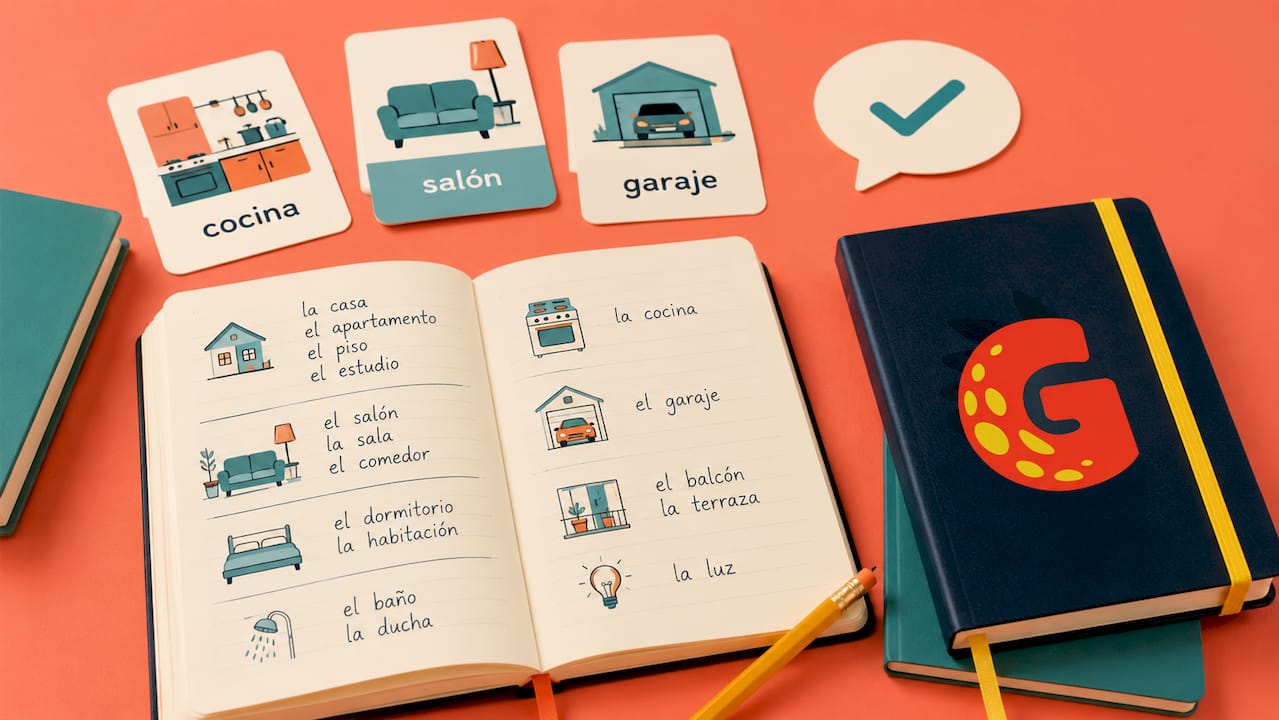
The table below covers the most common property types, their meanings in Spain, and how those meanings shift in Latin America.
| Spanish Term | Meaning in Spain | Latin American Equivalent or Note |
|---|---|---|
| Piso | Apartment in a multi-story building | “Apartamento” or “departamento” |
| Apartamento | Small apartment, often a studio | Same term widely used |
| Chalet | Detached house, often with a garden | “Casa” or “residencia” |
| Villa | Luxury detached home, often coastal | Same term, but less common |
| Bungalow | Ground-floor unit, but can be multi-level on Costa Blanca | Single-story home elsewhere |
| Casa adosada | Townhouse or semi-detached home | “Casa en condominio” in some regions |
| Ático | Penthouse or top-floor apartment | Same term, less frequent |
| Vivienda unifamiliar | Single-family home | “Casa unifamiliar” |
The “bungalow” entry deserves special attention. In most English-speaking countries, a bungalow is a single-story home. On Spain’s Costa Blanca, the same word can describe a two-story property. That gap between expectation and reality is exactly why property type nuances matter so much for learners.
Pro Tip: When viewing a property, ask the agent directly: “¿Qué tip ode vivienda es exactamente?” (What type of home is this exactly?) Never assume the English equivalent of a Spanish property term.
What are the key room names in Spanish?
Room vocabulary is the foundation of everyday housing communication. You need these terms to describe where you live, ask about a property, and understand what a listing includes.
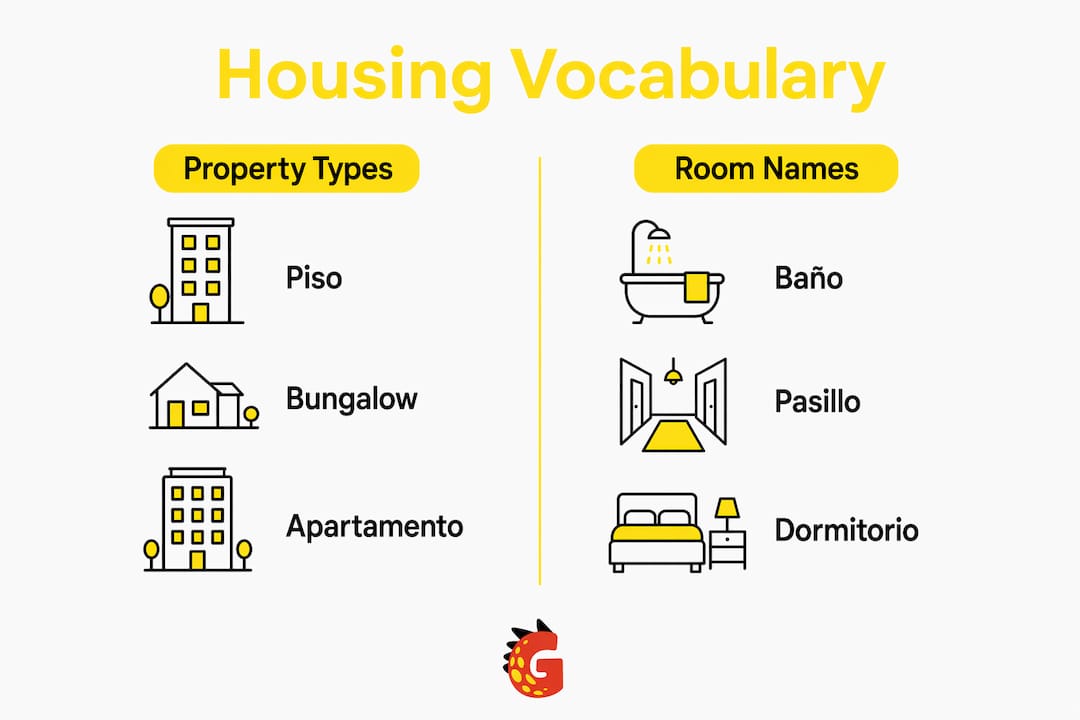
Spanish room names are mostly straightforward, but several terms have regional variants or overlapping meanings that trip up learners. The word “salón,” for example, refers to the living room in Spain. In some Latin American countries, “sala” is more common. “Dormitorio” and “habitación” both translate to “room” or “bedroom” in English, but their usage differs in listings, which creates real confusion (more on that in the next section).
Here are the top 15 room and feature terms every learner needs:
- Dormitorio - bedroom (the sleeping room specifically)
- Habitación - room (general; can include non-bedroom rooms)
- Salón / Sala de estar - living room
- Comedor - dining room
- Cocina - kitchen
- Baño completo - full bathroom (toilet, sink, shower or tub)
- Aseo / Medio baño - half bathroom (toilet and sink only)
- Terraza - terrace or balcony
- Balcón - balcony (usually smaller than a terraza)
- Garaje - garage
- Trastero - storage room or utility closet
- Pasillo - hallway
- Entrada / Recibidor - entryway or foyer
- Estudio - studio or home office
- Salón - living room
The “baño completo” versus “aseo” distinction matters when you are evaluating a property. A “baño completo” has a shower or bathtub. An “aseo” does not. Listings sometimes advertise “2 baños” when one is actually an aseo, so always ask for clarification.
Pro Tip: For pronunciation, “ll” in words like “pasillo” sounds like a “y” in most of Spain and Latin America. Practice saying “pa-SEE-yo” out loud until it feels natural.
How do Spanish real estate listings work?
Spanish real estate listings use specific terms that do not translate directly into English. Learning the complex floor naming system and measurement terms is the single most practical skill you can build before searching for property.
Measurement terms: metros construidos vs. metros útiles
The most important measurement distinction in Spanish listings is between “metros construidos” and “metros útiles.” Metros construidos includes structural walls, shared building elements, and common areas. Metros útiles is the actual interior space where your furniture fits. The difference is not small. Usable space is typically 15-25% smaller than the advertised built space. A listing that says 100 square meters may only offer 75-85 square meters of livable area.
Floor numbering in Spain
Floor naming in Spain does not match the American system. The ground floor is “planta baja,” not the first floor. Above that comes “entreplanta” (mezzanine level, not always present), then “principal” or “planta 1.” This means planta 1 might actually be the third or fourth physical floor by American counting. Always confirm the physical floor number when viewing a property.
Common listing terms and what they really mean
| Listing Term | Literal Translation | What It Actually Means |
|---|---|---|
| Metros construidos | Built square meters | Total area including walls and shared spaces |
| Metros útiles | Usable square meters | Actual livable interior space |
| Habitaciones | Rooms | All rooms, not just bedrooms |
| Dormitorios | Bedrooms | Sleeping rooms specifically |
| Planta baja | Ground floor | First physical floor (American: ground floor) |
| Entreplanta | Mezzanine | Between ground and first floor |
| Para reformar | Needs renovation | Major work required before moving in |
| Para entrar a vivir | Move-in ready | Habitable now, but standards vary |
| Sin amueblar | Unfurnished | May lack appliances and closets entirely |
| Bajo | Ground-level unit | Often used for garden apartments |
The “para reformar” versus “para entrar a vivir” distinction is critical for budget planning. A “para reformar” listing signals major renovation costs ahead. “Para entrar a vivir” means the property is livable, but the standard of what counts as move-in ready varies widely between sellers.
The “sin amueblar” entry surprises many learners from the United States. In Spain, an unfurnished rental can mean no kitchen appliances, no light fixtures, and no built-in closets. That is a very different baseline than an unfurnished American apartment.
Pro Tip: If possible, physically measure the main rooms yourself during a viewing. Bring a tape measure and compare your numbers against the listing’s metros útiles.
How does housing vocabulary affect real-world communication?
Vocabulary knowledge directly affects your ability to negotiate, ask questions, and avoid misunderstandings with landlords and agents. Knowing terms like “precio de mercado” (market price) versus “precio negociable” (negotiable price) gives you real leverage in a conversation. Without that distinction, you cannot tell whether a seller expects to negotiate or considers the price fixed.
One of the most common learner errors involves “alquiler” and “alquilar.” “Alquiler” is the noun meaning rent, while “alquilar” is the verb meaning to rent. Mixing them up produces sentences that confuse native speakers. Saying “quiero alquiler un piso” instead of “quiero alquilar un piso” is a clear signal that you are not confident with the language, which can affect how seriously an agent takes your offer.
Here are practical phrases and questions you can use directly in housing conversations:
- “¿El precio es negociable?” - Is the price negotiable?
- “¿Cantos dormitorios Taine exactamente?” - How many bedrooms does it have exactly?
- “¿Está incluido el garaje en el precio?” - Is the garage included in the price?
- “¿Cuánto es la fianza?” - How much is the security deposit?
- “¿El contrato es de large duración?” - Is the lease long-term?
- “¿Está amueblado o sin amueblar?” - Is it furnished or unfurnished?
- “¿Cuáles son los gastos de communized?” - What are the community fees?
- “¿Hay trastero incluido?” - Is a storage room included?
The term “fianza” (security deposit) and “contrato” (lease contract) are non-negotiable vocabulary for any rental situation. Hiring an independent “abogado” (lawyer) to review your contract is strongly recommended for purchases. That advice assumes you understand enough vocabulary to brief the lawyer on your concerns in the first place.
Mastery of local housing vocabulary is the difference between a confident negotiation and a costly misunderstanding. The learners who struggle most are those who know general Spanish but have never practiced the specific terms that appear in contracts and listings.
Why learning housing vocabulary requires more than memorization
Language teachers often observe that housing is one of the first topics where conversational Spanish is no longer enough. While many learners can comfortably discuss everyday subjects, understanding property listings, rental agreements, or conversations with landlords requires more specialized vocabulary and familiar grammar patterns.
The challenge is not simply learning new words - it is learning how those words are naturally used in context. Reading authentic listings, describing properties, asking about rental conditions, or discussing repairs all rely on vocabulary, grammar, and common expressions working together. This kind of practical exposure helps learners develop confidence far more effectively than memorizing isolated word lists.
As Daria Tsibina, Founder of Gramanator, discovered during her own language-learning journey, repeated practice with relevant, real-life content is what transforms knowledge into confidence. That philosophy became the foundation of Gramanator. Instead of practicing grammar through disconnected sentences, learners train with exercises built around everyday situations such as housing, work, travel, dating, and other practical topics across CEFR levels. By practicing grammar within realistic contexts, learners not only reinforce sentence structures but also become familiar with the vocabulary and expressions they are most likely to encounter in daily life.
Whether preparing to rent an apartment, relocate abroad, or simply communicate more naturally, combining grammar with meaningful, real-world vocabulary helps build the automatic language skills that everyday situations demand.
Gramanator and Spanish housing vocabulary practice
Building real confidence with Spanish real estate terms requires more than reading a word list once. You need to use the vocabulary in context, make mistakes, get corrected, and repeat until the patterns feel automatic.
Gramanator is built for exactly that kind of training. The platform combines 10,000+ structured grammar drills with real-life Spanish contexts, including the kinds of phrases and constructions that appear in housing conversations and lease negotiations. You get immediate feedback, targeted review of your weak areas, and grammar explanations built into every practice session. If you are serious about using Spanish in a housing or real estate context, start your grammar training with Gramanator and build the instinct that vocabulary lists alone cannot give you. Explore the available practice plans to find the right fit for your level.
FAQ
What is the difference between “piso” and “apartamento”?
“Piso” is the standard term for apartment in Spain, while “apartamento” or “departamento” are preferred in Latin America. Both refer to a residential unit in a multi-story building.
What does “metros útiles” mean in a Spanish listing?
Metros útiles is the actual usable interior space of a property, typically 15-25% smaller than the advertised metros construidos, which includes walls and shared building elements.
What does “para reformar” mean in Spanish real estate?
“Para reformar” means the property needs major renovation before it is livable. It signals significant costs beyond the purchase or rental price.
How does floor numbering work in Spain?
The ground floor in Spain is “planta baja.” The floor above it is “planta 1,” which corresponds to the second physical floor by American counting. This means listings can be confusing if you apply American floor numbering.
What is the difference between “habitaciones” and “dormitorios”?
“Habitaciones” refers to all rooms in a property, including non-bedroom spaces. “Dormitorios” refers specifically to bedrooms. A listing for “3 habitaciones” may not mean three bedrooms, so always confirm the number of dormitorios directly.
Key takeaways
Spanish housing vocabulary requires precise knowledge of property types, measurement terms, and listing language to avoid costly misunderstandings in real estate and everyday communication.
| Point | Details |
|---|---|
| Property terms vary by region | “Piso” means apartment in Spain; “apartamento” or “departamento” are standard in Latin America. |
| Measurement terms differ significantly | Metros útiles is 15-25% smaller than metros construidos; always check which figure a listing uses. |
| Floor numbering is not intuitive | Planta baja is the ground floor; planta 1 is the second physical floor by American counting. |
| Listing condition terms carry real cost implications | “Para reformar” means major renovation needed; “para entrar a vivir” means move-in ready but standards vary. |
| Grammar and vocabulary work together | Confusing “alquiler” (noun) with “alquilar” (verb) signals low confidence and can affect negotiations. |