Spanish Travel Vocabulary Context: Grammar Drills for Fast Replies
Spanish travel vocabulary context means grammar-focused practice for travel situations, not a list of words to memorize before your flight.

Spanish travel vocabulary context means grammar-focused practice for travel situations, not a list of words to memorize before your flight. The goal is training your brain to produce correct, automatic spoken responses when a hotel clerk asks ¿A nombre de quién está la reserva? or a taxi driver says ¿Adónde va? The Cambridge Papers in ELT (2019) call this “proceduralization” - converting rule knowledge into instinctive output. Gramanator is built around exactly this process. Your one-line action plan: pick one travel context today, run 10-12 repetition drills on its core grammar structure, then attempt three communicative uses with a partner or out loud.
Table of Contents
- Why drill-based grammar practice outperforms phrasebooks for adult learners
- Key grammar structures to train for travel interactions
- Which drill types produce automatic spoken responses?
- Ready-to-run drills for common travel scenarios
- Key Takeaways
- Gramanator puts this workflow into practice for you
- Useful sources
Why drill-based grammar practice outperforms phrasebooks for adult learners
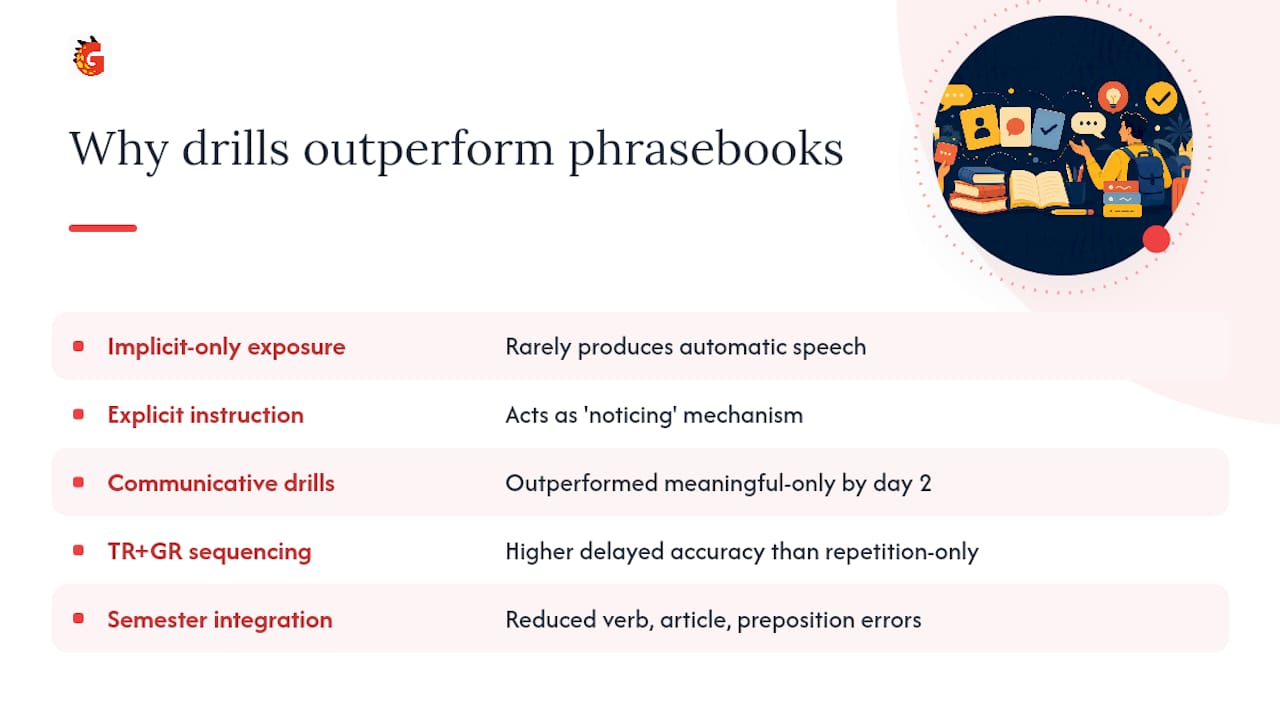
Adult learners have weaker implicit learning channels than children, which means passive exposure rarely produces automatic speech. Explicit instruction acts as a “noticing” mechanism: once you consciously know a rule, you start catching it in real input and wiring it faster. The Cambridge 2019 paper recommends pairing a narrow-channel grammar focus with broad communicative activities, precisely because neither alone is enough.
Research on communicative intent in drills shows that when drills require a real communicative exchange rather than rote echoing, learners show measurably stronger improvement across sessions. The communicative-first group in that study outperformed the meaningful-only group by the second day of practice.
“Repetition drills, when contextualized, reliably improve sentence structures and help establish kinetic memory for challenging grammar items - but only when the learner is producing meaning, not just sounds.” - International Journal of Language
TR+GR sequencing (task repetition plus grammatization) takes this further: learners who repeated a task and then explicitly analyzed its grammar outperformed those who only repeated the task on delayed accuracy tests. That delayed accuracy is exactly what you need when you are tired, jet-lagged, and trying to check into a hotel. A semester-long study integrating explicit grammar instruction with communicative practice found reductions in verb conjugation errors, article mistakes, and preposition errors in written production - the same structures that trip up travelers in spoken exchanges. Explicit grammar instruction consistently produces higher gains than implicit-only approaches in both receptive and productive modes for adult learners.
Key grammar structures to train for travel interactions
Map each travel context to a specific structure, then drill that structure until the reply shape is automatic.
| Structure | Travel use | Model sentence |
|---|---|---|
| Question formation (¿Dónde/Cuándo/Cuánto?) | Asking for info anywhere | ¿Dónde está la salida? → “Está a la derecha.” |
| Imperative / polite command | Giving and following directions | Gire a la izquierda en el semáforo. |
| Present tense | Describing needs in real time | Necesito una habitación doble. |
| Simple past (pretérito) | Reporting problems | Perdí mi pasaporte. |
| Conditional (quisiera, podría) | Polite requests | ¿Podría traerme la cuenta? |
| Object pronouns (lo, la, me, le) | Avoiding repetition naturally | ¿Lo tiene en otro color? |
| Ser vs. estar | Descriptions and locations | La habitación está sucia. vs. El hotel es nuevo. |
| Prepositions of place | Directions and locations | Está al lado del banco. |
| Basic subjunctive (quiero que + subj.) | Polite requests with staff | Quiero que me cambien la habitación. |
For A2 learners, focus on present tense, basic question formation, and ser/estar. At B1, add the conditional and simple past. B2 learners can layer in object pronouns and the subjunctive for polite requests. Trying to drill all nine structures at once produces none of them automatically.
Which drill types produce automatic spoken responses?
| Drill type | Strengths | Limits | Session design |
|---|---|---|---|
| Repetition (mechanical) | Builds kinetic memory for hard forms | No communicative transfer alone | 10-12 reps per pattern, 5 minutes max |
| Communicative drill | Transfers grammar to real exchange | Needs a partner or prompt system | 3-5 communicative uses after mechanical reps |
| TR+GR (task repeat + grammatize) | Best delayed accuracy gains | Temporarily reduces fluency | Repeat task, then analyze one grammar point |
| Roleplay | Closest to real interaction | Hard to self-correct in the moment | 2-3 scripted turns, then open variation |
| Shadowing / echoing | Builds prosody and speed | Passive if not followed by production | Use as warm-up, not main drill |
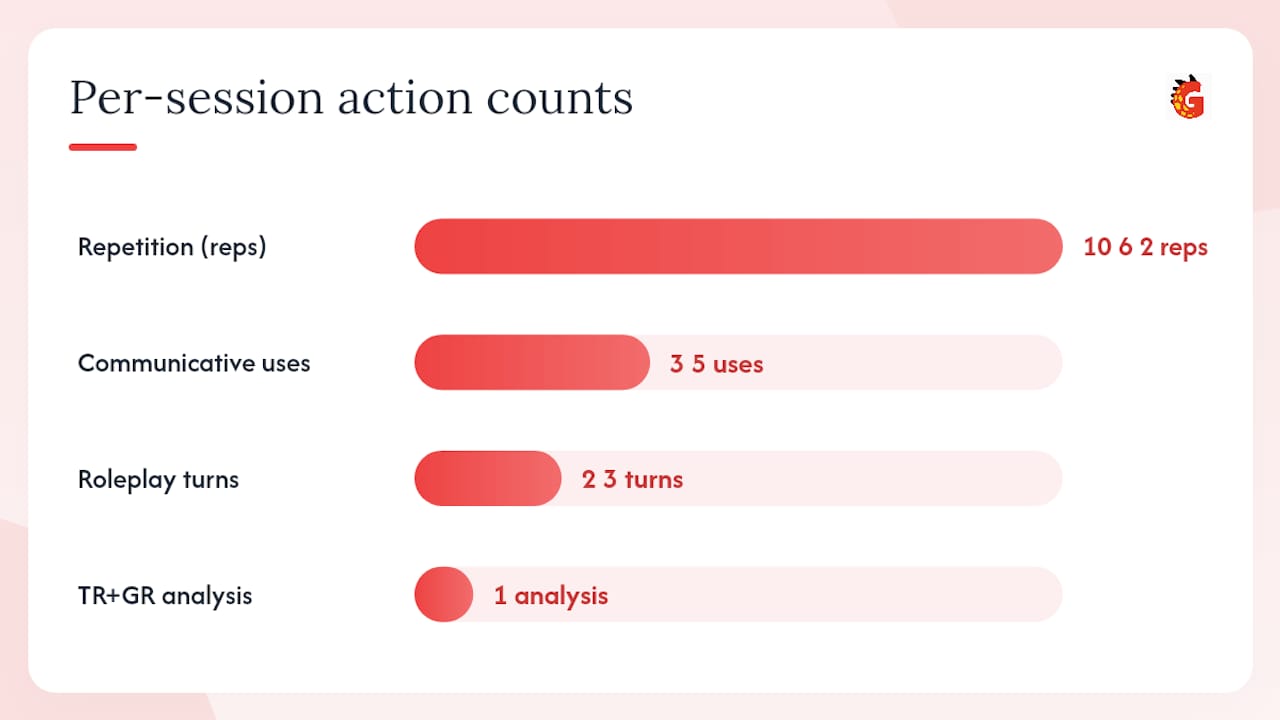
Design rules that matter most: keep focused drill sessions to 5-15 minutes, space them across days rather than cramming, and always end with at least three communicative uses of the target structure. Immediate feedback on errors is more effective than delayed correction. If you are drilling solo, record yourself and compare your output to a model sentence.
Pro Tip: Design every drill so that your reply changes the situation - a correct answer moves the conversation forward, a wrong one stalls it. That communicative pressure is what separates a drill that builds instinct from one that builds habit.
Ready-to-run drills for common travel scenarios
Ordering food (target: conditional quisiera)
- Hear the cue: ¿Qué desea?
- Reply: Quisiera el menú del día, por favor.
- Repeat 10 times with varied food items (quisiera una mesa para dos / quisiera la cuenta).
- Switch to communicative use: have a partner ask follow-up questions (¿Con o sin postre?) and respond naturally.
- Log any hesitation on quisiera vs. quiero - that gap is your next drill target.
Asking for directions (target: imperatives + prepositions)
- Cue: Perdone, ¿cómo llego al metro?
- Reply: Siga recto, gire a la derecha en la segunda calle.
- Drill 10 variations (left/right, first/second street, traffic light/corner).
- Communicative transfer: partner gives you a real map location and you navigate verbally.
Buying a ticket (target: numbers + ir a + infinitive)
- Cue: ¿Cuántos billetes quiere?
- Reply: Voy a comprar dos billetes para Madrid, por favor.
- Drill 8-10 reps with different destinations and quantities.
- Add a payment follow-up: ¿Va a pagar en efectivo o con tarjeta?
Timed micro-workout (15 minutes total):
- Warm-up (2 min): shadow a model dialogue at native speed.
- Focused pattern drill (8 min): 10-12 mechanical reps on one structure.
- Communicative transfer (4 min): 3 live or recorded exchanges using the structure.
- Cooldown (1 min): log one error and write the correct form once.
Key Takeaways
Grammar-focused travel practice, not phrasebook memorization, is what produces automatic spoken responses in real airport, hotel, and restaurant interactions.
| Point | Details |
|---|---|
| Define the training goal | Spanish travel vocabulary context means grammar drills for travel situations, not word lists. |
| Prioritize six contexts | Airport, hotel, food, transit, payments, and emergencies cover about 80% of traveler interactions. |
| Use TR+GR sequencing | Task repetition plus grammatization produces the best delayed accuracy, which is what counts under travel pressure. |
| Test with three axes | Measure accuracy (under 10% errors), latency (under 2 seconds), and fluency before you travel. |
| Train with Gramanator | Gramanator’s structured travel-context drills and progress tracking implement this exact workflow from A1 to C1. |
Gramanator puts this workflow into practice for you
Most learners know they need to practice. The gap is having a system that runs the right drills, catches errors in real time, and tells you exactly where your automaticity breaks down. That is what Gramanator is built to do.
The platform’s travel-context drill paths cover every scenario in this article: airport check-in, ordering food, directions, payments, and emergencies. Each session combines mechanical repetition, communicative transfer, and instant feedback on structural errors - the exact sequence the research supports. Progress tracking shows your accuracy and latency trends over time, so you know when a pattern is proceduralized and when it still needs work.
Getting started takes three steps: start a free trial, select a travel grammar path, and run your first 15-minute micro-workout today. You can explore the full platform and begin drilling the structures that matter most for your destination.