Spanish Emergency Phrases: Real Scripts for Spain
When you need help in Spain, three sentences can make all the difference. Say them in this order: “Es una emergencia” (EHS oo-nah eh-mehr-HEN-syah) to…

When you need help in Spain, three sentences can make all the difference. Say them in this order: “Es una emergencia” (EHS oo-nah eh-mehr-HEN-syah) to signal urgency, then “Necesito una ambulancia / un médico / la policía” (neh-seh-SEE-toh) to name the service you need, and finally “Estoy en [your location]” (ehs-TOY en) to give your position. That three-line structure is exactly what dispatchers expect when they answer a 112 call, and it gets help moving faster than any longer explanation.
Short, literal sentences beat complex translations under stress because your brain’s grammar recall collapses when adrenaline spikes. Dispatchers work in high-pressure, multilingual environments and prefer one-line answers over halting attempts at full sentences.
The three things every dispatcher needs from you:
- Urgency: “Es una emergencia” or “Necesito ayuda” (I need help)
- Service requested: ambulance, police, or fire service
- Location: street address, km marker, or landmark
Pro Tip: If your Spanish runs out immediately, say “Inglés, por favor” (EEN-glehs, por fah-VOR) right after your first sentence. The operator will transfer you to an English-speaking colleague, often within seconds.
Key Takeaways
The three-line opening script (urgency, service, location) is the single most important thing to memorize before any trip or move to Spain.
| Point | Details |
|---|---|
| Three-line opening script | Say “Es una emergencia,” name the service, then give your location - in that order. |
| Say “Inglés” early | Requesting an English operator right after your opener gets you transferred fast. |
| Top four medical phrases | “No puedo respirar,” “Tengo dolor en el pecho,” “Está inconsciente,” “Soy alérgico/a a...” change triage priority immediately. |
| Location template | “Estoy en Calle [X], número [Y], [city]” or “Estoy en la carretera [A-4], kilómetro [X]” gives dispatchers what they need. |
| Gramanator for automaticity | Structured timed drills on Gramanator build the instinctive recall that makes these phrases available under real stress. |
Table of Contents
- How do you call 112 in Spain and what will the dispatcher ask?
- What medical phrases do you need in a Spanish emergency?
- How do you report a crime and file a denuncia in Spain?
- What do you say for fires, gas leaks, and road accidents?
- How do you give a precise location in Spanish?
- Which pronunciation rules help you be understood fast?
- What should you have ready before an emergency happens?
- How do you make emergency phrases automatic in 7 days?
- Gramanator turns emergency phrases into instinctive responses
- Sources
How do you call 112 in Spain and what will the dispatcher ask?
Spain’s single emergency number is 112, available 24/7 for police, medical, and fire emergencies. Separate lines exist too: 061 for medical emergencies, 091 for the national police, and 080 for fire services in most cities. For most travelers, 112 is the only number you need to memorize.
English-speaking operators are widely available on 112, but delivering your first three sentences in Spanish often speeds the call considerably. The dispatcher can begin dispatching help while you are still talking, rather than waiting for a transfer.
What dispatchers typically ask (and how to answer):
- ¿Cuál es la emergencia? (What is the emergency?) - “Hay un accidente” / “Está inconsciente”
- ¿Está consciente? (Is the patient conscious?) - “Sí” or “No”
- ¿Está respirando? (Is the patient breathing?) - “Sí” or “No”
- ¿Cuál es su dirección? (What is your address?) - State street, number, city
Example call script 1 - house emergency:
Example call script 2 - unconscious person on the street:
“Necesito ayuda. Hay una persona inconsciente. Estoy frente al Mercado Central, Valencia.” Dispatcher: ¿Está respirando? You: “No lo sé.” (I don’t know.)
| Spanish phrase | English meaning | When to use |
|---|---|---|
| Necesito ayuda | I need help | Any emergency opener |
| Es una emergencia | It’s an emergency | First sentence on any call |
| Necesito una ambulancia | I need an ambulance | Medical emergency |
| Necesito a la policía | I need the police | Crime or threat |
| Necesito a los bomberos | I need the fire service | Fire or gas leak |
What medical phrases do you need in a Spanish emergency?
Medical staff triage faster when you give them short, direct symptom phrases rather than descriptions. The sentences below cover the situations that change treatment decisions most dramatically.
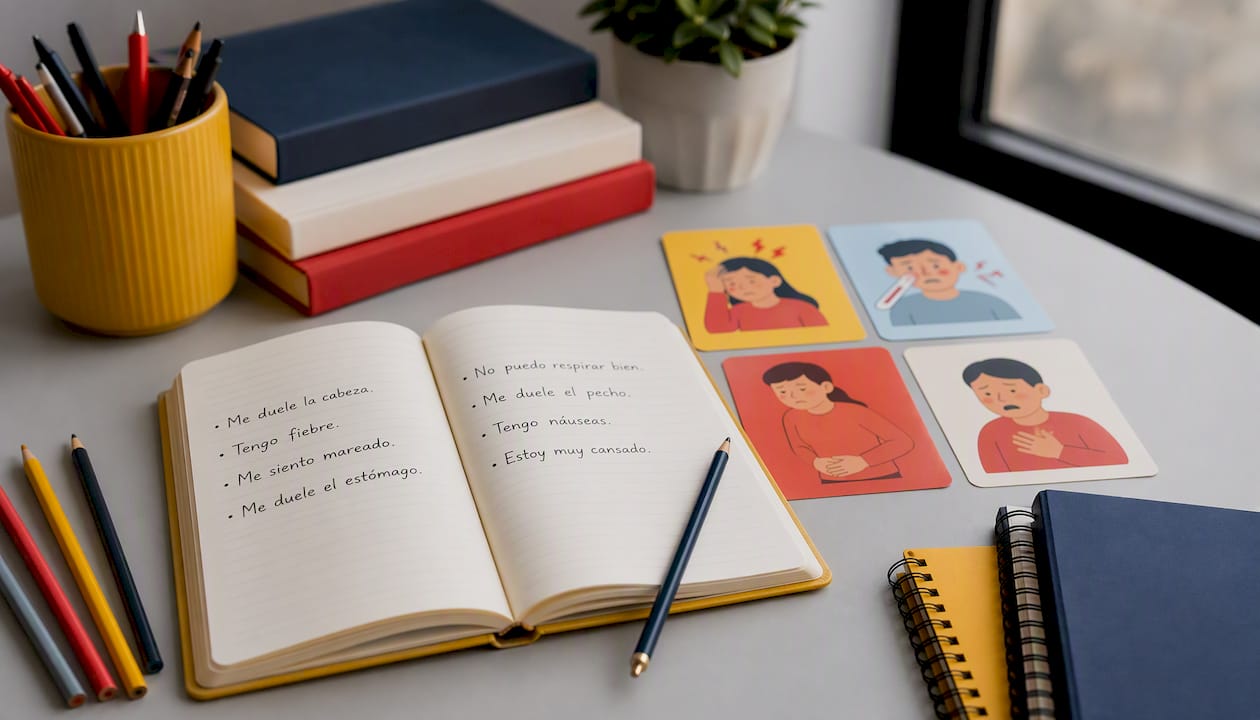
| English phrase | Spanish phrase | Phonetic hint | When to use |
|---|---|---|---|
| I can’t breathe | No puedo respirar | no PWEH-doh reh-spee-RAR | Breathing difficulty |
| I have chest pain | Tengo dolor en el pecho | TEN-goh doh-LOR en el PEH-choh | Cardiac symptoms |
| She/he is unconscious | Está inconsciente | ehs-TAH een-kon-SYEN-teh | Unconscious person |
| I am pregnant | Estoy embarazada | ehs-TOY em-bah-rah-SAH-dah | Pregnancy complication |
| I am allergic to... | Soy alérgico/a a... | soy ah-LEHR-hee-koh/ah ah | Allergy declaration |
| I take... (medication) | Tomo... | TOH-moh | Medication disclosure |
| Since this morning | Desde esta mañana | DEHS-deh EHS-tah mah-NYAH-nah | Symptom timeline |
Declaring allergies immediately with “Soy alérgico/a a...” and announcing pregnancy with “Estoy embarazada” are the two facts that most directly change triage priority and treatment choices. Common allergens to know in Spanish: penicilina (penicillin), frutos secos (tree nuts), mariscos (shellfish), lactosa (lactose), gluten.
When describing pain, point to the body part and say “Me duele aquí” (it hurts here). Add punzante (stabbing, poon-SAN-teh) or sordo (dull, SOR-doh) to help the nurse classify severity. Triage nurses will often follow up with ¿Desde cuándo? (Since when?) and ¿Toma alguna medicación? (Are you on any medication?), so have your timeline and medication names ready.
Minimal triage sequence to rehearse:
- State the symptom: “Tengo dolor en el pecho.”
- Add the timeline: “Desde hace una hora.” (For about an hour.)
- Declare allergies: “Soy alérgico a la penicilina.”
- List medications: “Tomo aspirina y metformina.”
How do you report a crime and file a denuncia in Spain?
When something is stolen or you witness a crime, the first call goes to 112 or 091. At the scene, keep your statement short:
- “Me han robado.” (They robbed me / I’ve been robbed.) - meh ahn roh-BAH-doh
- “Necesito a la policía.” (I need the police.)
- “Estoy en [location].”
At the police station, you will file a denuncia (formal complaint). Asking for “una copia de la denuncia” before you leave is legally critical for insurance claims and replacing a stolen passport. Many travelers forget this step and must return to the station the next day.
Useful phrases at the station:
- “Quiero poner una denuncia.” (I want to file a report.) - KYEH-roh POH-nehr oo-nah deh-NOON-syah
- “Me han robado el pasaporte / la cartera.” (They stole my passport / wallet.)
- “¿Habla inglés?” (Do you speak English?)
- “¿Puede hablar más despacio, por favor?” (Can you speak more slowly, please?)
- “Necesito un intérprete.” (I need an interpreter.)
- “Quiero una copia de la denuncia.” (I want a copy of the report.)
Steps at the police station:
- Tell the officer at the desk: “Quiero poner una denuncia.”
- Describe what happened in simple sentences.
- Provide your passport or ID when asked.
- Before leaving, say: “¿Puedo tener una copia de la denuncia?”
- Keep the copy safe for your insurance company and embassy.
What do you say for fires, gas leaks, and road accidents?
Some emergencies require a shout before a phone call. These attention words carry across noise and distance:
- ¡Fuego! (FWEH-goh) - Fire!
- ¡Socorro! (soh-KOR-roh) - Help! (classic distress call)
- ¡Auxilio! (owk-SEE-lyoh) - Help! (urgent, slightly more formal)
- ¡Ayuda! (ah-YOO-dah) - Help!
- ¡Cuidado! (kwee-DAH-doh) - Watch out!
- ¡Llamen a los bomberos! (YAH-men ah lohs bom-BEH-rohs) - Call the fire service!
For a gas leak: “Hay un escape de gas.” (There is a gas leak.) For heavy smoke: “Hay mucho humo.” (There is a lot of smoke.) To ask people to evacuate: “¡Salgan del edificio!” (Everyone leave the building!)
At a traffic accident, the two most important phrases for the dispatcher are:
- “Hay heridos.” (There are injured people.) - AY eh-REE-dohs
- “No hay heridos.” (No one is injured.) - the dispatcher’s triage priority changes completely depending on which you say
For motorway incidents, give the road number and kilometer marker: “Estoy en la autovía A-4, kilómetro noventa y dos, dirección Madrid.” If you don’t know the km marker, name the nearest exit or a visible landmark.
Pro Tip: Move to a safe spot before calling 112 at a road accident or fire. A 30-second delay to reach safety is worth it. Once safe, use visible landmarks or a business sign if you cannot see a km marker.
How do you give a precise location in Spanish?
Dispatchers need your location in the first 30 seconds. Use these ready-made templates:
- Street address: “Estoy en Calle [name], número [X], [city].” (I am on [street], number [X], [city].)
- Motorway: “Estoy en la carretera [A-7 / N-340], kilómetro [X].” - dispatchers rely on road number and km point for fast location on highways
- Building and floor: “Estoy en el [primer / segundo] piso.” (I am on the [first / second] floor.)
- Hotel: “Estoy en el Hotel [name], habitación [X], [city].”
- Beach: “Estoy en la playa de [name], cerca de [landmark].”
- GPS coordinates: “Mis coordenadas son [latitude], [longitude].” - useful when you have no address
When you have no street number, name a nearby business, monument, or intersection: “Estoy frente a [business name]” (I am in front of [business name]) or “Estoy en la esquina de [street A] y [street B]” (I am at the corner of [street A] and [street B]).
Speak slowly and repeat your address once. Dispatchers often confirm it back to you: if they repeat it correctly, say “Sí, correcto.” If not, say “No, es...” and give it again.

Which pronunciation rules help you be understood fast?
You don’t need perfect Spanish pronunciation in an emergency. You need to be understood. A few rules cover most of the high-stakes words:
- Vowels are pure and short: A = “ah,” E = “eh,” I = “ee,” O = “oh,” U = “oo.” Never slide them like English vowels.
- J sounds like a strong English H: emergencia = eh-mehr-HEN-syah; herido = eh-REE-doh
- Ñ sounds like “ny”: mañana = mah-NYAH-nah
- LL sounds like “y”: llamen = YAH-men
- H is always silent: herido starts with the “e” sound, not “h”
Shoutable words and their phonetics:
- ¡Ayuda! - ah-YOO-dah
- ¡Socorro! - soh-KOR-roh
- ¡Auxilio! - owk-SEE-lyoh
- ¡Fuego! - FWEH-goh
These short attention words are effective for alerting bystanders and responders in any public space. In Catalonia or the Basque Country, locals may speak Catalan or Basque, but Spanish works in virtually every emergency context across Spain. If you are relocating to a region with a co-official language, resources like regional education differences in Spain give useful context on where local languages are most prominent.
Speak at a normal, clear pace rather than shouting words. Confident, steady delivery is easier to understand than fast, panicked speech. Dispatchers are trained to work with stressed callers, but clarity always helps.
What should you have ready before an emergency happens?
Preparation takes five minutes and can save critical time at a hospital or police station.
Documents and items checklist:
- Passport or national ID card
- European Health Insurance Card (EHIC) or private insurance card
- Written allergy list in Spanish (see phrases below)
- Current medications with dosages, in Spanish if possible
- Emergency contact name and phone number
- Travel insurance policy number
Phrases to present documents:
- “Tengo mi pasaporte.” (I have my passport.)
- “Aquí está mi tarjeta de seguro.” (Here is my insurance card.)
- “Soy alérgico/a a [allergen].” (I am allergic to [allergen].)
- “Tomo [medication], [dosage] al día.” (I take [medication], [dosage] per day.)
Pro Tip: Lock a screenshot of your allergy list and medication names in Spanish on your phone’s lock screen. Medical staff can read it even if your phone is password-protected and you are unconscious.
Pharmacies in Spain are trained to treat many minor emergencies without a prescription, and tourist police in major cities often speak English. For a minor cut, mild allergic reaction, or stomach issue, walking into a farmacia and saying “Necesito ayuda, por favor” can get you treated faster than calling 112.
How do you make emergency phrases automatic in 7 days?
Knowing a phrase and producing it under stress are two different skills. The goal is automaticity, which means the sentence comes out before you have time to think about it. Language professionals recommend short rehearsed phrases practiced until they become instinctive, because grammar recall collapses under high-stress conditions.
7-day micro-practice plan (10-15 minutes daily):
- Day 1: Memorize the three-line opening script. Say it aloud ten times, timing yourself.
- Day 2: Add the four medical phrases (breathing, chest pain, unconscious, allergy). Drill them in pairs.
- Day 3: Practice giving your current location using the street template. Change the address each time.
- Day 4: Simulate a 112 call aloud. Play both roles: caller and dispatcher.
- Day 5: Add police phrases. Practice the denuncia sequence from call to station.
- Day 6: Add fire and road phrases. Drill the shoutable words at full volume.
- Day 7: Full 3-minute simulated emergency call covering all scenarios. Time yourself.
Sample 3-minute drill:
- 0:00 - Say the three-line opener for a medical emergency
- 0:30 - Answer three dispatcher questions with one-line responses
- 1:00 - Give your location using the street template, then the motorway template
- 1:30 - Declare allergies and medications
- 2:00 - Switch to a police scenario: report a theft, ask for a denuncia copy
- 2:30 - Shout the fire attention words, then give a motorway location
Timed repetition is what separates passive knowledge from real performance. If you want to build that kind of recall across broader Spanish contexts, why grammar matters for Spanish fluency explains the training rationale behind structured drills and how automaticity develops through repetition under pressure.
Gramanator turns emergency phrases into instinctive responses
Memorizing a list of phrases is a start. Producing them under stress, without hesitation, is the real goal.
Gramanator is built for exactly that kind of training. The platform’s timed grammar workouts and mistake-focused repetition drills train your brain to produce Spanish sentences automatically, not just recognize them. You can work through real-life emergency contexts, including medical and travel situations, using structured drills that reinforce the exact sentence patterns this guide covers. Honest scope: Gramanator builds grammatical automaticity and phrase recall. It is not a substitute for medical or legal training, and it won’t replace a certified interpreter in a complex legal situation. What it does exceptionally well is turn phrases you’ve studied into sentences you can actually say when it counts. Start your free trial at Gramanator and see how quickly timed drills change your recall speed, or check the Gramanator plans to find the right fit.
Sources
These are the primary references used to build this guide. Each covers a specific aspect of emergency communication in Spain.
- Spanish Words and Phrases to Help You in An Emergency - SpanishEnglish
- Spanish Phrases for Travelers: What to Say in Urgent Situations - WORLDLANGS
- Emergency Services in Spain - 112, 061, 091 Explained
- Emergency Spanish: What to Say When You Need Help in Spain - SeekSpain