Spanish vocabulary vs grammar: What professionals need
Spanish vocabulary vs grammar for professionals. How to split study time based on your real work tasks and speaking goals.

Most adult Spanish learners hit the same wall: they wonder whether to drill vocabulary or focus on grammar, and they pick one almost at random. Understanding the real spanish vocabulary vs grammar learning benefits for your specific situation changes everything. If you are a professional preparing for meetings in Madrid or an expatriate navigating daily life in Mexico City, this is not an abstract debate. The choice you make shapes how fast you communicate, how accurately you express yourself, and whether your Spanish stays stuck at a functional level or actually grows into something fluent and natural.
Table of Contents
- How to evaluate your Spanish learning focus: criteria and goals
- Benefits of focusing on Spanish vocabulary for adult learners
- Advantages of mastering Spanish grammar through explicit instruction
- Spanish vocabulary and grammar: a side-by-side comparison
- Tailoring Spanish learning for professionals and expatriates: situational recommendations
- Rethinking the vocabulary vs grammar debate: a hybrid approach for lasting fluency
- Boost your Spanish fluency with targeted grammar practice from Gramanator
- Frequently asked questions
Key Takeaways
| Point | Details |
|---|---|
| Both vocabulary and grammar matter | To achieve Spanish fluency, learners must balance building vocabulary and mastering grammar. |
| Explicit grammar instruction boosts accuracy | Direct grammar teaching prevents common errors and accelerates professional-level accuracy. |
| Vocabulary builds communication foundation | Knowing high-frequency words enables early real-world communication and supports incidental learning. |
| Hybrid approach is best | Combining explicit grammar study with immersion and vocabulary practice yields lasting fluency. |
| Tailor learning to goals | Professionals and expatriates should customize focus based on their communication needs and proficiency level. |
How to evaluate your Spanish learning focus: criteria and goals
Before you commit to any learning approach, you need a clear picture of where you are and where you need to go. The wrong focus at the wrong stage wastes months of effort.
Ask yourself these questions honestly:
- What is your current level? A beginner at A1 needs different tools than someone sitting at B1 trying to break through to professional fluency.
- What does your Spanish actually need to do? Negotiating contracts in Spanish demands a different skill set than ordering food or chatting with neighbors.
- Are you prioritizing accuracy, fluency, or both? Accuracy means saying things correctly. Fluency means saying them without stopping to think. Professionals usually need both, but in different proportions at different stages.
- What type of usage dominates your day? Conversational Spanish forgives more errors than written reports or formal presentations.
- How much time can you study consistently? Short-term vocabulary wins are satisfying but grammar gains compound over time.
- Are you comfortable with explicit study (consciously learning rules) or do you prefer implicit learning (absorbing language through exposure)? Research strongly suggests adult learners benefit most from explicit instruction combined with rich input.
Knowing these answers before you read further will make the recommendations in this article far more useful to you.
Benefits of focusing on Spanish vocabulary for adult learners
Vocabulary is the raw material of communication. Without words, grammar has nothing to work with. This is why many effective Spanish language learning strategies start here, especially at beginner levels.
The core benefits of Spanish vocabulary focus include:
- Speed to basic communication. Learning the most frequent 2,000 to 3,000 Spanish words gives you access to the vast majority of everyday speech. You can ask questions, follow conversations, and handle common workplace situations.
- Better comprehension of real-world input. Once you understand enough words, you start learning more just by listening and reading. This is called incidental acquisition. Vocabulary frequency lists with spaced repetition (SRS) yield 2 to 5% incidental acquisition rates, building a foundational lexicon for real-world communication within 3 to 6 months.
- Cognitive wins from spaced repetition. SRS tools schedule reviews at the optimal moment before you forget a word. This dramatically increases retention compared to reading a list once.
- Faster payoff for beginners. If you are a professional or expatriate just starting out, vocabulary growth feels immediate and motivating. You remember a word today and use it tomorrow.
- Support for grammar learning. The more words you know, the more grammar examples you can understand and practice with. Vocabulary and grammar are not competitors; they feed each other.
Understanding the difference between ser and estar, for example, becomes much easier once you have enough vocabulary to work through real sentence examples rather than abstract rules alone.
Pro Tip: Build audio-anchored vocabulary lists. Instead of reading words silently, listen to native speaker recordings as you study. This links the correct pronunciation to the word in memory from day one, which helps both comprehension and speaking confidence.
Advantages of mastering Spanish grammar through explicit instruction
Here is where many adult learners underinvest. Vocabulary gives you words. Grammar gives you the structure to use those words accurately and flexibly. The benefits of grammar-focused Spanish learning go well beyond sounding polished.
Key advantages include:
- Metalinguistic awareness. When you understand why a sentence is correct, you can self-correct in real time. This is something implicit learners often lack, especially under pressure in professional settings.
- Preventing fossilized errors. Fossilization happens when incorrect patterns get so deeply ingrained that you stop noticing them. Common examples include mixing up ser and estar, or using the wrong verb tense consistently. Explicit instruction catches these early.
- Faster route to B2 fluency. Explicit grammar instruction produces significantly larger effects (d greater than 0.8) than implicit methods alone for adult accuracy in forms like Spanish ser/estar. That is a large effect size by any research standard.
- Mastery of complex forms. The Spanish subjunctive mood, for instance, is notoriously hard to acquire through exposure alone. Explicit study of its rules and triggers makes it manageable.
- Confidence in formal registers. Professionals writing emails, presenting proposals, or negotiating in Spanish need grammatical precision. A wrong tense or mood in a formal context reads as incompetence, not just a minor accent.
“Explicit instruction outperforms implicit by large margins for grammar, but combining it with rich input multiplies benefits for Spanish professionals aiming for B2 fluency in 12 to 18 months.”
Pro Tip: Prioritize grammar points that have clear rules and are nearly impossible to pick up through listening alone. The subjunctive mood, the distinction between preterite and imperfect, and the use of formal registers (usted versus tú) are all high-priority targets for professional learners.
Start applying these rules with real exercises through structured grammar practice designed specifically for adult learners.
Spanish vocabulary and grammar: a side-by-side comparison
Having explored each skill separately, comparing them directly helps you see which to prioritize at each stage of your learning.
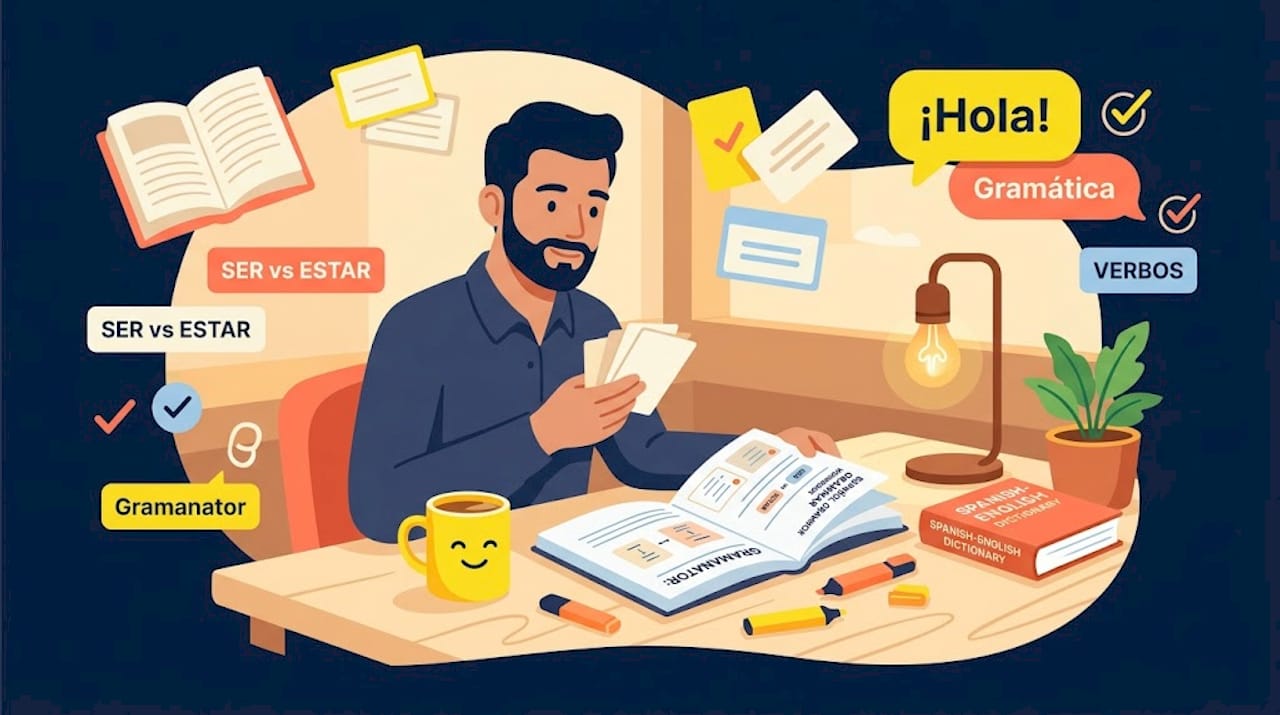
| Dimension | Vocabulary focus | Grammar focus |
|---|---|---|
| Acquisition speed | Fast early gains; slows after 3,000 words | Slower initial payoff; accelerates accuracy over time |
| Retention method | Spaced repetition, contextual exposure | Pattern drilling, conscious rule application |
| Communicative impact | High at beginner level; enables basic interaction | High at intermediate and advanced levels; enables precision |
| Professional suitability | Essential for initial workplace survival | Essential for negotiation, formal writing, presentations |
| Error risk | Grammatical errors masked by word-level communication | Fewer errors, more natural-sounding output over time |
| Best learning method | SRS apps, frequency lists, immersive input | Explicit instruction, monitored output, error correction |
| Fluency contribution | Builds comprehensible input base | Builds accuracy and flexibility in real-time speech |
| Combining both | Combining both methods multiplies gains significantly | Works best when vocabulary base supports grammar examples |
One important threshold: vocabulary acquisition beyond 1,000 words shifts to incidental learning when 95 to 98% of input is comprehensible. Below that threshold, acquisition stalls. This is why building a strong vocabulary base early is not optional. It is the foundation that makes everything else work.
Tailoring Spanish learning for professionals and expatriates: situational recommendations
Generic advice is rarely useful. Here is what to actually do based on your situation.
- If you are a beginner (A1 to A2), start with high-frequency vocabulary lists and an SRS tool. Get to 1,500 to 2,000 words as quickly as possible. This unlocks real-world input and makes grammar examples meaningful.
- Introduce explicit grammar instruction early, even as a beginner. Do not wait until you feel “ready.” Learning basic verb conjugations and sentence structure from day one prevents bad habits from forming.
- Use comprehensible input constantly. Podcasts, graded readers, and native-speaker conversations at your level keep you absorbing correct patterns. This is how grammar rules move from conscious knowledge to automatic use.
- At the intermediate level (B1 to B2), shift more attention toward grammar. Verb mood distinctions, object pronouns, and formal registers become the bottlenecks. This is where many adult learners plateau without targeted grammar work.
- Prioritize grammar points that directly affect your professional context. If you write business emails in Spanish, the subjunctive in formal requests (Le agradecería que...) is worth more than obscure vocabulary.
- Practice monitored output regularly. Speaking and writing in Spanish where someone can correct you is irreplaceable. It forces your conscious grammar knowledge into active use and exposes gaps you did not know existed.
Pro Tip: Record yourself speaking Spanish for 60 seconds on a professional topic once a week. Listen back and note errors in tense, agreement, or word choice. This simple habit reveals patterns in your mistakes that you can then address with targeted grammar study.
The hybrid approach combining explicit grammar instruction with immersion produces the most natural speech for expatriate communication. Neither alone is sufficient for the demands of professional Spanish.
Rethinking the vocabulary vs grammar debate: a hybrid approach for lasting fluency
Here is something most resources will not tell you directly: framing this as a debate is itself the problem. Choosing one side and sticking with it is how adult learners get stuck.
Pure vocabulary memorization without grammar gives you a collection of words you cannot reliably arrange into correct, precise sentences. Pure grammar study without sufficient vocabulary leaves you knowing rules you cannot apply because you do not have enough words to practice with. Both roads stall progress.
The research is clear on this. Vocabulary and grammar are best acquired simultaneously through comprehensible input at the i+1 level (meaning input that is just slightly above your current level). Isolated study of either skill in a vacuum fails to produce the automatic, fluent use that professionals and expatriates actually need.
What actually works is what linguists call “noticing.” When you study a grammar rule explicitly, you prime your brain to notice it in the wild. You hear the subjunctive in a conversation and recognize it instead of letting it wash past. Explicit grammar primes this noticing, which then feeds implicit acquisition. The rule becomes automatic through repeated exposure after you first understood it consciously.
The practical takeaway is this: treat grammar study and vocabulary building as two parallel tracks, not a sequence. Read Spanish grammar insights on specific structures while simultaneously consuming input where those structures appear naturally. When you encounter a word you do not know, look it up. When you encounter a grammar form you cannot explain, study it explicitly. This is not complicated. It just requires resisting the urge to pick a lane and ignore the other.
Fossilized errors almost always come from one of two sources: too much implicit exposure without correction, or too much rote memorization without real use. The hybrid model avoids both.
Boost your Spanish fluency with targeted grammar practice from Gramanator
Understanding the importance of grammar is one thing. Having a structured place to practice it daily is another.
Gramanator is built specifically for adult professionals and expatriates who want to move past survival Spanish and into genuine fluency. The platform offers over 10,000 interactive grammar exercises covering real-world scenarios including workplace communication, travel, and cultural conversations. Every exercise comes with detailed explanations of grammar structure, hints, and mistake breakdowns so you understand why an answer is correct, not just what it is. Personalized recommendations track your strengths and weaknesses, so your study time goes exactly where it will help most. Explore Gramanator’s plans and start turning grammar knowledge into fluent, confident Spanish.
Frequently asked questions
Which is more important for Spanish fluency: vocabulary or grammar?
Both are essential and work best together. Vocabulary gives you the building blocks to express ideas, while grammar gives you the structure to express them accurately. Both are best acquired simultaneously through comprehensible input for automatic real-world use.
Can I become fluent just by learning Spanish vocabulary?
No. Vocabulary alone does not produce fluent, precise communication. Explicit grammar instruction produces significantly larger effects on accuracy than vocabulary study alone, and without it, persistent errors become hard to correct.
How does explicit grammar instruction benefit adult learners?
It teaches you the rules behind correct usage, which helps you self-correct in real time and avoid fossilized errors. Explicit instruction outperforms implicit methods for grammar accuracy, particularly for complex forms like the subjunctive.
Is immersion enough to learn Spanish grammar effectively?
Immersion builds natural-sounding speech but often leaves gaps in difficult grammar points. Explicit grammar yields short-term accuracy gains while immersion supports fluency, and combining both produces the best results.
What are some effective strategies for building Spanish vocabulary?
Start with frequency-based word lists paired with spaced repetition tools. Maintain a study environment where 95 to 98% of your input is comprehensible to keep incidental acquisition rates high and vocabulary growth consistent.