Spanish Expat Daily Conversation Grammar Guide
Speak Spanish confidently as an expat. Daily conversation grammar for shops, appointments, and small talk, tuned for adult learners in Spain.

If you are living abroad and struggling to get past basic phrases, your problem probably is not vocabulary. It is grammar that blocks you. The challenge of spanish expat daily conversation grammar is real: you may know hundreds of words, yet still freeze when someone asks ¿Cuándo llegaste? (When did you arrive?). This guide cuts through the noise. You will learn which grammar patterns actually matter for daily life, which mistakes trip up nearly every expat, and exactly how to practice so that the grammar becomes instinct instead of effort.
Table of Contents
- Key takeaways
- Core grammar essentials for daily Spanish conversations
- Common grammar pitfalls for expats and how to fix them
- Using language chunks and conversation fillers
- Speaking practice routines that actually work for expats
- My honest take on expat language learning
- Train your grammar until it becomes instinct
- FAQ
Key takeaways
| Point | Details |
|---|---|
| Three tenses cover most ground | Present, preterite, and near future handle the vast majority of expat daily conversations. |
| Ser vs. estar is the top error | Learning the DOCTOR and PLACE mnemonics dramatically reduces this common mistake. |
| Chunks beat word-by-word building | Pre-learned phrase chunks like es que... make you sound natural and buy thinking time. |
| Speaking badly early wins | Attempting imperfect Spanish builds trust with locals and speeds up integration significantly. |
| Ten minutes daily beats long sessions | Short, structured daily practice outperforms occasional marathon study sessions every time. |
Core grammar essentials for daily Spanish conversations
Here is something most expats do not hear early enough: you do not need to master all Spanish tenses to function well. Prioritizing three tenses allows you to handle housing, transport, pharmacies, banks, and healthcare communication with confidence. Those three are present tense, preterite, and the near future construction using ir + a + infinitivo.
The three survival tenses
- Present tense (presente): Use it for everyday facts, routines, and current situations. Vivo en Madrid (I live in Madrid). Trabajo por la mañana (I work in the morning). This tense alone covers a huge portion of daily speech.
- Preterite (pretérito indefinido): Use it to describe completed past events. Fui al banco ayer (I went to the bank yesterday). Llamé al médico (I called the doctor). Expats need this tense constantly when explaining situations to landlords, neighbors, and officials.
- Near future (ir + a + infinitivo): Use it to express plans and intentions. Voy a llamar mañana (I am going to call tomorrow). Van a arreglar el problema (They are going to fix the problem). This construction is far more common in speech than the full future tense.
Pro Tip: Before moving to other tenses, drill these three until they feel automatic. Understanding Spanish grammar at the survival level means recognizing that these tenses are the backbone of daily expat life.
Five verbs that do the heaviest lifting
Once you have the tenses, focus on five core verbs that appear in almost every conversation:
- Ser and estar (to be, two different verbs)
- Tener (to have): Tengo una cita (I have an appointment)
- Ir (to go): ¿Dónde va este autobús? (Where does this bus go?)
- Hacer (to do/make): ¿Qué hago aquí? (What do I do here?)
These five verbs appear in an enormous share of common Spanish phrases for expats. If you can conjugate them confidently in the three survival tenses, you already have a working grammar foundation. Check the Gramanator grammar blog for detailed conjugation breakdowns with real-life examples.
Common grammar pitfalls for expats and how to fix them

Knowing the rules and automatically applying them under conversational pressure are two very different things. Ser vs. estar confusion is the top grammar error among Spanish learners, and gender agreement mistakes follow closely. Knowing this means you can prioritize your practice time on exactly what matters.
Ser vs. estar: a clear comparison
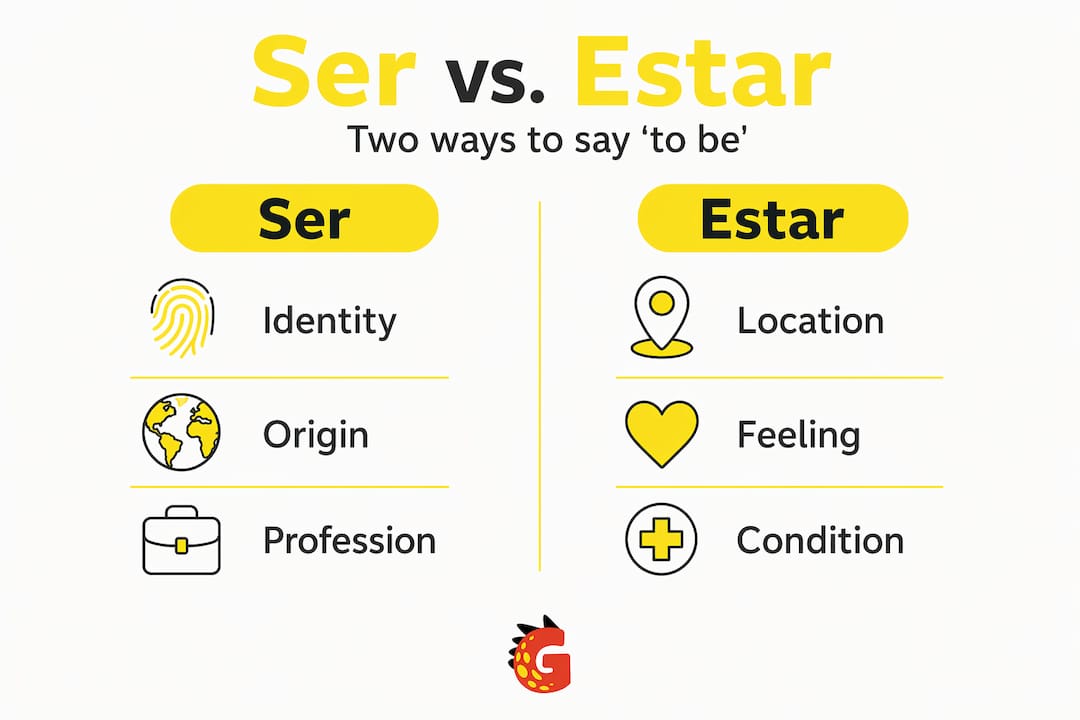
Both ser and estar translate as “to be” in English, which is why they cause so much trouble. Think of ser as the verb of permanent identity and estar as the verb of temporary state.
| Verb | Use for | Example |
|---|---|---|
| Ser | Identity, origin, profession, characteristics | Soy estadounidense. (I am American.) |
| Estar | Location, emotions, temporary conditions | Estoy cansado. (I am tired.) |
| Ser | Time, dates, events | La reunión es a las tres. (The meeting is at three.) |
| Estar | Progressive actions | Estoy comiendo. (I am eating.) |
Memory trick: Use DOCTOR for ser (Description, Occupation, Characteristic, Time, Origin, Relationship) and PLACE for estar (Position, Location, Action, Condition, Emotion). You can go deeper with the ser vs. estar complete guide to see every rule with practical examples.
Gender agreement and how to remember it
Spanish nouns are masculine or feminine, and adjectives must match. El médico nuevo but la médica nueva. Expats frequently say el problema grande (correct) but also slip into el mano (wrong, it is la mano). A few strategies that work:
- Learn nouns with their article from the start: say la calle, not just calle.
- Group exceptions and memorize them as a short list rather than fighting individual words.
- When you use essential expat Spanish vocabulary, always note the article alongside each noun.
Pro Tip: Weekly timed sentence drills, where you write or say ten sentences using ser and estar correctly in under three minutes, build the automatic response your brain needs. Knowing the rule matters far less than having practiced it until the right verb comes out without thinking.
Using language chunks and conversation fillers
One of the most practical Spanish conversation tips you will get: stop building sentences one word at a time. Native speakers do not do this, and it is the main reason expat speech sounds halting even when the grammar is technically correct.
Using chunks and fillers such as es que... and a ver... creates natural conversational flow and buys you thinking time without going silent. Experts recommend integrating these into your speech early because they accelerate oral fluency faster than drilling isolated grammar rules.
Common filler phrases and what they do
- A ver... (Let me see / Well...) Buys a second of thinking time. A ver, creo que sí. (Let me think, I believe so.)
- Es que... (The thing is...) Introduces an explanation or excuse. Es que no entendí bien. (The thing is, I did not understand well.)
- O sea... (I mean / That is...) Clarifies or rephrases. O sea, necesito más tiempo. (I mean, I need more time.)
- Pues... (Well...) A filler that starts a response. Pues, no sé exactamente. (Well, I am not exactly sure.)
- ¿Sabes? (You know?) Checks for understanding and sounds conversational.
How to build chunk-based speech
Instead of memorizing grammar rules and then constructing sentences, collect ready-made language chunks for your most common situations.
- Identify your top five daily scenarios: ordering food, asking for directions, speaking with your landlord, at the pharmacy, and at work.
- For each scenario, memorize four to six chunks that cover the most common exchanges. For the pharmacy: Me duele aquí (It hurts here), ¿Tiene algo para...? (Do you have something for...?), ¿Cuántas veces al día? (How many times a day?).
- Practice each chunk aloud in context, not as isolated vocabulary.
- Gradually expand each chunk by substituting one element at a time: ¿Tiene algo para el dolor? becomes ¿Tiene algo para la tos? (for the cough).
This is how conversational competence builds in real life. You are not translating. You are reacting with prepared material that becomes automatic over time.
Speaking practice routines that actually work for expats
Having grammar knowledge and being able to speak under real-life pressure are not the same thing. The gap between them closes through one thing: consistent speaking practice. Ten minutes of structured daily practice outperforms a two-hour session once a week. Your brain builds fluency through repeated, distributed exposure, not occasional intensity.
Here is a practical routine you can start this week:
- Morning shadowing (five minutes). Find a short audio clip in Spanish, a podcast, a YouTube video, or a conversation app. Play it and repeat every phrase simultaneously, matching the speaker’s rhythm and intonation. Shadowing native audio bypasses analytical learning and builds automaticity. The psychological block to speaking often comes from discomfort with your own pronunciation, not from grammar gaps, and shadowing fixes this directly.
- Daily self-talk (five minutes). Narrate your morning routine in Spanish, out loud, alone. Me levanto a las siete. Preparo el café. Voy al trabajo en metro. This trains grammar in context without the social pressure of a conversation partner.
- Topic island rehearsal (ten minutes, three times a week). Choose one daily scenario and practice it as a full conversation with yourself or a recording device. Use your pre-learned chunks. Pre-planned phrase chunks for recurring daily scenarios enable smoother conversations and faster integration for expats.
- Record yourself once a week. Play it back. Notice where you hesitate. That hesitation points to the grammar pattern you need to drill next.
Pro Tip: Speak badly on purpose in low-stakes situations: with a cashier, a neighbor, a waiter. Attempting imperfect Spanish improves relationships with locals and service providers. Errors are data, not failures. The expats who progress fastest are the ones who embrace the awkward stage instead of waiting to feel ready.
You can also use Gramanator’s grammar weakness identifier to pinpoint exactly which patterns your speaking practice should target next.
Why many expats stay stuck despite studying grammar
Language teachers often observe the same pattern among expats learning Spanish. Many spend months studying grammar, building vocabulary, and waiting until they feel "ready" to speak. Then, when a native speaker talks at a natural pace, they hesitate or remain silent - not because they lack knowledge, but because they have not yet developed automaticity.
One principle consistently supported by language learning research is that grammar becomes useful through production, not through memorization alone. Communicative effectiveness depends on adaptation, not flawless grammar. Learners who make steady progress are rarely those with perfect verb forms. They are the ones who become comfortable communicating despite making mistakes and gradually refine their accuracy through practice.
Experienced tutors often follow the same approach. Rather than spending every lesson explaining grammar rules, they create repeated opportunities to produce the language, provide immediate corrections, and reinforce the same structures until they become instinctive. Fluency is built through thousands of successful repetitions with timely feedback - not by reading one more grammar explanation.
As Daria Tsibina, Founder of Gramanator, experienced while preparing for university entrance exams with a private English tutor, this training approach was the single biggest accelerator of language learning. Consistent practice, immediate feedback, and repeated exposure transformed grammar from something consciously remembered into something used automatically. That experience inspired Gramanator: a Spanish grammar gym designed to deliver structured, high-volume practice with instant feedback, helping learners build the same automaticity whether or not they have regular access to native speakers or a personal tutor.
One simple habit can make a meaningful difference: commit to producing Spanish every day. Say a few sentences out loud, write a short paragraph, or complete a focused grammar session with feedback. Grammar becomes instinct through repeated use - not through reading about it.
Train your grammar until it becomes instinct
If this guide gave you clarity on where to focus, Gramanator gives you the structure to make it stick. The platform is built for exactly the kind of expat language learning described here: targeted grammar drills, real-life conversation contexts, and daily practice workouts that train your instincts instead of testing your memory.
Gramanator covers everything from present tense conjugations to ser vs. estar mastery, with immediate feedback and mistake-focused repetition so you are always training your weak spots. Start your grammar training today and see your first personalized workout in minutes. If you are ready to commit, explore the Gramanator grammar plans and choose the right level for where you are now.
FAQ
What grammar tenses should expats learn first?
Start with present tense, preterite, and the ir + a + infinitivo near future construction. These three tenses cover most daily expat interactions, from housing and healthcare to transport and banking.
Why do expats confuse ser and estar so often?
Both verbs translate as “to be” in English, which has no equivalent distinction. Use the DOCTOR mnemonic for ser (Description, Occupation, Characteristic, Time, Origin, Relationship) and PLACE for estar (Position, Location, Action, Condition, Emotion).
How can I sound more natural when speaking Spanish?
Stop constructing sentences word by word. Instead, memorize pre-built chunks and filler phrases like a ver, es que, and o sea. These phrases buy thinking time and match how native speakers actually talk.
How much daily practice do expats actually need?
Ten minutes of structured speaking practice every day produces more progress than a long session once or twice a week. Consistency matters more than duration. Shadowing, self-talk, and topic island rehearsal are the most efficient formats.
Is it worth speaking Spanish before your grammar is perfect?
Absolutely. Attempting Spanish with imperfect grammar builds trust with locals and speeds up integration. Communicative effectiveness comes from adapting to your listener, not from grammatical perfection.