Porque, Por Qué, Porqué & Por Que: Quick Rules That Stick
Porque, Por Qué, Porqué & Por Que: Quick Rules That Stick

Porque, Por Qué, Porqué & Por Que: Quick Rules That Stick
Here’s the one-sentence version: porqué is a noun (“the reason”), por qué asks or reports a question (“why”), porque answers with a cause (“because”), and por que is a preposition glued to a relative pronoun or another word’s required “que.” Every confusing sentence you’ve ever hit boils down to figuring out which of these four jobs the word is doing.
You don’t need to memorize a wall of rules to get this right. You need a handful of tests you can run in two seconds:
- Can you slide an article in front of it (el porqué, un porqué)? It’s the noun.
- Can you swap it for “por qué motivo” or “por qué razón” and it still makes sense? It’s the interrogative.
- Is it introducing the reason for something, answering a “why”? It’s the conjunction.
- Can you insert “el/la/los/las” between por and que (por el que)? It’s the preposition-plus-relative combo.
This isn’t guesswork. The Real Academia Española and FundéuRAE both frame the distinction the same way: stop treating these as four spellings of one word, and start asking what grammatical job each one is doing.
Key Takeaways
Choosing correctly among porqué, por qué, porque, and por que comes down to identifying the word’s grammatical role, then applying one matching test, not memorizing four spellings.
| Point | Details |
|---|---|
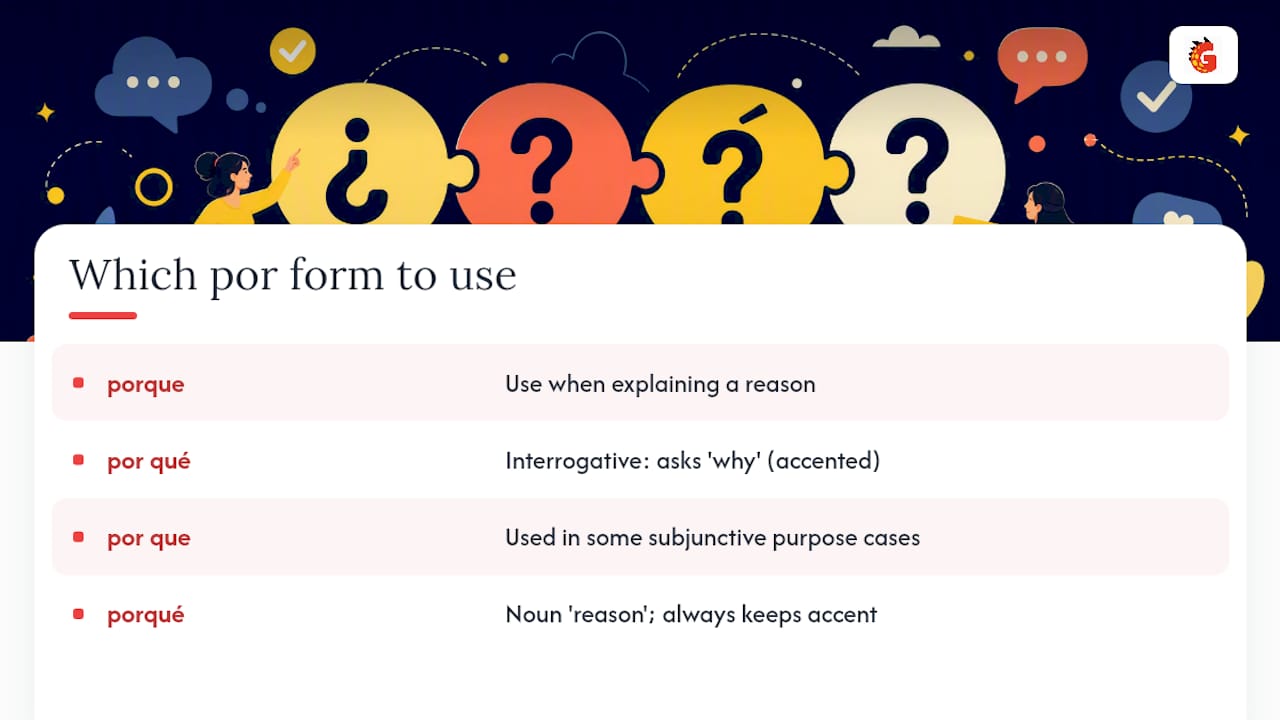
| Porqué is a noun | Test with an article (“el porqué”) and remember it pluralizes as “los porqués.” |
| Por qué asks “why” | Works in direct and indirect questions and exclamations; substitute “por qué motivo” to confirm. |
| Porque answers “why” | One word, no accent, introduces a cause; rarely also expresses purpose with subjunctive. |
| Por que splits by grammar | Insert an article (por el que) to confirm a relative pronoun; otherwise “por” is required by another word. |
| Train it with repetition | Gramanator turns these substitution and article tests into daily drills until the choice becomes automatic. |
Table of Contents
- Porqué: the noun hiding in plain sight
- Por qué: asking (or reporting) a question
- Porque: the conjunction that answers “why”
- Por que: when grammar forces por and que apart
- A four-step test you can run in seconds
- Where learners go wrong, and how to fix it
- Quick practice: short drills and a one-week plan
- Train these distinctions until you don’t have to think about them
- Frequently Asked Questions
- Sources
Porqué: the noun hiding in plain sight
Porqué is a masculine noun. It means “the cause,” “the reason,” or “the motive,” and like any noun, it plays by noun rules: it takes an article, it takes a possessive, and it pluralizes.
That last part trips people up the most, because English speakers rarely expect “why” to have a plural form. Spanish doesn’t blink at it: los porqués is completely standard when you’re talking about multiple reasons behind something.
Run the article test whenever you’re unsure. If you can naturally say “el porqué” or “su porqué,” you’ve got the noun. Try it on these:
- No entiendo el porqué de su decisión. (“I don’t understand the reason for his decision.”) Swap in “la razón” and the sentence still works.
- Su porqué era simple: quería empezar de cero. (“His reason was simple: he wanted to start over.”)
- Nunca explicó los porqués de su renuncia. (“She never explained the reasons for her resignation.”)
The RAE’s Diccionario panhispánico de dudas confirms this is the only one of the four forms that functions as a full noun, determiner and all.
Por qué: asking (or reporting) a question
Por qué is two words: the preposition “por” plus the interrogative or exclamative “qué.” You’ll see it in direct questions, indirect questions, and exclamations, and in every case it’s asking for a cause.
The substitution test here is almost identical to the noun test, just phrased differently: try replacing the phrase with “por qué motivo” or “por qué razón.” If the sentence still makes sense, you’re dealing with the interrogative, not the noun and not the conjunction.
Compare these three:
- Direct question: ¿Por qué llegaste tarde? (“Why did you arrive late?”)
- Indirect question: No sé por qué llegaste tarde. (“I don’t know why you arrived late.”)
- Exclamative: ¡Por qué cosas se preocupa la gente! (“The things people worry about!”)
Notice that indirect question. This is where most learners slip, because English collapses “why did you” and “I don’t know why” into structures that feel grammatically different, while Spanish keeps the same accented, two-word “por qué” in both. According to Academia Mexicana de la Lengua, indirect interrogatives never lose that accent or merge into one word, no matter how buried the question feels inside the sentence.
Porque: the conjunction that answers “why”
Porque is one unaccented word, and it’s a conjunction. Its main job is causal: it introduces the reason behind something, usually as the answer to a “why” question or as a subordinate clause that explains a main clause.
This is the workhorse of the four forms. Every time you explain a decision, justify an action, or answer someone’s “¿por qué?”, you’re almost certainly reaching for porque.
- Llegué tarde porque había mucho tráfico. (“I arrived late because there was a lot of traffic.”)
- No fui a la fiesta porque estaba cansado. (“I didn’t go to the party because I was tired.”)
There’s a secondary, less common use worth knowing: porque can express purpose (“in order that”) when it’s followed by a subjunctive verb, functioning close to “para que.” The RAE’s Diccionario panhispánico de dudas documents this final sense directly, and it’s also where things get genuinely blurry, because in some of these subjunctive-purpose constructions, both “por que” and “porque” are considered acceptable. Outside of that narrow overlap, porque stays one word with no accent, full stop.
Por que: when grammar forces por and que apart
Por que is the trickiest of the four because it isn’t really one grammatical unit. It’s two separate pieces that happen to land next to each other: either “por” (preposition) plus “que” (relative pronoun), or “por” required by a specific verb, noun, or adjective, followed by the conjunction “que” introducing its clause.
Wikilengua suggests the cleanest way to spot it: try inserting an article between por and que. If “por el que,” “por la que,” or “por los que” works, you’re looking at the relative pronoun case.
- Este es el motivo por que luchamos. → expandable to el motivo por el que luchamos. Relative pronoun confirmed.
- Estoy preocupado por que llegues tarde. Here, “preocupado” grammatically requires “por,” and “que” simply introduces the clause. No article fits, so it’s the second case.
As FundéuRAE notes, this second pattern (por required by another word, plus que) is where the por que/porque overlap with subjunctive purpose clauses tends to show up. When in doubt, expand the phrase or try substitution before you commit.
A four-step test you can run in seconds
When you’re staring at a sentence and can’t decide which form fits, run through these steps in order:
- Is it naming a thing? Try slipping in an article. If “el porqué” works, stop there. It’s the noun.
- Is it asking about, or reporting, a cause? Swap it for “por qué motivo.” If that fits, use por qué, and keep it two words with the accent.
- Is it introducing an answer or a reason? If the sentence is explaining “why” rather than asking it, use porque, one word, no accent.
- Is “por” required by another word, with “que” tagging along? Try inserting an article between them. If it works, it’s a relative pronoun; if not, it’s still por que, just two separate pieces.
Example run-through: “No entiendo ___ no viniste.” Step 1 fails (no article fits). Step 2 works (“por qué motivo no viniste” makes sense). Answer: por qué.
Where learners go wrong, and how to fix it
The four forms sound identical out loud, which is exactly why writers mix them up. Here are the pairs that cause the most damage:
“No entiendo el porqué” vs. “No entiendo por qué.” Both are correct Spanish, but they mean slightly different things. The first names the reason as a thing (“I don’t understand the reason”). The second asks about the cause directly (“I don’t understand why”). Mixing up the article signals which one you meant.

Joining indirect questions into one word. Writing “porque” when you mean an indirect question (“no sé porque llegaste tarde”) is one of the most common errors flagged by the RAE’s Diccionario panhispánico de dudas. Fix: if the sentence could stand alone as a direct question, it needs the accented, two-word por qué.
Assuming por que always needs an article to work. Sometimes “por” is simply required by a verb like “preocuparse por,” and no article will ever fit. Don’t force the test; if it fails, check whether another word in the sentence is grammatically demanding “por.”
Quick practice: short drills and a one-week plan
Fill in the blank, then check your answer.
- Nadie sabe ___ se fue tan pronto. (por qué)
- Se enojó ___ llegamos tarde. (porque)
- Ese es el motivo ___ decidí quedarme. (por que → expandable to “por el que”)
Answer key: 1. por qué, 2. porque, 3. por que.
Ten to fifteen minutes a day for one week is enough to make these tests automatic. Day one, drill porqué and por qué side by side. Day two, add porque. Days three and four, mix in por que. From day five on, pull real sentences from anything you’re reading and turn each one into a ten-second test: cover the tricky word, guess the form, then check.
Pro Tip: Next time you read a Spanish article or book, circle every instance of these four forms before you check which one it is. Predicting first, then verifying, builds the pattern-recognition your brain needs far faster than reading explanations alone.
Turning this into instinct rather than a rule you look up every time is exactly the kind of repetition Gramanator is built around.
Train these distinctions until you don’t have to think about them
Knowing the four tests is one thing. Reaching for the right form in the middle of a live conversation, without pausing to run through steps, is another skill entirely, and it only comes from repeated, structured practice. Gramanator was built for exactly that gap: instead of re-reading grammar rules, you drill them in real contexts until the correct choice fires automatically.

The platform’s structured grammar training runs from A1 to C1, with daily workouts that mix tricky pairs like this one into real-life scenarios, from workplace emails to travel conversations. Each drill gives immediate feedback, so a porque/por qué mix-up gets corrected on the spot instead of hardening into a habit. If the one-week plan above helped, the Gramanator platform extends that same approach into a full daily system, and you can check current plans and pricing to start your first structured workout today.
Frequently Asked Questions
Is it “por qué” or “porque” when answering a question? Use porque. If someone asks “¿Por qué no viniste?” and you’re explaining your reason, your answer starts with porque: “Porque estaba enfermo.”
Why do porque and por qué sound the same but mean different things? Spanish accent marks affect meaning, not just pronunciation weight in casual speech. Por qué carries stress on “qué” as a genuine interrogative, while porque is unstressed and functions as a connector, a distinction FundéuRAE says is best resolved by function, not sound.
Can “por que” and “porque” both be correct in the same sentence? In specific subjunctive constructions expressing purpose, yes. The RAE’s Diccionario panhispánico de dudas documents this narrow overlap, but outside of that case, the two forms aren’t interchangeable.
How do I know if I need an accent on “que”? If the word is functioning as an interrogative or exclamative (asking or reporting a “why”), it needs the accent: por qué. If it’s a relative pronoun or a plain conjunction, no accent: por que or porque.
Does “porqué” ever need an accent removed? No. As a noun, porqué always keeps its accent and stays one word, regardless of whether it’s singular (“el porqué”) or plural (“los porqués”).
Sources
For deeper reference, check the RAE’s Español al día for definitions, FundéuRAE for practical usage guidance, the Diccionario panhispánico de dudas for nuanced subjunctive cases, and Wikilengua for learner-friendly expansion tests.
- «Porqué» / «porque» / «por qué» / «por que» | Español al día
- «porqué», «porque», «por que» y «por qué» | FundéuRAE
- Porque, porqué o por qué - Academia Mexicana de la Lengua