Spanish Tax Terminology Explained for Non-Residents
If you are a foreigner dealing with Spanish authorities, six terms will come up before anything else: NIE/NIF (your tax ID), NAF/NUSS (your social security…

If you are a foreigner dealing with Spanish authorities, six terms will come up before anything else: NIE/NIF (your tax ID), NAF/NUSS (your social security number), IRPF (resident income tax), IRNR (non-resident income tax), IVA (VAT), retenciones (withholdings), and Modelo 210 (the non-resident tax form). Knowing these seven items by name, meaning, and context means you can read a letter from Hacienda, follow a conversation with your gestor, and file correctly without guessing.
- NIE / NIF - your Spanish tax identification number
- NAF / NUSS - your social security affiliation number
- IRPF - personal income tax paid by residents (worldwide income)
- IRNR - income tax paid by non-residents (Spanish-source income only)
- IVA - value-added tax (Spain’s equivalent of sales tax / VAT)
- Retenciones - tax withheld at source, like U.S. withholding
- Modelo 210 - the standard non-resident income tax return
183-day rule: Spend more than 183 days in Spain in a calendar year and you become a tax resident. That single threshold switches your filing obligation from IRNR (Spanish-source income only) to IRPF (worldwide income), which changes everything about how much you owe and which forms you file.
Table of Contents
- What are the Spanish identification numbers you need?
- How do the main Spanish taxes differ for residents vs. non-residents?
- How do you read a Spanish payslip?
- What property tax terms will you see on Spanish documents?
- Which AEAT forms and digital tools do non-residents use?
- How do common U.S. tax terms translate into Spanish?
- How do you pronounce key Spanish tax terms correctly?
- How do you make Spanish tax vocabulary stick?
- Key Takeaways
- Practice Spanish tax phrases faster with Gramanator
- Official sources and suggested further reading
What are the Spanish identification numbers you need?
Understanding Spanish tax vocabulary starts with knowing which number goes where. Spain separates tax identifiers from labor identifiers, and mixing them up causes delays with both Hacienda and Social Security.
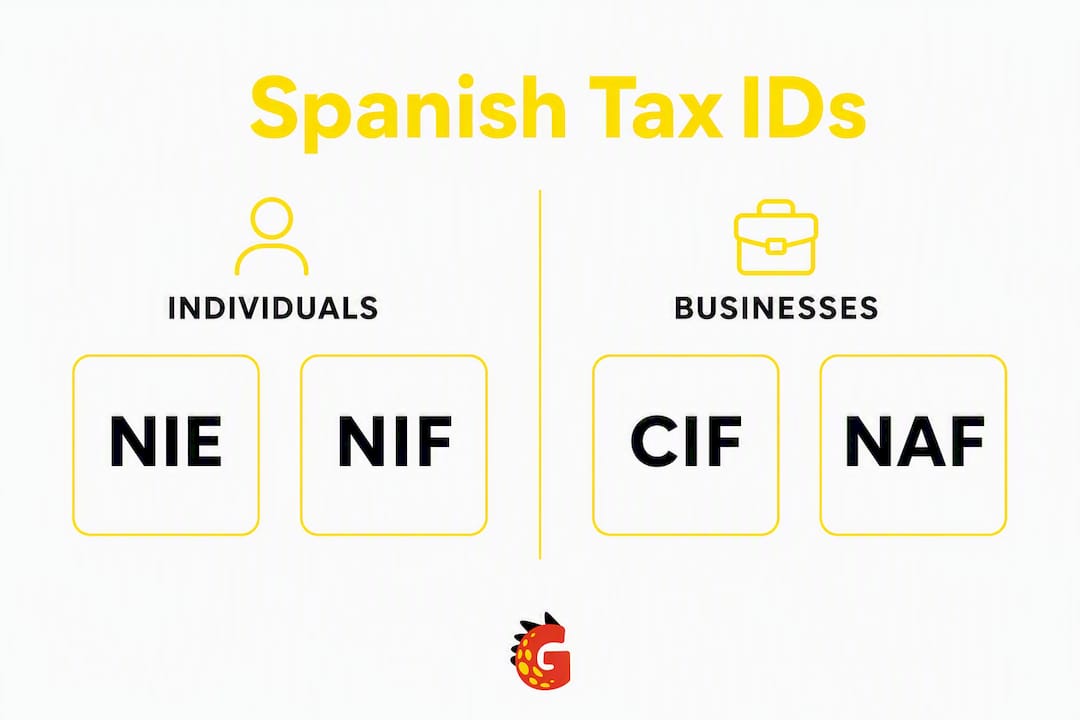
NIE (Número de Identificación de Extranjero) is the foreigner identification number issued by the National Police. It looks like X1234567Z. NIF (Número de Identificación Fiscal) is the tax identifier used by the Agencia Tributaria. For most foreigners, the NIE becomes the NIF once you register with Hacienda. They share the same string, but they serve different systems. Many expats assume the NIE alone covers their tax filings; you must explicitly register with the Agencia Tributaria so that number functions as a NIF, otherwise administrative delays occur.

CIF (Código de Identificación Fiscal) is the business equivalent. If you set up a Spanish company, the CIF is what appears on invoices and contracts.
For employment or social security, you need a NAF (Número de Afiliación a la Seguridad Social), also called the NUSS (Número de la Seguridad Social). This is issued by the Tesorería General de la Seguridad Social and must be obtained before any paid work begins. Your employer uses it to register your payroll contributions; without it, you cannot access healthcare or pension benefits.
Pro Tip: Register your NAF with Social Security and your NIE/NIF with Hacienda as two separate steps. Completing one does not complete the other. Do both before your first paycheck arrives.
How do the main Spanish taxes differ for residents vs. non-residents?
Spanish public charges fall into three legal categories: impuestos (taxes paid to the Treasury without direct compensation), tasas (fees for specific public services), and contribuciones especiales (special levies for public works that benefit a property). The taxes non-residents encounter most are IRPF, IRNR, and IVA.
| Spanish Term | English Equivalent | Where It Appears |
|---|---|---|
| IRPF | Personal Income Tax | Resident annual return, payslip |
| IRNR | Non-Resident Income Tax | Modelo 210, rental contracts |
| IVA | Value Added Tax (VAT) | Invoices, receipts, contracts |
| Impuesto | Tax (general) | Official letters, forms |
| Tasa | Fee / Levy | Municipal bills, service invoices |
| Contribución especial | Special levy | Property deeds, municipal notices |
IRPF (Impuesto sobre la Renta de las Personas Físicas) is Spain’s progressive personal income tax for residents, with top progressive rates depending on the region. IRNR (Impuesto sobre la Renta de No Residentes) applies to non-residents and covers only Spanish-source income. The IRNR rates differ depending on residency status within the EU/EEA or outside it. That gap is significant, and correctly determining your residency status at the outset is the most consequential decision you will make in the Spanish tax system.
IVA (Impuesto sobre el Valor Añadido) is Spain’s VAT. The general rate is 21%, with reduced rates for food, medicine, and certain services. You will see it broken out on every Spanish invoice.
Regional rules also matter. Madrid and Andalucía, for example, offer very low wealth tax in some cases, while other regions tax more heavily. The same IRPF income can produce a meaningfully different bill depending on where you live.
How do you read a Spanish payslip?
A nómina is a Spanish payslip. Every employed worker receives one monthly, and it contains several terms that directly affect your take-home pay.
Retenciones are tax withholdings deducted from your gross salary each month and sent to Hacienda on your behalf. They function exactly like U.S. federal income tax withholding on a W-2. At year-end, your actual IRPF liability is calculated, and you either receive a refund (devolución) or pay the difference.
Cotizaciones are social security contributions, split between employee and employer. These fund healthcare, unemployment insurance, and pensions. They appear as a separate line on the nómina and are distinct from retenciones.
If you work as an autónomo (self-employed), the structure changes entirely. You register with Hacienda using Modelo 036 or 037, invoice clients with IVA added, and file quarterly IRPF and IVA returns yourself. There is no employer to handle withholdings for you.
Key nómina line items to recognize:
- Salario bruto - gross salary before deductions
- Retención IRPF - income tax withheld
- Cuota obrera SS - employee social security contribution
- Salario neto - net take-home pay
What property tax terms will you see on Spanish documents?
Non-resident property owners encounter a specific cluster of Spanish tax vocabulary that appears on municipal bills, deeds, and official notices.
IBI (Impuesto sobre Bienes Inmuebles) is the annual municipal property tax. Think of it as Spain’s equivalent of U.S. property tax. The amount is calculated from the Valor Catastral, which is the government’s assessed value of the property. This figure appears on your deed (escritura) and on the IBI bill itself.
Plusvalía municipal (Impuesto sobre el Incremento de Valor de los Terrenos de Naturaleza Urbana) is a municipal tax on the increase in land value when a property is sold. It is calculated by the local council and appears on the sale deed. Sellers typically pay it, though contracts sometimes shift the obligation.
Pro Tip: As a non-resident property owner, Spanish law requires you to appoint a fiscal representative if you are outside the EU/EEA. Official notices, including IBI bills and tax demands, are served to that representative. Without one, you may miss deadlines without knowing it.
Non-residents who earn rental income from Spanish property must file Modelo 210 to declare that income under IRNR. The same form covers deemed income on unrented properties.
Which AEAT forms and digital tools do non-residents use?
The Agencia Tributaria (also called Hacienda) manages tax filings through an electronic platform at sede.agenciatributaria.gob.es. Here are the forms you will encounter most:
- Modelo 036 / 037 - registration with Hacienda as a taxpayer or autónomo; 036 is the full version, 037 is a simplified version for individuals
- Modelo 100 - the annual resident personal income tax return (IRPF)
- Modelo 210 - the non-resident income tax return; used for rental income, property gains, and deemed income on Spanish property
To file electronically, you need either a Digital Certificate (Certificado Digital) or access through Cl@ve, Spain’s digital identity system. The Digital Certificate is required for many mandatory filings and is issued by FNMT (Fábrica Nacional de Moneda y Timbre). Practitioners treat it as a practical requirement, not an optional convenience. Without it, many interactions with Hacienda require an in-person appointment.
When filing, have your NIE/NIF, Spanish bank IBAN, and property cadastral reference (referencia catastral) ready. The AEAT portal has an English-language interface at sede.agenciatributaria.gob.es/Sede/en_gb.
How do common U.S. tax terms translate into Spanish?
When you speak with a Spanish adviser or official, using the right Spanish equivalent of a U.S. tax term prevents confusion. The table below maps the most common U.S. concepts to their Spanish counterparts.
| U.S. Term | Spanish Equivalent | Usage Note |
|---|---|---|
| W-2 | Certificado de retenciones | Ask your employer for this at year-end |
| - | Factura / Certificado de ingresos | Used for freelance or investment income |
| Tax return | Declaración de la renta | The annual IRPF or IRNR filing |
| Refund | Devolución | Hacienda pays this after processing |
| Withholding | Retención | Deducted monthly from salary or invoices |
| Tax ID number | NIF / NIE | Use this on all official forms |
| Filing deadline | Plazo de presentación | Check AEAT each year for exact dates |
One common false friend: renta in Spanish means “income” or “income tax return,” not “rent.” If you say “mi renta” to a tax official, they understand your income or your tax filing. For rental payments, use alquiler.
Sample phrases for written or phone contact with Hacienda or Social Security:
- “Quisiera solicitar información sobre mi declaración de la renta.” (“I would like to request information about my income tax return.”)
- “Necesito obtener mi certificado de retenciones.” (“I need to obtain my withholding certificate.”)
How do you pronounce key Spanish tax terms correctly?
Saying these terms correctly in a phone call or office visit builds confidence and gets faster responses. Here are simple phonetic guides for the highest-priority words:
- NIE - “nee-EH” (two syllables, stress on the second)
- NIF - “neef” (rhymes with “leaf”)
- IRPF - spell it out: “ee-EH-reh-peh-EF-eh”
- IVA - “EE-vah” (stress on the first syllable)
- Retenciones - “reh-ten-SYOH-nes”
- Nómina - “NOH-mee-nah” (stress on the first syllable)
- Modelo 210 - “moh-DEH-loh dos-SYEHN-tos dee-EZ”
Three ready-to-use phrases for official interactions:
- “Buenos días, llamo para preguntar sobre el Modelo 210.” (“Good morning, I’m calling to ask about Modelo 210.”)
- “¿Puede confirmar mi número de NIF, por favor?” (“Can you confirm my NIF number, please?”)
- “Necesito renovar mi certificado digital.” (“I need to renew my digital certificate.”)
Pro Tip: Record yourself saying these phrases once a day for a week. Hearing your own voice builds the muscle memory that makes the words come out naturally under pressure.
How do you make Spanish tax vocabulary stick?
Reading a glossary once is not enough. The phrases need to become automatic so you can use them under pressure, in a phone call, or when reading a letter that just arrived. Here is a two-week practice plan focused specifically on tax vocabulary:
- Days 1-3: Read one official form (Modelo 210 or a sample nómina) and write down every unfamiliar term. Look up each one and write a one-sentence English definition.
- Days 4-5: Practice the pronunciation guide above out loud. Record yourself on your phone and replay it.
- Days 6-7: Write three sample emails to Hacienda using the phrase templates in the previous section. Use the professional Spanish email grammar checklist to check your sentence structure.
- Week 2, Days 1-4: Log in to the AEAT demo portal and navigate to the Modelo 210 filing page. Read every field label aloud. This turns passive vocabulary into active recognition.
- Week 2, Days 5-7: Review your error list. Focus only on the terms you got wrong or hesitated on. Identifying your specific grammar weaknesses early means you spend practice time where it counts.
Targeted grammar drills and spaced repetition are especially effective for official phrase frames because they train the exact sentence structures you need, not general conversation. Gramanator’s daily grammar workouts let you drill the phrase patterns behind official Spanish, building the automatic recall that makes a Hacienda phone call feel manageable rather than stressful.
Key Takeaways
Understanding Spanish tax terminology means knowing which seven terms to learn first, confirming your residency status, and getting the right ID numbers registered with the right agencies before you file anything.
| Point | Details |
|---|---|
| Learn six terms first | NIE/NIF, NAF/NUSS, IRPF/IRNR, IVA, retenciones, and Modelo 210 cover most non-resident situations. |
| Residency status changes everything | Spending more than 183 days in Spain switches your filing from IRNR to IRPF and taxes worldwide income. |
| Register with two agencies separately | Your NIE/NIF goes to Hacienda; your NAF/NUSS goes to Social Security. One registration does not cover both. |
| Get a Digital Certificate early | The AEAT requires it for most electronic filings; apply through FNMT before your first deadline. |
| Gramanator builds phrase recall | Daily grammar drills on official Spanish phrases train the automatic recall you need for forms and phone calls. |
Regional tax rules vary significantly across Spain. Always verify current rates and deadlines directly on the Agencia Tributaria website or with a qualified tax adviser before filing.
Practice Spanish tax phrases faster with Gramanator
Tax Spanish is not casual Spanish. The phrases are formal, the sentence structures are specific, and a wrong word in a letter to Hacienda can cause real delays. Gramanator is built for exactly this kind of high-stakes language training.

The platform’s structured grammar drills go from A1 to C1 and include real-world official contexts, so you are not just learning grammar in the abstract. You are training the exact phrase patterns that appear on forms, in letters, and in phone calls with Spanish authorities. Daily micro-workouts keep vocabulary active without requiring hours of study. Immediate feedback on every drill means you correct mistakes before they become habits.
Start your free trial at Gramanator and build the grammar foundation that makes Spanish tax interactions feel natural, not intimidating.
Official sources and suggested further reading
- Agencia Tributaria (AEAT) - Tax Glossary - official definitions of base imponible, cuota, and other core terms; start here for any term you see on a Spanish tax form.
- Agencia Tributaria - Digital Certificate FAQ - step-by-step guidance on obtaining and using a Digital Certificate for AEAT filings.
- La Moncloa - Government portal - official guidance on NIE, NIF, and NAF registration across agencies.
- Administración.gob.es - Income tax for EU citizens - plain-language explanation of resident vs. non-resident tax obligations from the Spanish government.
- IRS Publication 850 - English-Spanish Tax Glossary - the IRS bilingual glossary; useful for mapping U.S. tax terms to Spanish equivalents when speaking with advisers.
- Invest in Spain - Tax System Guide - covers direct taxes, VAT, local taxes, and the role of regional authorities in a business context.
- Blevins Franks - Spanish taxation overview - practical summary of IRPF bands, regional wealth-tax differences, and planning considerations for expats.
Always verify tax rates, form deadlines, and eligibility rules directly on official AEAT or Tesorería pages before filing. Rates and thresholds change, and regional variations can significantly affect your liability.
This article provides general information about Spanish tax terminology and is not professional tax or legal advice. Confirm your specific obligations with a qualified Spanish tax adviser or the relevant official authority.