What Is Passive Se in Spanish? Full Guide With Examples
The passive se makes the thing being acted on the grammatical subject of the sentence, without ever naming who did the action.

The passive se makes the thing being acted on the grammatical subject of the sentence, without ever naming who did the action. The formula is short: se + a third-person verb + the thing acted on, and that verb has to agree in number with whatever noun follows it. You have already seen this everywhere. “Se vende casa” means “House for sale” (literally, “House sells itself”), and “Se venden casas” means “Houses for sale,” with venden switching to plural because casas is plural. That single agreement shift is the whole engine of passive se, and once you feel it, you will start noticing it on every “for rent” sign and restaurant menu you pass.
Key Takeaways
Passive se turns the thing acted on into the grammatical subject using se plus a third-person verb that must agree in number with that subject, and it only works with transitive verbs.
| Point | Details |
|---|---|
| Core formula | Use se + third-person verb, matching the verb’s number to the noun that follows it. |
| Transitivity requirement | Only verbs that take a direct object in their active form can build a passive se sentence. |
| No agent allowed | Passive se can never include a por phrase; switch to ser plus participle to name who did it. |
| People rule | When the object is a person, Spanish typically uses the personal a with an impersonal construction instead. |
| Daily practice line | Repeat “Se vende casa, se venden casas” aloud until the agreement shift feels automatic. |
Table of Contents
- What Is Passive Se in Spanish, Exactly?
- How Do You Form Passive Se? The Rules That Matter
- Where Do You Actually Hear Passive Se in Spanish?
- Passive Se vs. Impersonal Se: What’s the Difference?
- When Do Spanish Speakers Use Ser Plus Participle Instead?
- What Mistakes Do Learners Make With Passive Se?
- Practice: Test Your Passive Se Skills
- Ready to Make Passive Se Automatic?
- Where to Learn More About Spanish Passives
- Frequently Asked Questions
What Is Passive Se in Spanish, Exactly?
Passive se lets Spanish speakers describe an action on an object while leaving the doer out entirely. Nobody is announcing who is selling the house or who wrote the sign. The house itself becomes the subject, and the verb bends to match it. This is not some obscure textbook rule reserved for advanced grammar drills. According to Lingolia, passive se is the everyday, default way Spanish speakers express this idea, both in speech and writing, while the alternative construction with ser plus a past participle sounds noticeably more formal.
You will also hear this called the pasiva refleja in traditional grammar terms. That is the standard, cited-in-textbooks name for what you are about to learn, and you will see both labels used interchangeably as you keep studying. Don’t let the terminology intimidate you. The mechanics are simpler than the name suggests.
How Do You Form Passive Se? The Rules That Matter
Building a correct passive se sentence comes down to four moving parts, and each one has a job to do.
- Placement: Se goes directly before the conjugated verb, almost always at the front of the sentence or clause.
- Verb form: Only third-person forms are used, either singular or plural, never first or second person.
- Agreement: The verb must match the number of the noun that follows it, since that noun is functioning as the grammatical subject.
- Verb type: Only transitive verbs, meaning verbs that take a direct object when used actively, can form a passive se sentence.
That last rule is the one learners skip past too quickly, and it causes more mistakes than any other part of this construction. A transitive verb needs something to act on. Vender (to sell) is transitive. Llegar (to arrive) is not. That is why “Se vende casa” works but you would never say “Se llega casa.”
Watch how the direct object of an active sentence becomes the subject of the passive se version:
- Active: Venden pan en esa panadería (They sell bread at that bakery) → Passive se: Se vende pan en esa panadería (Bread is sold at that bakery).
- Active: Alquilan apartamentos en este edificio (They rent apartments in this building) → Passive se: Se alquilan apartamentos en este edificio (Apartments are rented in this building).
- Active: Necesitan camareros los fines de semana (They need waiters on weekends) → Passive se: Se necesitan camareros los fines de semana (Waiters are needed on weekends).
Notice pan stays singular and vende stays singular, while apartamentos and camareros are plural, pulling alquilan and necesitan into plural agreement right along with them.
Pro Tip: Before you commit to passive se, run a quick test. Find the direct object in the active version of your sentence. If it exists and it refers to a thing rather than a person, passive se almost certainly works. No direct object, no passive se.
Where Do You Actually Hear Passive Se in Spanish?
You run into passive se constantly, and once you know the pattern, it starts jumping out at you from storefronts, cookbooks, and public notices.
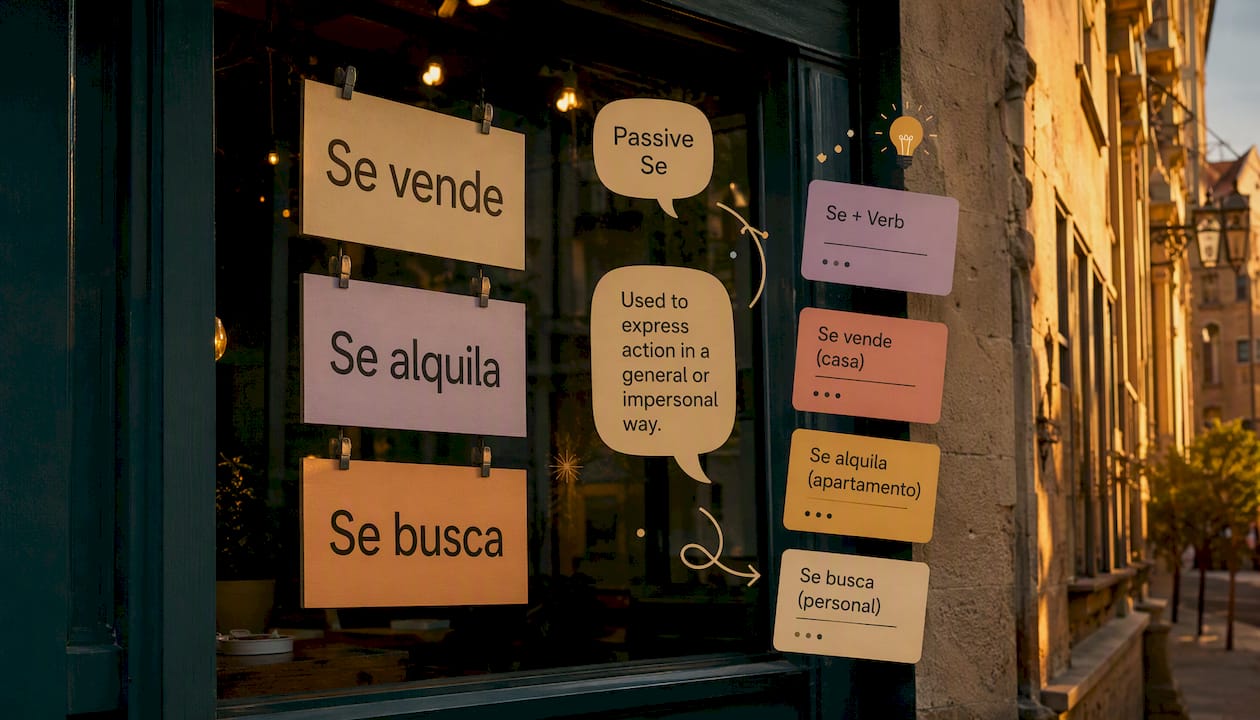
Classified ads and signs lean on this construction more than almost any other context. “Se vende” (for sale), “Se alquila” (for rent), and “Se busca” (wanted) appear on windows, bulletin boards, and online listings across the Spanish-speaking world. SpanishDict documents these exact phrases as some of the most common real-world examples of passive se, precisely because nobody needs to say who is doing the selling, renting, or searching. The context makes that obvious.
Recipes and instructions use the same pattern to describe steps without pointing at a cook. “Se cortan las cebollas en trozos pequeños” means “The onions are cut into small pieces,” and “Se hornea a 180 grados” means “It is baked at 180 degrees.” You will see this constantly in cookbooks and appliance manuals, where the focus stays on the process, not the person doing it.
Public announcements and rules follow the same logic. “Se prohíbe fumar” (Smoking is prohibited) and “Se aceptan tarjetas de crédito” (Credit cards are accepted) both put the rule or policy front and center. Statements about general availability work the same way: “Se habla inglés” (English spoken here) tells you what is available without identifying a specific employee.
One hard limit worth memorizing: passive se can never carry a por phrase to name the agent. You cannot say “Se vende la casa por el agente” to mean “The house is sold by the agent.” If you genuinely need to state who performed the action, you have to switch constructions entirely, which is exactly what the next section covers.
Passive Se vs. Impersonal Se: What’s the Difference?
These two constructions look almost identical on the surface, and that similarity trips up even learners who have studied Spanish for years. The distinction comes down to transitivity and whether a grammatical subject exists at all.
Compare these two sentences side by side: “Se venden libros” (Books are sold) is passive se, because libros is the subject and the verb agrees with it in the plural. “Se trabaja mucho aquí” (People work a lot here) is impersonal se, because trabajar is intransitive. There is no object to promote into a subject position, so the verb just stays locked in third-person singular no matter what.
Run through this quick decision check whenever you are unsure:
- Is the verb transitive, meaning does it take a direct object in its active form?
- Does that direct object exist in your sentence?
- Can that object shift into the grammatical subject position, pulling verb agreement with it?
If you answered yes to all three, you are looking at passive se. If the answer is no anywhere along that chain, you are dealing with impersonal se instead.
People create a special wrinkle here. When the “object” of the action is a person rather than a thing, Spanish typically marks that person with the personal a and defaults to an impersonal construction instead of true passive se. That is why you will hear “Se busca a un médico” (A doctor is being sought) rather than a sentence that treats médico as a plural-agreeing subject. The RAE confirms this pattern directly, noting that constructions involving people behave differently from the object-focused agreement rules that govern passive se with things. The verb in these people-cases tends to stay singular, treating the whole idea as an impersonal action rather than a true passive.
| Feature | Passive Se | Impersonal Se |
|---|---|---|
| Verb type required | Transitive | Any verb, including intransitive |
| Subject present | Yes, the thing acted on | No true grammatical subject |
| Verb agreement | Matches the object turned subject (singular or plural) | Stays third-person singular |
| Can name an agent with por | No | No |
| Typical context | Ads, signs, recipes, general statements about things | General statements about people or activities |
When Do Spanish Speakers Use Ser Plus Participle Instead?
Passive se covers most everyday situations, but Spanish keeps a second passive structure in reserve for moments when se simply will not do the job: ser plus a past participle. Compare “Se vendió la casa” (The house was sold, everyday phrasing) with “La casa fue vendida por un agente inmobiliario” (The house was sold by a real estate agent, more formal). The second version names the agent directly with a por phrase, something passive se can never do.
You will see ser plus participle most often in journalism, legal writing, and other formal registers where naming who did what actually matters. BBC Bitesize notes that this ser-based passive tends to read as more formal and less common in everyday conversation, while alternatives, passive se chief among them, dominate ordinary speech.
The RAE distinguishes between pasivas perifrásticas (formed with ser plus participle) and pasivas reflejas (passive se), observing that the reflexive passive shows up far more often in current Spanish, especially inside instructions and general statements.
That distinction gives you a practical rule of thumb: default to passive se in daily speech and writing. Reach for ser plus participle only when the agent genuinely needs a name or the context calls for a more formal tone.
What Mistakes Do Learners Make With Passive Se?
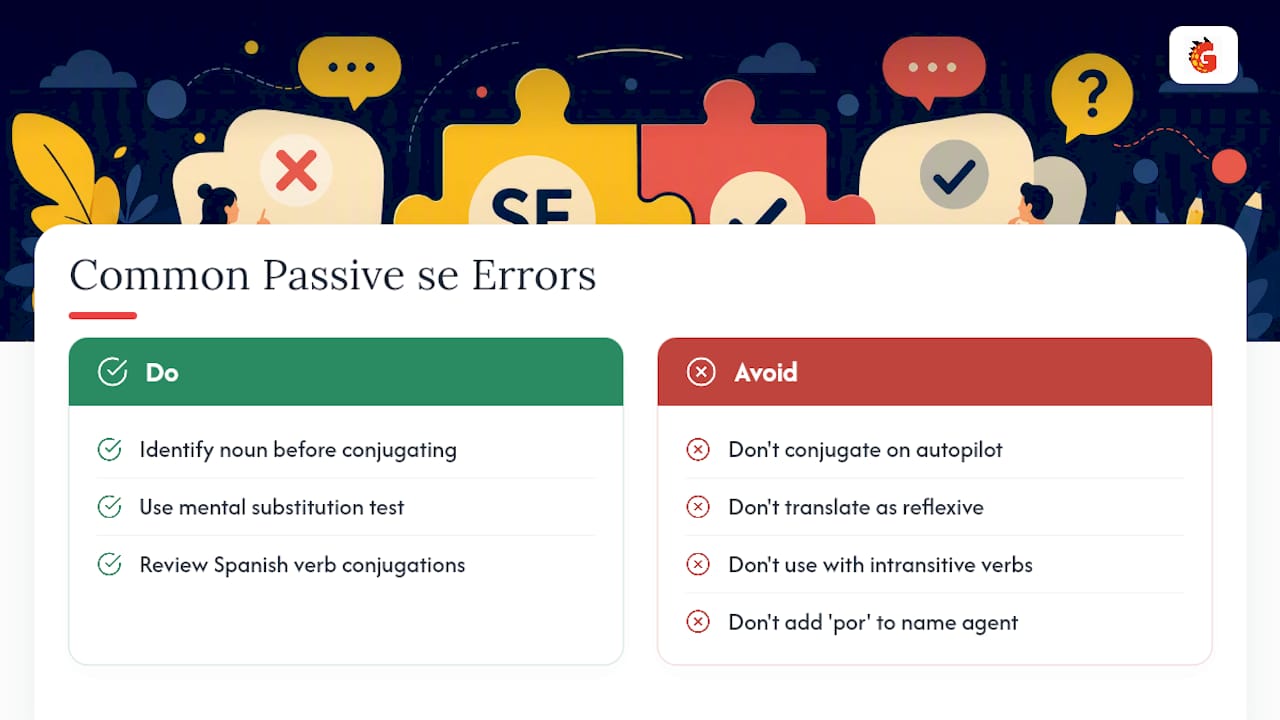
The most common error is verb agreement drift, where a learner writes “Se vende casas” instead of “Se venden casas,” forgetting that the plural noun requires a plural verb. Fix it by always identifying the noun immediately after the verb first, then conjugating to match it, rather than conjugating on autopilot.
A second trap is assuming every se you encounter must be reflexive. Learners sometimes translate “Se habla inglés” as something close to “English speaks to itself,” hunting for a reflexive meaning that was never there. Passive se is a grammatical marker that erases the agent, not a signal that the subject is acting on itself. If you catch yourself forcing a reflexive translation that sounds absurd in English, that is your cue to reconsider.
A third mistake is trying to use passive se with an intransitive verb, producing something like “Se llega tarde por el tráfico” when the intended meaning actually calls for an impersonal construction instead. Since llegar takes no direct object, there is nothing to promote into subject position, and the sentence collapses into confusion.
Finally, some learners try to tack a por phrase onto a passive se sentence to name an agent, writing something like “Se rompió el vaso por el niño.” That structure is not available in passive se. You would need to either recast the sentence actively (“El niño rompió el vaso”) or switch to ser plus participle if a passive tone is required.
Pro Tip: Try the mental substitution test. Swap “se + verb” for an English passive construction in your head. If “is sold,” “are needed,” or “is prohibited” sounds natural, passive se is probably the right call. If the English passive sounds strained or nonsensical, you are likely looking at impersonal se instead.
Errors like these often trace back to shaky subject-verb agreement instincts more broadly, so reviewing Spanish verb conjugation rules can reinforce the same muscle memory passive se depends on.
Practice: Test Your Passive Se Skills
Work through these quickly, then check your answers against the explanations below.
- Convert to passive se: Venden zapatos en esa tienda.
- Choose the correct verb: Se ___ (vende/venden) manzanas frescas aquí.
- Passive se or impersonal se? Se vive bien en esta ciudad.
- Fill in the blank for a classified ad: “___ apartamento con dos habitaciones.” (Se alquila/Se alquilan)
- Convert to passive se: Buscan camareros con experiencia.
- Passive se or impersonal se? Se necesita paciencia para aprender español.
- Fill in the blank: “Se ___ (prohíbe/prohíben) fumar en este edificio.”
- Rewrite with an agent named: Se escribió la novela. (Add: by a famous author)
Answer key:
- Se venden zapatos en esa tienda. Zapatos is plural, so the verb agrees in the plural.
- Venden is correct. Manzanas is plural, requiring plural agreement.
- Impersonal se. Vivir is intransitive here, and there is no object to promote into subject position.
- Se alquila apartamento if singular, though Se alquilan apartamentos also works if the noun is plural. Match the noun you choose.
- Se buscan camareros con experiencia. Camareros is plural, pulling the verb into plural agreement.
- Impersonal se, since paciencia functions more like an abstract requirement than a clear grammatical subject taking third-person plural agreement, and the verb stays singular.
- Prohíbe, staying singular because the implied subject (the general act of smoking) is treated as singular in this common fixed phrase.
- La novela fue escrita por un autor famoso. Naming the agent forces a shift to ser plus participle.
Five minutes with this kind of set, repeated daily for a week, builds the kind of instinct that turns a grammar rule into something you produce without thinking. That repetition is exactly what structured grammar drills are built around: short, focused sessions that target one pattern at a time until it becomes automatic instead of something you have to calculate mid-sentence.
Ready to Make Passive Se Automatic?
Reading the rules gets you halfway there. The other half comes from repeating these patterns enough times that your brain stops calculating verb agreement and starts producing it on reflex, the same way a native speaker does. Gramanator builds its entire training approach around that gap between knowing a rule and using it instinctively, with structured drills spanning A1 through C1 that isolate patterns like passive se and hammer them into working memory through repetition and immediate feedback. If today’s practice set felt useful, a structured grammar plan can carry that same drilling method across every grammar point that currently slows down your Spanish.
Where to Learn More About Spanish Passives
The RAE’s guide to active and passive sentences lays out the formal distinction between periphrastic passives and passive se with prescriptive authority straight from the Spanish language academy.
BBC Bitesize’s passive voice overview compares register differences between se and ser constructions for learners studying toward formal exams.
Frequently Asked Questions
What is passive se in Spanish, in one sentence? Passive se is a Spanish construction that describes an action performed on a thing without naming who performed it, built with se plus a third-person verb that agrees with that thing.
Is passive se the same as reflexive se? No. Reflexive se shows the subject acting on itself, while passive se removes the agent entirely and lets the object of the action become the grammatical subject.
Can passive se be used with people? Not in the typical agreement pattern used for things. When the object is a person, Spanish usually adds the personal a and shifts to an impersonal construction, as in Se busca a un médico.
Why does the verb change between Se vende and Se venden? The verb agrees with the noun that follows it. Casa is singular, so vende stays singular; casas is plural, so the verb becomes venden.
When should I use ser plus participle instead of passive se? Reach for ser plus participle when you need to name the agent with a por phrase or when writing in a formal register like journalism or legal documents. Passive se covers nearly everything else in everyday Spanish.