What Is A1 Grammar Level Spanish: A Beginner's Guide
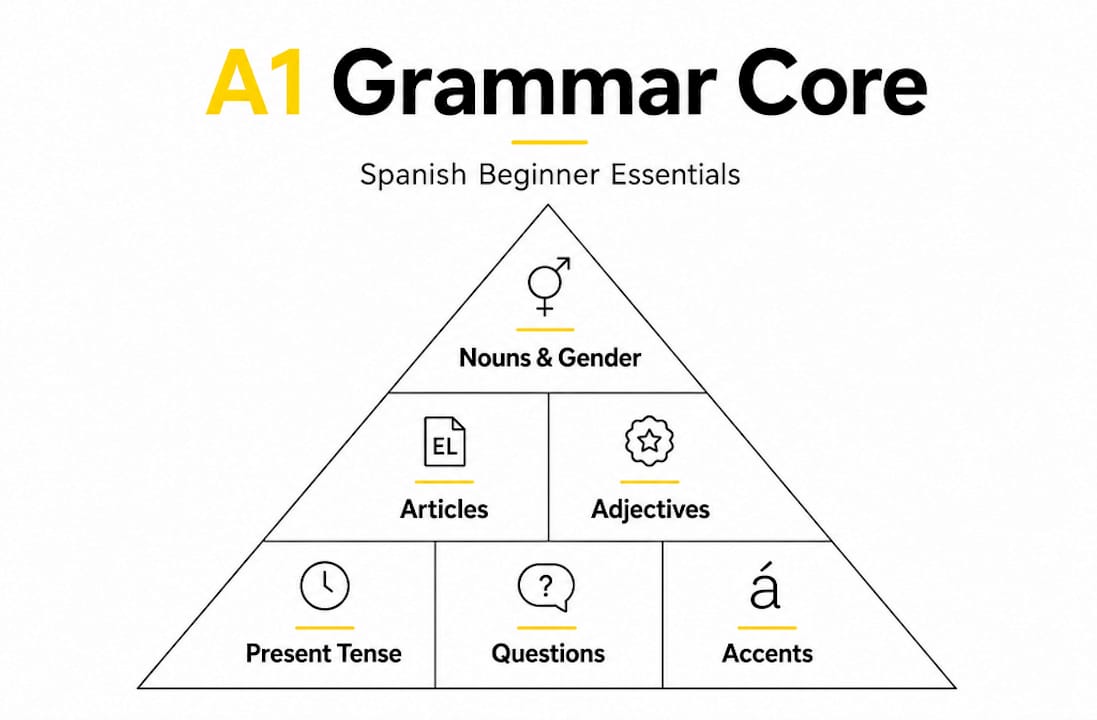
Every A1 Spanish grammar rule in one guide: gender, articles, present tense, questions and accents - with a full checklist, examples and beginner mistake fixes.

If you are just starting out with Spanish, you may have come across the term “A1” and wondered exactly what it means for your learning. Understanding what is A1 grammar level Spanish is the first step to knowing what you actually need to focus on. The good news: A1 is not about memorizing complicated rules. According to the CEFR framework, A1 is defined by practical, communicative ability in everyday situations. This guide breaks down every grammar concept you will encounter at this level, clearly and concisely.
Short answer: A1 Spanish grammar is the beginner set of rules the CEFR expects for simple, everyday exchanges: noun gender and number, definite and indefinite articles, adjective agreement, subject pronouns, the present indicative of regular -ar/-er/-ir verbs plus the key irregulars (ser, estar, ir, tener, haber), the six core question words, and basic accentuation. Most adults cover it in roughly 60-100 hours of focused study. This guide uses Castellano (Spain) Spanish.
Table of Contents
- Key takeaways
- What is A1 grammar level Spanish, explained clearly
- The complete A1 Spanish grammar checklist
- Nouns, articles, gender, and number
- Present tense verb conjugations
- Forming basic questions
- Spanish accentuation rules at A1
- Five common A1 mistakes and how to fix them
- How A1 grammar enables real communication
- Learning A1 Spanish grammar the right way
- Train your A1 Spanish grammar with Gramanator
- FAQ
Key takeaways
| Point | Details |
|---|---|
| A1 is practical, not theoretical | The CEFR defines A1 by what you can do with language, not how many rules you can recite. |
| Gender and articles come first | Mastering noun gender and definite/indefinite articles is the foundation for building any Spanish sentence. |
| A small verb toolkit goes far | Learning present tense conjugations for high-frequency verbs gives you most of what you need for basic conversation. |
| Questions unlock conversation | Knowing six key interrogative words lets you ask and extend almost any everyday exchange. |
| Accents affect meaning | Even at A1, basic accentuation rules matter for both correct writing and clear pronunciation. |
What is A1 grammar level Spanish, explained clearly
A1 is the entry point on the CEFR scale, which stands for the Common European Framework of Reference for Languages. It is used worldwide to describe language proficiency, and Spanish learning programs are built around it. At A1, the focus is squarely on communication. You are learning to handle simple, concrete interactions, not to analyze complex sentence structures.
Many beginners assume that even starter-level grammar must be overwhelming. It is not. A1 grammar topics include personal subject pronouns, noun and adjective gender agreement, basic present tense verbs like ser and estar, interrogative words, and simple sentence construction. These are the building blocks that let you introduce yourself, describe your surroundings, and ask for basic information.
Think of A1 grammar as a toolkit, not a textbook. You are selecting the most useful tools for everyday situations. Everything else comes later.
The complete A1 Spanish grammar checklist
Before the detail, here is the full A1 syllabus in one view. If you can produce a correct sentence for every row below, you have covered A1 grammar.
| Grammar point | What you should be able to do | Example |
|---|---|---|
| Noun gender and number | Pick the right article and plural ending | el libro → los libros, la ciudad → las ciudades |
| Definite and indefinite articles | Choose between el/la/los/las and un/una/unos/unas | Quiero un café. El café está frío. |
| Adjective agreement | Match gender and number, and place the adjective after the noun | una casa pequeña, unos coches rojos |
| Subject pronouns and tú/usted | Choose the formal or informal register | ¿Cómo te llamas? / ¿Cómo se llama usted? |
| Present indicative, regular verbs | Conjugate -ar, -er and -ir verbs in all six persons | hablo, comes, vivimos |
| Core irregular verbs | Use ser, estar, ir, tener, haber without hesitating | Soy profesora. Estoy en casa. |
| Ser vs estar | Separate identity and characteristics from state and location | Ana es simpática. Ana está cansada. |
| Hay vs está | Say what exists versus where something is | Hay un banco aquí. El banco está allí. |
| Question words and word order | Ask and answer simple personal questions | ¿Dónde vives? |
| Negation with no | Put no directly before the verb | No hablo francés. |
| Mandatory contractions | Use al and del instead of a el and de el | Voy al mercado. Vengo del trabajo. |
| Possessives and demonstratives | Say whose something is and which one you mean | mi hermana, este libro, esa mesa |
| Numbers, dates and time | Give prices, ages, days and the hour | Son las tres y media. Cuesta doce euros. |
| Gustar and basic likes | Use the indirect-object structure | Me gusta el cine. Nos gustan los libros. |
| Accentuation and inverted punctuation | Write ¿ and ¡ and place written accents correctly | ¿Cuántos años tienes?, ¡Qué bien! |
Pro Tip: Work down this checklist one row per study session. A single grammar point drilled to automation beats five points half-remembered.
Nouns, articles, gender, and number
Spanish assigns a grammatical gender to every noun. Every noun is either masculine or feminine, and this affects nearly everything attached to it, including articles and adjectives. This is one of the first things you will learn, and getting it right makes your sentences sound natural from the start.
Here is how the definite and indefinite articles break down:
| Type | Masculine singular | Feminine singular | Masculine plural | Feminine plural |
|---|---|---|---|---|
| Definite (“the”) | el | la | los | las |
| Indefinite (“a/some”) | un | una | unos | unas |
So el libro means “the book” and la mesa means “the table.” To make them plural: los libros and las mesas.
Adjectives follow the same agreement pattern. Un chico alto (a tall boy) becomes una chica alta (a tall girl). The adjective changes its ending to match the noun’s gender and number. This is the core of A1 Spanish grammar rules for noun phrases.
- Most masculine nouns end in -o (libro, amigo), and most feminine nouns end in -a (mesa, amiga)
- Nouns ending in -e or a consonant can be either gender (el estudiante, la pared), so these require memorization
- To form plurals, add -s to nouns ending in a vowel and -es to nouns ending in a consonant
Pro Tip: When you learn a new noun, always learn its article at the same time. Saying “el libro” instead of just “libro” from day one will save you from gender confusion later.
Present tense verb conjugations
Verbs are where A1 Spanish grammar starts to feel real. You will learn to conjugate regular verbs in the present indicative tense across three verb groups: -ar verbs like hablar (to speak), -er verbs like comer (to eat), and -ir verbs like vivir (to live). Each group follows a predictable pattern once you learn the endings.

For hablar in present tense: hablo, hablas, habla, hablamos, habláis, hablan. For comer: como, comes, come, comemos, coméis, comen. For vivir: vivo, vives, vive, vivimos, vivís, viven. Once you internalize these patterns, you can conjugate hundreds of verbs correctly.
But A1 also requires you to know the most important irregular verbs. These do not follow the standard patterns, but they appear so often that you cannot hold a basic conversation without them:
- Ser (to be, for identity): soy, eres, es, somos, sois, son
- Estar (to be, for state or location): estoy, estás, está, estamos, estáis, están
- Ir (to go): voy, vas, va, vamos, vais, van
- Haber (to have, auxiliary): he, has, ha, hemos, habéis, han
- Tener (to have, possession): tengo, tienes, tiene, tenemos, tenéis, tienen
Subject pronouns are equally important at this level: yo (I), tú (you, informal), él/ella (he/she), nosotros (we), vosotros (you all, Spain), ellos/ellas (they). One distinction that beginners often overlook early on is the difference between tú and usted. Use tú with friends and peers. Use usted in formal contexts, with strangers, or with people older than you. Getting this wrong can come across as impolite, so learning it from the start matters.
Pro Tip: Focus your early practice on ser, estar, ir, and tener. These four verbs appear in almost every Spanish conversation. Drill them until conjugating feels automatic, not calculated.
Forming basic questions
Asking questions is where grammar becomes real conversation. At A1, you only need six interrogative words to get a lot done. These interrogatives let you ask follow-up questions and extend exchanges well beyond a simple greeting.
The core six are: ¿Qué? (What?), ¿Cuál? (Which?), ¿Cómo? (How?), ¿Dónde? (Where?), ¿Cuándo? (When?), and ¿Cuánto/a? (How much/many?).
Forming a question in Spanish is straightforward. Here is a simple process to follow:
- Start with your interrogative word (¿Dónde?)
- Add the verb in its conjugated present tense form (está)
- Add the subject or object if needed (el banco)
- Result: ¿Dónde está el banco? (Where is the bank?)
That structure works across most everyday situations. ¿Cómo te llamas? (What is your name?), ¿Cuántos años tienes? (How old are you?), ¿Dónde vives? (Where do you live?). Notice that Spanish questions use an inverted question mark at the start as well as a closing one. This is part of standard Spanish orthography and appears in all written questions.
The CEFR can-do descriptors for A1 describe exactly this kind of ability: interacting in a simple way, asking and answering questions about personal details and everyday topics, provided the other person speaks slowly and clearly. Mastering question formation gets you there.
Spanish accentuation rules at A1
Written accents in Spanish are not decoration. They affect pronunciation and sometimes meaning. At A1, you will encounter the four categories of Spanish words based on stress placement, and knowing these rules prevents common writing and speaking errors.
Here is a summary of the rules:
| Word type | Stress position | Takes written accent when... | Example |
|---|---|---|---|
| Aguda | Last syllable | Ends in n, s, or a vowel | café, camión |
| Llana | Second-to-last syllable | Does NOT end in n, s, or a vowel | árbol, fácil |
| Esdrújula | Third-to-last syllable | Always | música, rápido |
| Sobresdrújula | Fourth-to-last | Always | dígamelo |
According to Spanish accentuation rules, esdrújulas and sobresdrújulas always carry a written accent without exception. Agudas only need one when they end in n, s, or a vowel. Llanas are the opposite: they take an accent when they do not follow those endings.
Accents also distinguish meaning between identical words. Tú (you) versus tu (your). Sí (yes) versus si (if). These pairs appear constantly at A1 level, so accent placement is genuinely worth learning early. You can also explore this pronunciation guide for beginners for a deeper look at how stress and sound connect in Spanish.
Pro Tip: Practice writing sentences from your current lessons and consciously check each word for accent placement. This trains your eye and your ear at the same time.
Five common A1 mistakes and how to fix them
Beginner errors are remarkably predictable. These five account for most of the corrections A1 learners receive, and each has a quick fix you can apply today.
- Using ser where estar belongs. Soy cansado describes a personality; you almost certainly meant Estoy cansado (I am tired). Fix: if the word describes a temporary state, mood or location, reach for estar.
- Adding the subject pronoun to every sentence. Yo hablo, yo como, yo vivo sounds mechanical because the verb ending already tells you who. Fix: use yo or tú only for contrast or emphasis (Yo trabajo, ella estudia).
- Forgetting adjective agreement. Una casa pequeño is the single most common written error. Fix: after writing any adjective, glance back at the noun and match both gender and number.
- Skipping al and del. Voy a el cine is never correct in Spanish; the contraction is obligatory. Fix: whenever a or de meets el, contract it automatically.
- Dropping the opening ¿ and ¡. These are not optional stylistic marks in Spanish orthography. Fix: type the opening mark first, then write the sentence, so you never forget it.
Pro Tip: Keep a personal error list. Re-drilling your own five recurring mistakes is worth more than reading a new grammar chapter.
How A1 grammar enables real communication
Knowing the rules is one thing. Using them in a real exchange is another. The A1 Spanish syllabus is built around situations you will actually face: greeting people, introducing yourself, asking for directions, ordering food, describing your family, and talking about daily routines. All of those scenarios run on the grammar you have just read about.
Here is what A1 grammar actually lets you do in practice:
- Introduce yourself: Me llamo Ana. Soy de México. Tengo veintiocho años.
- Ask for information: ¿Dónde está la estación de metro?
- Describe someone: Mi madre es alta y simpática.
- Talk about daily life: Como en casa todos los días.
- Express location or state: El restaurante está cerca. Estoy cansado.
Each of those sentences draws on nouns with correct gender, present tense verb conjugations, adjective agreement, or interrogative structure. None of them require advanced grammar. They require solid A1 grammar used consistently. The beginner Spanish grammar essentials that seem abstract in a textbook become clear once you connect them to real-world usage like this.
The most effective practice at this stage combines reading, listening, speaking, and writing in context. Review your grammar in short sessions. Use new structures in sentences about your own life. And focus on building automatic responses, not translating word by word.
Learning A1 Spanish grammar the right way
Language teachers often notice two common mistakes among adult beginners. Some learners assume A1 grammar is too basic to deserve serious attention. Others become so focused on mastering every rule that they hesitate to start speaking. Both approaches can slow progress.
In reality, A1 is one of the most important stages of language learning. The patterns established at this level become the foundation for everything that follows. Habits related to gender agreement, verb conjugations, and sentence structure often persist well beyond the beginner stage, making it worthwhile to build them correctly from the start.
One area that teachers frequently recommend addressing early is the distinction between tú and usted. Understanding when to use informal and formal forms helps learners navigate everyday social situations more naturally and avoid common communication mistakes.
Another often-overlooked skill is mastering the core interrogative words: ¿Qué?, ¿Cómo?, ¿Dónde?, ¿Cuándo?, ¿Quién?, and ¿Por qué? Once learners can confidently ask questions, they gain the ability to participate in conversations even with a limited vocabulary. Asking good questions is often more valuable than knowing hundreds of additional words.
The goal at A1 is not perfect grammar. It is developing functional grammar that can be used confidently in real situations. Strong foundations at the beginner level make every subsequent stage of learning easier and more effective.
Train your A1 Spanish grammar with Gramanator
Reading about A1 grammar is a start. Turning it into instinct is the real work.

Gramanator is built for exactly this stage. The platform gives you structured grammar drills organized around A1 topics: noun gender, present tense conjugations, article agreement, question formation, and accentuation. Every session gives you immediate feedback and targets the specific patterns where you make mistakes. You are not just reviewing rules. You are training your brain to produce correct grammar automatically, without thinking.
If you are serious about building a Spanish foundation that holds up in real conversation, start training on Gramanator today. The A1 grammar path is ready for you, structured drill by drill, pattern by pattern.
FAQ
What does A1 mean in Spanish grammar?
A1 is the beginner level on the CEFR scale. It focuses on practical communication skills like introducing yourself and asking simple questions, built on foundational grammar such as present tense verbs, noun gender, and basic interrogatives.
What grammar topics are covered at A1 Spanish level?
A1 Spanish grammar covers noun gender and number, definite and indefinite articles, adjective agreement, present tense regular and irregular verbs, personal pronouns, question words, and basic accentuation rules.
How is A1 Spanish different from higher levels?
At A1, grammar is limited to present tense and simple sentence structures. Higher levels add past and future tenses, subjunctive mood, complex clauses, and broader vocabulary, making A1 the most manageable and focused stage of learning.
Why do accent marks matter at A1 level?
Accent marks in Spanish change both pronunciation and meaning. Words like tú (you) and tu (your) are distinguished only by the accent, so learning basic accentuation rules at A1 prevents confusion from the very beginning.
How long does it take to reach A1 Spanish proficiency?
Most adult learners reach A1 proficiency after 60 to 100 hours of focused study and practice, though this varies based on consistency, study method, and prior language learning experience.
What grammar is required for the DELE A1 exam?
The DELE A1 exam tests the same core inventory: present indicative of regular and high-frequency irregular verbs, noun and adjective agreement, articles, possessives and demonstratives, question words, negation, numbers, dates and time, and gustar-type structures. No past or future tenses and no subjunctive are required.
How should a beginner practise A1 Spanish grammar?
Practise in short, daily sessions of 10 to 20 minutes, focused on one grammar point at a time, and always produce full sentences rather than filling isolated gaps. Immediate feedback matters more than volume: correcting an error within seconds is what turns a rule into an automatic habit.
Do I need to learn vosotros at A1?
If you are learning Castellano, the Spanish of Spain, then yes. Vosotros habláis is the standard informal plural there and appears from the first lessons. Latin American varieties use ustedes for both formal and informal plural, so learners targeting those regions can treat vosotros as recognition-only.