Speak Like a Spaniard: Master Vosotros and Ustedes in 5-10 Minutes
If you’re speaking Spain Spanish, use vosotros for informal groups and ustedes only for formal groups.

If you’re speaking Spain Spanish, use vosotros for informal groups and ustedes only for formal groups. In Latin America, ustedes covers every plural “you,” formal or casual. The two pronouns also carry their own verb endings, object pronouns, and possessives, so getting the choice right shapes far more than a single word.
The short answer
- Using vosotros instead of ustedes in Spain signals familiarity, but learners must master its unique verb endings like -áis, -éis, and -ís.
- Learners should practice conjugating vosotros forms repeatedly, especially for past tenses and commands, to develop automatic recognition and production.
- In Latin American Spanish, ustedes covers both formal and informal plural, making vosotros unnecessary and keeping speech consistent across contexts.
- Common mistakes include using ustedes in Spain with friends or vosotros in Latin America, which can sound awkward or overly formal, respectively.
- Regional variations exist, with Canary Islands and western Andalusia sometimes adopting ustedes even informally, but standard Madrid Spanish remains the safest choice for learners.
Table of Contents
- Vosotros vs Ustedes: Where and When Each One Is Used
- How Do Vosotros and Ustedes Conjugate Differently?
- Os vs Les, Vuestro vs Su: Getting the Small Words Right
- Do the Canary Islands and Andalusia Break the Rules?
- The Vosotros vs Ustedes Mistakes That Give You Away Instantly
- How to Actually Train Vosotros and Ustedes Into Instinct
- Where to Verify Vosotros and Ustedes Usage
- Sources
Vosotros vs Ustedes: Where and When Each One Is Used
Picture two friends chatting with a group of college buddies in Madrid, then picture the same friends addressing a panel of judges.
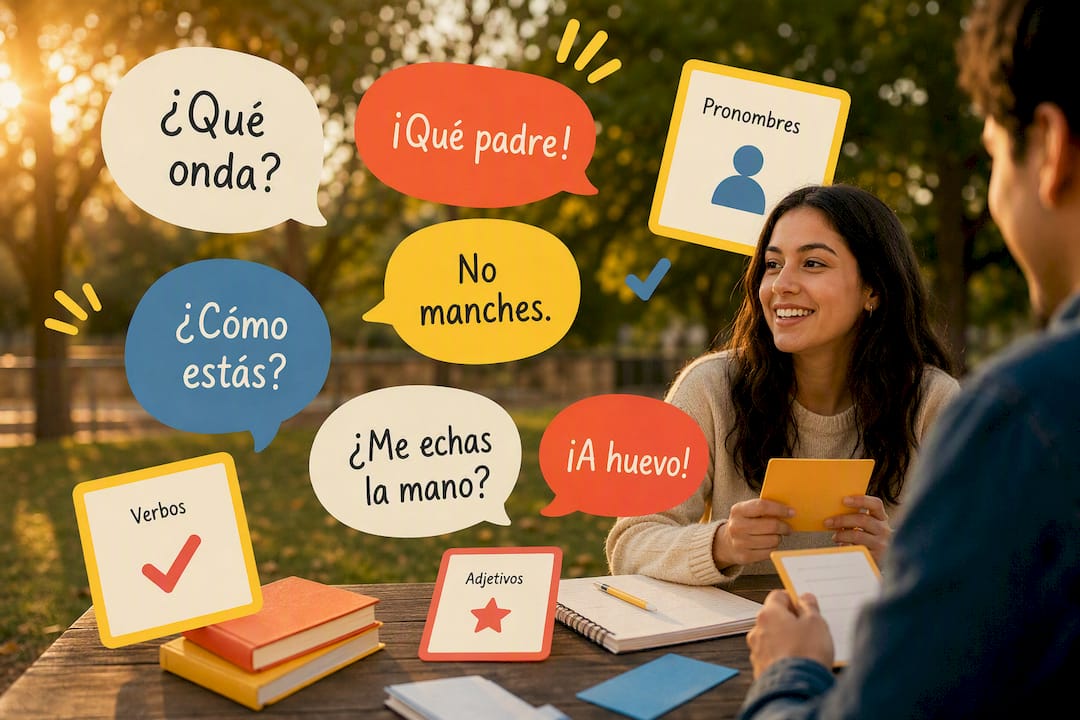
In the first scene, they’d say “¿Vosotros venís a la fiesta?” In the second, it’s “¿Ustedes vienen a la reunión?” Same meaning, “you all,” completely different register.
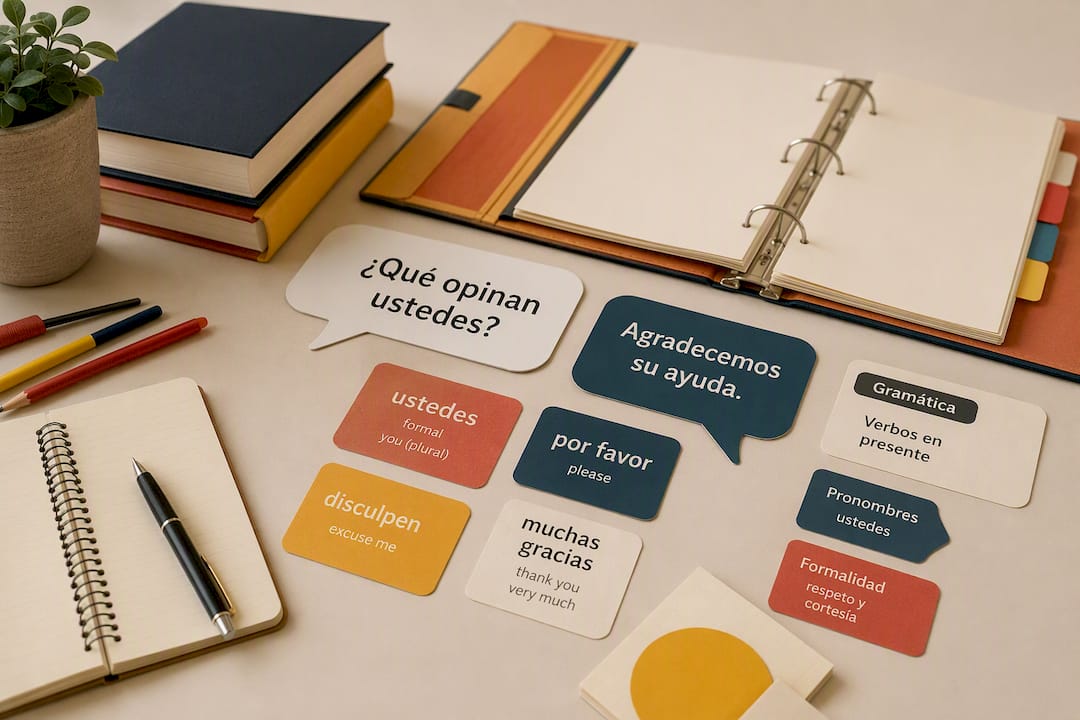
That contrast only exists in Spain. In Mexico City, Bogotá, or Buenos Aires, both scenes get the same pronoun: ustedes. Latin American Spanish dropped vosotros from everyday speech centuries ago, so ustedes now does double duty as the informal and formal plural. In Spain, the Real Academia Española’s Diccionario panhispánico de dudas confirms the split still holds: vosotros for friends, family, and peers; ustedes reserved for formal plural address.
A few things to keep straight as you build this into your speech:
- Spain: vosotros (informal group) vs. ustedes (formal group)
- Latin America: ustedes covers both registers, no vosotros in daily use
- All-female groups use vosotras instead of vosotros in Spain
- Cross-dialect comprehension isn’t a problem. Spaniards understand ustedes-only speech instantly, and Latin American speakers recognize vosotros even if they never use it actively.
That last point matters for confidence: you won’t confuse anyone by mixing systems occasionally while learning. You just won’t sound local until the split becomes automatic.
How Do Vosotros and Ustedes Conjugate Differently?
This is where most learners hit a wall, because vosotros isn’t just a different pronoun. It drags its own full verb paradigm along with it, while ustedes recycles the third-person plural forms you already know from ellos/ellas.
In the present tense, vosotros takes distinct endings: -áis, -éis, -ís. Ustedes uses the same third-person plural ending as ellos. Compare:
- Vosotros habláis español. / Ustedes hablan español.
- Vosotros coméis aquí. / Ustedes comen aquí.
- Vosotros vivís cerca. / Ustedes viven cerca.
The past tenses trip people up just as often. In the preterite, it’s comisteis (vosotros) versus comieron (ustedes). In the imperfect, comíais versus comían. Miss that one letter and a native speaker’s ear catches it instantly, even if the sentence is otherwise flawless.
Pro Tip: Say the vosotros and ustedes versions of the same sentence back to back out loud. The physical repetition trains your mouth to feel the difference, not just your brain to recognize it.
Commands split the same way. Hackett Publishing’s grammar reference notes that vosotros has its own affirmative imperative pattern, ending in -ad, -ed, or -id, while ustedes commands borrow the subjunctive:
- Hablad más despacio. (vosotros) / Hablen más despacio. (ustedes)
- Comed ahora. (vosotros) / Coman ahora. (ustedes)
- Venid aquí. (vosotros) / Vengan aquí. (ustedes)
Mixing a vosotros verb ending onto an ustedes subject, or vice versa, is one of the fastest ways to sound like you learned Spanish from a textbook instead of from people.
Os vs Les, Vuestro vs Su: Getting the Small Words Right
Object pronouns and possessives follow the same divide as the verbs, and they trip up even intermediate learners because they’re easy to overlook in fast speech.
Vosotros pairs with os for direct object, indirect object, and reflexive uses, plus the possessive vuestro/a/os/as. Ustedes pairs with los/las/les for objects and su/sus for possession, since it grammatically patterns with the third person, the same slot ellos and ellas occupy.
- Os veo mañana. (I’ll see you all tomorrow, vosotros) / Los veo mañana. (ustedes)
- Vuestra casa es bonita. (vosotros) / Su casa es bonita. (ustedes)
- ¿Os ayudo? (vosotros) / ¿Les ayudo? (ustedes)
That os clitic is doing serious work in the vosotros system. It covers direct object, indirect object, and reflexive roles all at once, which is part of why native speakers process it so fast and why learners need real repetition to catch up.
One wrinkle worth knowing: su and les are ambiguous on their own, since the same forms cover both ustedes and ellos/ellas. Spanish speakers resolve this constantly through context, tone of address, or by simply adding a clarifying phrase like su casa, la de ustedes when a sentence could be read either way.
Do the Canary Islands and Andalusia Break the Rules?
Yes, and it’s worth knowing before you land somewhere assuming the textbook split applies everywhere. The Canary Islands and much of western Andalusia use ustedes even in casual, informal settings, a pattern distinct from mainland formal Spanish. Sometimes speakers there attach a second-person verb form to ustedes, producing hybrid constructions that sound unusual to someone trained on standard peninsular grammar.
An example: instead of the expected “¿Ustedes vienen?”, you might hear a local blend that carries the informal tone of vosotros but keeps the ustedes pronoun. These regional patterns are well documented, and they’re considered nonstandard outside their home region, especially in formal writing or professional contexts.
The practical move: learn the standard Madrid based split first, since it maximizes comprehension across Spain and Latin America alike.
- Standard peninsular Spanish: vosotros informal, ustedes formal
- Canary Islands and western Andalusia: ustedes for informal groups is common
- Adapt locally only once you’re confident you know the region’s actual norm
The Vosotros vs Ustedes Mistakes That Give You Away Instantly
Two mistakes account for nearly every slip learners make with these pronouns, and both come from applying the wrong regional system in the wrong place.
- Using ustedes with friends in Spain. It’s not wrong grammatically, but it sounds distant, almost cold, like addressing your buddies as if they were your boss.
- Using vosotros in Latin America. Native speakers will understand you, but it reads as oddly formal or textbook-ish, since nobody there uses it in conversation.
The fix comes down to a one-question test: would you call each person in the group tú individually? If yes, use vosotros for the whole group when you’re in Spain. If even one person in that group would get usted, default to ustedes for everyone.
If you catch yourself mid-sentence with the wrong pronoun, don’t freeze. Native speakers make quick repairs constantly. Just restate the verb with the correct ending and move on, or add a short clarifier (“me refiero a todos vosotros”) if the referent seems unclear. A smooth recovery reads as fluency, not failure.
Pro Tip: When you’re unsure which region’s habits to default to, pick standard peninsular Spain Spanish. It’s the version most language schools, media, and grammar references teach, and it transfers cleanly once you understand the Latin American simplification.
How to Actually Train Vosotros and Ustedes Into Instinct
Recognizing the difference on a worksheet and producing it correctly at conversational speed are two different skills, and most learners only ever build the first one. Closing that gap takes structured, repeated practice, not another read through of the rules.
A workable session typically involves starting with recognition drills (spot which pronoun a sentence needs), moving into active conjugation (produce the verb form yourself, out loud), then layering in imperative commands, and finishing with focused repetition on any errors. Learners planning time in Spain benefit from treating vosotros as active vocabulary rather than something to merely recognize, while those focused on Latin America can prioritize ustedes fluency and keep vosotros at the recognition level.
Concrete drills that work:
- Minimal pair flashcards: same sentence, vosotros form on one side, ustedes form on the other
- 30 second rapid response rounds where you conjugate a verb across both pronouns without pausing
- Imperative roleplay: give commands to an imaginary group, alternating formal and informal scenarios
Track an error log. Spanish learners who write down which conjugation slipped, and revisit it on a spaced schedule days later, close these gaps faster than learners who just keep reading new material. A tight, five to ten minute daily workout targeting your specific weak spots beats an occasional long study session every time. This is exactly the kind of structured, mistake-focused repetition Gramanator was built around, and it’s worth trying if you want the vosotros/ustedes split to stop requiring conscious thought.
Ready to build that instinct? Gramanator’s structured grammar drills target exactly this kind of pattern with timed workouts and mistake-focused repetition, and the pricing plans let you start with a trial before committing.
Where to Verify Vosotros and Ustedes Usage
For normative definitions, check the RAE’s entries on vosotros and usted, the two go to authorities for formal Spanish grammar. For conjugation paradigms, Wikipedia’s overview of Spanish personal pronouns lays out the full pattern side by side. If you’re settling in a specific region, cross check local usage against materials written for that area, since regional variation is real and worth respecting.