Spanish workplace grammar: a professional's guide
Spanish workplace grammar for professionals. Register, softeners, and tenses for meetings, email, and Slack in Spain and Latin America.

If you have ever confidently greeted a new colleague in Spanish, only to watch their expression shift the moment you used tú instead of usted, you already know that spanish workplace communication grammar is about far more than verb endings. It sits at the intersection of grammar, tone, hierarchy, and cultural expectation. Get one element wrong and the message lands awkwardly, no matter how accurate the conjugation. This guide walks you through the grammar rules that matter most in professional Spanish settings, the cultural logic behind them, and practical strategies for applying them with confidence every day.
Table of Contents
- Understanding key grammar rules in Spanish workplace communication
- Cultural nuances and tone: how Spanish workplace communication differs from English
- Mastering practical communication scenarios: meetings, emails, and deadlines in Spanish
- Regional variations and formality: adapting Spanish grammar to your workplace
- Strategies for continuous improvement: practicing Spanish workplace grammar effectively
- Why mastering Spanish workplace grammar is more than just language rules
- Boost your Spanish workplace grammar skills with Gramanator
- Frequently asked questions
Understanding key grammar rules in Spanish workplace communication
Spanish grammar for professionals starts with one fundamental choice: usted or tú? This is not just a pronoun decision. It determines your entire verb conjugation pattern for that conversation, and it signals immediately whether you understand Spanish professional norms.
Business Spanish often employs the formal usted form, particularly for first meetings. When you use usted, the verb conjugates in the third person singular, so “you speak” becomes usted habla rather than tú hablas. That one-letter difference carries significant social weight in a business context.
Here are the core grammar rules to prioritize when building your workplace Spanish:
- Formal address (usted): Use it with clients, senior colleagues, and anyone you have just met professionally. Switch to tú only when invited.
- Subjunctive mood for polite requests: Instead of quiero que me envíes el informe (I want you to send me the report), the more professional form is le agradecería que me enviara el informe (I would appreciate it if you could send me the report). The subjunctive softens the command and sounds far more collaborative.
- Sentence structure: Spanish allows greater flexibility in word order than English, but in professional writing, Subject-Verb-Object is clearest. El equipo presentará los resultados (The team will present the results) is cleaner than inverting for stylistic effect.
- Gender agreement: Every noun has grammatical gender, and adjectives must match. Writing estimado cliente (dear male client) versus estimada clienta (dear female client) in emails shows attention to detail and respect.
Pro Tip: Learn the subjunctive in its imperfect form (enviara, pudiera, tuviera) first. This is the tense that appears most often in polite professional requests and conditional statements. You can find targeted exercises on Spanish grammar tips that isolate exactly these structures.
Cultural nuances and tone: how Spanish workplace communication differs from English
Grammar rules only tell part of the story. The other part is cultural logic, and understanding it changes how you interpret and deliver every sentence.
“UK and US business communication often emphasizes indirectness and reserved politeness, whereas many Spanish-speaking cultures prioritize a more expressive, personal, and collaborative tone.”
What does that mean practically? In English-speaking workplaces, keeping communication brief and task-focused is often seen as respectful of others’ time. In many Spanish-speaking professional environments, skipping the personal check-in at the start of a meeting or email can actually feel cold and abrupt. Building rapport is not small talk. It is a professional investment.
Here is how cultural expectations shape workplace communication in Spanish:
- Formality lasts longer: Do not assume a warm conversation means you can drop usted on the second meeting. In many Latin American countries especially, formal address continues until explicitly changed.
- Titles matter: Using Licenciado García or Ingeniera Martínez signals that you understand organizational hierarchy. Dropping the title prematurely can feel disrespectful.
- Warmth is professional: Opening an email with Espero que se encuentre muy bien (I hope you are doing very well) is not a formality to skip. It sets the relational tone for everything that follows.
- Disagreement is handled indirectly: Instead of saying eso no funcionará (that won’t work), the culturally attuned version is podríamos considerar otra alternativa (we might consider another alternative). The grammar is conditional; the intention is diplomatic.
Practicing Spanish tone alongside grammar, rather than treating them as separate skills, is one of the fastest ways to close the gap between textbook Spanish and real professional fluency.
Mastering practical communication scenarios: meetings, emails, and deadlines in Spanish
Theory only takes you so far. Let’s look at the grammar structures that actually appear in your workday.
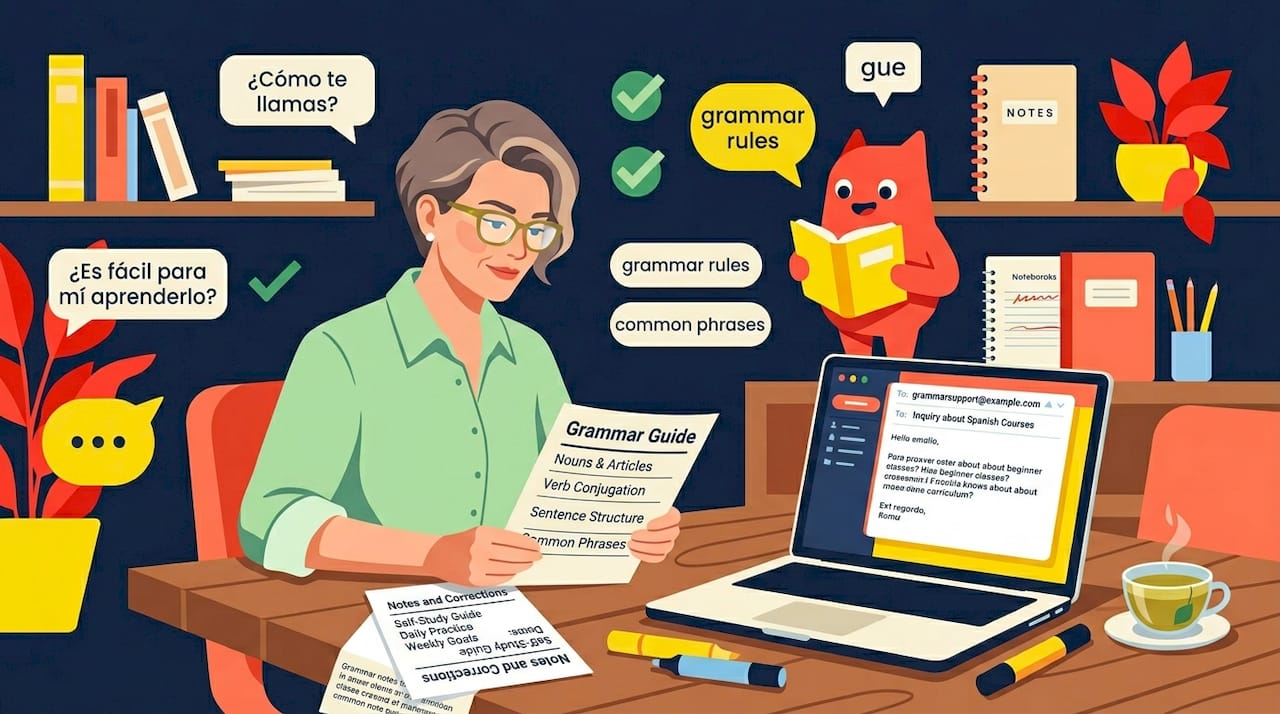
Effective business Spanish is not about memorizing phrases but about mastering tone and clarity. In meetings, focus on diplomatic opinion-sharing, active listening, and summarizing next steps.
Here is a quick comparison of common workplace phrases in formal versus informal Spanish:
| Scenario | Informal (tú) | Formal (usted) |
|---|---|---|
| Requesting a document | Mándame el archivo. | Le agradecería que me enviara el archivo. |
| Confirming a deadline | ¿Cuándo lo tienes listo? | ¿Podría indicarme la fecha de entrega? |
| Expressing disagreement | No estoy de acuerdo. | Me permito señalar una perspectiva diferente. |
| Closing a meeting | Nos vemos luego. | Quedo a su disposición para cualquier consulta. |
For emails, follow this structure to stay professional and grammatically sound:
- Opening: Estimado/a [title + surname]: followed by a warm sentence such as Espero que este mensaje le encuentre bien.
- Purpose: State your reason clearly using indicative mood: Me dirijo a usted para informarle sobre...
- Polite request (subjunctive): Le agradecería que revisara el documento adjunto antes del viernes.
- Deadline phrasing: Sería ideal contar con su respuesta a más tardar el jueves. (The conditional sería softens the urgency.)
- Closing: Quedo a su disposición y le saludo cordialmente.
Pro Tip: When discussing delays, avoid blunt statements. Use the conditional: Lamentamos informarle que el plazo podría extenderse (We regret to inform you that the deadline may be extended). This construction uses the subjunctive’s close relative, the conditional, to soften what could otherwise sound like an excuse. Practice these structures in real workplace Spanish examples before you need them in a live situation.
You can also reinforce these patterns through Spanish grammar practice exercises built specifically around professional scenarios.
Regional variations and formality: adapting Spanish grammar to your workplace
Spanish is not one language with minor accents. It is a family of professional registers that vary significantly by country. Using the wrong pronoun or verb form is not just awkward; it can signal that you have not done your homework.
In Spain, tú is common among colleagues and usted is reserved for clients; in Mexico, formal usted is used more broadly; Argentina uses vos frequently. When in doubt, start with usted and switch to tú when invited.
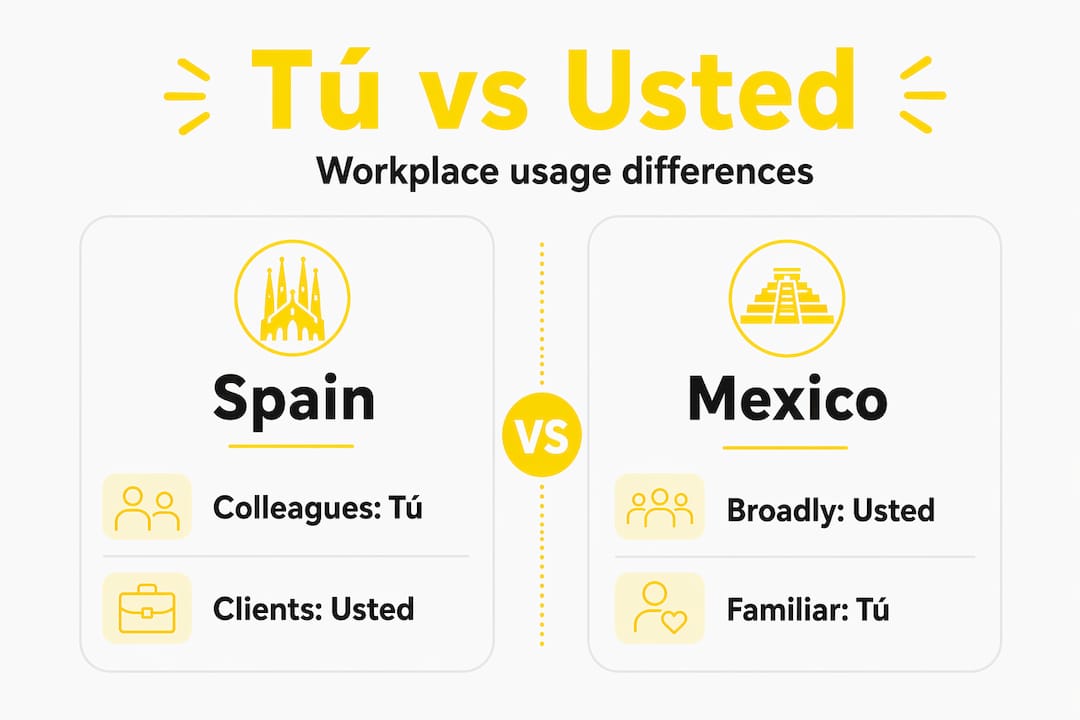
Here is a quick reference for regional address forms:
| Region | Common pronoun among colleagues | Formal pronoun | Notes |
|---|---|---|---|
| Spain | tú | usted | Vosotros used for plural informal address |
| Mexico | usted | usted | Tú used when relationship is close |
| Argentina | vos | usted | Vos replaces tú; different verb conjugations |
| Colombia | usted | usted | Even close colleagues may use usted |
| Chile | tú | usted | Informal vos exists but is regional |
When you start a new role or client relationship, follow these steps:
- Default to usted: It is never offensive. Too informal, however, can feel presumptuous.
- Listen before you shift: If a colleague uses tú with you consistently, that is the signal to reciprocate.
- Match the verb form of vos carefully: In Argentina, vos querés replaces tú quieres. The accent shifts and the ending changes. Getting this right in Buenos Aires earns real credibility.
- Use titles until corrected: Señor, Señora, Licenciado, Ingeniero are safe defaults that show respect across all regions.
Check out regional Spanish grammar resources to practice the specific verb forms associated with vos and regional usted usage.
Strategies for continuous improvement: practicing Spanish workplace grammar effectively
Knowing the rules is step one. Making them automatic under professional pressure is the real goal. Here is a practical approach to building that fluency:
Learning Spanish business phrases and mastering tone are the fastest ways to improve your professional profile. Practice with conversation partners before important meetings.
- Role-play specific scenarios: Pick one workplace situation each week, a performance review, a deadline negotiation, a client email, and practice it in full using the appropriate grammar level. Say it out loud. Write it down. Revise it.
- Target your weak grammar points: If subjunctive requests are shaky, do not study everything at once. Spend two weeks only on polite subjunctive constructions in professional contexts. Depth beats breadth when you need grammar to hold up under pressure.
- Use a language partner with professional experience: A conversation partner who works in a Spanish-speaking business environment gives you real feedback on tone and register, not just accuracy.
- Record and review your spoken Spanish: Hearing yourself on a recording reveals patterns you miss in real time, like defaulting to tú when nervous or dropping agreement endings under pressure.
- Build a personal phrase bank: Keep a running document of polished sentences you have refined for your specific industry. A lawyer, a project manager, and a sales director all need different professional vocabulary anchored to the same core grammar.
Pro Tip: Use Spanish grammar practice tools that give you immediate feedback on grammar structure, not just vocabulary. Knowing why a sentence is wrong helps you avoid the same error next time. You can also explore learning Spanish grammar resources organized by professional scenario to make your practice sessions more targeted.
Why mastering Spanish workplace grammar is more than just language rules
Here is something most language courses will not tell you: your grammar can be flawless and your communication can still fail.
Effective business Spanish depends on discourse patterns and interpersonal dynamics, not just vocabulary. That insight deserves a moment. It means that the professional who understands when to speak, how to soften disagreement, and why hierarchy is encoded in grammar will consistently outperform the person who just memorizes more phrases.
Think about indirect disagreement. In many Spanish-speaking workplaces, contradicting a senior colleague directly is considered disrespectful, even if you are factually correct. The grammar of disagreement is conditional and hedged: Entiendo su punto; sin embargo, cabría considerar... (I understand your point; however, one might consider...). The subjunctive cabría removes the personal accusation and frames the alternative as a neutral possibility. That is not just grammar. It is professional judgment encoded in verb mood.
The same logic applies to silence. In English-speaking meetings, pauses can signal awkwardness. In some Spanish-speaking business cultures, a pause before responding signals that you are taking the matter seriously. Filling that pause with filler words actually weakens your credibility.
The professionals who advance fastest in bilingual environments are not the ones who speak the most words correctly. They are the ones who understand that tone, timing, and relational awareness sit underneath every sentence. Grammar is the foundation. Business communication insights built on cultural context are the structure above it. You need both.
Boost your Spanish workplace grammar skills with Gramanator
Knowing these grammar patterns intellectually is very different from using them automatically when a client emails you at 8 AM on a Monday. That kind of fluency comes from structured, repeated practice tied to real professional scenarios.

Gramanator Spanish grammar practice is built for exactly this. The platform gives you over 10,000 grammar exercises organized by context and level, including dedicated modules for formal and informal address, subjunctive requests, email structure, and professional vocabulary. Every exercise explains not just whether your answer is right, but why it works grammatically. You get personalized recommendations based on your specific weaknesses, so your practice time actually builds the skills you need most. Explore Gramanator pricing plans and find the option that fits your learning pace and professional goals.
Frequently asked questions
What is the main difference between tú and usted in the workplace?
Tú is informal and generally used among colleagues in Spain, while usted is formal and used for clients or new professional contacts; in Latin America, usage varies significantly by country, with Colombia and Mexico favoring usted even among colleagues, and Argentina using vos in place of tú.
How important is learning the subjunctive mood for Spanish business communication?
It is very important because the subjunctive expresses polite requests, conditional suggestions, and diplomatic phrasing that are essential for professional Spanish communication, particularly in emails, meetings, and any situation where you need to ask for something without sounding demanding.
Can I use informal Spanish in business emails?
Generally, formal language and greetings are preferred in business emails in Spanish until familiarity is clearly established, and even then, maintaining a semi-formal register is safer than going fully casual, particularly with clients or cross-regional contacts.
How can I practice Spanish workplace grammar effectively?
Use role-playing focused on specific professional scenarios, targeted grammar exercises that address your weak points, and conversation partners with real business experience, as practicing with partners before important meetings builds both accuracy and confidence quickly.