Spanish Family Conversation Grammar: Adult Learner's Guide
Talk to Spanish family and in-laws with ease. Grammar patterns for tu vs usted, past stories, and warm requests, built for adult learners.

Spanish family conversation grammar is defined as the set of grammatical rules governing how you describe family relationships, ages, and possession in spoken Spanish, with the verbs ser and tener and possessive adjectives forming the core structure. Most adult learners already know words like madre, hermano, and abuelo, but vocabulary alone does not produce natural dialogue. The real gap is grammar: knowing which verb to use, how to match adjective endings, and when to clarify possession. Resources like Rosetta Stone and LibreTexts Español document these patterns in detail, and platforms like Gramanator train them through structured repetition. This guide covers every grammar topic for family discussions you need to move from hesitant sentences to confident, natural conversation.
What is Spanish family conversation grammar and why it matters
Spanish family conversation grammar, known in formal linguistics as gramática conversacional familiar, is the applied grammar system that makes family dialogue accurate and natural. It is not a separate grammar category. It is the intersection of verb choice, possessive agreement, and sentence structure as they appear in real family contexts. Focusing on grammar choice rather than vocabulary alone is what makes learners sound natural rather than textbook-correct. That distinction matters because family conversations are among the first real interactions adult learners face with native speakers.
The three pillars of this grammar system are ser (to be, for identity), tener (to have, for age and possession), and possessive adjectives (mi, tu, su, nuestro, and their plural forms). Each pillar has specific rules that do not transfer from English. English speakers say “I am twenty years old,” but Spanish requires Tengo veinte años (“I have twenty years”). Getting these structures right is what separates a learner who sounds fluent from one who sounds like they are still translating.
How to use ser and tener to talk about family relationships and age
Ser is the verb of identity, and family relationships are treated as permanent identities in Spanish. That is why you say Ella es mi hermana (“She is my sister”) and Él es mi sobrino (“He is my nephew”). According to Rosetta Stone’s grammar guide, ser expresses essential characteristics including family belonging, which aligns with the mnemonic DOCTOR (Description, Occupation, Characteristic, Time, Origin, Relationship). Relationship is the R in DOCTOR, and that single letter explains why ser is always the right choice for stating who someone is to you.
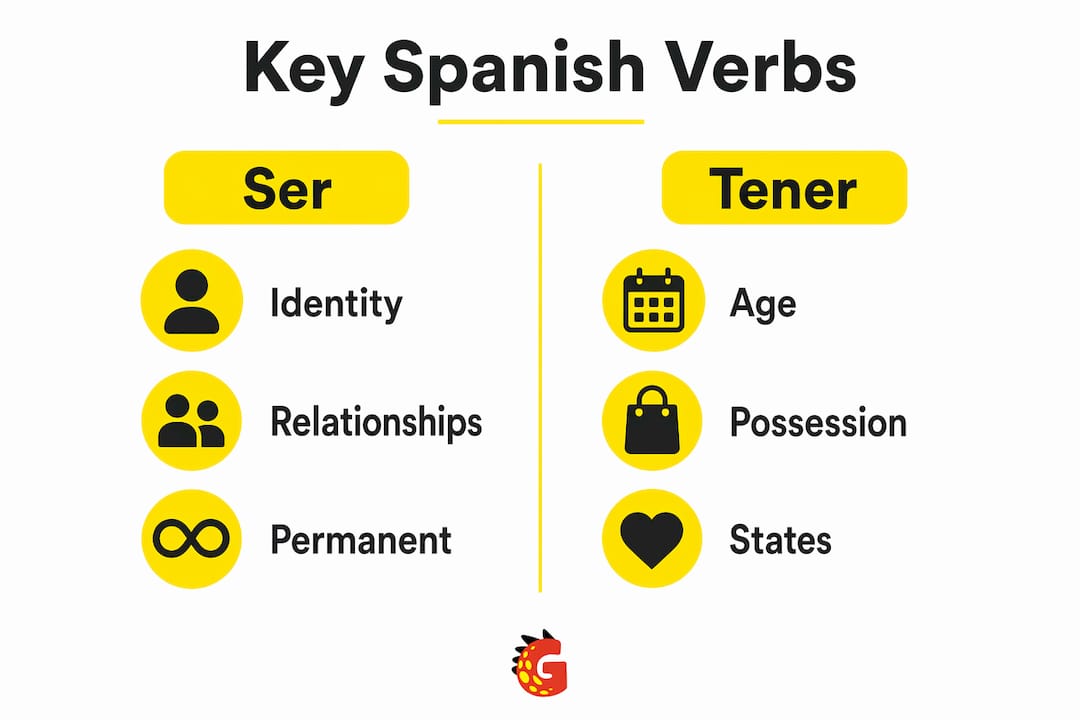
Tener handles two distinct jobs in family conversations: expressing possession and stating age. Both jobs follow the same verb, which surprises English speakers who use “have” only for possession. Age in Spanish uses tener, not ser or estar, so the correct form is Tengo veinte años rather than the common learner error Soy veinte años. This error is so frequent that most Spanish teachers address it in the first week of family vocabulary instruction.
Here is where learners most commonly go wrong with these two verbs:
- Using ser for age: Soy treinta años is incorrect. Always use Tengo treinta años.
- Using tener for relationships: Tengo una hermana means “I have a sister” (possession), but Ella es mi hermana is the identity statement. Both are grammatically valid but carry different meanings.
- Confusing estar with ser for family roles. Estar signals temporary states. Family identity is not temporary, so estar does not belong in relationship statements.
- Forgetting to conjugate tener correctly. The yo form is tengo, not teno. The él/ella form is tiene.
Pro Tip: Think of ser as the verb of identity and tener as the verb of possession and age. If you can replace the Spanish sentence with “X is defined as Y” or “X has Y,” you have chosen the right verb.
Mastering possessive adjectives in Spanish family conversations
Possessive adjectives must agree in number and sometimes gender with the noun being possessed, not with the person who owns it. This is the single most counterintuitive rule for English speakers, because English possessives agree with the owner (“his sister,” “her brother”). In Spanish, the noun determines the adjective form. Mi familia uses the singular form because familia is singular. Mis padres uses the plural form because padres is plural. The owner’s gender is irrelevant.
The table below shows the full set of possessive adjective forms for family conversations:
| Possessor | Singular noun | Plural noun |
|---|---|---|
| yo (I) | mi familia | mis padres |
| tú (you, informal) | tu hermano | tus hermanos |
| él/ella/usted (he/she/formal you) | su madre | sus hijos |
| nosotros (we) | nuestro padre / nuestra madre | nuestros tíos / nuestras tías |
| vosotros (you all, Spain) | vuestro abuelo / vuestra abuela | vuestros primos / vuestras primas |
| ellos/ustedes (they/you all) | su familia | sus familias |
Notice that nuestro and vuestro are the only forms that change for gender. Possessive adjectives vary by number and gender specifically for the nosotros and vosotros forms, which means nuestros libros (masculine plural) and nuestras casas (feminine plural) are both correct but refer to different nouns.
The biggest source of confusion is su and sus. These forms cover six different possessors: él, ella, usted, ellos, ellas, and ustedes. In practice, su madre could mean his mother, her mother, your mother (formal), or their mother. Context usually clarifies meaning, but when it does not, the ser + de construction resolves the ambiguity. Instead of su madre, say la madre de María to make clear whose mother you mean. This is not a workaround. It is the standard grammatical solution native speakers use.
Pro Tip: Always match your possessive adjective ending to the noun being owned, not to the person who owns it. When su/sus creates confusion, switch to the ser+de construction immediately.
Common grammatical pitfalls in family dialogues
The ser versus estar distinction trips up learners at every level, but family conversations make the rule clear. Ser expresses essential characteristics including family belonging, while estar is reserved for temporary states. A family relationship is not temporary, so estar almost never appears in family identity statements. You will not say Estoy la hermana de Carlos. You say Soy la hermana de Carlos.
Several specific pitfalls appear repeatedly in family dialogue:
- Age with the wrong verb. Saying Soy cuarenta años is a direct translation error from English. The correct form is Tengo cuarenta años, because Spanish treats age as something you “have,” not something you “are.”
- Possessive ambiguity left unresolved. Saying Su abuela vive en México without context leaves the listener guessing whose grandmother you mean. Use la abuela de Pedro vive en México when the context is unclear.
- Skipping gender agreement on family vocabulary. Terms like familia nuclear and familia extensa require adjectives that match in gender and number. Saying mi familia extensa es grande is correct. Saying mi familia extensa es grande with a masculine adjective attached to a feminine noun is not.
- Forgetting question patterns. Natural family conversations depend on questions as much as statements. ¿Tienes hermanos? (“Do you have siblings?”) and ¿Cuántos años tiene tu madre? (“How old is your mother?”) are the building blocks of real dialogue.
Practicing these patterns in question-and-answer loops, rather than drilling isolated sentences, is what builds genuine fluency. You can find targeted grammar weakness diagnostics through Gramanator’s grammar weakness identifier to pinpoint exactly which of these pitfalls affects your speaking most.
How to conduct natural family conversations in Spanish
Natural family conversations follow a predictable loop: ask a question, give an answer, follow up with a related question. Practicing family conversations as loops of question and answer builds grammar instinct faster than memorizing isolated sentences. The structure forces you to conjugate verbs in real time and match possessives to nouns without stopping to think. That is the goal: automatic recall, not conscious translation.
Here is a practical sequence you can use to practice right now:
- Open with a relationship question. ¿Tienes hermanos? (Do you have siblings?) uses tener in the second person. Practice the tú conjugation (tienes) until it feels automatic.
- Answer with a full sentence. Sí, tengo dos hermanos y una hermana. This response uses tener for possession and introduces family vocabulary with correct gender agreement (hermanos for brothers, hermana for sister).
- Add an identity statement. Mi hermano mayor se llama Carlos. Él es ingeniero. This shifts to ser for identity and introduces the possessive adjective mi matched to the singular noun hermano.
- Include an age statement. Mi madre tiene cincuenta años. This reinforces tener for age and uses the possessive mi correctly.
- Describe extended family. Tengo una familia extensa. Mis abuelos viven en Guadalajara. This uses familia extensa as a cultural term and shifts the possessive to mis because abuelos is plural.
- Practice the formal register. With older relatives or new acquaintances, switch from tú to usted. ¿Cuántos hijos tiene usted? uses the same tener conjugation as él/ella, which makes the formal register easier than learners expect.
For spoken practice beyond written drills, the spoken Spanish practice lessons from James Spanish School offer structured audio dialogues built around exactly these family conversation patterns. Combining audio input with grammar drills accelerates the transfer from knowledge to instinct.
Accurate possessive adjectives are the detail that separates a learner who sounds natural from one who sounds like they are still working through a textbook. The grammar is learnable. The key is structured, repeated practice in real conversational contexts.
Key takeaways
Mastering Spanish family conversation grammar requires correct use of ser for identity, tener for age and possession, and possessive adjectives that agree with the noun, not the owner.
| Point | Details |
|---|---|
| Ser for family identity | Use ser to state all family relationships, as they are treated as permanent identities in Spanish. |
| Tener for age and possession | Always say Tengo X años for age, never Soy X años. The same verb covers both age and possession. |
| Possessive adjective agreement | Match adjective endings to the noun owned, not the owner. Mi familia vs. mis padres shows number agreement. |
| Resolving su/sus ambiguity | Replace ambiguous su/sus with the ser + de construction, such as la madre de María, to clarify possession. |
| Conversational loop practice | Practice grammar through question-and-answer loops like ¿Tienes hermanos? Sí, tengo dos hermanos to build automatic recall. |
What I have learned teaching family grammar to adult learners
I have watched adult learners spend months drilling vocabulary lists and still freeze when a native speaker asks ¿Cuántos hermanos tienes? The problem is almost never vocabulary. It is grammar automaticity. They know the words. They do not yet own the structure.
The learners who progress fastest are the ones who stop treating ser and tener as rules to remember and start treating them as reflexes to train. That shift in mindset changes everything. Instead of asking “which verb do I use here?” they just say Tengo dos hermanos the way a native speaker would, without a pause.
Possessive adjective agreement is the other sticking point I see consistently. The rule is simple on paper: match the adjective to the noun. But under the pressure of a real conversation, learners revert to English logic and match to the owner. The only fix is repetition in context, not more explanation. More explanation without practice produces more knowledge, not more fluency.
My honest recommendation: spend less time reading about family grammar and more time speaking it in structured loops. Find a practice partner, use a grammar training platform, or work through audio dialogue resources. The grammar for family conversations is not complex. What takes time is making it automatic. That is a training problem, not an understanding problem.
- Daria
Train your family conversation grammar with Gramanator
If you want to move from knowing these grammar rules to using them automatically, Gramanator is built for exactly that. The platform trains ser, tener, and possessive adjective agreement through 10,000+ structured drills in real conversational contexts, including family dialogue scenarios. You get immediate feedback, targeted repetition of your weak spots, and grammar explanations embedded directly inside practice sessions so you understand why, not just what.
Gramanator is not a vocabulary app or a casual learning tool. It is a Spanish grammar training platform designed for serious adult learners who want automatic recall, not just textbook knowledge. Check the available plans and start training the grammar foundation your family conversations depend on.
FAQ
What verbs are most important for Spanish family conversations?
Ser and tener are the two most important verbs. Ser expresses family relationships as permanent identities, while tener is used for both possession and age.
Why do possessive adjectives agree with the noun, not the owner?
Spanish grammar requires possessive adjectives to match the noun being possessed in number and sometimes gender. This differs from English, where possessives agree with the owner.
How do I clarify who su familia refers to?
Use the ser + de construction to resolve ambiguity. Instead of su madre, say la madre de María to specify whose mother you mean.
Is it ever correct to use estar for family relationships?
No. Estar is reserved for temporary states, and family relationships are treated as permanent identities in Spanish. Always use ser for statements like Ella es mi hermana.
What is the best way to practice grammar for family conversations?
Practice in question-and-answer loops such as ¿Tienes hermanos? Sí, tengo dos hermanos. This structure trains verb conjugation and possessive agreement in a natural conversational rhythm.