Spanish Grammar Spaced Repetition: Your Learning Guide
Use spaced repetition to master Spanish grammar. Review intervals, tools, and a weekly plan that turns rules into automatic recall.

If you have ever studied Spanish grammar for hours, only to forget it all a week later, you are not alone. The answer to “what is Spanish grammar spaced repetition” is simpler than you think, and understanding it could change the way you study forever. Spaced repetition is a science-backed learning method that schedules reviews at growing intervals, timed precisely to strengthen memory just before it fades. Instead of grinding through the same material in one sitting, you revisit it strategically. The result is deeper, longer-lasting grammar retention with far less wasted effort.
Table of Contents
- Key Takeaways
- What is Spanish grammar spaced repetition?
- Why Spanish grammar is especially hard to learn
- How to set up spaced repetition for Spanish grammar
- Common mistakes that kill your progress
- My take: what spaced repetition actually changed for me
- Level up your Spanish grammar with Gramanator
- FAQ
Key Takeaways
| Point | Details |
|---|---|
| Spaced repetition beats cramming | Spaced learners gain 18% retention strength while cramming learners lose 14% after a rest period. |
| First review timing matters | Reviewing a grammar rule within 24 hours of first learning it is critical for memory consolidation. |
| Track each grammar form separately | Log each verb conjugation as its own card rather than grouping forms under one verb entry. |
| Consistency beats intensity | Daily 15 to 20 minute sessions produce better results than sporadic multi-hour study marathons. |
| Limit new cards daily | Adding only 5 to 10 new cards per day keeps your review load sustainable and prevents burnout. |
What is Spanish grammar spaced repetition?
Spaced repetition is a learning technique that presents material for review at carefully timed intervals. The idea is simple: you study something new, then review it again before you fully forget it. Each successful review pushes the next one further out. Over time, the intervals grow from one day, to three days, to a week, to two weeks and beyond.
This method works because of how human memory behaves. Without reinforcement, memory decays rapidly after initial learning. Most of the forgetting happens in the first 24 hours. Spaced repetition counters this by timing reviews to interrupt the forgetting process right when memory starts to slip.
The science is compelling. Spaced learners gain 18% in retention strength after a rest period, while learners who cram lose 14% over the same time. That is a massive swing in your favor when you commit to spaced practice. The gap widens further the more material you cover.
Active recall is the other half of the equation. Spaced repetition does not work through passive re-reading. You need to actively retrieve the information from memory. Active recall drives better retention than simply reviewing notes. Think of it as the difference between reading a word and forcing yourself to produce the correct Spanish verb form before flipping a card to check.
“The goal is not to study more. The goal is to study smarter by reviewing material exactly when your brain needs reinforcement most.”
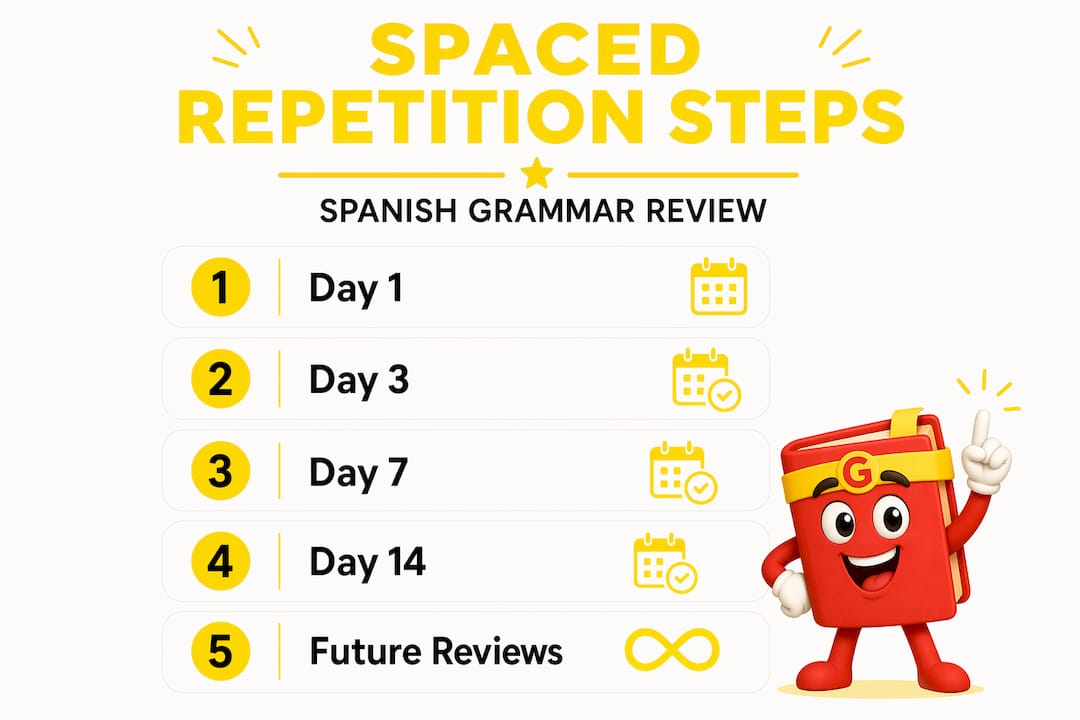
The ideal spaced repetition schedule starts with a review on day 1, then day 3, day 7, and day 14, with intervals expanding from there. This progressive spacing is more effective than reviewing at fixed, equal intervals. And the first review after learning something new must happen within 24 hours to get the full benefit of memory consolidation.
Why Spanish grammar is especially hard to learn
Spanish grammar is not just about memorizing words. It requires understanding relationships between forms, rules, and meaning all at once. Spanish grammar covers two major domains: morphology, which is the structure of words, and syntax, which is how words combine into sentences. Both demand structured, repeated practice.
Verb conjugations are where most learners hit a wall. Consider the verb hablar (to speak). In the imperfect tense alone, you have six distinct forms: hablaba, hablabas, hablaba, hablábamos, hablabais, hablaban. Each one marks a different person and number. Each one can be tested in context. And that is just one tense of one verb.
Other grammar areas that create real difficulty include:
- Noun and adjective agreement: Every adjective must match the noun it modifies in gender and number. Un libro rojo (a red book) becomes una casa roja (a red house).
- Ser vs. estar: Both translate as “to be,” but ser is used for identity and permanent traits while estar is used for states, conditions, and locations.
- Subjunctive mood: This one trips up even advanced learners. The subjunctive appears in phrases expressing doubt, emotion, or hypothetical situations, such as Espero que vengas (I hope you come).
- Direct and indirect object pronouns: These shift position depending on the sentence structure, and they can even be combined, as in Se lo digo (I tell it to him/her).
The reason spaced repetition suits Spanish grammar so well is that grammar mastery requires knowing discrete forms with precision. Each verb conjugation form should be tracked separately in a spaced repetition system rather than lumped under a single verb entry. Knowing that hablábamos is the first-person plural imperfect of hablar is a separate piece of knowledge from knowing habló is the third-person singular preterite.
“Explicit grammar instruction gives you short-term accuracy gains, while comprehensible input builds more natural, lasting fluency. The most effective learning combines both.”
This post-Krashen synthesis, combining structured grammar study with real input, is exactly why spaced repetition fits so naturally into a modern Spanish learning plan. It handles the explicit, form-based side of learning while you pair it with reading, listening, and conversation practice.
How to set up spaced repetition for Spanish grammar
Getting started does not require complicated software or a steep learning curve. You need a clear system, a manageable daily habit, and the right type of material to study.
- Start with your weakest grammar areas. Identify which forms you get wrong most often. Common culprits are the subjunctive, irregular preterite verbs, and gendered noun agreements. Build your first set of cards around these gaps.
- Create cards for specific forms, not vague rules. Instead of writing “ser vs. estar,” write a card showing a sentence with a blank: Ella _____ cansada. The answer is está because fatigue is a state. This tests active recall of a specific, real-world usage.
- Follow the progressive interval schedule. Review new cards on day 1, day 3, day 7, and day 14. After that, correct answers push the interval out further. Wrong answers reset the card to a shorter interval.
- Limit your new cards. Adding 5 to 10 new cards per day keeps your daily review load from growing out of control. After a few weeks of steady input, you will have a rich review queue without feeling overwhelmed.
- Pair grammar cards with real examples. A card that asks you to conjugate tener in the conditional is useful. A card that shows the context, Si tuviera dinero, viajaría a España (If I had money, I would travel to Spain), is even better. Practice with grammar examples beats rote form memorization.
Pro Tip: Prioritize grammar patterns over isolated vocabulary. A card that tests whether you can produce the correct subjunctive trigger phrase, like “Quiero que tú...” (I want you to...), builds grammar muscle that transfers across hundreds of different sentences.
Balance is also critical. Spaced repetition handles the explicit grammar side, but you need comprehensible input alongside it. Read Spanish articles, watch Spanish shows with subtitles, and have conversations. Daily 15 to 20 minute grammar sessions combined with input practice produce the most natural fluency over time. You can explore native speaker grammar patterns to better understand which forms appear most frequently in real speech.
Common mistakes that kill your progress
Even learners who understand the spaced repetition technique can undermine their own results. Here are the mistakes that come up most often, and how to fix them.
- Delaying the first review. If you learn a grammar rule today but do not review it until three days later, you have already lost most of the benefit. Delayed first reviews reduce effectiveness significantly. Review within 24 hours, without exception.
- Passive re-reading instead of active recall. Reading through your notes or scrolling through Spanish grammar guides feels productive, but it does not strengthen memory the way active retrieval does. Always answer the question before you check the answer.
- Adding too many cards at once. It is tempting to load up your deck when you are motivated. But if you add 30 new cards on Monday and none for the rest of the week, your review pile on Wednesday will be brutal. Steady daily input is the only sustainable approach.
- Grouping all verb forms under one card. Writing one card that says “conjugate hablar in the preterite” and listing all six forms is not enough. Each form needs to be tested and tracked on its own so your review schedule reflects your real knowledge gaps.
- Skipping sessions when life gets busy. This one is especially damaging. Inconsistent review sessions undermine spaced repetition directly, since the entire system depends on reviewing at the right time. Even 10 minutes counts more than skipping.
Pro Tip: Set a non-negotiable daily review time, even if it is just while you drink your morning coffee. The habit matters more than the duration. Short, consistent sessions are the backbone of effective Spanish learning strategies.
Grammar cards also need to be specific and testable. Vague cards like “use subjunctive for doubt” are hard to answer precisely. Better cards present a real sentence with a blank and require you to produce the exact correct form.
My take: what spaced repetition actually changed for me
I spent a long time studying Spanish grammar the traditional way. I would read a grammar chapter, do a few exercises, and feel confident. Two weeks later, I would struggle to produce the same forms in conversation. The knowledge felt hollow.
What I discovered when I switched to structured spaced repetition was that grammar forms I had reviewed just four times over two weeks felt genuinely solid. Not “I’ve seen this before” solid. More like “I produced it automatically in a conversation” solid. That shift was the turning point.
What I have found is that the biggest gains come not from adding more content but from reviewing what you already have at the right time. Missing a session hurts more than you expect. Catching a review on day one feels almost too easy, yet it locks in knowledge that would otherwise vanish.
My honest advice: do not think of spaced repetition as a separate tool you use on top of your other study methods. Build it into the center of how you learn Spanish grammar.
Gradual progress feels slow. It is not. It compounds.
- Daria Tsibina, Founder of Gramanator
Level up your Spanish grammar with Gramanator
If you want a platform that puts spaced repetition and grammar at the center of every session, Gramanator is built exactly for that.

Gramanator is a Spanish grammar platform with over 10,000 interactive grammar exercises built around real-world scenarios: workplace conversations, travel situations, and everyday interactions. The platform tracks your progress in detail, identifies your weak grammar patterns, and recommends exactly which forms to review next. You do not have to manage your own deck or figure out your intervals manually. Gramanator’s system handles the scheduling so you can focus on practicing. Check out the available subscription options to find the plan that fits your level and goals, whether you are building A1 foundations or pushing toward C1 fluency.
FAQ
What is spaced repetition in language learning?
Spaced repetition is a study technique that schedules review sessions at increasing time intervals to strengthen long-term memory. It works by having you actively recall information just before your memory of it fades.
How does spaced repetition help with Spanish grammar?
Spaced repetition helps you retain specific grammar forms, like verb conjugations and noun-adjective agreements, by reviewing them repeatedly over time at the right intervals. It is more effective than cramming because it matches how memory naturally consolidates.
How often should I review Spanish grammar with spaced repetition?
The recommended schedule starts with reviews on day 1, day 3, day 7, and day 14 after first learning a form. After each successful review, the next interval grows longer.
Can I use spaced repetition for all areas of Spanish grammar?
Yes. Spaced repetition works well for verb conjugations, subjunctive triggers, gender agreements, pronoun placement, and more. The key is writing specific, testable cards for each grammar form rather than broad summary cards.