Reflexive Spanish Verbs List: Top 25 + 100 Reference
Reflexive verbs in Spanish are verbs where the subject performs the action on itself, and they always require a matching reflexive pronoun (me, te, se, nos,…

Reflexive verbs in Spanish are verbs where the subject performs the action on itself, and they always require a matching reflexive pronoun (me, te, se, nos, os, se). If you skip the pronoun, the sentence either breaks or means something completely different. Before diving into the full reflexive Spanish verbs list, here are the Super 7 you should memorize first:
- levantarse - to get up (Me levanto a las siete. - I get up at seven.)
- llamarse - to be called (Me llamo Ana. - My name is Ana.)
- sentirse - to feel (Se siente cansado. - He feels tired.)
- ponerse - to put on / to become (Me pongo el abrigo. - I put on my coat.)
- quedarse - to stay / to remain (Nos quedamos en casa. - We stay home.)
- irse - to leave / to go away (Se va mañana. - She leaves tomorrow.)
- despertarse - to wake up (Te despiertas tarde. - You wake up late.)
Mastering these seven verbs first gives you a working reflexive structure you can use in real conversations immediately. Once the pronoun-verb pairing feels automatic, every new reflexive verb you learn slots in without extra effort.
Reflexive verbs cluster around daily routines, emotional states, and physical changes - which means they show up constantly in everyday Spanish. Learning them systematically, rather than one at a time, is one of the fastest ways to close the gap between knowing grammar and actually speaking it. Understanding native-speaker grammar patterns shows exactly why reflexives are so central to natural Spanish.
Table of Contents
- The top 25 reflexive verbs you need to know first
- Extended reference: 100 common reflexive verbs by level
- How reflexive pronouns work: conjugation and placement rules
- When reflexive verbs change meaning: true reflexives, pseudo-reflexives, and reciprocals
- A practical 4-week plan to make reflexive verbs automatic
- How the passive reflexive works in Spanish
- Key Takeaways
- Gramanator trains reflexive verbs until they’re instinctive
- Useful sources and further reading
The top 25 reflexive verbs you need to know first
This list follows frequency-based rankings of common reflexive verbs, so you’re studying the ones that appear most in real conversations. Each entry includes the infinitive, its English meaning, and one example sentence showing correct pronoun placement.
- levantarse - to get up | Me levanto a las seis de la mañana.
- llamarse - to be called | ¿Cómo te llamas?
- sentirse - to feel (emotional/physical) | No me siento bien hoy.
- ponerse - to put on (clothing) / to become | Se pone nerviosa antes del examen. (meaning changes)
- quedarse - to stay, to remain | Nos quedamos hasta las diez.
- irse - to leave, to go away | Me voy ahora mismo.
- despertarse - to wake up | ¿A qué hora te despiertas?
- ducharse - to shower | Ella se ducha por la mañana.
- acostarse - to go to bed | Los niños se acuestan a las nueve.
- vestirse - to get dressed | Me visto rápido los lunes.
- afeitarse - to shave | Él se afeita todos los días.
- lavarse - to wash (oneself) | Me lavo las manos antes de comer. (note: definite article, not possessive)
- peinarse - to comb / brush one’s hair | Se peina frente al espejo.
- maquillarse - to put on makeup | Tarda veinte minutos en maquillarse.
- cepillarse - to brush (teeth, hair) | Me cepillo los dientes tres veces al día.
- acordarse de - to remember | ¿Te acuerdas de su nombre?
- olvidarse de - to forget | Se olvidó de llamarme.
- preocuparse - to worry | No te preocupes tanto.
- alegrarse - to be glad / to cheer up | Me alegro de verte.
- enfermarse - to get sick | Se enferma cada invierno.
- casarse con - to marry | Se casaron en junio.
- sentarse - to sit down | Siéntate aquí, por favor.
- quejarse de - to complain about | Siempre se queja del trabajo.
- probarse - to try on (clothing) | Me pruebo los zapatos antes de comprarlos.
- quitarse - to take off (clothing) | Se quita el abrigo al entrar.
A few of these verbs shift meaning when used reflexively. Poner means “to put” or “to place,” but ponerse means “to put on clothing” or “to become (an emotional state).” Quedar means “to arrange to meet,” while quedarse means “to stay.” Catching these pairs early prevents a whole category of common errors.
Pro Tip: Print this list as a one-page cheat sheet and keep it visible during your first two weeks of study. Seeing the pronouns alongside the verb forms every day builds passive recognition before you even start drilling actively.

Extended reference: 100 common reflexive verbs by level
Use this list to build flashcard decks, select verbs for drills, or identify gaps in your knowledge. Level markers follow a simplified CEFR scale: A1 (beginner), B1 (intermediate), C1 (advanced). Pair this list with conjugation practice to move from recognition to production.
A1 - Start here
- aburrirse (to get bored) · acostarse (to go to bed) · afeitarse (to shave) · bañarse (to bathe) · cepillarse (to brush) · despertarse (to wake up) · ducharse (to shower) · irse (to leave) · lavarse (to wash) · levantarse (to get up) · llamarse (to be called) · maquillarse (to put on makeup) · peinarse (to comb hair) · ponerse (to put on) · quitarse (to take off) · sentarse (to sit down) · sentirse (to feel) · vestirse (to get dressed)
B1 - Build on your foundation
- acordarse de (to remember) · acostumbrarse a (to get used to) · alegrarse (to be glad) · alejarse de (to move away from) · animarse (to cheer up) · apresurarse (to hurry) · arreglarse (to get ready) · caerse (to fall down) · calmarse (to calm down) · cansarse de (to get tired of) · casarse con (to marry) · colocarse (to position oneself) · contentarse con (to be content with) · disponerse a (to get ready to) · enfermarse (to get sick) · equivocarse (to make a mistake) · hacerse (to become) · irse (to go away) · juntarse (to get together) · lastimarse (to hurt oneself) · levantarse (to stand up) · marcharse (to leave) · meterse en (to get into) · molestarse (to bother oneself) · negarse a (to refuse) · ocuparse de (to take care of) · olvidarse de (to forget) · parecerse a (to look like) · portarse (to behave) · preocuparse (to worry) · prepararse (to prepare) · probarse (to try on) · quedarse (to stay) · quejarse de (to complain) · quemarse (to burn oneself) · reírse de (to laugh at) · resignarse a (to resign oneself) · reunirse (to meet up) · romperse (to break a limb) · secarse (to dry oneself) · servirse (to help oneself) · tratarse de (to be about)
C1 - Advanced and idiomatic
- apartarse de (to move aside from) · apoyarse en (to lean on) · aprovecharse de (to take advantage of) · arrepentirse de (to regret) · atreverse a (to dare to) · burlarse de (to mock) · comprometerse a (to commit to) · convertirse en (to become / to turn into) · darse cuenta de (to realize) · dedicarse a (to dedicate oneself to) · despedirse de (to say goodbye to) · empeñarse en (to insist on) · enamorarse de (to fall in love with) · enfrentarse a (to face / to confront) · enterarse de (to find out about) · fiarse de (to trust) · fijarse en (to notice) · graduarse (to graduate) · hacerse cargo de (to take charge of) · independizarse (to become independent) · instalarse (to settle in) · interesarse por (to take interest in) · jubilarse (to retire) · limitarse a (to limit oneself to) · mantenerse (to maintain oneself) · mudarse (to move house) · negarse a (to refuse) · oponerse a (to oppose) · parecerse a (to resemble) · perderse (to get lost) · plantearse (to consider / to pose to oneself) · ponerse de acuerdo (to come to an agreement) · quejarse de (to complain about) · referirse a (to refer to) · relacionarse con (to relate to) · resolverse a (to resolve to) · suicidarse (to take one’s own life) · tratarse de (to be a matter of) · valerse de (to make use of) · volverse (to become / to turn around)
To get the most from this list, pick 5-10 verbs per week at your current level, drill them in conjugated sentences, and only advance when you can produce the pronoun and verb form without pausing.
How reflexive pronouns work: conjugation and placement rules
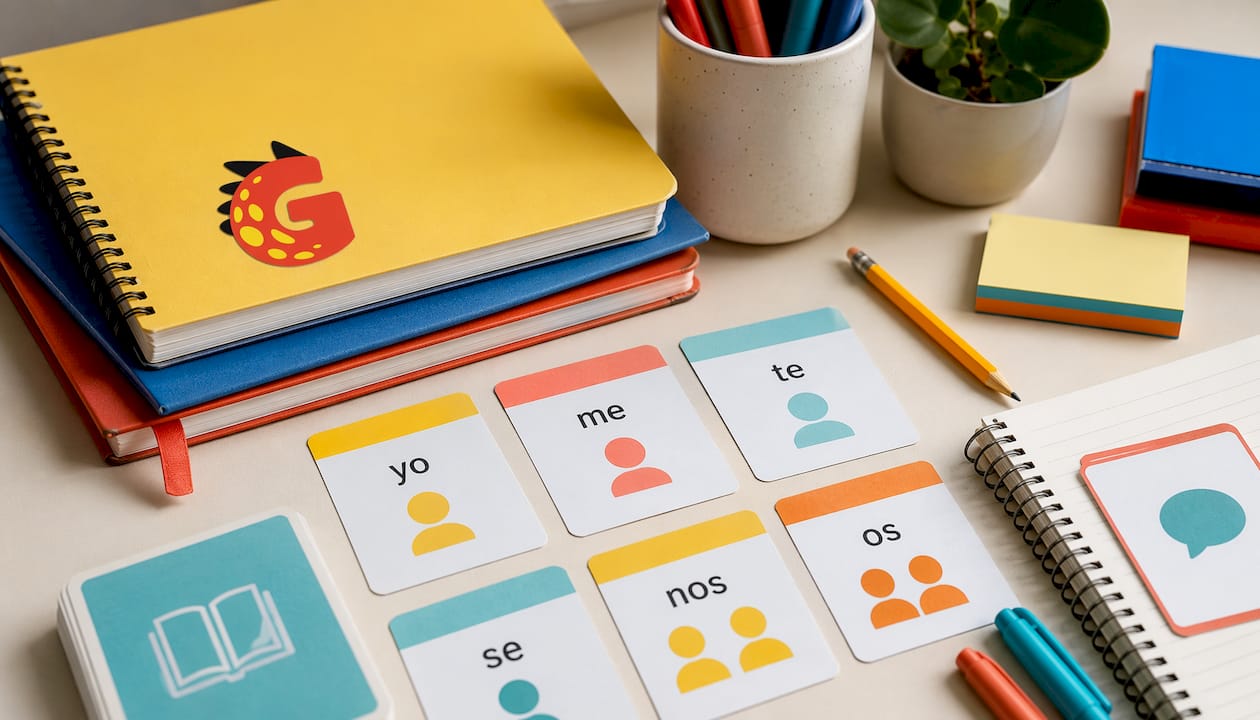
The reflexive pronoun must match the subject of the verb. Here is the full set, as required by Spanish grammar rules:
- yo → me
- tú → te
- él / ella / usted → se
- nosotros → nos
- vosotros → os (used primarily in Spain)
- ellos / ellas / ustedes → se
The os form is largely a Spain-specific feature. In Latin America, ustedes covers the second-person plural, so se does the work for that group as well.
Conjugation table: levantarse (present and preterite)
| Subject | Pronoun | Present | Preterite |
|---|---|---|---|
| yo | me | me levanto | me levanté |
| tú | te | te levantas | te levantaste |
| él / ella | se | se levanta | se levantó |
| nosotros | nos | nos levantamos | nos levantamos |
| vosotros | os | os levantáis | os levantasteis |
| ellos / ellas | se | se levantan | se levantaron |
Pairing the pronoun as a separate column, as shown above, is one of the most effective ways to internalize reflexive verb patterns.
Pronoun placement rules
Placement depends on the verb form in the sentence:
- Conjugated verb: pronoun goes before the verb. → Me levanto temprano.
- Infinitive: pronoun attaches to the end of the infinitive, or goes before the conjugated helper verb. → Voy a levantarme. / Me voy a levantar.
- Gerund: pronoun attaches to the end of the gerund, or precedes the conjugated helper. → Estoy levantándome. / Me estoy levantando.
- Affirmative command: pronoun attaches to the end of the command form. → ¡Levántate!
- Negative command: pronoun goes before the verb. → ¡No te levantes!
When talking about body parts, Spanish uses the reflexive pronoun plus a definite article rather than a possessive adjective. You say Me lavo la cara (“I wash my face”), not Me lavo mi cara. This is a consistent pattern across grooming and hygiene verbs.
Pro Tip: When you’re unsure about pronoun placement, say the sentence aloud with the pronoun in both positions. The version that sounds natural to a native speaker is almost always the grammatically correct one - and your ear trains faster than you think.
When reflexive verbs change meaning: true reflexives, pseudo-reflexives, and reciprocals
Not every verb ending in -se signals a literal action on oneself. Pronominal verbs in Spanish fall into three distinct categories, and confusing them is one of the most common intermediate-level mistakes.
Three categories to know
True reflexives - the subject acts directly on itself:
- Ella se mira en el espejo. (She looks at herself in the mirror.)
- Me corto el pelo. (I cut my own hair.)
Pseudo-reflexives (pronominal verbs) - the -se is a grammatical marker that changes the verb’s meaning, not a signal of self-directed action:
- quedar (to arrange to meet) vs. quedarse (to stay, to remain)
- ir (to go) vs. irse (to leave, to go away)
- poner (to put/place) vs. ponerse (to put on clothing / to become an emotional state)
- hacer (to make/do) vs. hacerse (to become)
Reciprocal verbs - two or more subjects act on each other; these use the plural pronouns nos, os, or se:
- Se besan. (They kiss each other.) - though context could theoretically mean “they kiss themselves,” real usage almost always signals reciprocal action.
- Nos llamamos cada día. (We call each other every day.)
A quick decision rule
When you encounter a -se verb in the wild, ask three questions:
- Is the subject acting on itself? → True reflexive.
- Does removing -se give a completely different verb meaning? → Pseudo-reflexive.
- Are there two or more subjects exchanging the action? → Reciprocal.
Contrastive drilling, practicing quedar and quedarse in back-to-back sentences, is the fastest way to lock in these distinctions. Context is the only reliable guide for verbs like besarse, which can technically mean either “to kiss oneself” or “to kiss each other” depending on the situation.
A practical 4-week plan to make reflexive verbs automatic
Knowing a list is not the same as using it fluently. Structured grammar practice that targets specific patterns and repeats them in varied contexts is what builds automatic recall. Here is a four-week plan built around that principle.
Week-by-week breakdown
-
Week 1 - Pronouns and the Super 7: Drill the seven high-frequency verbs from the opening section in all six present-tense forms. Write five sentences per verb using real daily-routine contexts. Checkpoint: Can you produce the correct pronoun without pausing?
-
Week 2 - Top 25 in context: Work through verbs 8-25 from the high-frequency list. For each verb, write one sentence in the present tense and one in the preterite. Focus on placement with infinitives (voy a ducharme) and gerunds (estoy duchándome). Checkpoint: Can you switch between placement options mid-sentence?
-
Week 3 - Meaning contrasts: Take five pseudo-reflexive pairs (ir/irse, poner/ponerse, quedar/quedarse, hacer/hacerse, ir/irse) and drill them side by side. Write two sentences per pair, one reflexive and one not. Checkpoint: Can you explain the meaning difference without translating?
-
Week 4 - Commands and conversation: Practice affirmative and negative commands with ten verbs from your list. Then use three role-play prompts: describing your morning routine, giving a friend advice about a habit, and narrating what happened yesterday. Checkpoint: Do the pronouns come out before you think about them?
Sample 5-item drill (copy and use today)
| # | Prompt | Your answer |
|---|---|---|
| 1 | Conjugate levantarse for nosotros (present) | nos levantamos |
| 2 | Attach the pronoun: Voy a _____ (ducharse) | Voy a ducharme |
| 3 | Negative command for tú with quedarse | No te quedes |
| 4 | Translate: “She gets dressed quickly” | Ella se viste rápido |
| 5 | Is irse a true reflexive or pseudo-reflexive? | Pseudo-reflexive |
Pro Tip: Use WordByWord to find real example sentences for any reflexive verb you’re drilling. Seeing a verb in five different authentic contexts does more for retention than writing five identical practice sentences.
Gramanator’s grammar drills are built around exactly this kind of targeted, mistake-focused repetition. The platform tracks which verb forms trip you up and cycles them back until the response is automatic, which is precisely what week-by-week checkpoints are designed to measure.
How the passive reflexive works in Spanish
The passive reflexive (also called the se impersonal or se pasivo) uses se with a third-person verb to express an action without naming who performs it. You see it constantly on signs, in instructions, and in formal writing.
- Se habla español aquí. - Spanish is spoken here.
- Se venden apartamentos. - Apartments are sold. / Apartments for sale.
- Se prohíbe fumar. - Smoking is prohibited.
The verb agrees with the grammatical subject (the thing being acted upon), not with a person. In Se venden apartamentos, the verb is plural because apartamentos is plural. In Se habla español, the verb stays singular because español is singular.
This construction is different from a true reflexive because no subject is acting on itself. The se here is a grammatical device that removes the agent from the sentence entirely. Learners often confuse passive reflexive se with reflexive se because the pronoun looks identical, but the test is simple: if you can ask “who did it?” and the answer is deliberately hidden, you’re looking at a passive reflexive. If the subject is doing something to itself, it’s a true reflexive.
Key Takeaways
Reflexive verbs require a matching pronoun (me, te, se, nos, os, se), and mastering the Super 7 first gives you a working structure for real conversations before you tackle the full list.
| Point | Details |
|---|---|
| Start with the Super 7 | Memorize levantarse, llamarse, sentirse, ponerse, quedarse, irse, and despertarse before expanding your list. |
| Use the top-25 list for daily study | These high-frequency verbs cover most reflexive usage in everyday Spanish conversation. |
| Level-mark your extended list | Use the A1/B1/C1 markers in the 100-verb reference to prioritize which verbs to drill next. |
| Know the three categories | True reflexives, pseudo-reflexives, and reciprocals each behave differently - drilling pairs like quedar/quedarse prevents lasting confusion. |
| Gramanator for automatic recall | Gramanator’s targeted, repetition-based drills track your weak verb forms and cycle them back until the pronoun placement becomes instinctive. |
Gramanator trains reflexive verbs until they’re instinctive
Reading a list builds awareness. Drilling it builds fluency. Gramanator is built for the second part: the platform maps directly to the four-week practice plan above, giving you structured grammar drills that target reflexive pronouns, conjugation, and placement in real-life Spanish contexts.

Three features make a real difference for reflexive verb mastery:
- Targeted reflexive drills - practice pronoun placement with conjugated verbs, infinitives, gerunds, and commands in the same session, so you train all four patterns together.
- Mistake-focused repetition - when you get a pronoun wrong, Gramanator flags it and brings that exact form back until you answer correctly three times in a row.
- Real-life context prompts - drills use workplace, travel, and daily-routine scenarios, so you’re training the reflexive verbs that actually come up in conversation, not abstract textbook sentences.
If you’re ready to move from recognizing reflexive verbs on a list to producing them automatically in speech, start your free trial and run your first reflexive drill today. Check the pricing page to see which plan fits your study schedule.
Useful sources and further reading
These are the most reliable references for deepening your understanding of Spanish reflexive verbs. Use them alongside your drills for grammar explanations, extended verb lists, and additional examples.
- Spanish/Reflexive Verbs - Wikibooks: A free, open-reference list of reflexive verbs with definitions and example sentences. Good for browsing the full inventory and checking unfamiliar verbs.
- Lawless Spanish - Reflexive Verbs: Clear grammar explanations covering pronoun use, body-part article rules, and common reflexive verb categories. Use it to reinforce the mechanics covered in this article.
- Real Fast Spanish - Top 25 Reflexive Verbs: A frequency-based list with audio and example sentences. Useful for checking pronunciation alongside your written drills.
- FluentU - Pronominal Verbs in Spanish: Covers the distinction between reflexive, reciprocal, and pseudo-reflexive uses with example sentences. Read this after completing Week 3 of the practice plan.
- Espanido - Reflexive Verb Conjugation Rules: Detailed conjugation rules and pronoun pairing tables. Use it as a reference when the placement rules in this article need more examples.
- Gramanator Spanish Grammar Blog: Study strategies, conjugation guides, and grammar explanations written for adult learners. A practical companion to the drills on the platform.
- WordByWord: Corpus-based example sentences for any Spanish verb. Search a reflexive verb here to find authentic usage examples that go beyond textbook sentences.
For a printable version of the Super 7 and top-25 lists, copy the tables from this article into a single document and print it as a one-page reference. Keep it on your desk during Week 1 and Week 2 of the practice plan.