How Spanish Output Practice Builds Fluency Fast
How Spanish output practice accelerates fluency. Speaking and writing drills that make grammar rules automatic, backed by SLA research.

Most Spanish learners spend months listening to podcasts and reading grammar guides before they say a single sentence aloud. It feels safe. But passive input alone will not get you fluent. Understanding how Spanish output practice builds fluency is the missing piece for most adult learners. When you produce language instead of just consuming it, your brain shifts gears. You move from recognizing Spanish to retrieving it under real pressure. That shift is where fluency actually lives.
Table of Contents
- Key takeaways
- How Spanish output practice builds fluency
- Structured output techniques that actually work
- Balancing input and output at every level
- Overcoming the biggest obstacles in output practice
- My honest take on output practice and fluency
- Build the grammar foundation output practice demands
- FAQ
Key takeaways
| Point | Details |
|---|---|
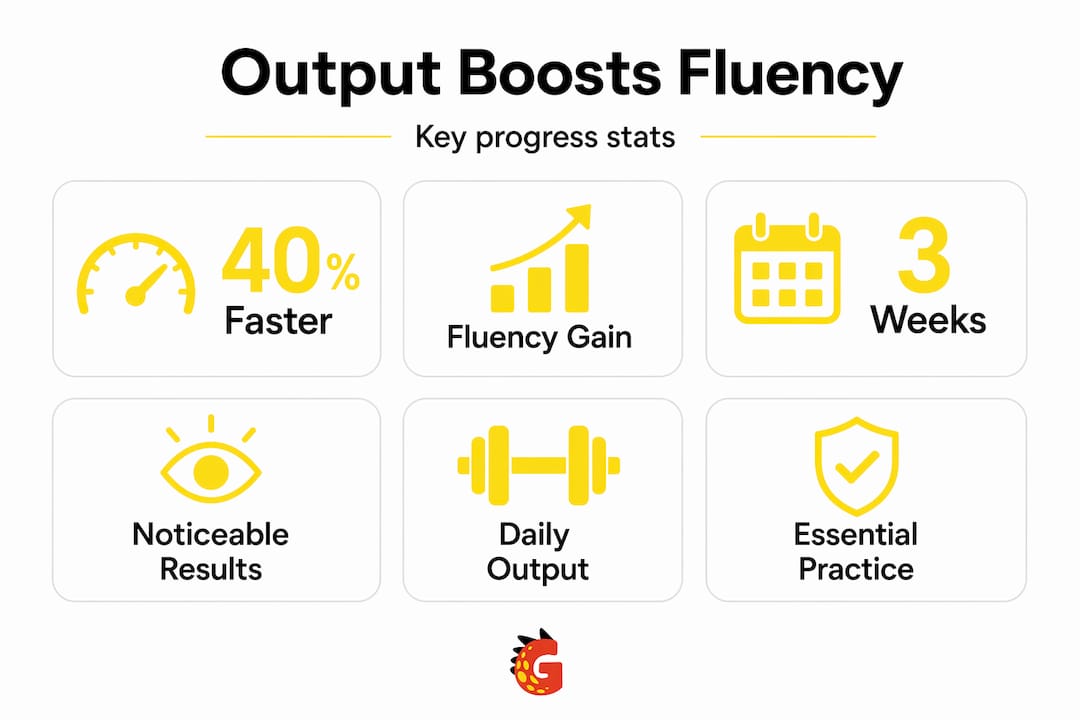
| Output accelerates fluency | Combining input and output produces up to 40% faster speaking progress than input alone. |
| Short daily sessions win | Practicing speaking for 10 to 15 minutes daily produces measurable improvement in just 2 to 3 weeks. |
| Record-review loops work | Recording short monologues and replaying them helps you spot errors and close the gap between thought and speech. |
| Balance shifts with level | Beginners need more input; intermediate and advanced learners should push output much harder to build automatic recall. |
| Mindset matters | Accepting imperfect speech as part of training, not failure, is what separates learners who plateau from those who break through. |
How Spanish output practice builds fluency
Linguist Merrill Swain developed the Output Hypothesis after studying French immersion students in Canada. Those students had years of comprehensible input, yet they still made consistent grammatical errors when speaking or writing. The conclusion was clear. Input builds comprehension, but it does not force you to produce accurate language. French immersion students had strong receptive skills but struggled grammatically when required to produce output.
Swain identified three key functions that output practice performs:
- Noticing gaps. When you try to say something and realize you do not know how, you become aware of a real gap in your knowledge. That moment of noticing is far more powerful than passively encountering the same structure in a text.
- Hypothesis testing. Every time you produce a sentence, you are testing a grammar rule. You experiment. You get feedback. You revise. This is how you actually internalize a structure rather than just recognizing it.
- Metalinguistic reflection. Speaking or writing forces you to think consciously about how Spanish works. That reflection deepens understanding in a way that listening never triggers on its own.
“Most adult learners wait to speak until they feel ‘ready,’ but output forces noticing and drives learning much faster than passive study alone.”
The practical payoff is significant. Learners who combine input and output show up to 40% faster progress in speaking proficiency compared to those who rely on input only. That is not a minor difference. That is the gap between someone who sounds conversational after six months and someone who still hesitates after two years.
Structured output techniques that actually work
Knowing you should practice output is one thing. Knowing how is another. These are the methods that produce real results for adult Spanish learners.
-
Daily short monologues. Pick a topic you care about, set a timer for five minutes, and speak in Spanish without stopping. Do not worry about accuracy at first. The goal is retrieval under time pressure. 10 to 15 minutes daily consistently beats one or two hours practiced once a week, with measurable improvement appearing in as little as two to three weeks.
-
The record-review-adjust loop. Record yourself speaking for 60 seconds on any topic. Play it back. Note where you hesitated, avoided a word, or used the wrong tense. Re-record immediately. Recording short monologues daily and reviewing them improves automaticity in as little as two to four weeks. This one habit alone closes the gap between what you know and what you can actually say under pressure.
-
AI conversation partners. Tools that simulate real conversation give you low-stakes repetitions without the anxiety of a live partner. You can practice ordering food, describing your weekend, or navigating a workplace conversation repeatedly until the grammar feels automatic. No judgment, no social pressure.
-
Shadowing native speakers. Find a short audio clip from a native speaker and repeat it simultaneously, matching their rhythm and pronunciation. Shadowing is not just about accent. It trains your mouth and brain to process Spanish at natural speed, which is entirely different from the slow, careful reading most learners do.
-
Role-play and scenario practice. Pick a real-world situation: a job interview, a doctor’s visit, a phone call to a landlord. Write out the likely conversation structure, then act it out alone. Repeat the same scenario several times over a week. Contextualizing your output like this is how you build conversational fluency that transfers to real life.
Pro Tip: Set your phone to Spanish for one week. Every notification, menu, and setting becomes a micro-dose of output practice when you have to respond or navigate in the language.
Balancing input and output at every level
The right ratio of input to output changes as your Spanish develops. Getting this balance wrong is one of the most common reasons learners stall.
| Proficiency level | Recommended input focus | Recommended output focus | Primary goal |
|---|---|---|---|
| Beginner (A1-A2) | 70 to 80% | 20 to 30% | Build vocabulary and pattern recognition |
| Intermediate (B1-B2) | 50% | 50% | Develop spontaneous speech and fix fossilized errors |
| Advanced (C1-C2) | 40% | 60% | Express complex ideas with automaticity and precision |
Beginners genuinely need more input. You cannot produce what you have never encountered. At this stage, your goal is to build a mental library of patterns and vocabulary through comprehensible input so you have material to work with when you start producing.
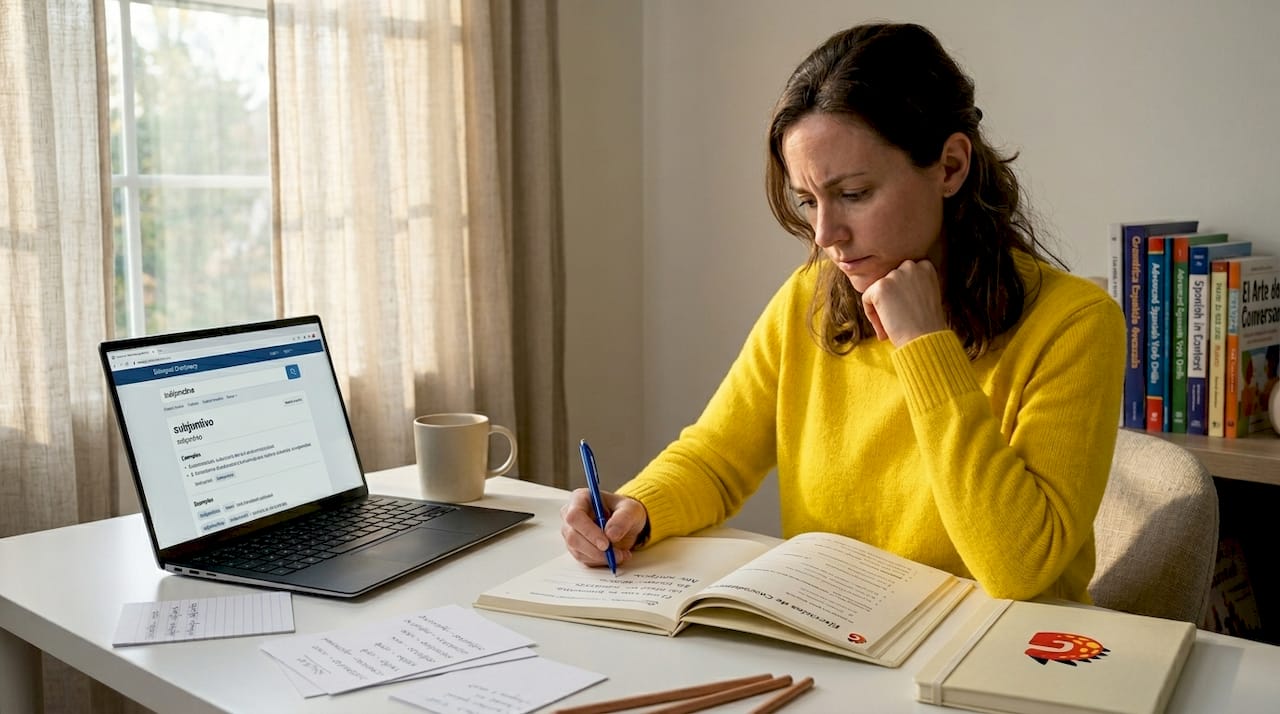
The shift happens at the intermediate level. This is where many learners get stuck. They understand quite a lot, but they still pause, translate in their heads, and avoid complex structures. Pushed output at the intermediate stage combats fossilized errors, those mistakes that become habits because no one ever challenged you to produce accurately under pressure. Increasing output here is not optional. It is the fix.
Advanced learners need to keep pushing output into uncomfortable territory. Discussing abstract topics, debating, telling nuanced stories. Output must push beyond comfort zones to express complex ideas and build skills that comprehension practice simply cannot develop. Continuing to consume rich input at this stage also matters, but output carries more weight.
Pro Tip: If you are at the intermediate level, commit to one five-minute speaking session before you consume any Spanish input that day. Production before consumption trains retrieval before recognition.
Overcoming the biggest obstacles in output practice
Speaking a foreign language out loud feels vulnerable. That discomfort is real, and it has a name. Many learners experience what researchers call a panic-freeze response, where the pressure of producing speech in real time causes a mental blank.
The root cause is almost always translation-heavy thinking. When you mentally compose a sentence in English first and then try to convert it to Spanish, you overload your working memory. Panic-freeze in conversation is caused by translation-heavy thinking, not a lack of vocabulary. The fix is training your brain to think directly in Spanish through repeated production, not studying more grammar rules.
Here are the practical strategies that work:
- Use the two-second reset. When you feel a blank coming, pause deliberately for two seconds before speaking. A strategic short pause buys your brain processing time without fillers like “um” or “eh,” and it actually sounds more confident to a listener than a filler-heavy rush.
- Accept imperfect output as data. Every mistake you make while speaking is information. It tells you exactly where your grammar is weak. Waiting to speak until you are perfect means waiting forever.
- Start solo. Solo output practice reduces social anxiety and lets you focus entirely on identifying and fixing your own errors. Build confidence in private before you take it live.
- Use daily triggers. Attach your speaking practice to an existing habit. Morning coffee, your commute, your lunch break. Consistency over volume is what builds the neural pathways that make language automatic.
The goal is not perfect Spanish. The goal is faster retrieval. Automatization through repeated production under time pressure is what creates the neural pathways essential for fluent speaking. You are training a reflex, not reciting memorized phrases.
My honest take on output practice and fluency
I have worked with adult language learners long enough to see the same pattern repeat. Someone spends months studying and listening and reads every grammar explanation they can find. They understand Spanish reasonably well. But put them in a real conversation and they freeze. The knowledge is there. The reflex is not.
What I have seen break that pattern consistently is not more input. It is showing up and speaking badly, on purpose, every single day. The learning breakthrough comes from doing, not knowing. When I started recording myself and listening back, the improvement felt almost unfair. I could hear exactly what was wrong and fix it in the next take. No class, no tutor, just an honest feedback loop with myself.
The contrarian truth is this: your mistakes are your most valuable training data. Learners who treat errors as failures avoid them. Learners who treat errors as feedback chase them down. One group plateaus. The other gets fluent. You can find more perspective on this at the Gramanator grammar blog, which covers exactly this kind of approach to Spanish fluency development.
Realistic expectations also matter. You will not sound natural in three weeks. But you will sound noticeably better. That is enough to keep going.
- Daria
Build the grammar foundation output practice demands
Output practice without grammar training is like running drills without knowing the plays. You need the patterns to be automatic before they can show up in live speech.
Gramanator is built specifically for this. It is a Spanish grammar training platform designed for serious adult learners who want grammar to become instinct, not something they have to consciously recall mid-sentence. The platform includes 10,000+ structured grammar drills across real-life contexts, timed grammar workouts that train retrieval speed, and targeted review of your actual weak areas. Every session builds the reflexive grammar foundation that your output practice depends on. When your grammar fires automatically, your speaking gets faster, cleaner, and more confident. Start structured grammar training with Gramanator today and give your output practice the foundation it needs.
FAQ
What is the output hypothesis in language learning?
The output hypothesis, developed by Merrill Swain, argues that producing language through speaking and writing accelerates fluency in ways that input alone cannot. It works by forcing learners to notice gaps, test grammar hypotheses, and reflect on language structure.
How long before output practice improves my Spanish?
Most learners see measurable improvement in spoken Spanish within two to three weeks of consistent daily output practice. Conversational fluency typically develops over three to six months of regular short sessions.
Is output practice better than input for learning Spanish?
Neither replaces the other, but the balance shifts with proficiency level. Beginners need more input to build a foundation, while intermediate and advanced learners see the fastest gains by increasing their output significantly.
How do I practice Spanish output if I have no conversation partner?
Solo methods work very well. Record short monologues, use AI-powered conversation tools, practice shadowing native speakers, and run role-play scenarios by yourself. Solo output practice reduces anxiety and provides focused, repeatable feedback.
Why do I freeze when speaking Spanish even though I know the grammar?
Freezing usually happens because you are translating from English rather than retrieving Spanish directly. The solution is repeated output practice under mild time pressure, which trains your brain to retrieve Spanish automatically instead of processing it through translation.