Spanish Complaint Letter Grammar: A Guide for Adult Learners
A professional Spanish complaint letter follows a five-part architecture and relies on three core grammar patterns: formal usted conjugations throughout,…


A professional Spanish complaint letter follows a five-part architecture and relies on three core grammar patterns: formal usted conjugations throughout, the conditional + imperfect subjunctive pairing for polite requests, and neutral, situation-focused adjectives like defectuoso (defective) and insatisfecho (unsatisfied) rather than emotional language. Get those three things right, and your letter will read as educated and credible regardless of the specific complaint.
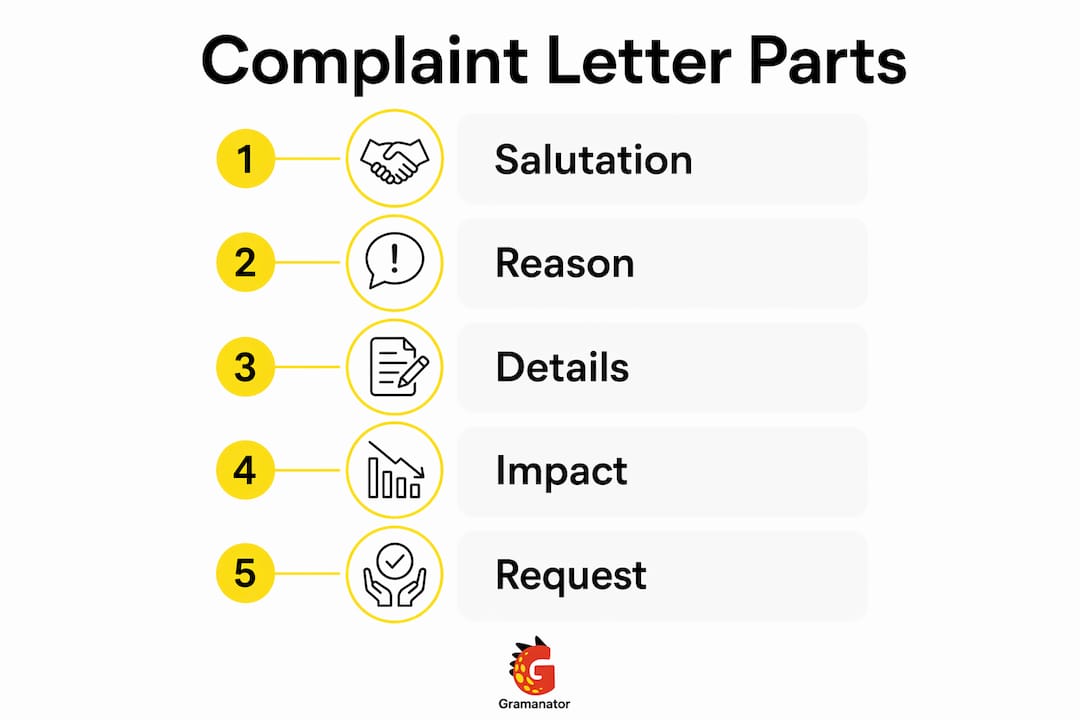
The five-part structure works like this:
- Salutation: Estimado/a Sr./Sra. [Apellido]: or A quien corresponda:
- Reason for writing: One sentence stating the complaint and the date or reference number
- Factual details: Objective description of what happened, supported by evidence
- Impact/consequence: How the situation affected you, stated calmly
- Specific request + closing: A clear resolution request with a deadline, followed by Atentamente or Un cordial saludo
Two sentences you can copy and adapt right now:
Me dirijo a usted para expresar mi descontento con el producto adquirido el pasado [fecha], el cual resultó ser defectuoso. (I am writing to express my dissatisfaction with the product purchased on [date], which proved to be defective.)
Le agradecería que revisara esta incidencia y me ofreciera una solución adecuada en un plazo de diez días hábiles. (I would appreciate it if you would review this matter and offer me an appropriate solution within ten business days.)
Those two lines alone cover the opening and the request. The rest of this guide explains the grammar behind every section so you can write any variation with confidence.
Table of Contents
- How the 5-part architecture shapes your grammar choices
- Why usted is non-negotiable in formal complaint letters
- The grammar devices that make a complaint coherent and professional
- A phrase bank you can copy directly into your letter
- Common mistakes learners make in complaint letters
- A full annotated complaint letter you can adapt
- Your proofing checklist before you send
- Key Takeaways
- Gramanator trains the grammar patterns complaint letters depend on
- Authoritative sources and recommended next steps
How the 5-part architecture shapes your grammar choices
Each paragraph in a Spanish complaint letter has a specific job, and each job calls for a specific grammar tool. Understanding that connection is what separates a letter that gets results from one that gets filed away.
Part 1: Salutation
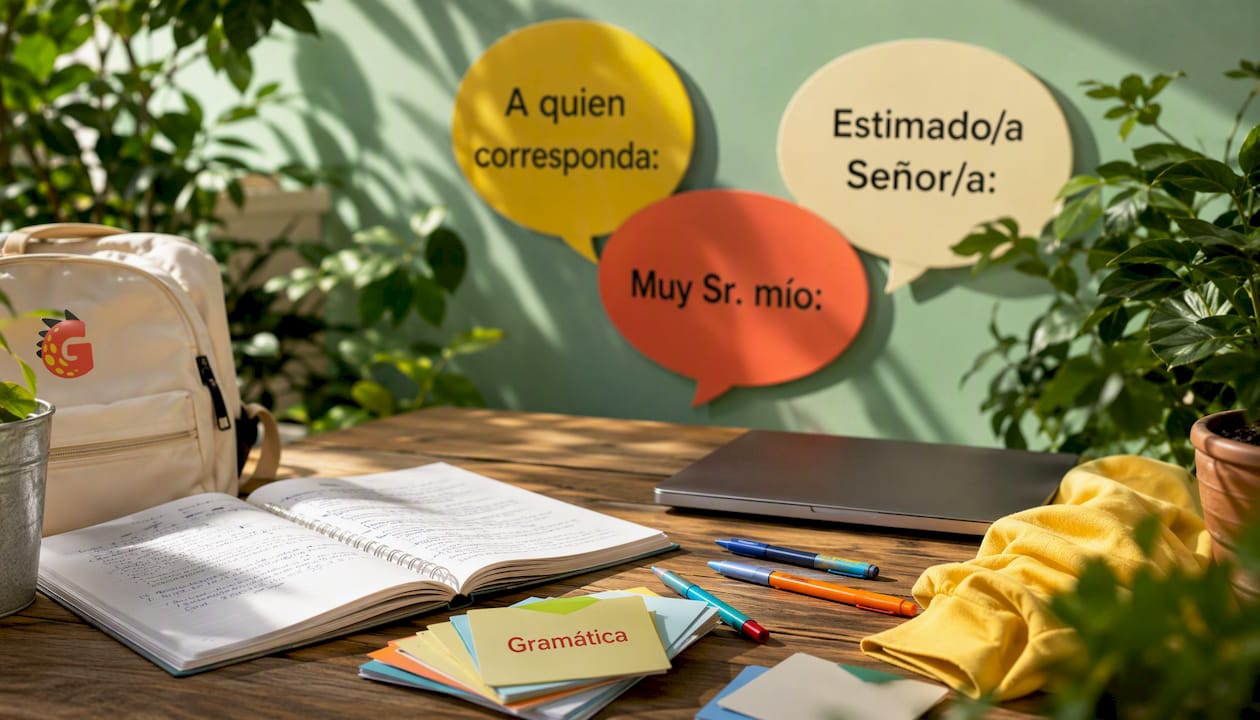
Use Estimado/a Sr./Sra. [Apellido]: when you know the recipient’s name. Use A quien corresponda: when you do not. Spanish formal letters use a colon after the salutation, not a comma. That single punctuation detail signals native-level register immediately.
Part 2: Reason for writing
Open with a first-person present-tense statement: Me dirijo a usted para... or El motivo de la presente es presentar una reclamación acerca de... Keep this paragraph to two sentences maximum. State the complaint category and the date or reference number.
Part 3: Factual details
This is where tense choice matters most. Use the pretérito indefinido (simple past) to narrate completed events: El producto llegó dañado el 3 de mayo. Use the pretérito perfecto (present perfect) when the situation is still ongoing or recent: He intentado contactar con su servicio de atención al cliente en tres ocasiones. For citing company materials, use reported speech: según lo indicado en su página web... This construction reframes the dispute as a contractual mismatch rather than a personal grievance, which is exactly the tone you want.

Part 4: Impact and consequence
State the consequence in a single, calm sentence. Como consecuencia de esta situación, me he visto obligado/a a... or Debido a lo ocurrido, el producto no cumple con las necesidades para las que fue adquirido. Avoid adjectives that describe your emotional state; describe the situation instead.
Part 5: Request + closing
This is where the conditional + subjunctive combination does its work. Por todo lo expuesto, le agradecería que revisara esta incidencia y me ofreciera una solución adecuada. Close with Quedo a la espera de su respuesta before the sign-off. A formal opening (Estimado Sr.) requires a formal close: Atentamente or Reciba un cordial saludo.
Pro Tip: Think of the five parts as a logical argument, not a list of complaints. Each paragraph builds the case for the next. The request in Part 5 only lands with authority if Parts 3 and 4 have established the facts and the impact clearly.
| Paragraph | Primary grammar tool | Example phrase |
|---|---|---|
| Salutation | Formal address + colon | Estimado Sr. García: |
| Reason for writing | Present tense, usted forms | Me dirijo a usted para... |
| Factual details | Pretérito indefinido / reported speech | El pedido llegó incompleto... según lo indicado en su catálogo... |
| Impact | Causal connectors + pretérito perfecto | Como consecuencia, he tenido que... |
| Request + closing | Conditional + imperfect subjunctive | Le agradecería que revisara... |
Why usted is non-negotiable in formal complaint letters
The choice between usted and tú is not just a politeness preference. It changes every verb conjugation in your letter, and slipping between the two registers is one of the most credibility-damaging errors a learner can make.
When you use usted, the verb takes the third-person singular form: usted tiene, usted puede, usted revisa. When you write tú, it shifts to second-person singular: tú tienes, tú puedes, tú revisas. In a formal complaint, every verb addressed to the recipient must follow the usted pattern. One tú form buried in the third paragraph signals carelessness to a native reader.
Beyond pronoun choice, formal register means replacing casual verbs with their elevated equivalents. Learners frequently confuse pedir and solicitar, for example, even though both mean “to ask for.” Solicitar is the correct choice in official correspondence. The same logic applies to rogar (to request earnestly) and sírvase + infinitive as an alternative to translating English “please” constructions directly.
| Casual (tú register) | Formal (usted register) | Use in complaints |
|---|---|---|
| ¿Puedes ayudarme? | ¿Podría usted ayudarme? | ✓ Formal |
| Te pido que me devuelvas el dinero. | Le solicito que proceda al reembolso. | ✓ Formal |
| Por favor, arréglalo. | Sírvase proceder a la corrección. | ✓ Formal |
| Quiero que me llames. | Le agradecería que me contactara. | ✓ Formal |
| Estoy muy enojado. | Considero que la situación es inaceptable. | ✓ Formal |
A useful rule of thumb: when in doubt, default to usted. Using usted when tú might have been acceptable is never offensive. The reverse is not true.
What to avoid: Slang, emotional venting, direct accusations (“ustedes son irresponsables”), and rhetorical questions (“¿Por qué no pueden hacer bien su trabajo?”). Spanish business writing values composure. Aggressive language reduces the effectiveness of a complaint, regardless of how justified the grievance is.
The grammar devices that make a complaint coherent and professional
Four grammar tools do most of the heavy lifting in a well-written Spanish complaint letter: the conditional + imperfect subjunctive for requests, narrative past tenses for describing events, passive voice for objectivity, and connectors for logical flow.
Conditional + imperfect subjunctive for requests
This is the single most important grammar pattern in the letter. The structure is: conditional in the main clause + imperfect subjunctive in the subordinate clause.
Le agradeceríamos que revisara el pedido y nos confirmara la fecha de envío. (We would appreciate it if you would review the order and confirm the shipping date.)
The conditional + imperfect subjunctive combination signals education and authority more effectively than a direct imperative. It softens the request while preserving its force. Compare: Revise el pedido (Review the order) versus Le agradecería que revisara el pedido (I would appreciate it if you would review the order). Both ask for the same thing. The second version is far more likely to get a response.
Narrative tenses
Use the pretérito indefinido for specific, completed past events: El técnico visitó las instalaciones el 12 de abril y no resolvió el problema. Use the pretérito perfecto for situations with present relevance: Han transcurrido tres semanas sin que hayamos recibido respuesta. Mixing these tenses randomly is a common learner error that makes the timeline of events hard to follow.
Passive voice and reported speech
Passive constructions add objectivity: El producto fue entregado en mal estado (The product was delivered in poor condition) sounds more measured than ustedes entregaron el producto en mal estado (you delivered the product in poor condition). For citing company materials, reported speech is the professional standard: según lo indicado en su página web or de acuerdo con la información facilitada en su catálogo. These phrases cast the company’s own claims as evidence, which is both legally weightier and tonally neutral.
Connectors for logical flow
Use formal connectors to build a coherent argument:
- En primer lugar (First of all) - introduces the first problem: En primer lugar, el producto llegó con tres días de retraso.
- Además (Furthermore) - adds a related point: Además, el embalaje presentaba daños visibles.
- Sin embargo (However) - introduces a contrast: Sin embargo, su servicio de atención al cliente no ofreció ninguna solución.
- Por lo tanto (Therefore) - signals the logical conclusion: Por lo tanto, solicito el reembolso íntegro del importe abonado.
- No solo... sino que (Not only... but also) - layers complaints for emphasis: No solo el producto llegó tarde, sino que faltaban dos unidades.
A phrase bank you can copy directly into your letter
The table below groups ready-to-use phrases by function. Each entry includes the Spanish phrase, a plain English gloss, and a register note so you know exactly when to use it.
| Function | Spanish phrase | English gloss | Register |
|---|---|---|---|
| Formal opener | Me dirijo a usted para expresar mi descontento con... | I am writing to express my dissatisfaction with... | Formal |
| Formal opener | El motivo de la presente es presentar una reclamación acerca de... | The purpose of this letter is to file a complaint regarding... | Very formal |
| Formal opener | Por medio de la presente, le comunico que... | By means of this letter, I inform you that... | Very formal |
| Stating facts | El pasado [fecha], adquirí [producto] en su establecimiento. | On [date], I purchased [product] at your establishment. | Neutral |
| Stating facts | El producto resultó ser defectuoso / llegó en mal estado. | The product proved to be defective / arrived in poor condition. | Neutral |
| Citing evidence | Según lo indicado en su página web... | According to what was stated on your website... | Formal |
| Citing evidence | De acuerdo con la información facilitada en su catálogo... | In accordance with the information provided in your catalog... | Formal |
| Impact statement | Como consecuencia de esta situación, me he visto obligado/a a... | As a result of this situation, I have been forced to... | Formal |
| Polite request | Le agradecería que revisara esta incidencia. | I would appreciate it if you would review this matter. | Formal |
| Polite request | Sírvase proceder al reembolso del importe abonado. | Please proceed with the refund of the amount paid. | Very formal |
| Firm request | Por todo lo expuesto, les solicito que... | In light of the above, I request that... | Formal |
| Deadline | Espero su respuesta dentro de los próximos diez días hábiles. | I await your response within the next ten business days. | Formal |
| Formal closing | Quedo a la espera de su respuesta. | I await your response. | Formal |
| Formal closing | Agradezco de antemano su atención. | I thank you in advance for your attention. | Formal |
| Sign-off | Atentamente, | Sincerely, / Yours faithfully, | Very formal |
| Sign-off | Un cordial saludo, | Kind regards, | Formal |
When choosing between a polite request and a firm one, consider the stage of the complaint. A first letter warrants Le agradecería que... A follow-up after no response justifies Por todo lo expuesto, les solicito que... and a deadline statement. Reserve Sírvase + infinitive for administrative or official correspondence where maximum formality is expected.
Common mistakes learners make in complaint letters
These errors appear repeatedly in learner writing. Each one has a straightforward fix.
-
Slipping from usted to tú mid-letter. Writing Le informo que el producto que compraste... mixes third-person usted with second-person tú. Fix: read every verb addressed to the recipient and confirm it follows the third-person singular pattern. Le informo que el producto que usted adquirió... is correct.
-
Using pedir instead of solicitar or rogar. Quiero pedirle que me devuelva el dinero is grammatically correct but registers as informal. Replace with Le solicito que proceda al reembolso or Le ruego que gestione la devolución correspondiente. The verb swap alone raises the register significantly.
-
Translating English “please” directly. Writing Por favor, devuélvame el dinero is not wrong, but it reads as casual in formal correspondence. Use sírvase + infinitive or the conditional + subjunctive pattern instead: Le agradecería que procediera a la devolución del importe.
-
Wrong tense for the narrative. Writing Ayer compré el producto y está roto mixes present and past in a way that sounds conversational. In a formal letter, narrate past events consistently in the pretérito indefinido: El pasado martes adquirí el producto, el cual presentaba daños visibles en el embalaje.
-
Incorrect subjunctive after the conditional. A frequent error is using the present subjunctive instead of the imperfect: Le agradecería que revise (wrong) versus Le agradecería que revisara (correct). The conditional in the main clause requires the imperfect subjunctive in the subordinate clause. If you need to drill this pattern until it becomes automatic, the conditional tense mistakes guide covers the most common traps in detail.
-
Emotional or accusatory language. Writing Su empresa es completamente irresponsable damages your credibility and gives the recipient a reason to dismiss the complaint. Replace with a situation-focused statement: Considero que la gestión de esta incidencia no ha cumplido con los estándares de calidad esperados.
-
Missing the specific resolution request. Many learners describe the problem thoroughly but close with a vague espero que solucionen esto. A professional letter names the exact remedy: refund, replacement, correction, or written explanation, with a reasonable deadline attached.
A full annotated complaint letter you can adapt
Read through this sample letter once for the overall flow, then use the annotation table below to understand each grammar choice.
[Your name and address] [City, date: 15 de junio de 2026]
Atención al Cliente [Company name and address]
Asunto: Reclamación por producto defectuoso - Pedido n.º 45821
Estimada señora García:
(1) Me dirijo a usted para presentar una reclamación en relación con un pedido realizado en su tienda online el pasado 2 de junio del presente año.
(2) El artículo recibido, referencia XP-200, no coincidía con las especificaciones técnicas publicadas en su página web en el momento de la compra. Según lo indicado en dicha descripción, el dispositivo incluía una batería de 5.000 mAh; sin embargo, el modelo entregado incorpora una batería de 3.000 mAh.
(3) Como consecuencia de esta discrepancia, el producto no cumple con las necesidades para las que fue adquirido, lo que me ha obligado a continuar utilizando un equipo antiguo con el consiguiente perjuicio para mi actividad profesional.
(4) Por todo lo expuesto, le agradecería que revisara esta incidencia y procediera, a la mayor brevedad posible, a la sustitución del artículo por el modelo correcto o, en su defecto, al reembolso íntegro del importe abonado. Espero su respuesta dentro de los próximos diez días hábiles.
Quedo a la espera de su respuesta y agradezco de antemano su atención.
Atentamente,
[Your full name] [Phone / email]
| Sentence | Grammar device | Why it works |
|---|---|---|
| Me dirijo a usted para presentar... | Present tense + usted form | Establishes formal register from the first word |
| Según lo indicado en su página web... | Reported speech formula | Frames the dispute as a contractual mismatch, not a personal accusation |
| sin embargo, el modelo entregado incorpora... | Contrast connector + passive participle | Highlights the gap between promise and reality objectively |
| Como consecuencia de esta discrepancia... | Causal connector + noun phrase | Introduces impact without emotional language |
| le agradecería que revisara... | Conditional + imperfect subjunctive | Polite, firm request - the hallmark of educated professional Spanish |
| Espero su respuesta dentro de los próximos diez días hábiles. | Present tense + deadline phrase | Sets a clear, reasonable timeframe without sounding aggressive |
Three adaptation hints:
- Damaged product: Replace no coincidía con las especificaciones with presentaba daños físicos visibles en el embalaje y en el propio artículo.
- Service delay: Replace the product reference with el servicio contratado el [fecha] aún no ha sido prestado, a pesar de haber transcurrido [X] días desde la fecha acordada.
- Billing error: Replace the body with se ha realizado un cargo de [importe] en mi cuenta que no corresponde a ningún servicio contratado, según lo reflejado en el extracto bancario adjunto.
Your proofing checklist before you send
Run through this list before printing or sending your letter. Each item catches a specific category of error.
- Format: Does the letter include your name and address, the date in Spanish format (15 de junio de 2026), the recipient’s name and address, and a subject line (Asunto:)?
- Register consistency: Have you used usted forms throughout, with no tú forms slipping in? Check every verb addressed to the recipient.
- Verb moods: Does every polite request use the conditional + imperfect subjunctive pattern (Le agradecería que revisara...)? Have you avoided the present subjunctive after the conditional?
- Evidence phrasing: Have you cited company materials using según lo indicado en... or de acuerdo con... rather than informal paraphrases?
- Connectors: Have you used at least one connector (en primer lugar, además, sin embargo, por lo tanto) to link your points?
- Specific resolution: Does the letter name the exact remedy you want (refund, replacement, correction)?
- Deadline: Have you included a reasonable response timeframe? Espero su respuesta dentro de los próximos diez días hábiles is a standard, professional phrase.
- Closing match: Does your sign-off match your opening? Estimado/a Sr./Sra. pairs with Atentamente or Reciba un cordial saludo. A formal opening and closing must be consistent throughout.
- Tone check: Read the letter aloud. If any sentence sounds angry, accusatory, or sarcastic, rewrite it using a situation-focused adjective or a causal connector instead.
Follow-up language: If you receive no response by your stated deadline, a short follow-up letter or email can reference the original: En relación con mi reclamación del [fecha], referencia [número], y no habiendo recibido respuesta hasta la fecha, me permito reiterar mi solicitud. If a second attempt also goes unanswered, that is typically the point to escalate to a consumer protection body or formal legal claim, depending on the amount and jurisdiction involved.
Key Takeaways
A professional Spanish complaint letter depends on three grammar patterns working together: usted forms throughout, conditional + imperfect subjunctive for requests, and neutral situation-focused adjectives instead of emotional language.
| Point | Details |
|---|---|
| Use usted throughout | Every verb addressed to the recipient must follow the third-person singular pattern; one tú form breaks the register. |
| Conditional + subjunctive for requests | Le agradecería que revisara... is the standard polite-but-firm request pattern in formal Spanish. |
| Be factual, not emotional | Use adjectives like defectuoso and insatisfecho to describe the situation; avoid personal accusations. |
| Use connectors | En primer lugar, además, sin embargo, and por lo tanto turn a list of grievances into a coherent argument. |
| Gramanator for grammar drills | Gramanator’s targeted conditional/subjunctive and usted conjugation drills build the automaticity these patterns require. |
Gramanator trains the grammar patterns complaint letters depend on
Writing a complaint letter in Spanish is a high-stakes grammar test. You need the conditional + imperfect subjunctive to fire automatically, usted conjugations to stay consistent under pressure, and formal verb choices like solicitar and rogar to feel natural rather than forced. Knowing the rules is not the same as producing them correctly when it counts.

That gap between knowing and doing is exactly what Gramanator is built to close. The platform’s structured drills cover conditional tense patterns, imperfect subjunctive constructions, and formal register contrasts from A1 through C1, with immediate feedback and mistake-focused repetition that builds the kind of automatic recall a complaint letter demands. Daily personalized grammar workouts mean you are not just reviewing rules once; you are training them until they become instinct.
If the conditional + subjunctive pattern in this article felt unfamiliar, start with Gramanator’s Spanish verb conjugation drills to build the foundation, then move to formal register practice. A free trial gives you access to the full drill library so you can target exactly the patterns this article covers.
Authoritative sources and recommended next steps
The sources below back the grammar guidance in this article and offer additional practice material. The recommended practice path follows the table.
| Source | What it offers |
|---|---|
| Enforex blog: writing a letter in Spanish | Covers the five-part structure and formal connector usage with examples |
| The Bogota Post: formal Spanish formations | Detailed guidance on conditional + subjunctive, solicitar vs. pedir, and reported speech formulas |
| Naatik Mexico: formal letters and emails in Spanish | Tone management and the case for situation-focused adjectives over emotional language |
| Crisol Español: DELE C1 letter of complaint | Full model letter with structure notes; useful for advanced learners targeting C1 |
| SpanishStep: deadline and follow-up phrasing | Practical phrases for response deadlines and escalation language |
| Gramanator grammar blog | Articles and drill recommendations covering conditional tense, usted conjugations, and formal register |
Recommended practice path:
- Drill the conditional tense and its most common errors (start with Gramanator’s conditional tense mistakes guide).
- Practice usted conjugations across all tenses until the third-person singular form is automatic.
- Work through formal register contrasts: pedir vs. solicitar, tú phrases vs. usted equivalents.
- Write one practice complaint letter using the five-part template and annotated sample above, then check it against the proofing checklist.