How Mexican Spanish Grammar Differs from Spain Spanish
If you have ever studied Spanish and then tried speaking with someone from Mexico, you may have noticed that something feels slightly off.

If you have ever studied Spanish and then tried speaking with someone from Mexico, you may have noticed that something feels slightly off. The grammar you learned does not always match what you hear. Understanding how Mexican Spanish grammar differs from the Spanish taught in many textbooks is not about learning a new language. It is about recognizing specific patterns, pronoun choices, and tense preferences that make Mexican Spanish its own distinct variety, and then training yourself to use them naturally.
Table of Contents
- Key takeaways
- How Mexican Spanish grammar differs: the pronoun that changes everything
- Object pronouns in Mexican Spanish
- Verb tense preferences that separate the two variants
- Indigenous and English influences on grammar
- Syntax quirks unique to Mexican Spanish
- Understanding the difference between Castilian and Mexican Spanish
- Build a strong foundation in standard Spanish with Gramanator
- FAQ
Key takeaways
| Point | Details |
|---|---|
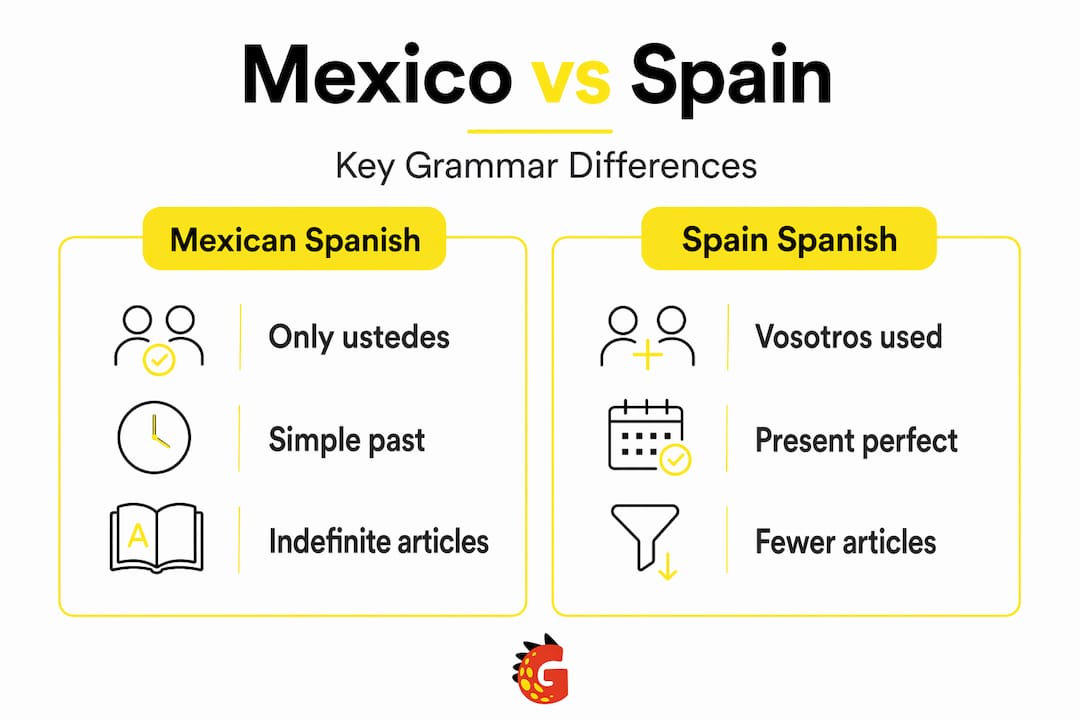
| Ustedes replaces vosotros | In Mexico, ustedes is the only plural “you,” eliminating the formal/informal split used in Spain. |
| Simple past over present perfect | Mexican speakers typically say comí (I ate) where Spain speakers would say he comido (I have eaten). |
| Object pronouns follow function | Choosing lo/la versus le/les depends on sentence role, not gender or animacy. |
| Loanwords conjugate as Spanish | English-origin verbs like checar follow standard Spanish conjugation patterns completely. |
| Syntax quirks are usage-based | Negative questions and indefinite article preferences reflect cultural habit, not separate grammar rules. |
How Mexican Spanish grammar differs: the pronoun that changes everything
The single biggest structural shift you will encounter when moving from Spain Spanish to Mexican Spanish is the pronoun system for “you all.” In Mexico, ustedes replaces both the informal vosotros and the formal ustedes that Spain uses. There is no dividing line between talking to your friends as a group versus addressing a formal audience. Ustedes covers everyone.
This matters because the verb conjugation follows accordingly. Ustedes uses third-person plural verb forms at all times in Mexican Spanish. If you learned vosotros habláis for “you all speak” in a Spain-focused course, you can set that aside entirely. In Mexico, it is always ustedes hablan, just like ellos hablan. The verb form is identical whether you are talking about “they” or “you all.”
Here is a quick comparison to make this concrete:
- Vosotros queréis café (Spain, informal plural) = Ustedes quieren café (Mexico, any group)
- Ustedes tienen razón (Spain, formal plural) = Ustedes tienen razón (Mexico, same form for everyone)
- Vosotros sois mis amigos (Spain, informal plural) = Ustedes son mis amigos (Mexico, any group)
Vosotros is simply absent from Mexican Spanish, reinforcing ustedes as the universal plural pronoun. And unlike parts of South America where voseo appears, Mexico uses vos only in archaic or ceremonial contexts.
The practical impact on learners is significant. Beginners who learned with Spain Spanish materials often hit a wall when switching because they have internalized vosotros conjugations as the natural plural “you.” Reprogramming that instinct takes deliberate practice, not just awareness.
Pro Tip: When drilling verb conjugations for Mexican Spanish, simply skip the vosotros row entirely. Practice the six remaining forms until ustedes + third-person plural becomes your automatic response.
Object pronouns in Mexican Spanish
Object pronouns are one of the trickier areas in Mexican grammar rules, and learners often get them wrong for the same reason: they try to choose based on gender or whether the noun refers to a person. That approach does not work reliably in Spanish in general, and in Mexican Spanish it will trip you up regularly.
The standard system works like this. Choosing lo/la versus le/les depends on whether the pronoun is functioning as a direct object or an indirect object in the sentence. Lo and la are direct object pronouns. Le and les are indirect object pronouns. The gender of the noun matters for lo/la, but the grammatical role of the pronoun in the sentence is what determines whether you use the lo/la set or the le/les set.
Consider these examples:
- Lo vi ayer = I saw him yesterday (lo = direct object)
- Le dije la verdad = I told him the truth (le = indirect object, la verdad = direct object)
- La llamé esta mañana = I called her this morning (la = direct object)
Now, where Mexican Spanish adds a layer of complexity is in the phenomenon known as leísmo. This refers to using le where standard grammar calls for lo, specifically when referring to a male person. Object pronouns require analyzing the verb’s argument structure rather than relying on gender or animacy. In Mexico, some leísmo for male persons is accepted and heard in everyday speech, but the cleaner practice for learners is to stick to the function-based rule.
Here is what commonly trips people up:
- Confusing le gusta (indirect) with lo gusta (incorrect in this structure)
- Using la for a female person when she is the indirect object
- Treating all human referents as requiring le regardless of sentence role
Pro Tip: Before choosing your object pronoun, ask two questions: Is this pronoun receiving the action directly, or is it receiving the transfer indirectly? That single diagnosis will put you in the right pronoun category almost every time.
Verb tense preferences that separate the two variants
Here is a difference that catches learners off guard the first time they hear it in conversation. In Spain, the present perfect tense (he comido, he hablado) is used frequently for actions that happened recently or have a connection to the present. In Mexico, speakers overwhelmingly prefer the simple past (comí, hablé) even in those same situations.

Mexican Spanish favors the simple past over the present perfect in contexts where Spain Spanish would default to the perfect tense. This is not a grammatical error in Mexico. It is a legitimate regional preference that reflects how tense is used across most of Latin America.
To see this in practice, here are four common scenarios:
- This morning: Spain says He desayunado ya (I have already had breakfast). Mexico says Ya desayuné.
- Just now: Spain says He llegado hace un momento (I have just arrived). Mexico says Llegué hace un momento.
- Today: Spain says He trabajado mucho hoy (I have worked a lot today). Mexico says Trabajé mucho hoy.
- Recent events: Spain says ¿Has visto esa película? (Have you seen that film?). Mexico says ¿Viste esa película?
The cultural reason behind this is not entirely clear, but the practical result is this: if you are targeting Mexican Spanish and you use present perfect in everyday speech, you will sound slightly formal or European. Your message gets through, but the register feels off. Training yourself to default to simple past for completed actions will make your speech sound immediately more natural to a Mexican ear.
This also affects your listening comprehension. When you hear a Mexican speaker say ¿Ya comiste? instead of ¿Ya has comido?, both mean “Have you eaten yet?” Understanding that shift will stop you from overcorrecting or second-guessing what you heard.
Indigenous and English influences on grammar
The Nahuatl language, spoken by the Aztec civilization and still active in Mexico today, has left a strong mark on Mexican Spanish vocabulary. Words like chocolate, aguacate (avocado), tomate, and chile come directly from Nahuatl. Nahuatl’s influence is mainly lexical, with little direct impact on grammatical structures. The grammar system of Mexican Spanish remains fundamentally Spanish. What changes is the vocabulary you need to recognize and use.
English loanwords tell a slightly different story. Because of the long shared border between Mexico and the United States, Mexican Spanish has absorbed numerous English terms and adapted them as fully conjugated Spanish verbs. The most common example is checar, from the English word “check.” English-origin verbs like checar are conjugated exactly like regular Spanish verbs: checo, checas, checa, checamos, and so on.
Other common examples include:
- Googlear (to Google something): ¿Lo googlaste? = Did you Google it?
- Textear (to text someone): Te texteo más tarde = I’ll text you later
- Parquear (to park): Voy a parquear aquí = I’m going to park here
For learners, these borrowed verbs are actually good news. You already know the meaning from English, and the conjugation follows patterns you already know from Spanish. The grammar stays the same. What you are adding is vocabulary, not new rules.
Syntax quirks unique to Mexican Spanish
Beyond pronouns and tenses, there are several smaller syntax habits in Mexican Spanish that will help you sound more natural once you recognize them. Think of these as stylistic tendencies rather than mandatory grammar rules.
| Feature | Mexican Spanish | Spain Spanish / Neutral |
|---|---|---|
| Negative questions | ¿No quieres algo de tomar? | ¿Quieres algo de tomar? |
| Indefinite articles | Tráeme un lapicero | Tráeme el lapicero |
| Plural “you” formality | Ustedes (always, any register) | Vosotros (informal), Ustedes (formal) |
| Diminutives for softening | Un momentito, por favor | Un momento, por favor |
Mexican speakers form negative questions more frequently than other dialects, using structures like ¿No quieres...? (Wouldn’t you like...?) as a softer, more inviting way to offer something. This is not expressing doubt. It is a politeness strategy baked into everyday speech.
The use of indefinite articles is also more common in Mexican Spanish than in Spain. Where a Spanish speaker from Madrid might say dame el vaso, a Mexican speaker would often say dame un vaso. Both are correct grammatically, but the preference creates a different register feel.
Pro Tip: When practicing Mexican Spanish syntax, pay attention to how questions are framed in TV series, podcasts, or films from Mexico. You will start noticing the negative question pattern within hours of focused listening.
Understanding the difference between Castilian and Mexican Spanish
Language teachers often remind learners that Spanish is a global language spoken by more than 500 million people across dozens of countries. While pronunciation, vocabulary, and everyday expressions vary from one region to another, the core grammar remains remarkably consistent. For most learners, the challenge is not learning a different grammar system - it is becoming familiar with regional preferences and cultural nuances.
Many of the differences between Spain and Mexico appear in everyday vocabulary rather than grammar. For example, people in Spain usually say coche for "car," while in Mexico carro is more common. A mobile phone is móvil in Spain but celular in Mexico. You may rent a piso in Madrid but a departamento in Mexico City, drink zumo in Spain but jugo in Mexico, or ask for a pajita instead of a popote. These differences are part of the richness of Spanish rather than barriers to communication, and native speakers generally understand both forms.
| English | Spain | Mexico |
|---|---|---|
| Car | coche | carro |
| Apartment | piso | departamento |
| Mobile phone | móvil | celular |
| Juice | zumo | jugo |
| Straw | pajita | popote |
| Computer | ordenador | computadora |
| Pen | bolígrafo | pluma |
For learners, the most effective approach is to build a solid foundation in standard Spanish grammar while gradually becoming familiar with regional vocabulary through authentic content, conversations, and repeated exposure. Once the grammar becomes automatic, adapting to local expressions is significantly easier than trying to memorize every regional variation from the beginning.
Build a strong foundation in standard Spanish with Gramanator
Knowing that regional differences exist is useful, but fluency comes from being able to produce correct grammar automatically in real conversations.
Gramanator is built around standard Castilian Spanish, providing learners with a consistent grammatical foundation through structured, high-volume practice and immediate feedback. Rather than memorizing isolated rules, learners develop automatic grammar skills across real-life topics such as work, housing, travel, shopping, dating, and everyday communication.
Because the underlying grammar is shared across the Spanish-speaking world, this foundation makes it much easier to understand and adapt to regional varieties, including Mexican Spanish. As learners become familiar with local vocabulary and expressions through exposure, the grammar patterns they have already trained remain the same.
Whether your goal is to communicate confidently in Spain or understand Spanish spoken across Latin America, consistent practice and repeated exposure are what transform grammar knowledge into real-world communication.
FAQ
What is the biggest grammar difference in Mexican Spanish?
The most significant structural difference is the use of ustedes as the only plural “you” in Mexican Spanish, replacing both vosotros and ustedes as used in Spain. This changes which verb conjugations you need to learn and use.
Does Mexican Spanish use the present perfect tense?
Mexican Spanish strongly favors the simple past tense over the present perfect for recently completed actions, where Spain would typically use the present perfect. Saying comí instead of he comido for “I ate” is the norm in Mexico.
How do object pronouns work in Mexican Spanish?
Object pronoun choice depends on grammatical function. Lo and la are for direct objects, while le and les are for indirect objects. Some regional leísmo for male persons is accepted, but function-based selection is the most reliable method.
Is Spanish grammar in Mexico different from other Latin American countries?
Mexican Spanish shares most of its grammar patterns with other Latin American varieties, particularly the use of ustedes and preference for simple past. Vocabulary influenced by Nahuatl and English is more specific to Mexico.
Do English loanwords change Spanish grammar in Mexico?
No. English-origin words like checar or googlear are fully integrated into Spanish grammar and conjugated like regular Spanish verbs. The grammar system stays intact regardless of where the vocabulary comes from.