Stop Mixing tan and tanto: Six Timed Drills for Intermediate Learners
Tan goes before adjectives and adverbs and never changes; tanto agrees with the noun it counts. Clear rules, examples, comparisons of equality and timed drills.

Use tan with adjectives and adverbs, and it never changes form. Use tanto when you’re quantifying a noun or modifying a verb, and it agrees with that noun as tanto, tanta, tantos, or tantas. “Tan alto” describes how tall someone is; “tantos libros” counts how many books there are. Once that split clicks, the rest is just practice.
Tan vs tanto: the short answer
- Tan never changes form and goes before an adjective or adverb: tan alto, tan rápido.
- Tanto quantifies a noun and agrees with it: tanto, tanta, tantos, tantas.
- After a verb, tanto is invariable: Trabaja tanto.
- Equality: tan + adjective + como vs tanto/a/os/as + noun + como.
- The usual mistake is putting tan before a noun or forgetting agreement on tanto.
Table of Contents
- Tan vs. Tanto: What Each One Actually Does
- How Tan Works With Adjectives and Adverbs
- Tanto: Agreement Rules and Verb Use
- Comparisons of Equality: Choosing the Right Formula
- Exceptions, Tricky Cases, and Common Mistakes
- Practice: Six Drills to Build Automatic Use
- Why Drilling Beats Memorizing for This Rule
- Turn the Rule Into Instinct With Gramanator
- Sources
Tan vs. Tanto: What Each One Actually Does
Here’s the short version before we dig in: tan is about quality, tanto is about quantity. If you’re answering “how?” you want tan. If you’re answering “how much?” or “how many?” you want tanto. This is the core of the tan vs. tanto comparison, and almost every learner mistake traces back to blurring that line.
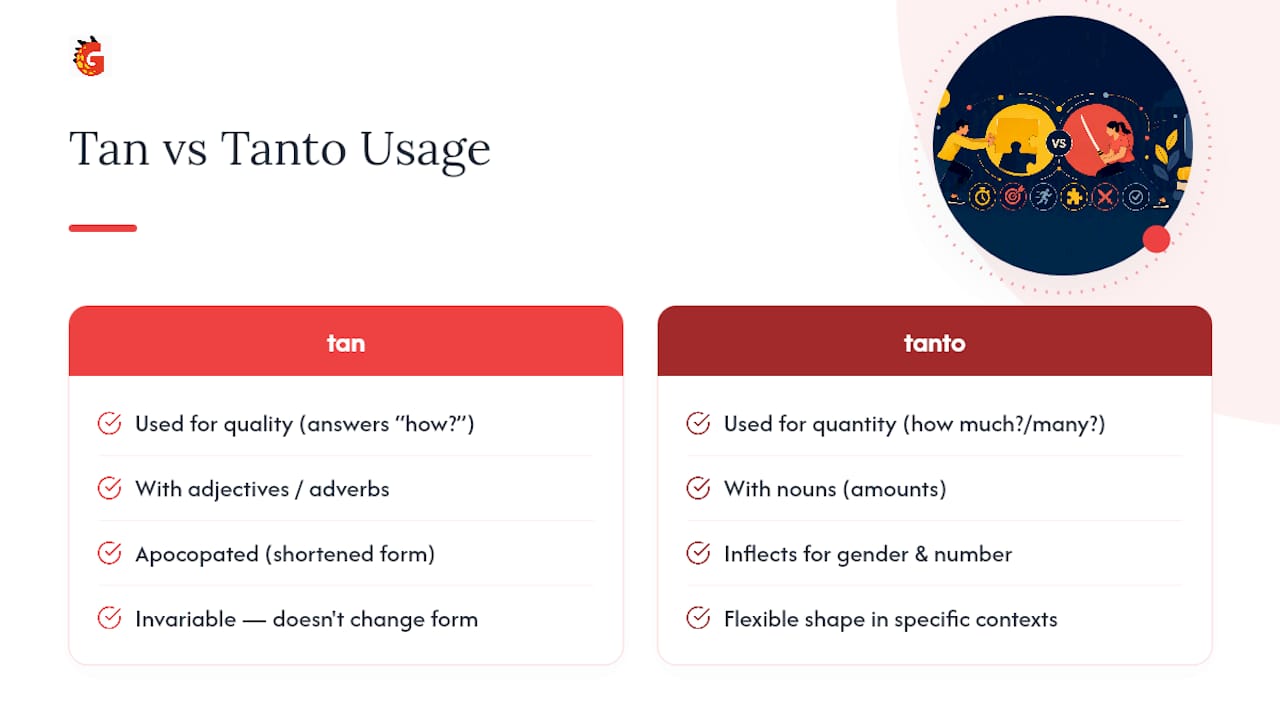
Grammatically, tan is what’s called an apocopated form. That’s a fancy way of saying it’s a shortened version of tanto, and the Diccionario panhispánico de dudas confirms this historical link directly. Because tan is a clipped form, it lost its ability to change endings somewhere along the way. Tanto kept that flexibility, which is why it still inflects for gender and number when it’s attached to a noun.
Think of it this way: tan always stays exactly as it is, no matter what it’s describing. Tanto is a shape-shifter, but only in specific situations. Get that distinction locked in, and the usage of tan and tanto stops feeling like a coin flip.
How Tan Works With Adjectives and Adverbs
Tan is invariable. It never becomes “tana” or “tanos,” no matter what noun or gender is nearby, because it isn’t modifying a noun at all. It’s modifying an adjective or an adverb, and neither of those pulls tan into agreement. The Diccionario panhispánico de dudas treats this as one of the clearest fixed rules in Spanish grammar.
You’ll see tan in a few recurring patterns:
- Tan + adjective: “Ella es tan inteligente.” (She is so intelligent.)
- Tan + adverb: “Corre tan rápido.” (He runs so fast.)
- Tan + adjective + que: “Es tan tarde que perdimos el tren.” (It’s so late that we missed the train.)
- Tan + adjective/adverb + como: “Es tan alto como su hermano.” (He’s as tall as his brother.)
Here’s how that scales from casual speech to more formal writing:
- Casual: “¡Qué día tan largo!” (What a long day!)
- Everyday: “No es tan difícil como parece.” (It’s not as hard as it looks.)
- Formal: “El proceso resultó ser tan complejo que requirió una revisión completa.” (The process turned out to be so complex that it required a full review.)
Quick practice. Fill in the blank with tan:
- Ella habla ______ despacio que no la entiendo. (Answer: tan - modifies the adverb “despacio”)
- Es ______ amable como su madre. (Answer: tan - comparing an adjective)
- Nunca había visto un atardecer ______ hermoso. (Answer: tan - modifies the adjective “hermoso”)
Pro Tip: If you can rephrase the sentence as a “how?” question, tan is almost always your answer. “How tall?” “How fast?” “How difficult?” All roads lead to tan.
Tanto: Agreement Rules and Verb Use
Tanto works completely differently, and this is where the tan vs. tanto comparison starts to matter for accuracy, not just style. When tanto quantifies a noun, it agrees with that noun’s gender and number. The Diccionario de la lengua española lists all four forms plainly: tanto, tanta, tantos, tantas.
Here’s how the agreement plays out with different noun types:
- Masculine singular: “Tengo tanto trabajo.” (I have so much work.)
- Feminine singular: “Hay tanta gente aquí.” (There are so many people here.)
- Masculine plural: “Compró tantos libros.” (He bought so many books.)
- Feminine plural: “Vimos tantas películas.” (We watched so many movies.)
Now flip to verbs, and the rules change again. When tanto modifies a verb instead of a noun, it stays locked in the masculine singular form, full stop. “Ella trabaja tanto” (She works so much) never becomes “trabaja tanta,” even though “ella” is feminine. The verb isn’t a noun, so there’s nothing for tanto to agree with. This exact distinction is spelled out in the Diccionario de la lengua española, and it’s the single most misapplied rule among intermediate learners.
Tanto also functions as a standalone pronoun (“No sabía que había tanto”) and shows up in the fixed pairing tanto... como, which you’ll meet again in the comparisons below.
Try these three prompts:
- Ella tiene ______ (tanto/tanta) paciencia con sus estudiantes. (Answer: tanta - “paciencia” is feminine singular)
- Nunca he visto ______ (tanto/tantos) problemas en un solo proyecto. (Answer: tantos - “problemas” is masculine plural)
- Él no duerme ______ (tanto/tanta) como debería. (Answer: tanto - modifying the verb “duerme,” stays invariable)
Comparisons of Equality: Choosing the Right Formula
Spanish gives you three separate templates for saying two things are equal, and mixing them up is the most common source of tan tanto errors in speech. The RAE’s grammar reference on equality comparisons lays out all three formally.
- Tan + adjective/adverb + como: for comparing qualities. “Es tan rápido como un guepardo.” (He’s as fast as a cheetah.)
- Tanto/a/os/as + noun + como: for comparing quantities of nouns, with agreement. “Tiene tantas ideas como su jefe.” (She has as many ideas as her boss.)
- Verb + tanto como: for comparing actions, invariable. “Ella estudia tanto como su compañero.” (She studies as much as her classmate.)
Notice the parallel structure. “Es tan alto como su padre” describes a quality (height), so it uses tan. “Tiene tantos años como su padre” counts a quantity (years), so it uses tanto with agreement to match “años,” which is masculine plural.
Countable nouns like “libros” or “amigos” take tantos/tantas depending on gender. Uncountable nouns like “dinero” or “paciencia” still take the singular form: tanto dinero, tanta paciencia. The quick cue: if you could count it on your fingers, check for plural agreement. If you can’t, default to the singular form and match only the gender.

Exceptions, Tricky Cases, and Common Mistakes
A few constructions don’t fit neatly into the tan/tanto split, and they trip up even advanced learners. “Un tanto + adjective” softens a statement, functioning almost like “somewhat” in English: “Es un tanto complicado” means “It’s somewhat complicated,” not “It’s so complicated.” Separately, “treinta y tantos” is a common way to express an approximate age or quantity, roughly “thirty-something.” Both idioms are documented in detail on Burbuja del Español, which is worth bookmarking for extra example sentences.
Here are the top errors learners make, with corrections:
- Wrong: “Tengo tan hambre.” Right: “Tengo tanta hambre.” Hambre is a noun, so it needs tanto’s agreement, not tan.
- Wrong: “Ella corre tanta rápido.” Right: “Ella corre tan rápido.” Rápido is an adverb here, so it takes tan.
- Wrong: “Él trabaja tanta.” Right: “Él trabaja tanto.” The verb never triggers agreement.
- Wrong: “Es tan problemas.” Right: “Tiene tantos problemas.” Tan cannot sit directly before a noun.
- Wrong: “Tan gente vino.” Right: “Tanta gente vino.” Same fix, different noun.
- Wrong: “Estudia tan como yo.” Right: “Estudia tanto como yo.” Verb comparisons need tanto, not tan.
Memory trick: ask yourself “how?” or “how much?” before you speak. “How?” answers point to tan. “How much/many?” answers point to tanto.
Pro Tip: English and Italian speakers often default to tan because their native languages use a single word for “so/as” regardless of what follows. Listen for a noun right after the word. If there’s a noun, tan is wrong every time.
Practice: Six Drills to Build Automatic Use
Rules stick faster when you apply them under light time pressure instead of just reading them. Try these six items, giving yourself no more than 15 seconds each.
- Fill in: “No hay ______ tiempo como quisiera.”
- Fill in: “Ella es ______ talentosa como su hermana.”
- Rewrite for agreement: “Compré tantas manzanas.”
- Fill in: “Él corre ______ como un atleta profesional.”
- Fill in: “Tiene ______ (tanto/tantas) dudas sobre el examen.”
- Rewrite for agreement: “Trabajamos tantos, pero no terminamos.”
Here’s the answer key with the reasoning behind each fix:
| Item | Correct answer | Why |
|---|---|---|
| 1 | tanto | “Tiempo” is a noun, masculine singular, uncountable |
| 2 | tan | Modifies the adjective “talentosa” |
| 3 | Compré tantas manzanas | “Manzanas” is feminine plural, needs agreement |
| 4 | tan | Modifies the adverb-like phrase describing manner |
| 5 | tantas | “Dudas” is feminine plural |
| 6 | Trabajamos tanto, pero no terminamos | Modifies the verb “trabajamos,” stays invariable |
A 5 to 10 minute daily micro-drill, repeated over two weeks with spaced review every third day, is enough to move this from a rule you check to a rule you feel. The Lingoda breakdown of tan versus tanto reinforces the same “how vs. how much” framing that makes the split easy to recall mid-conversation.
Why Drilling Beats Memorizing for This Rule
Grammar rules fade fast if you only read them once. What actually sticks is repetition under realistic pressure, the kind that forces you to choose tan or tanto in half a second instead of pausing to recite the rule in your head. That’s the reasoning behind converting grammar knowledge into micro-drills rather than relying on translation from your first language.
A focused two-week plan works well for this specific pair:
- Days 1 to 3: Isolate tan with adjectives and adverbs only. No tanto yet.
- Days 4 to 6: Isolate tanto with nouns, drilling all four agreement forms separately.
- Days 7 to 10: Mix both in comparison sentences (tan... como and tanto... como side by side).
- Days 11 to 14: Timed alternation drills that randomly switch between adjective-based and noun/verb-based prompts, since that randomness is what exposes swap-errors before they become habits.
Statistic-style callout: Consistent short sessions, roughly 5 to 10 minutes daily, tend to outperform occasional long study blocks for building automatic recall of grammar patterns like this one.
Gramanator’s structured drills follow exactly this kind of sequencing: isolate the pattern, contextualize it in real sentences, then mix it under time pressure with immediate feedback on what you got wrong and why.
Turn the Rule Into Instinct With Gramanator
Reading this article gets you the rule. Getting tan and tanto right without thinking about it takes repetition, and that’s exactly the gap Gramanator was built to close. Instead of rereading grammar explanations, you work through structured drills that isolate tan and tanto separately, then mix them together with contextualized sentences and instant feedback when you slip up.

The platform tracks which patterns you keep missing and resurfaces them automatically, so a tan/tanto mix-up from Tuesday gets targeted again on Thursday instead of quietly becoming a bad habit. It’s built around the same idea behind the two-week plan above: short, focused sessions that convert a rule you can explain into a rule you no longer have to think about. If you want to test that approach on this exact pair, try a grammar workout with Gramanator and see how quickly tan and tanto start feeling automatic.