Subjunctive vs Indicative Spanish: A Practical Guide
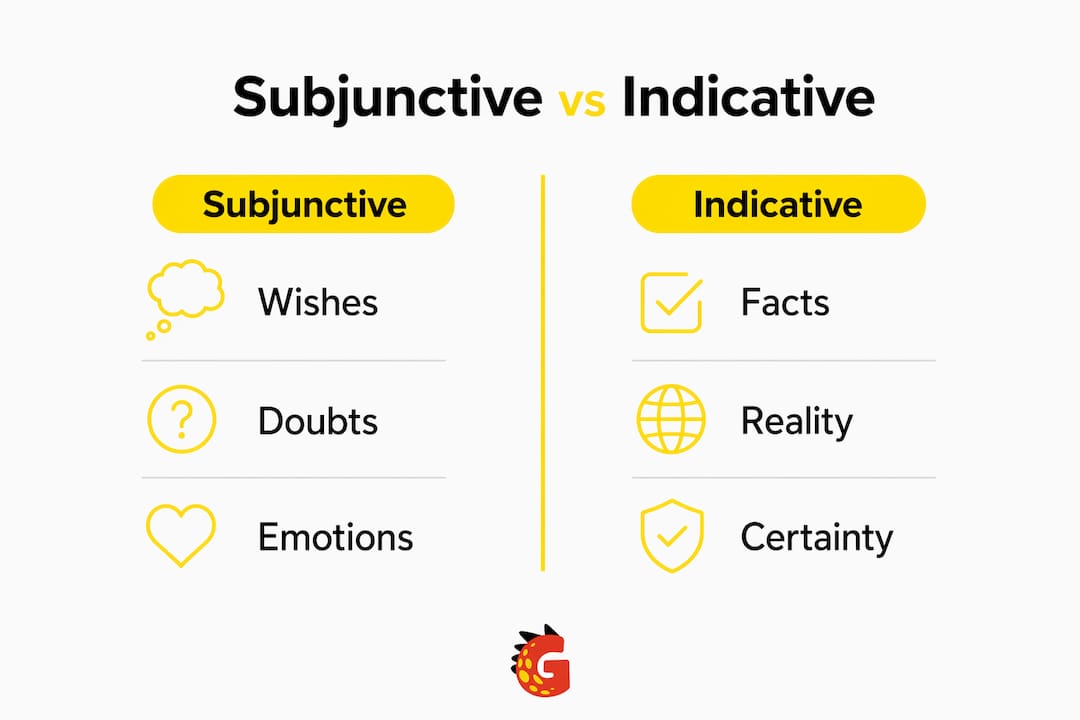
The indicative states facts. The subjunctive expresses what you feel, want, doubt, or imagine. That single distinction is the core of subjunctive vs…

The indicative states facts. The subjunctive expresses what you feel, want, doubt, or imagine. That single distinction is the core of subjunctive vs indicative Spanish, and once you internalize it, the rest of the grammar falls into place.
The indicative mood presents information as objective reality. “Tom habla español” (Tom speaks Spanish) is a fact from the speaker’s point of view. The subjunctive, by contrast, signals subjectivity: wishes, doubts, emotions, and hypotheticals. “Es posible que Tom hable español” (It’s possible that Tom speaks Spanish) puts the same idea into uncertain territory. The verb changes because the speaker’s attitude changes, not because the underlying fact is different.

One structural clue shows up in most subjunctive sentences: two different subjects connected by “que.” When you want someone else to do something, the subjunctive appears in the second clause. When the subject stays the same, you use an infinitive instead.

Quick reference: when each mood appears
Indicative triggers:
- Facts and objective descriptions (“Ella trabaja aquí” / She works here)
- Positive beliefs and certainties (“Creo que viene” / I think he’s coming)
- Verbs of perception and knowledge: “saber,” “ver,” “oír”
- Scheduled events and habitual actions
Subjunctive triggers:
- Wishes and desires: “quiero que,” “espero que”
- Emotions and reactions: “me alegra que,” “es una lástima que”
- Doubt or denial: “no creo que,” “dudo que”
- Impersonal expressions: “es importante que,” “es posible que”
- Recommendations: “te aconsejo que,” “sugiero que”
- Fixed expressions with “ojalá”
Mood vs tense: why the distinction matters for Spanish learners
Learners often confuse mood with tense, and that confusion makes the whole subjunctive feel harder than it is. Tense tells you when something happens. Mood tells you how the speaker frames what’s happening.
Think of it this way: you can express a wish in the present, the past, or the future. The tense shifts, but the mood stays subjunctive throughout because the speaker’s attitude hasn’t changed. Both the indicative and the subjunctive exist across multiple tenses.
| Mood | Associated tenses |
|---|---|
| Indicative | Present, preterite, imperfect, future, conditional |
| Subjunctive | Present, present perfect, imperfect (past), past perfect |
| Imperative | Commands only (no tense variation) |
The indicative carries more tenses because it covers the full range of factual statements across time. The subjunctive has fewer, but they still let you place a wish or doubt in the past, present, or future.
One practical takeaway: when you learn a new subjunctive tense, you’re not learning a new mood. You’re just learning to place the same subjunctive attitude at a different point in time.
General rules for choosing the subjunctive vs indicative
Three structural features appear in most subjunctive sentences. Check for all three when you’re unsure which mood to use.
1. Two different subjects. The subjunctive almost always appears when the subject of the main clause differs from the subject of the subordinate clause. “Quiero que tú vengas” (I want you to come) has two subjects: “yo” and “tú.” If the subject is the same, use the infinitive: “Quiero venir” (I want to come).
2. Two verbs linked by “que.” The main clause verb stays in the indicative; the subordinate clause verb takes the subjunctive. The connector “que” is the signal to switch moods.
3. A WEIRDO verb in the main clause. The WEIRDO acronym is the most practical mnemonic for subjunctive triggers:
- W - Wishes: “querer que,” “desear que”
- E - Emotions: “alegrarse de que,” “temer que”
- I - Impersonal expressions: “es necesario que,” “es bueno que”
- R - Recommendations: “recomendar que,” “sugerir que”
- D - Doubt/Denial: “dudar que,” “no creer que”
- O - Ojalá: “ojalá que venga” (I hope he comes)
When the main clause verb fits one of these categories and you have two different subjects, the subjunctive follows, as explained in our guide to fluidez pasiva y activa en idiomas. The indicative, by contrast, pairs with verbs of certainty, speech, and knowledge: “decir,” “saber,” “es cierto que,” “es evidente que.”
Pro Tip: Ask yourself two questions before choosing a mood: Does the speaker treat this as a fact or as a wish/doubt? And are there two different subjects? If the answer to both is yes, the subjunctive is almost certainly correct.
Common phrases that trigger each mood
Knowing the trigger phrases by heart is one of the fastest ways to build automatic mood selection. The table below organizes the most common ones.
| Subjunctive triggers | Indicative triggers |
|---|---|
| es bueno que (it’s good that) | creo que (I believe that) |
| me gusta que (I like that) | es cierto que (it’s certain that) |
| dudo que (I doubt that) | es obvio que (it’s obvious that) |
| quiero que (I want that) | sé que (I know that) |
| es importante que (it’s important that) | es verdad que (it’s true that) |
| ojalá (hopefully) | estoy seguro de que (I’m sure that) |
| no creo que (I don’t think that) | decir que (to say that) |
A few patterns are worth highlighting. “Es bueno que” triggers the subjunctive because it’s an impersonal expression of judgment, placing it squarely in the “I” of WEIRDO. “Me gusta que” triggers it because it expresses an emotional reaction. Both fit the same underlying logic: the speaker is not asserting a fact but reacting to a situation.
Negation flips the mood in a way that surprises many learners. “Creo que viene” (I think he’s coming) uses the indicative because it’s a positive belief. “No creo que venga” (I don’t think he’s coming) switches to the subjunctive because negation introduces doubt. The same verb, “creer,” behaves differently depending on whether it’s affirmed or denied.
Certain conjunctions always require the subjunctive regardless of the subjects involved. These include “para que” (so that), “a menos que” (unless), “antes de que” (before), and “con tal de que” (provided that). Memorizing this short list saves you from second-guessing every time they appear.
Learner questions about subjunctive and indicative usage
Why does the same verb sometimes take indicative and sometimes subjunctive?
Speaker attitude is the deciding factor, not the verb itself. “Decir” normally takes the indicative when it reports speech (“Me dijo que venía” / He told me he was coming), but it can take the subjunctive when it conveys a command or request (“Me dijo que viniera” / He told me to come). The shift in meaning is real, even when the English translation looks similar.
What happens with subject change?
When the subject of the main clause and the subordinate clause are the same person, the infinitive replaces the subjunctive entirely. “Quiero ir” (I want to go) and “Quiero que vayas” (I want you to go) illustrate the contrast. The moment a second subject enters, the subjunctive becomes necessary.
Are there regional differences in mood use?
Yes. The Real Academia Española notes that in Mexico and Caribbean Spanish, speakers often use the subjunctive in constructions where Spain and the Río de la Plata region prefer the indicative. “No sé si te guste esta comida” is natural in Mexican Spanish, while “No sé si te gusta esta comida” is the standard form in Spain. Neither is wrong; they reflect regional variation in mood preference.
What about fixed expressions that use the subjunctive without a trigger verb?
The subjunctive appears independently in fixed expressions and commands that don’t follow the two-subject rule at all. “¡Que te vaya bien!” (Hope things go well for you!) and “Hágase la luz” (Let there be light) are examples where the subjunctive stands alone. These require memorization rather than rule application.
Expert insights on subjunctive vs indicative in Spanish
The most useful reframe for adult learners comes from linguist Christopher Pountain, who describes the subjunctive as a marker of irrealis: information the speaker presents as non-asserted, hypothetical, or uncertain. This is broader than simply “unreal.” A wish can be entirely achievable; a doubt can turn out to be unfounded. What matters is how the speaker frames the information, not whether it’s actually true or false.
This insight matters practically. English speakers often try to map Spanish mood onto English modal verbs (“would,” “might,” “should”), but the systems don’t align. Spanish mood is triggered by the main clause verb and the speaker’s communicative intent, not by the English translation. Training your response to the trigger word itself, rather than translating first, is far more effective for building fluency.
The RAE’s style guide reinforces this by showing how mood alternation signals speaker intent with precision. “Busco a alguien que lleva sombrero” (indicative) means you’re looking for a specific person you know exists. “Busco a alguien que lleve sombrero” (subjunctive) means you’re looking for anyone who fits that description. Same sentence structure, completely different meaning.
Pro Tip: Stop asking “is this situation real or unreal?” and start asking “am I asserting this as a fact, or am I expressing a wish, doubt, or reaction?” That shift in question gets you to the right mood faster.
Gramanator’s training approach is built around exactly this kind of trigger recognition. Rather than memorizing rules in isolation, learners practice responding to the trigger word automatically through structured drills, so that “quiero que” instantly cues the subjunctive without conscious deliberation. That’s the difference between knowing the rule and actually using it in conversation.
How to conjugate the subjunctive and indicative moods
The conjugation patterns for both moods follow clear logic once you see them side by side. The present subjunctive is formed by taking the first-person singular of the present indicative, dropping the “o,” and adding the opposite vowel endings: “-ar” verbs take “-e” endings, and “-er”/“-ir” verbs take “-a” endings.
| Person | Present indicative | Present subjunctive | Preterite indicative | Past subjunctive |
|---|---|---|---|---|
| Yo | hablo | hable | hablé | hablara |
| Tú | hablas | hables | hablaste | hablaras |
| Él/Ella | habla | hable | habló | hablara |
| Nosotros | hablamos | hablemos | hablamos | habláramos |
| Vosotros | habláis | habléis | hablasteis | hablarais |
| Ellos/Ustedes | hablan | hablen | hablaron | hablaran |
The past subjunctive (imperfect subjunctive) is built from the third-person plural preterite. Drop the “-ron” ending and add “-ra” endings. This is why knowing the preterite well makes the past subjunctive much easier to form.
Irregular verbs in the present indicative carry their irregularity into the present subjunctive. “Tener” gives “tengo” in the first person, so the subjunctive stem becomes “teng-”: “tenga, tengas, tenga, tengamos, tengáis, tengan.” The same pattern applies to “venir” (venga), “hacer” (haga), and “salir” (salga). A handful of verbs are fully irregular in the subjunctive: “ser” (sea), “ir” (vaya), “haber” (haya), “saber” (sepa), and “estar” (esté).
How mood works across different types of subordinate clauses
The subjunctive and indicative don’t behave the same way in every type of subordinate clause. The clause type shapes which mood is appropriate.
Noun clauses follow the WEIRDO logic most directly. When the main clause expresses a wish, emotion, doubt, or recommendation, the noun clause takes the subjunctive: “Espero que llegues a tiempo” (I hope you arrive on time). When the main clause expresses certainty or factual belief, the noun clause takes the indicative: “Sé que llegas a tiempo” (I know you arrive on time).
Adjective (relative) clauses depend on whether the antecedent is known and definite. If you’re describing a specific, known person or thing, use the indicative: “Tengo un amigo que habla chino” (I have a friend who speaks Chinese - a real, specific person). If the antecedent is unknown, hypothetical, or nonexistent, use the subjunctive: “Busco un amigo que hable chino” (I’m looking for a friend who speaks Chinese - anyone who fits). This is one of the most elegant distinctions in Spanish grammar.
Adverbial clauses split into two groups. Some conjunctions always require the subjunctive: “para que,” “antes de que,” “a menos que,” “con tal de que.” Others take the subjunctive only when referring to future or hypothetical events, and the indicative when referring to habitual or past events. “Cuando” is the classic example: “Cuando llegues, llámame” (When you arrive, call me - future, subjunctive) versus “Cuando llegaba, siempre me llamaba” (When he used to arrive, he always called me - habitual past, indicative).
Present vs past subjunctive and indicative: what changes
The present tense of both moods covers current facts, habits, and future plans. The past tenses shift the same attitudes back in time.
In the indicative, the preterite describes completed past actions (“Fui al mercado” / I went to the market), while the imperfect describes ongoing or habitual past states (“Iba al mercado todos los sábados” / I used to go to the market every Saturday). Both are factual; the difference is aspect, not certainty.
In the subjunctive, the present covers wishes or doubts about current or future situations: “Espero que vengas” (I hope you come). The past subjunctive shifts that same wish or doubt into the past: “Esperaba que vinieras” (I was hoping you would come). The sequence-of-tenses rule governs which subjunctive tense to use: a present or future main clause triggers the present subjunctive; a past or conditional main clause triggers the past subjunctive.
The past perfect subjunctive (“hubiera hablado”) appears in hypothetical past conditions, typically in “if” clauses: “Si hubiera sabido, habría venido” (If I had known, I would have come). This construction pairs with the conditional perfect in the main clause and signals a situation that didn’t happen.
Real situations vs hypothetical ones: the clearest contrast
The real/hypothetical contrast is where the indicative and subjunctive divide most sharply, and it shows up clearly in conditional sentences.
“Si” clauses with the present indicative describe real, likely conditions: “Si tienes tiempo, llámame” (If you have time, call me). The speaker considers this genuinely possible. Shift to the past subjunctive and the situation becomes hypothetical or contrary to fact: “Si tuvieras tiempo, me llamarías” (If you had time, you would call me - implying you probably don’t). The mood change alone signals whether the speaker sees the condition as realistic or imaginary.
The same contrast appears in relative clauses, as noted earlier. “Tengo un apartamento que tiene piscina” (indicative) describes a real apartment. “Busco un apartamento que tenga piscina” (subjunctive) describes a desired but not yet found one. One sentence is about reality; the other is about a wish.
For learners working toward native-level grammar, this real-vs-hypothetical distinction is where passive knowledge becomes active skill. You can understand the rule and still hesitate in conversation. The only way past that hesitation is repeated practice with real contexts, until the mood choice becomes automatic rather than calculated.
Turn grammar knowledge into speaking instinct with Gramanator
Understanding the subjunctive and indicative is one thing. Reacting to them instantly in conversation is another. Gramanator is built for exactly that gap.
Gramanator’s grammar training platform combines 10,000+ structured drills, timed workouts, and mistake-focused repetition across real-life Spanish contexts, from workplace conversations to travel situations. Every session reinforces the trigger recognition that makes mood selection automatic, not deliberate.
If you’re serious about moving from knowing the rules to using them without thinking, Gramanator is the Spanish Grammar Gym that gets you there.
Key Takeaways
The subjunctive and indicative moods in Spanish differ by speaker attitude: the indicative asserts facts, while the subjunctive expresses wishes, doubts, emotions, and hypotheticals, with mood choice governed by trigger words, subject change, and clause type.
| Point | Details |
|---|---|
| Core distinction | Indicative = factual assertion; subjunctive = subjectivity, doubt, or wish. |
| WEIRDO framework | Wishes, Emotions, Impersonal expressions, Recommendations, Doubt/Denial, and Ojalá reliably trigger the subjunctive. |
| Subject change rule | Two different subjects linked by “que” signal the subjunctive; same subject uses the infinitive instead. |
| Negation flips mood | “Creo que viene” (indicative) becomes “No creo que venga” (subjunctive) when negated. |
| Clause type matters | Adverbial conjunctions like “para que” always take the subjunctive; “cuando” takes subjunctive for future events and indicative for past habits. |