Spanish Subjunctive Practice: A Guide for Adult Learners
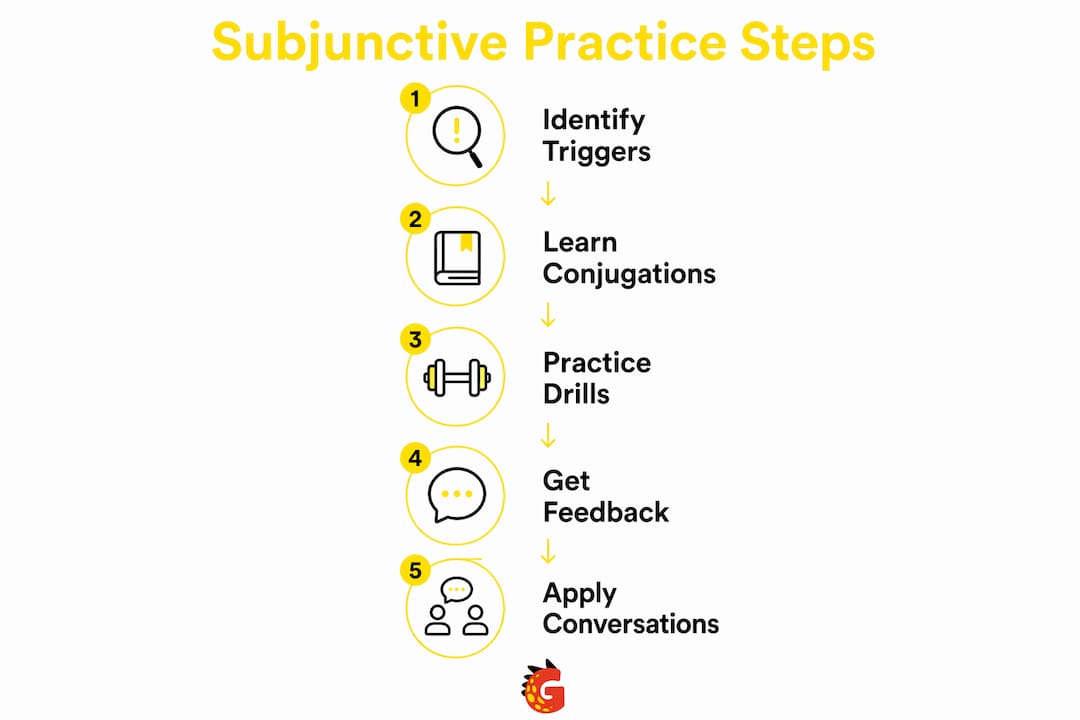
Effective Spanish subjunctive practice means working with trigger expressions and conjugation drills repeatedly until the mood shift becomes automatic.

Effective Spanish subjunctive practice means working with trigger expressions and conjugation drills repeatedly until the mood shift becomes automatic. You are not just memorizing endings. You are training your brain to recognize when a sentence calls for the subjunctive and respond without hesitation. The most productive approach combines three things: trigger recognition, conjugation accuracy, and contextual repetition across varied exercise types.
Here is what structured practice actually looks like:
- Trigger recognition drills: Identifying expressions like quiero que, espero que, and no creo que that signal a subjunctive verb follows
- Conjugation exercises: Practicing the present subjunctive stem and endings across regular, stem-changing, and irregular verbs
- Context-based quizzes: Choosing between indicative and subjunctive in real sentences to build judgment
- Immediate feedback loops: Catching errors at the moment they happen so corrections stick
- Progress tracking: Monitoring which verb types or triggers still trip you up
How to practice present subjunctive conjugations interactively
The most effective study modes for the present subjunctive combine active recall with real sentence context. Passive review of conjugation tables does not build the instinct you need for conversation.
Three modes work especially well:
- Flashcards targeting conjugation: Write the infinitive on one side and the full present subjunctive conjugation on the other. Focus on irregular yo forms first, since the present subjunctive stem derives directly from the yo indicative form minus the -o. For example, tener gives tengo, drop the -o, add subjunctive endings: tenga, tengas, tenga, tengamos, tengáis, tengan.
- Multiple choice quizzes in context: These force you to read a full sentence, identify the trigger, and select the correct conjugated form. Quizzes blending regular, stem-changing, and irregular verbs build confidence across all verb types at once.
- Sentence transformation exercises: Starting from an indicative sentence and rewriting it with a subjunctive trigger is one of the most effective drills available. The pattern compra becomes compres, gasta becomes gaste, and so on, training the vowel-flip rule until it feels natural.
Pro Tip: When you get a question wrong in a quiz, write the correct sentence out by hand before moving on. That one extra step reinforces the correction far better than just clicking “next.”
Game-based modes that make subjunctive drills stick
Games work for grammar practice because they raise the stakes just enough to sharpen attention without creating anxiety. When you are racing a timer or matching pairs, your brain encodes the pattern faster than it would during passive review.
Useful game formats for subjunctive training include:
- Timed fill-in-the-blank drills: You see a sentence with a blank and a trigger expression, and you type the conjugated verb before time runs out. Speed pressure forces recall rather than calculation.
- Matching games: Pair trigger expressions with the correct subjunctive clause. For example, match Espero que... with ...llegues a tiempo (I hope you arrive on time).
- Mood-choice challenges: Given a sentence, decide in two seconds whether it needs indicative or subjunctive. The binary choice trains the instinct that real conversation demands.
The key ingredient in any game format is immediate feedback. Knowing instantly whether you chose correctly, and why, is what separates a game that builds skill from one that just entertains.
Conjugation charts and quizzes: your reference foundation
Before drills can build automaticity, you need a clear picture of the endings. The present subjunctive follows a consistent pattern for regular verbs: take the yo present indicative form, drop the -o, and add the opposite vowel endings.

| Pronoun | -AR verbs (hablar) | -ER / -IR verbs (comer) |
|---|---|---|
| yo | hable | coma |
| tú | hables | comas |
| él / ella | hable | coma |
| nosotros | hablemos | comamos |
| vosotros | habléis | comáis |
| ellos / ellas | hablen | coman |
Six verbs are fully irregular and must be memorized separately: dar (dé), estar (esté), haber (haya), ir (vaya), saber (sepa), and ser (sea).
Key reference materials worth keeping close:
- A full irregular yo form list, since mastering those stems unlocks the subjunctive for dozens of verbs at once
- The WEIRDO acronym: Wishes, Emotions, Impersonal expressions, Recommendations, Doubt/Denial, and Ojalá as a quick trigger checklist
- A guide to subordinate clause types that trigger the subjunctive
How Gramanator trains the subjunctive for serious adult learners
Most practice tools give you exercises. Gramanator gives you a training system. The difference is structure, feedback, and repetition that targets your specific weak points rather than cycling through generic drills.
The platform is built around the idea that grammar pattern recognition is a trainable skill, not a memorization task. For subjunctive practice specifically, Gramanator offers:
- AI-powered personalized workouts that adjust difficulty based on your error history
- Integrated grammar theory delivered inside practice sessions, so you understand the rule at the moment you need it
- Real-life sentence contexts covering workplace, travel, and everyday situations where the subjunctive actually appears
- Progress tracking and grammar insights that show you exactly which triggers or verb types still need work
- Targeted mistake review that brings back your errors in new sentence contexts until the pattern sticks
The subjunctive is best understood as a mood that reflects the speaker’s internal attitude, not just a tense with different endings. Learners who approach it that way move from memorization to intuition far faster than those who treat it as a rule list to recite.
That shift in mindset is built into every Gramanator drill. You are not asked to recall a rule. You are trained to react to a trigger.
Ready to stop second-guessing the subjunctive? Start training on Gramanator and build the automatic recall that real conversations require.
Practicing past and imperfect subjunctive forms
Once the present subjunctive feels solid, the past and imperfect forms follow a logical pattern. The imperfect subjunctive has two forms: the -ra form (hablara) and the -se form (hablase). In everyday speech and writing, the -ra form dominates.
To form the imperfect subjunctive, take the third-person plural preterite (hablaron), drop -ron, and add the imperfect subjunctive endings: -ra, -ras, -ra, -ramos, -rais, -ran. So hablaron becomes hablara, hablaras, hablara, habláramos, hablarais, hablaran.
Common triggers for the imperfect subjunctive mirror present subjunctive triggers, but shifted into the past. No creía que (I didn’t think that) and esperaba que (I hoped that) both call for the imperfect subjunctive in the subordinate clause. A sentence like Quería que tú hablaras con él (I wanted you to speak with him) shows the pattern clearly. Practice by taking present subjunctive sentences you already know and converting the main clause verb to the past, then adjusting the subordinate verb accordingly.
How to recognize when to use the subjunctive in real conversations
The fastest way to build conversational instinct is to stop asking “is this subjunctive?” and start asking “what is the speaker expressing?” If the main clause conveys desire, doubt, emotion, or an impersonal judgment, the subordinate clause almost certainly needs the subjunctive.
A few practical signals to watch for:
- Two different subjects separated by que: Quiero que tú vengas (I want you to come) has two subjects, so the subjunctive applies. One subject means you use the infinitive instead: Quiero venir (I want to come).
- Temporal conjunctions pointing to the future: Cuando, hasta que, and después de que trigger the subjunctive only when the action is future or hypothetical. Cuando llegues (when you arrive, future) uses subjunctive; cuando llego (when I arrive, habitual) uses indicative.
- Certainty versus doubt: Creo que está en casa (indicative, certainty) versus No creo que esté en casa (subjunctive, doubt). The negative flips the mood.
Pro Tip: Train yourself to spot the trigger first, before you even look at the subordinate verb. Once you see “espero que,” your next word is always subjunctive. That two-step habit is what builds fluency faster than any grammar rule.
Key Takeaways
Consistent, trigger-focused Spanish subjunctive practice is the most direct path from knowing the rules to using them automatically in conversation.
| Point | Details |
|---|---|
| Start with the yo form | The present subjunctive stem comes from dropping the -o off the yo indicative form. |
| Use WEIRDO as your trigger guide | Wishes, Emotions, Impersonal expressions, Recommendations, Doubt, and Ojalá all require subjunctive. |
| Two subjects require subjunctive | When the main and subordinate clause have different subjects joined by que, use the subjunctive. |
| Time conjunctions depend on context | Cuando and hasta que take subjunctive for future events but indicative for habitual or past actions. |
| Imperfect subjunctive follows preterite | Drop -ron from the third-person plural preterite and add -ra endings to form the imperfect subjunctive. |