Spanish Job Interview Grammar: What You Need to Know
Ace a Spanish job interview. Preterite vs imperfect for your story, subjunctive for goals, and formal usted phrases hiring managers expect.

Spanish job interview grammar is defined as the formal register system, verb tense control, and professional sentence structures required to communicate competence and confidence in a Spanish-language professional setting. This is not casual conversational Spanish. It is a specific grammatical discipline built around the usted pronoun, consistent tense use, and precise vocabulary choices that signal professionalism to any Spanish-speaking recruiter. If you are preparing for a Spanish-language interview, understanding these grammar rules is the difference between sounding polished and sounding unprepared. Tools like Gramanator are built specifically to train these patterns until they become automatic, not just memorized.
What is Spanish job interview grammar and why does it matter?
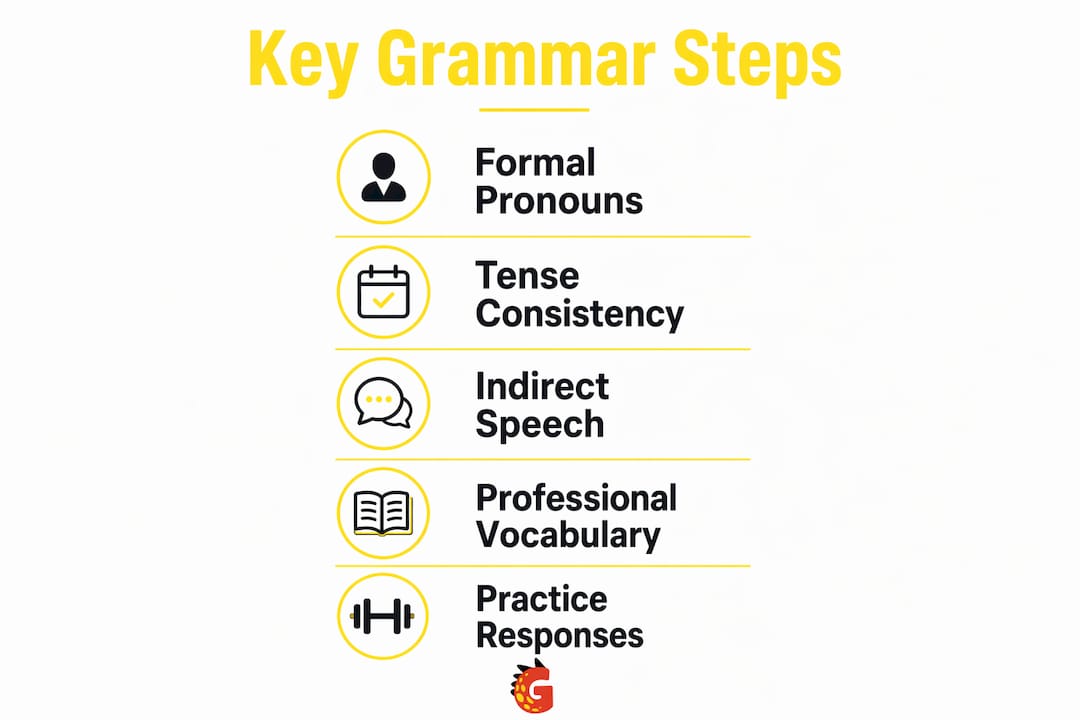
Spanish job interview grammar centers on three pillars: formal pronoun usage, tense consistency, and professional vocabulary. Together, these create the grammatical foundation that Spanish-speaking recruiters expect from any serious candidate. Recruiters perceive grammar issues as signals of confidence and clarity, not just technical errors. That means a grammar slip in an interview does not just sound wrong. It reads as uncertainty.
The formal register in Spanish is not optional in professional settings. Standard interview questions like “¿Cuáles son sus fortalezas?” (“What are your strengths?”) use usted-based grammar as the default. If you respond using informal tú forms, you are breaking the social contract of the interaction. Spanish-speaking professionals notice this immediately, even if they do not correct you out loud.

Success in a Spanish job interview is less about perfect grammar and more about consistent formal register and clear structure. That is an important reframe. You do not need to speak like a textbook. You need to stay in the right grammatical lane throughout the entire conversation.
How to use formal registers and pronouns in Spanish interviews
Usted is the singular formal “you” in Spanish, and it takes third-person singular verb forms. Ustedes is the plural formal “you all” and takes third-person plural verb forms. This distinction matters because your verb endings must match your pronoun choice at all times.
| Feature | Usted (singular formal) | Ustedes (plural formal) |
|---|---|---|
| Verb agreement | Third-person singular | Third-person plural |
| Example verb | habla (speaks/you speak) | hablan (speak/you all speak) |
| Possessive adjective | su / sus | su / sus (plural context) |
| Example question | ¿Cuál es su experiencia? | ¿Cuáles son sus expectativas? |
In practice, you will almost always use usted when speaking to a single interviewer and ustedes in a panel interview. The critical rule is to commit to one form and stay there. Mixing usted with informal tú phrasing mid-answer is one of the most common pitfalls for non-native speakers. It signals that your grammar is not yet automatic.
Formal pronoun choices also affect possessive adjectives and verb agreement. When you use usted, the paired possessive is su or sus. Practicing these pronoun and possessive pairs together builds the muscle memory you need to stay consistent under pressure.
Pro Tip: Before your interview, practice answering five common Spanish interview questions out loud using only usted forms. Record yourself and listen back for any accidental slips into tú. Catching the pattern in practice prevents it from appearing on the day.
How does tense consistency work when describing your experience?
Tense consistency is the grammar rule that most candidates overlook until they hear themselves stumble. The principle is straightforward: use the pretérito indefinido (simple past) for completed roles and tasks, the present tense for current responsibilities, and the present perfect (pretérito perfecto) for achievements that still affect your present situation.
Here is how that looks in practice:
- Past role: “Fui responsable de coordinar el equipo de ventas.” (“I was responsible for coordinating the sales team.”)
- Current role: “Actualmente gestiono un equipo de diez personas.” (“I currently manage a team of ten people.”)
- Ongoing achievement: “He desarrollado un sistema que ha reducido los costos en un 20%.” (“I have developed a system that has reduced costs by 20%.”)
- Mixing tenses incorrectly: “Fui responsable de ventas y actualmente fui también el líder del proyecto.” This sentence is grammatically broken because it uses past tense for a present fact.
Tense consistency improves clarity when describing experience, and it directly affects how organized and credible you sound. A candidate who drifts between tenses within a single answer creates confusion about what is current and what is historical.
Verb-tense drift occurs when candidates change tense unnecessarily while narrating accomplishments. The fix is to practice narrating full answer blocks in a single tense rather than drilling isolated verbs. If you are describing a past project, stay in the past tense for the entire answer before transitioning to the present.
Pro Tip: Structure your answers in three tense blocks: past (what you did), present (what you do now), and relevant achievement (what you have accomplished). This framework keeps your grammar organized and your answer easy to follow.
What are the grammar rules for indirect speech in interviews?
Indirect speech, known in Spanish as estilo indirecto, is the grammatical structure you use when restating a question, confirming information, or summarizing what was said. Mastering indirect speech is a practical skill for interviews because it lets you confirm understanding, buy thinking time, and demonstrate precision.
The rules follow a clear pattern:
- Use que to introduce reported statements: “El entrevistador dijo que la empresa busca líderes proactivos.” (“The interviewer said that the company is looking for proactive leaders.”)
- Use si to introduce reported yes/no questions: “Me preguntó si tenía experiencia en gestión de proyectos.” (“He asked me if I had experience in project management.”)
- Apply tense backshifting when the reporting verb is in the past: present tense shifts to imperfect, and simple past shifts to pluperfect.
- Drop question marks and inverted word order in indirect questions: “¿Tiene experiencia?” becomes “Preguntó si tenía experiencia.”
- Use common reporting verbs: decir (to say), afirmar (to state), preguntar (to ask), and explicar (to explain).
Correct que/si connectors and tense backshifts improve professional communication clarity in ways that most learners underestimate. When you can restate a question accurately before answering it, you signal both comprehension and grammatical control.
Avoiding common grammar and register mistakes in Spanish interviews
Most grammar mistakes in Spanish interviews fall into three categories: informal vocabulary, pronoun switching, and tense drift. Knowing the category helps you target your practice.
- Slang vs. professional vocabulary: Replace “curro” (slang for job) with “trabajo” or “puesto.” Replace “molar” (to be cool) with “valorar” (to value). Avoiding slang and using professional verbs like gestionar (to manage) and coordinar (to coordinate) immediately raises your register.
- Pronoun switching: Committing to usted forms from the first sentence prevents the mid-answer slip. If you catch yourself using tú, correct it smoothly: “Perdón, quería decir...” (“Sorry, I meant to say...”)
- Tense drift: Narrating accomplishments in a single tense block prevents drift. Practice full answers, not isolated sentences.
- Overly literal translations: Translating English phrases word-for-word produces unnatural Spanish. “I am very passionate about this role” does not translate as “Soy muy apasionado sobre este rol.” The natural Spanish equivalent is “Me apasiona este puesto.”
- Weak connectors: Relying on y (and) and pero (but) for every transition sounds elementary. Use además (furthermore), sin embargo (however), and por lo tanto (therefore) to sound more professional.
You can identify your specific weak areas before the interview by reviewing your Spanish grammar weaknesses systematically. Targeted practice on your actual errors is far more efficient than reviewing grammar rules you already know.
Pro Tip: Record a two-minute answer to “Tell me about yourself” in Spanish. Listen for slang, pronoun switches, and tense drift. These three errors account for the majority of register problems in Spanish interviews.
Sample grammatical templates for Spanish interview answers
Ready-to-use grammatical templates give you a reliable structure when nerves make spontaneous grammar harder. These widely used interview templates use formal usted-friendly grammar and cover the most common interview question types.
| Spanish template | English equivalent | Used for |
|---|---|---|
| Tengo X años de experiencia en... | “I have X years of experience in...” | Introducing your background |
| Fui responsable de... | “I was responsible for...” | Describing past roles |
| Actualmente me encargo de... | “I am currently in charge of...” | Describing current duties |
| Me adapto fácilmente a... | “I adapt easily to...” | Showing flexibility |
| Mi mayor fortaleza es... | “My greatest strength is...” | Answering strengths questions |
| He logrado... | “I have achieved...” | Highlighting accomplishments |
| Estoy muy interesado/a en... | “I am very interested in...” | Expressing motivation |
These templates are not scripts. They are grammatical anchors. You fill in the specific content from your own experience, and the grammar structure stays consistent. Notice that every template uses either the formal first-person present, the pretérito indefinido, or the present perfect. This is intentional. These three tenses cover 90% of what you need to say in a standard interview.
Tailoring these templates to your experience also forces you to practice the grammar in context, which is how patterns become automatic. Reading about “Fui responsable de...” is not the same as saying it ten times with your actual job history attached. For a broader view of how native grammar expectations shape professional Spanish, that context helps you understand why these templates work the way they do.
Key takeaways
Spanish job interview grammar requires consistent use of usted forms, tense control across past and present, and professional vocabulary to communicate competence clearly to any Spanish-speaking recruiter.
| Point | Details |
|---|---|
| Formal pronoun use | Always use usted (singular) or ustedes (plural) with matching third-person verb forms. |
| Tense consistency | Use past tense for completed roles, present for current duties, and present perfect for ongoing achievements. |
| Indirect speech rules | Use que for reported statements and si for reported yes/no questions, with tense backshifting. |
| Avoid register mixing | Never switch between usted and tú forms mid-answer; commit to one register from the first sentence. |
| Use grammatical templates | Templates like “Fui responsable de...” give you a reliable grammar structure under interview pressure. |
Why grammar consistency matters more than grammar perfection
I have reviewed a lot of Spanish interview preparation material over the years, and the advice that gets repeated most often is also the advice that gets applied least consistently: stay in your register. Candidates spend hours memorizing vocabulary lists and practicing pronunciation, but they walk into interviews and switch from usted to tú within the first two minutes. That single slip communicates more about their preparation level than any vocabulary choice.
What I have found actually works is practicing full answer narratives rather than isolated grammar rules. If you practice saying “Fui responsable de...” in isolation, you know the phrase. If you practice a two-minute answer about your last job entirely in the past tense, you train the tense. Those are very different skills. The second one is what the interview actually requires.
The other thing worth saying directly: self-correcting smoothly during an interview is a skill, not a failure. If you catch a grammar slip, a brief “Perdón, quería decir...” and a correction actually demonstrates grammatical awareness. It shows the interviewer that you know what correct sounds like. That is a better outcome than plowing through an error without noticing it.
Focus on clarity and consistency over perfection. A grammatically consistent answer that uses simple structures confidently will always outperform a grammatically ambitious answer that collapses mid-sentence. Build the foundation first. The complexity follows naturally.
- Daria
Train your Spanish interview grammar with Gramanator
If you want your grammar to hold up under interview pressure, you need more than knowledge. You need automatic recall.
Gramanator is built specifically for this. The platform’s Spanish grammar practice drills cover workplace communication contexts, including the formal register patterns, tense structures, and sentence templates that Spanish job interviews demand. You get 10,000+ structured drills, mistake-focused repetition, and immediate feedback that targets your actual weak points. Progress tracking shows you exactly where your grammar is solid and where it still needs work. If you are serious about walking into a Spanish interview with grammar that reacts automatically, Gramanator gives you the training structure to get there.
FAQ
What is the most important grammar rule for Spanish job interviews?
Using usted forms consistently throughout the interview is the single most important rule. Switching between usted and tú mid-answer signals a lack of preparation and breaks the formal register expected in professional settings.
Which verb tenses do I need for Spanish interview answers?
The three core tenses are the pretérito indefinido (simple past) for completed roles, the present tense for current responsibilities, and the present perfect for achievements that still affect your current situation.
How do I use indirect speech in a Spanish interview?
Use que to introduce reported statements and si for reported yes/no questions. When the reporting verb is in the past, backshift the tense of the reported clause. For example, “Me preguntó si tenía experiencia” (“He asked if I had experience”).
What vocabulary mistakes should I avoid in a Spanish interview?
Replace slang like “curro” with “trabajo” and use professional verbs like gestionar (to manage) and coordinar (to coordinate). Overly literal translations from English also produce unnatural Spanish, so practice phrasing ideas in Spanish directly rather than translating word-for-word.
How can I practice Spanish interview grammar effectively?
Practice full answer narratives in a single tense block rather than drilling isolated verbs or phrases. Recording yourself and listening for pronoun switches, tense drift, and slang gives you specific targets to correct before the actual interview.