Quedar vs Quedarse: Quick Rules & Examples for Learners
Master the difference between quedar and quedarse in Spanish with clear rules, examples, and common mistakes. Learn when to use the reflexive form.

Quedar vs Quedarse: Quick Rules & Examples for Learners
Use quedar (no pronoun) when you mean location, leftovers, a result, or an arrangement. Use quedarse (with a reflexive pronoun) when the subject stays somewhere, ends up in a new state, or keeps something for themselves. That is the whole rule.
Here’s the contrast in action:
- La panadería queda cerca del metro. (The bakery is located near the subway.)
- Me quedo en casa esta noche. (I’m staying home tonight.)
Pro Tip: If you can swap in “stayed” or “ended up” in English, you need the reflexive form. If you’re describing where something sits, what’s leftover, or a plan, drop the pronoun.
Key Takeaways
Choosing correctly between quedar and quedarse comes down to one question: does the sentence describe a location or plan, or does it describe the subject staying, changing, or keeping something?
| Point | Details |
|---|---|
| Core rule | Use quedar for location, leftovers, results, and arrangements; use quedarse when the subject stays, changes state, or keeps something. |
| Pronoun changes focus | Adding me, te, se, nos, or os shifts emphasis onto the subject’s experience, not the object or situation. |
| Watch quedar con vs. quedarse con | Quedar con someone means to arrange a meeting; quedarse con something means to keep it. |
| Avoid the dejar mix-up | Standard Spanish does not use quedar as a substitute for dejar (to leave something behind). |
| Build automatic recall | Gramanator’s targeted drills train the quedar/quedarse distinction until the choice happens without conscious translation. |
Table of Contents
- What’s the real difference between quedar and quedarse?
- When do you need quedarse instead?
- How do you decide between quedar and quedarse fast?
- What mistakes do learners make with quedar and quedarse?
- Practice: fill in quedar or quedarse correctly
- How can you make this choice automatic in conversation?
- Frequently asked questions about quedar vs quedarse
What’s the real difference between quedar and quedarse?
Quedar without a pronoun does four jobs in Spanish, and once you see them side by side, the pattern clicks fast.
- Location: La escuela queda en la esquina. (The school is on the corner.)
- Leftovers or remaining amount: Quedan tres galletas. (Three cookies are left.)
- Result of an action: Quedó impresionado con la presentación. (He was left impressed by the presentation.)
- Agreement or plan: Quedamos en las 7. (We agreed on 7:00.)
Watch for the constructions that come attached to these senses: quedar en + infinitive (“agree to do something”), quedar con + person (“arrange to meet someone”), quedar por + infinitive (“to still need doing”), and quedar + adjective (“to end up [state]”). A few more working examples: Ese vestido te queda perfecto (fit), Quedamos con Ana el sábado (arranging to meet), Queda mucho trabajo por hacer (still needs doing). The DLE entry for quedar lists these senses in full, and it’s worth skimming if a usage feels unfamiliar.
When do you need quedarse instead?
Quedarse takes a reflexive pronoun (me, te, se, nos, os, se), and that pronoun does real work. It shifts the focus onto the subject, marking that someone stays put, transforms into a new state, or ends up holding onto something.
- Staying in a place: Me quedo en casa. (I’m staying home.)
- Resulting state: Se quedó sorprendido. (He was left surprised.)
- Keeping possession: Me quedé con el libro. (I kept the book.)
- Running out of something: Nos quedamos sin leche. (We ran out of milk.)
A handful of idioms show up constantly in everyday speech: quedarse en blanco (to blank out, mentally), and quedarse con alguien (colloquially, “to pull someone’s leg” or “to keep someone’s change without asking”). Both trip up learners because the literal translation doesn’t map cleanly onto English. The Diccionario panhispánico de dudas confirms that the possession sense of quedar is normally pronominal, which is exactly why me quedé con el libro sounds natural and quedé el libro does not.
How do you decide between quedar and quedarse fast?
Run this two-question checklist in your head before you speak:
- Is the subject actively staying somewhere or shifting into a new condition? If yes, reach for quedarse.
- Is the sentence about a location, what’s left over, or a plan two people made? If yes, stick with quedar.
The reflexive pronoun isn’t decoration. Drop it or add it and the meaning of the sentence can flip entirely. Compare Quedó la casa vacía (the house ended up empty, describing the house) with Se quedó en casa (she stayed home, describing the person). Same root verb, completely different subject focus.
Pro Tip: When both forms seem grammatically possible, ask who or what the sentence is really about. Quedar tends to describe the object or situation; quedarse tends to describe the person’s experience of it.
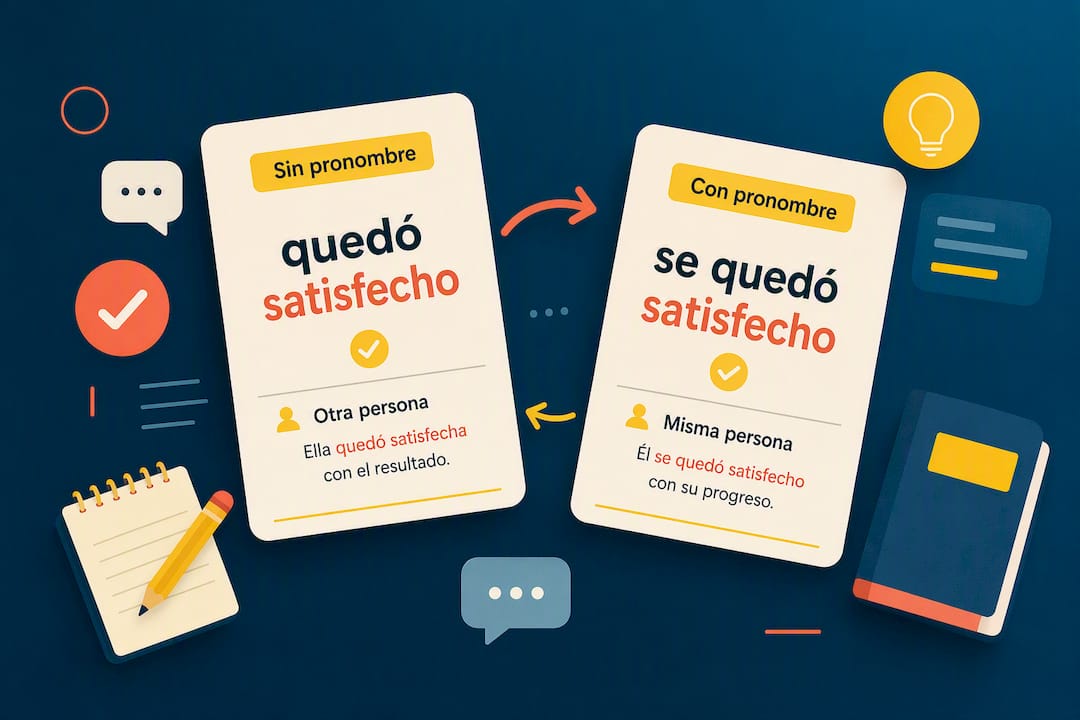
Overlap shows up most with adjectives after the verb. Quedó satisfecho and Se quedó satisfecho both mean “he was satisfied,” but native speakers lean toward the pronominal form here because it emphasizes the subject undergoing the change, according to the Diccionario panhispánico de dudas.
What mistakes do learners make with quedar and quedarse?
The most common slip is treating quedar as a stand-in for dejar (“to leave something/someone”). Standard usage does not support this. Quedé el libro en la mesa sounds off to a native ear; you want Dejé el libro en la mesa.
Other frequent traps:
- Dropping the reflexive pronoun when the sentence needs it, turning me quedé con el cambio into the incomplete quedé con el cambio.
- Confusing quedar con vs. quedarse con. Quedar con alguien means to arrange to meet someone; quedarse con algo means to keep something.
- Preposition mix-ups. Some American Spanish varieties use quedar de where Peninsular Spanish uses quedar en, a regional split noted in the detailed academic entry on quedar.
Memorize this corrected pair: ✗ Quedé con tu paraguas (wrong, sounds like you made plans with an umbrella) → ✓ Me quedé con tu paraguas (right, “I kept your umbrella”).
Practice: fill in quedar or quedarse correctly
Try these before checking the answers below.
- La tienda _____ a dos calles de aquí.
- Ellos _____ en vernos el lunes.
- Después del examen, ella _____ agotada.
- Nosotros _____ sin gasolina en la autopista.
- ¿Cuántas entradas _____ para el concierto?
- Yo _____ con la última porción de pastel.
Answers:
- queda (location, no pronoun needed)
- quedaron (agreement, no pronoun)
- se quedó (resulting state, needs the reflexive)
- nos quedamos (running out of something, reflexive required)
- quedan (leftover quantity, no pronoun)
- me quedé (kept possession, reflexive required)
If you got numbers 3 and 6 wrong, go back to the checklist: both describe the subject changing state or holding onto something, which always calls for the pronoun. For a subtler case like queda por hacer, the SpanishStep breakdown and the Linguatua guide to quedar both walk through extra examples worth reviewing.
How can you make this choice automatic in conversation?
Knowing the rule is one thing. Producing the right form in half a second, mid conversation, is another. That gap between “I understand the grammar” and “I said it correctly without thinking” is exactly what trips up intermediate learners on verbs like quedar and quedarse.
Gramanator is built around closing that specific gap. Instead of another explanation, you get structured drills that force you to choose between pronominal and non-pronominal forms under time pressure, the same way you’ll need to in a real exchange with a Spanish speaker.
- Targeted drills isolate quedar vs. quedarse alongside other pronominal verb pairs until the correct choice becomes reflexive rather than calculated.
- Immediate feedback flags the exact moment you drop a needed pronoun or add one you don’t need.
- Spaced repetition brings tricky patterns back right before you’d naturally forget them, based on your own error history.
Learners who want conversational instinct rather than rule memorization can start a free trial on Gramanator and run through the pronominal verb drills this week.
Frequently asked questions about quedar vs quedarse
Is quedar always non-reflexive? Not always. Quedar can appear pronominally for certain “passing into a state” senses, but the possession meaning (keeping something) is normally reflexive, per the Diccionario panhispánico de dudas.
Can quedar and quedarse ever mean the same thing? With some adjectives, yes, almost. Quedó satisfecho and Se quedó satisfecho both describe satisfaction, but the reflexive version puts more weight on the subject’s own experience of the change.
What does quedarse en blanco mean? It means to blank out mentally, usually under pressure, like forgetting your lines during a presentation. It has no literal English equivalent.
Is quedar de a mistake instead of quedar en? Not necessarily. Quedar en is standard in Spain, while quedar de appears in some American Spanish varieties for the same “to agree to” meaning. Neither is wrong; they’re regional.
How do I stop mixing up quedar con and quedarse con? Remember that con attaches to a person for meetups (quedar con Ana) and to an object for keeping (quedarse con las llaves). If a person follows con, you’re almost always talking about plans, not possession.
Recommended
- Ser vs Estar: complete guide with rules, examples & FAQ
- Spanish grammar blog - tips, examples & guides | Gramanator
- Common Spanish Conditional Tense Mistakes to Fix Now
- Spanish Verb Conjugation Rules: Your Complete 2026 Guide