Stop Leísmo Errors: 16 Example Pairs and RAE Rules
Leísmo happens when a speaker uses le or les to replace a direct object instead of lo , la , los , or las .

Leísmo happens when a speaker uses le or les to replace a direct object instead of lo, la, los, or las. The RAE’s Diccionario panhispánico de dudas accepts this swap when the direct object is a specific masculine person in the singular (“Le vi” for “vi a Juan”), but it rejects leísmo for things and generally rejects it for feminine and plural referents. Your working rule: default to lo/la/los/las for objects, and reserve le for people, singular, masculine.
TL;DR:
- Leísmo is acceptable only for masculine singular direct objects when referring to specific men, and even then, it retains regional popularity mainly in central Spain.
- Feminine leísmo and leísmo of inanimate objects are considered incorrect and should be avoided in formal speech and writing.
- The safest rule is to use lo, la, los, and las for direct objects and reserve le/les for indirect objects and formal courtesy addresses.
- Native regional varieties may accept leísmo in casual speech, but formal contexts require strict adherence to standard pronoun distinctions.
- Practice and repetition, especially through context-based drills and mistake logging, help internalize correct pronoun use and avoid common leísmo errors.
Table of Contents
- What is leísmo, and how does it fit the pronoun system?
- What do the RAE and FundéuRAE recommend?
- How do you spot leísmo in a sentence?
- Where does leísmo come from, and where will you actually hear it?
- Fifteen-plus example pairs to study and practice
- How do you train yourself out of leísmo mistakes?
- Turn pronoun rules into automatic speech with Gramanator
- Where to go for more on leísmo, laísmo, and loísmo
- Sources
What is leísmo, and how does it fit the pronoun system?
To understand leísmo, you need two grammar terms most textbooks gloss over too fast: direct object and indirect object. The direct object receives the action of the verb directly. In “Vi a María” (I saw María), María is the direct object because she’s the thing being seen. The indirect object receives the result of the action, usually marked by “a” and answerable with “to/for whom.” In “Le di el libro a María” (I gave the book to María), María is the indirect object because she’s receiving something someone else did.
In standard Spanish, direct objects take lo, la, los, las. Indirect objects take le, les. Leísmo blurs that line by pulling le/les into direct-object territory. Grammarians split it into three types, and knowing which one you’re looking at tells you instantly whether it’s acceptable:
- Leísmo de persona masculino (accepted in singular): “Le vi ayer” instead of “Lo vi ayer,” referring to a specific man.
- Leísmo de persona femenino (rejected): “Le vi ayer” referring to a woman, when standard usage calls for “La vi ayer.”
- Leísmo de cosa (rejected): “Le rompí” referring to a table or object, when standard usage calls for “Lo rompí.”
Notice the pattern: the only version with real normative backing involves a specific male person, and only in the singular. Everything else, feminine referents and inanimate objects, falls outside what the RAE calls standard. Spanish learners often assume leísmo is one blanket phenomenon they should either always avoid or always ignore. It’s not. It’s three distinct patterns, and only one has a real seat at the grammatical table.
What do the RAE and FundéuRAE recommend?
The RAE’s own Glosario de términos gramaticales treats leísmo as a documented dialectal feature rather than a simple mistake, but that tolerance has real limits. Masculine-person singular leísmo is common enough in central Spain that the RAE lets it stand in both speech and semi-formal writing. Leísmo de cosa and feminine leísmo don’t get the same pass. The Nueva gramática básica traces this asymmetry back to how the pronoun system reorganized itself over centuries, shifting from a case-based split to one built more around gender and person.
FundéuRAE’s guidance gives learners the cleanest possible shortcut:
The safest approach for anyone unsure which pronoun to use is to follow the traditional accusative and dative distinction: lo and la for direct objects, le for indirect objects. Exceptions like masculine-person leísmo and courtesy leísmo exist, but defaulting to the etymological pattern avoids errors in every other case.
That courtesy exception deserves its own mention because it trips up learners constantly. Leísmo de cortesía uses le for a person addressed as usted, regardless of gender, as a mark of formal respect: “Le atenderé enseguida” (I’ll help you right away) to a client, whether that client is a man or a woman. This isn’t really leísmo in the error sense. It’s a fossilized formal register the RAE treats as fully standard.
So the accepted list is short:
- Masculine-person singular direct objects (“le” for “lo”)
- Courtesy address with “usted,” regardless of gender
Everything else, feminine leísmo, plural leísmo, and leísmo de cosa, falls outside the standard and should be avoided in careful speech and writing.
How do you spot leísmo in a sentence?
Run a quick substitution test before you commit to a pronoun. Ask: can I replace this pronoun with a noun phrase using “a”? If the answer points to “vi a Juan,” “vi a María,” or “rompí la silla,” you’re dealing with a direct object, and lo/la/los/las is the standard choice. If the sentence structure calls for “to/for” someone, “le di el libro a Juan,” you’ve got an indirect object, and le/les is correct regardless of gender.
The body-part rule solves a huge chunk of learner confusion. When a body part functions as the direct object but belongs to a person who’s treated as receiving the action, Spanish speakers commonly shift to le: “Le vi la mano” (I saw his/her hand) rather than “Lo vi la mano.” This pattern shows up so often in native speech that even careful speakers use it without thinking twice, and it’s one case where FundéuRAE’s own diagnostic guidance treats le as the natural choice.
Certain verb categories also lean leísta more than others, particularly perception and communication verbs like ver (to see), oír (to hear), and llamar (to call) in spoken varieties from central Spain. Hearing “le vi” instead of “lo vi” in Madrid doesn’t mean the speaker made a mistake. It means you’re hearing a regional norm in action.
Here’s a four-step check you can run on any sentence:
- Identify the verb’s action. Does it land directly on someone/something, or does it describe something being given, told, or done “to/for” someone?
- Find the receiver. Is it a person, a thing, masculine, feminine, singular, or plural?
- Apply the base rule. Direct object → lo/la/los/las. Indirect object → le/les.
- Check for exceptions. Masculine-person singular direct objects and courtesy usted forms can take le even though they’re technically direct objects.
Pro Tip: Say the sentence out loud and swap in a full noun phrase where the pronoun sits. If “a Juan” fits naturally after the verb, you’re looking at a direct object, and that’s your cue to reach for lo , not le*.
Where does leísmo come from, and where will you actually hear it?
Leísmo concentrates heavily in central and northern Spain, especially Madrid and Old Castile, where the RAE’s grammatical glossary documents it as a defining regional feature. Cross the Atlantic and the picture changes almost completely. Leísmo shows up only in isolated pockets across the Americas, and most Latin American varieties stick closely to the standard lo/la distinction for direct objects.
The roots go back to medieval Castilian, when the Latin case system that once cleanly separated accusative and dative forms started collapsing into the simpler person and gender distinctions Spanish uses today. That reorganization didn’t land the same way everywhere. In some regions, contact with other languages, Basque influence in northern Spain, various indigenous language contact patterns in parts of the Americas, shaped which pronoun patterns stuck and which faded.
Here’s the practical takeaway that matters more than the history: hearing leísmo doesn’t mean it’s safe to write it. A few things to keep in mind as you calibrate your own usage:
- Exposure to a form in casual speech, even from native speakers, doesn’t equal formal grammatical endorsement.
- Regional norms in Madrid don’t automatically transfer to Mexico City, Bogotá, or Buenos Aires, where the same sentence might sound distinctly foreign.
- Formal writing, academic work, and professional correspondence call for the conservative standard almost everywhere, even in leísta zones.
Think of it the way you’d think about regional accents in English. Recognizing “y’all” as authentic Southern American English doesn’t mean you’d use it in a legal brief. Same logic applies here.
Fifteen-plus example pairs to study and practice
The clearest way to internalize leísmo is to see the standard form and the leísta form side by side, with a note on where each one stands. Leísmo in central Spain often involves masculine-person singular direct objects, the one category the RAE broadly accepts, according to the Diccionario panhispánico de dudas. That statistic alone tells you where to focus your attention: the accepted case is also the most common one.
- “Lo vi en la fiesta” / “Le vi en la fiesta” (referring to a man). Both used; le is accepted regionally.
- “La vi en la fiesta” / “Le vi en la fiesta” (referring to a woman). Le is discouraged; standard calls for la.
- “Los vi llegar” / “Les vi llegar” (referring to several men). Plural leísmo discouraged; standard calls for los.
- “Lo rompí sin querer” / “Le rompí sin querer” (referring to a vase). Le is incorrect for objects; use lo.
- “Le atenderé enseguida” to a female client using usted. Correct; courtesy leísmo applies regardless of gender.
- “Le vi la mano herida” / “Lo vi la mano herida.” Le is standard here under the body-part rule.
- “La llamé por teléfono” / “Le llamé por teléfono” (calling a woman). Le is nonstandard; use la.
- “Lo oí gritar desde la calle” / “Le oí gritar desde la calle” (a man shouting). Le is regionally accepted with perception verbs.
- “Las contraté para el proyecto” / “Les contraté para el proyecto” (hiring women). Les is incorrect; use las.
- “Lo ayudé con las maletas” / “Le ayudé con las maletas” (helping a man). Both heard; lo is the conservative choice.
- “Le expliqué el problema a usted” (formal, either gender). Correct courtesy form.
- “La invité a cenar” / “Le invité a cenar” (inviting a woman). Le is nonstandard here.
- “Lo encontré en el parque” / “Le encontré en el parque” (finding a man). Le acceptable in speech; lo safer in writing.
- “Les vi el miedo en los ojos” (seeing fear in their eyes, body part). Les acceptable under the body-part extension.
- “Lo escuché con atención” / “Le escuché con atención” (listening to a man speak). Le common with communication verbs.
- “Las vi salir del edificio” / “Les vi salir del edificio” (women leaving). Les incorrect; las is standard.
Use these as dictation drills: cover the label, say both versions aloud, and decide which one you’d write in a formal email versus a casual text to a friend.
How do you train yourself out of leísmo mistakes?
Fixing leísmo errors isn’t about memorizing a rule once and hoping it sticks. It’s about building the kind of automatic recall that lets you choose the right pronoun before you’ve even finished forming the sentence in your head. Rule knowledge and reflex speed are two different skills, and only one of them helps you in a live conversation.
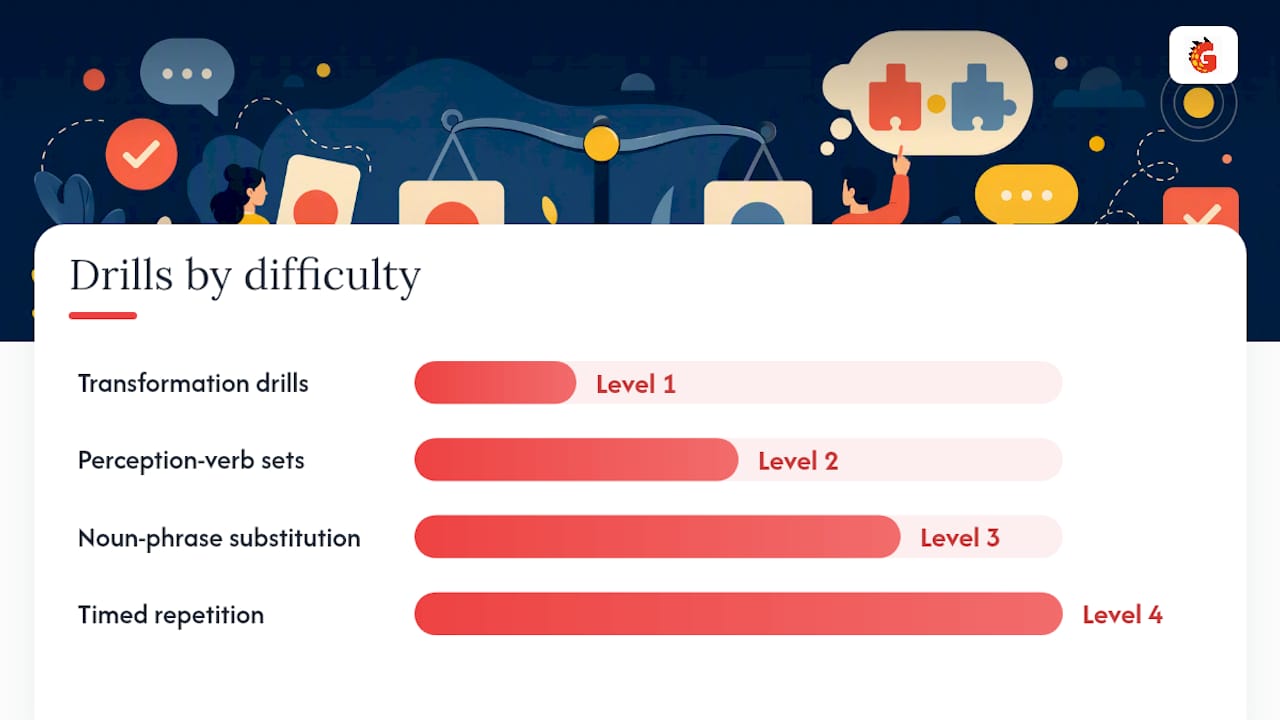
Try these four drills, in order of difficulty:
- Transformation drills. Take twenty sentences with explicit noun objects (“Vi a Pedro,” “Rompí la mesa”) and rewrite each one using the correct pronoun. Check every answer against the direct/indirect test before moving on.
- Perception-verb sets. Build a list of sentences using ver, oír, escuchar, and llamar with masculine, feminine, and plural objects. Practice choosing lo/la/los/las consistently, then compare against how a Madrid speaker might say the same sentence.
- Noun-phrase substitution. Take pronoun-only sentences and expand them back into full noun phrases to confirm your pronoun choice matches the object’s actual role.
- Timed repetition. Set a sixty-second timer and produce as many correct pronoun substitutions as you can from a verb-and-noun prompt list. Speed under pressure reveals which patterns you’ve actually automated versus which ones you’re still reasoning through.
For writing, stay conservative: use lo/la/los/las for every direct object unless you’re deliberately reproducing regional dialogue. For speaking, especially if you’re immersed in a leísta region, relax slightly and expect to hear le for masculine-person objects without treating it as an error.
Keep a simple mistake log. Every time you catch yourself defaulting to le for a feminine or inanimate direct object, write the sentence down, correct it, and revisit that list every few days. Spaced repetition on your own errors works faster than reviewing generic rule sheets, because you’re training the exact gap in your instinct rather than re-reading a rule you already technically know.
Turn pronoun rules into automatic speech with Gramanator
Reading about leísmo is one thing. Choosing lo over le correctly at conversational speed, without pausing to run the direct-object test in your head, is another skill entirely, and it’s the one that actually matters when you’re mid-conversation with a native speaker.

Gramanator was built around exactly that gap. Instead of another rule explanation, you get structured drills that put you in real sentence contexts, workplace exchanges, travel situations, everyday conversations, and force you to pick the correct pronoun under mild time pressure. Because the platform spans A1 through C1, you can start with basic direct/indirect object distinction and work up to the trickier cases covered here: courtesy leísmo, body-part constructions, and perception-verb patterns. Every drill gives immediate feedback, so a wrong pronoun choice gets flagged and repeated later instead of quietly reinforcing a bad habit. Mistake-focused repetition means the sentences you get wrong resurface more often until the correct choice becomes reflexive rather than something you calculate.
If leísmo and its cousins, laísmo and loísmo, keep showing up as sticking points in your Spanish, that’s precisely the kind of weak-area pattern Gramanator’s progress tracking is built to surface and target. Explore the full grammar training platform and check the subscription plans to start converting this pronoun knowledge into instinct.
Where to go for more on leísmo, laísmo, and loísmo
- RAE Diccionario panhispánico de dudas: the core normative source on which leísmo forms are accepted and which are rejected. See the entry.
- RAE Glosario de términos gramaticales: defines leísmo formally and maps its dialectal spread. See the glossary.
- FundéuRAE: practical, learner-friendly guidance on the safest pronoun choices and key exceptions. See the recommendation.
- CVC Cervantes: accessible tables and examples contrasting direct and indirect objects. See the primer.
- Nueva gramática básica (RAE/ASALE): historical background on how the pronoun system evolved into today’s leísmo patterns. See the chapter.