How Spanish Word Order Works: A Learner's Guide
How Spanish word order really works. SVO basics, pronoun placement, and emphasis patterns explained for adult learners at A2-B2.

If you’ve ever studied Spanish and assumed it works like English, you’ve already hit the first wall. Understanding how Spanish word order works is one of the most misunderstood areas of Spanish language syntax, and for good reason. Spanish is not random, but it is flexible in ways that English simply is not. The technical term linguists use is “free word order language,” though “flexible” is more accurate: Spanish follows rules, but those rules allow for more variation than most learners expect. This guide breaks down those rules clearly, from basic Spanish word order to pronoun placement and topicalization.
Table of Contents
- Key Takeaways
- How Spanish word order works: the SVO foundation
- Pronoun placement and the clitic rules
- Fronting and topicalization for emphasis
- Questions and negations in Spanish
- Why Word Order Is a Learning Priority
- Train Spanish word order until it’s automatic
- FAQ
Key Takeaways
| Point | Details |
|---|---|
| SVO is the default | Spanish declarative sentences follow Subject + Verb + Object order, just like English. |
| Subjects are often optional | Verb conjugation signals who is acting, so dropping the subject pronoun is grammatically correct. |
| Pronoun placement has firm rules | Object pronouns go before conjugated verbs but attach to infinitives, gerunds, and affirmative commands. |
| Fronting changes emphasis | Moving an object to the front of a sentence (topicalization) requires a matching clitic pronoun to stay grammatical. |
| Questions need minimal adjustment | Spanish yes/no questions often use the same word order as statements, with a change in intonation alone. |
How Spanish word order works: the SVO foundation
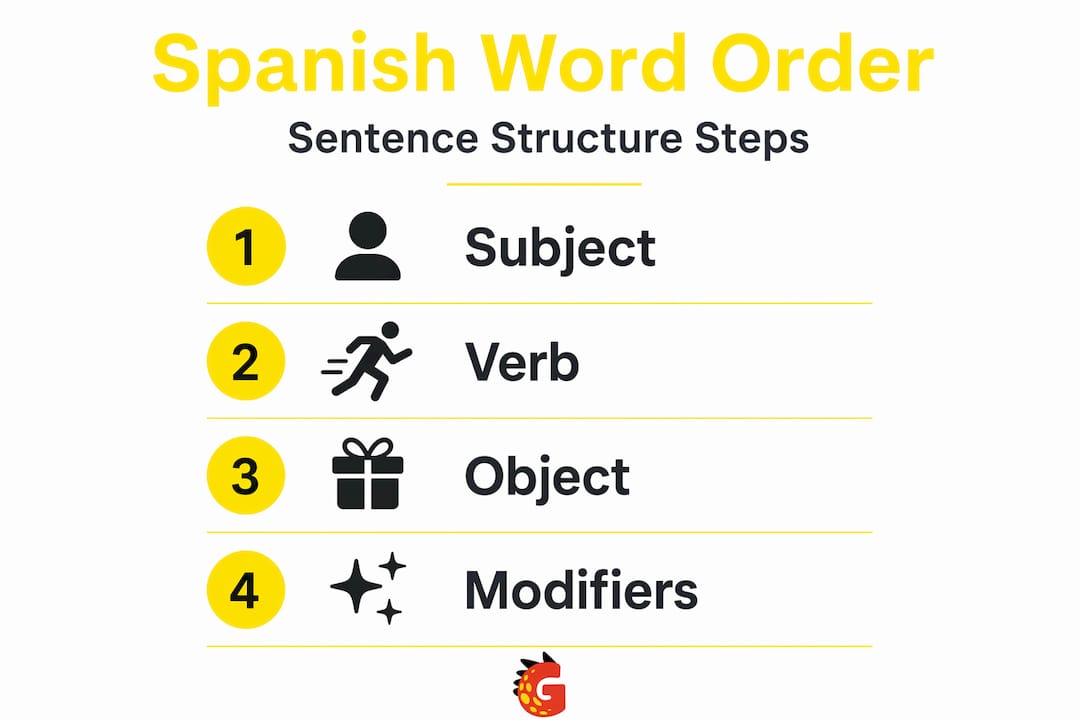
The starting point for understanding Spanish sentence structure is the Subject + Verb + Object pattern, also called SVO. This is the default word order in neutral declarative sentences. Take the sentence Juan come una manzana (“Juan eats an apple”). Subject first, verb second, object third. Sound familiar? It should, because English follows the same pattern.

That similarity is reassuring for beginners, but the differences matter just as much.
Dropping the subject
One immediate difference between English and Spanish grammar rules is that Spanish allows you to drop the subject pronoun entirely. In English, “I speak Spanish” requires “I.” In Spanish, verb conjugation signals the subject, so Hablo español is completely correct without yo. The “-o” ending on hablo already tells the listener it’s first person singular.
This is not just casual speech. It’s standard practice across all registers of Spanish.
How negation fits in
Negation in Spanish does not disrupt the SVO order. You simply place no directly before the conjugated verb. Compare the two structures:
| English | Spanish |
|---|---|
| Juan eats an apple. | Juan come una manzana. |
| Juan does not eat an apple. | Juan no come una manzana. |
| She sees him. | Ella lo ve. |
| She does not see him. | Ella no lo ve. |
Notice that even with object pronouns involved, no stays immediately before the verb. The SVO logic holds.
One Spanish grammar rule that confuses English speakers is the personal a. When a direct object is a specific person or pet, Spanish requires an a before it. You say Veo a María (“I see María”), not Veo María. This a has no English equivalent and is easy to forget, but it is a required part of how to structure sentences in Spanish involving animate, definite direct objects.
Pronoun placement and the clitic rules
Object pronouns in Spanish, called clitic pronouns, follow specific placement rules that depend entirely on the form of the verb they attach to. This is one area of Spanish sentence structure where learners make the most consistent mistakes.
Here is the core rule: object pronouns precede conjugated verbs but attach to the end of infinitives, gerunds, and affirmative commands.
- Lo veo. (“I see it.” Pronoun before conjugated verb.)
- Quiero verlo. (“I want to see it.” Pronoun attached to infinitive.)
- Estoy viéndolo. (“I am seeing it.” Pronoun attached to gerund.)
- Dámelo. (“Give it to me.” Pronouns attached to affirmative command.)
With a conjugated verb followed by an infinitive, you actually have a choice. Lo quiero ver and Quiero verlo are both correct. This optional flexibility confuses learners, but knowing both forms are acceptable gives you freedom in conversation.
The RID order for multiple pronouns
When two object pronouns appear together, Spanish enforces a fixed sequence: Reflexive, then Indirect object, then Direct object. This is often taught as the RID order.
You cannot swap them. The sentence Se lo doy (“I give it to him/her”) follows this structure. The key twist is that le and les change to se when followed by a direct object pronoun like lo, la, los, or las. Saying Le lo doy is not grammatical in Spanish. The se substitution is mandatory and avoids phonetic awkwardness.
When pronouns attach to verbs, accent marks (tildes) are often required. The word contármelo carries an accent to preserve the original stress of contar. Skipping this accent is a written error, and getting it right signals real mastery to native speakers.
Pro Tip: When you are unsure whether a pronoun attaches before or after a verb, ask yourself one question: is the verb conjugated for a specific subject? If yes, the pronoun goes before. If the verb is an infinitive, gerund, or affirmative command, attach the pronoun to the end.
Fronting and topicalization for emphasis
Here is where Spanish sentence structure gets genuinely interesting, and where it diverges most sharply from English. Spanish allows speakers to move elements around in a sentence to signal what is already known versus what is new information. Linguists call this topicalization or clitic left dislocation. You can think of it as word order in the service of emphasis.
The classic example is this comparison:
| Standard order | Topicalized order |
|---|---|
| Leí el libro ayer. (I read the book yesterday.) | El libro lo leí ayer. (The book, I read it yesterday.) |
| Compré las entradas. (I bought the tickets.) | Las entradas las compré yo. (The tickets, I bought them.) |
In the topicalized version, the object moves to the front. But crucially, a matching clitic pronoun must also appear next to the verb. This is not optional. English speakers learning Spanish routinely leave this pronoun out, producing ungrammatical sentences. If you front el libro, you must also include lo next to the verb.
Subject postposing
Spanish also allows the subject to follow the verb in certain natural contexts. The sentence Llegó mi amiga (“My friend arrived”) is perfectly natural in Spanish, especially when introducing new information. It sounds far more native than Mi amiga llegó, which puts stale emphasis on the subject. This verb-first pattern is especially common with verbs of arrival, appearance, or happening.
Word order in Spanish serves as a tool for managing information flow, not just a syntactic rule to memorize. This is why fluent speakers shift word order regularly in conversation without even thinking about it.
Pro Tip: When you want to emphasize an object, front it to the start of the sentence, but never forget the clitic pronoun that must accompany it. Think of the clitic as a shadow: wherever the fronted object goes, the clitic follows, anchored next to the verb.
Questions and negations in Spanish
Good news: forming questions in Spanish does not require the structural gymnastics that English demands. English needs auxiliary verbs like “do” and “does” to form questions. Spanish does not.
For yes/no questions, you have two options:
- Keep SVO order and raise your intonation: ¿Hablas español? (Do you speak Spanish?)
- Invert the verb and subject: ¿Habla usted español? (Do you speak Spanish? - formal)
Spanish questions often retain the same word order as their statement versions. The question marks in writing and the rising intonation in speech do the work. This is a relief for learners who spend too long trying to construct English-style question patterns in Spanish.
For information questions, the pattern is clear: interrogative word + verb + subject.
- ¿Qué quieres? (What do you want?)
- ¿Dónde vive ella? (Where does she live?)
- ¿Cuándo llegó tu amigo? (When did your friend arrive?)
For negations beyond simple no, Spanish uses double negatives correctly and grammatically. The sentence No veo nada (“I see nothing”) uses both no before the verb and nada after. In English, double negatives are considered errors. In Spanish, they are required. If you remove no and say Veo nada, the sentence becomes ungrammatical.
Other negative words follow the same logic:
- No habla nadie. (Nobody is talking.)
- No tengo ningún problema. (I have no problem.)
- No quiero nada tampoco. (I don’t want anything either.)
Each negative indefinite appears after the verb, while no holds its position before the conjugated form. The structure is consistent once you see the pattern.
Why Word Order Is a Learning Priority
One of the most common observations among Spanish teachers is that word order mistakes are rarely random. They usually stem from two predictable blind spots that many learners overlook.
The first is clitic pronoun placement. Learners who do not practice pronoun position early often continue to hesitate during conversations because they have to consciously think about where lo, la, or le belongs. Reading grammar explanations alone is rarely enough. Building confidence requires repeated practice until the pattern becomes automatic.
The second blind spot is topicalization. Many learners assume that fronting objects is an advanced structure they can postpone until later. In reality, native speakers use topicalization regularly to organize information, emphasize ideas, and guide the flow of conversation. Learning to combine a fronted object with its corresponding clitic pronoun is an important conversational skill rather than an advanced exception.
For this reason, many language educators recommend mastering basic subject-verb-object word order first, then developing automatic clitic pronoun placement through structured practice before introducing more advanced word order patterns. The goal is not simply to understand the rules but to retrieve them effortlessly during real conversations.
For most learners, the greatest obstacle is not a lack of grammar knowledge. It is the gap between understanding a rule and applying it instinctively. Identifying specific weaknesses and practicing them repeatedly is what gradually closes that gap and leads to more natural, confident communication.
Train Spanish word order until it’s automatic

Understanding the rules is step one. Making them automatic is where most learners stall. Gramanator is built specifically for this second step. As an AI-powered Spanish grammar training platform, Gramanator gives you 10,000+ structured drills targeting exactly the patterns covered in this article: SVO construction, clitic placement, topicalization, question formation, and double negatives. Every session is personalized to your weaknesses, with immediate feedback and integrated grammar explanations built into the practice itself. If you are serious about moving from knowing Spanish grammar to using it without translating in your head, explore Gramanator’s grammar practice plans and start training today.
FAQ
What is the default word order in Spanish?
The default Spanish word order is Subject + Verb + Object (SVO), the same as in English. Example: Juan come una manzana (Juan eats an apple).
Can you drop the subject pronoun in Spanish?
Yes. Because verb conjugation indicates person and number, subject pronouns like yo or él are regularly omitted in both speech and writing.
Where do object pronouns go in a Spanish sentence?
Object pronouns go before conjugated verbs and attach to the end of infinitives, gerunds, and affirmative commands. When two pronouns appear together, RID order applies: Reflexive, then Indirect, then Direct.
What is topicalization in Spanish?
Topicalization means moving an object to the front of a sentence for emphasis or to signal known information. A matching clitic pronoun must accompany the fronted object next to the verb. Example: El libro lo leí ayer.
Are double negatives correct in Spanish?
Yes. Spanish requires double negatives when combining no with negative indefinites like nada, nadie, or ninguno. The construction No veo nada (“I see nothing”) is grammatically correct and standard.