Bien vs Bueno: The Clear Rule Every Spanish Learner Needs
Bien is an adverb (well); bueno is an adjective (good). That single distinction solves most of the confusion, and two quick examples make it stick.

Bien is an adverb (well); bueno is an adjective (good). That single distinction solves most of the confusion, and two quick examples make it stick.
Verb example: Habla bien español (She speaks Spanish well) uses bien because it describes how she speaks, an action. Compare that to Es un buen hablante (He’s a good speaker), where buen describes the noun hablante, a person.
Noun example: La película es buena (The movie is good) pairs buena with the noun película. But if you’re describing how something was done, you’d say Actuó bien en la película (He acted well in the movie), never actuó buena.
One quick caveat before you move on: estoy bien means “I’m fine” or “I’m doing well,” while estoy bueno can mean “I’m tasty” or, in some regions, hint at physical attractiveness. Mixing those two up is one of the most common (and most awkward) beginner slips.
- Bien = adverb, invariable, modifies verbs/adjectives/adverbs
- Bueno = adjective, changes form (bueno/buena/buenos/buenas), modifies nouns
- Estoy bien ≠ estoy bueno, and the gap between them trips up even confident learners
Key Takeaways
Mastering bien vs bueno comes down to one question: are you describing an action or a thing, then matching gender and number when the answer is “a thing.”
| Point | Details |
|---|---|
| Core rule | Bien is an invariable adverb for actions; bueno is an adjective that agrees with nouns. |
| Watch the apocopation | Bueno shortens to buen only before masculine singular nouns, like un buen amigo. |
| Ser vs estar trap | Estoy bien expresses wellbeing; estoy bueno shifts toward taste or attraction. |
| Practice beats reading | Timed drills and spoken substitution convert the rule into automatic speech faster than rereading grammar notes. |
Table of Contents
- Bien vs Bueno: How the Adverb Bien Actually Functions
- Bien vs Bueno: Mastering Bueno, Buen, and Buena Agreement
- Common Bien vs Bueno Mistakes Every Learner Makes
- A Three-Step Method for Choosing Bien or Bueno on the Spot
- Why Drills, Not Just Rules, Make Bien vs Bueno Automatic
- Sources
Bien vs Bueno: How the Adverb Bien Actually Functions
Bien never changes form, no matter what it’s attached to. That’s the first thing to lock in: no gender, no number, no exceptions. It stays bien whether you’re describing a man, a woman, one person, or a group.
Its job is to modify actions and qualities, not things. Here’s how that plays out across four common patterns:
- Manner: Juega bien al fútbol (He plays soccer well) describes how he plays.
- Skill or ability: Habla bien español (She speaks Spanish well) describes her level of competence.
- Intensifier: Bien frío (very cold) or bien rápido (really fast) uses bien the way English speakers use “really” or “quite.”
- Discourse marker: Bien, empecemos (Alright, let’s begin) works as a conversational transition, similar to how English speakers use “okay” or “well” to open a new thought.
Pronunciation-wise, the ie in bien forms a single diphthong sound, roughly “byen,” said in one smooth breath rather than two separate vowel sounds. Spanish speakers rarely stumble over this word out loud. Where learners stumble is usage, not pronunciation.
You’ll also see bien directly after estar, and this combination deserves its own spotlight. Está bien means “it’s fine” or “that’s okay,” and it’s one of the most frequent phrases in everyday Spanish, used to confirm plans, calm a tense moment, or simply agree. Cambridge English’s learner grammar resources draw a similar parallel for English speakers separating adverbs from adjectives, and that framework transfers directly to bien versus bueno.
Pro Tip: If you can replace the word with “well” in English and the sentence still makes sense, you need bien. If you’d use “good,” you need a form of bueno.
Bien vs Bueno: Mastering Bueno, Buen, and Buena Agreement
Bueno behaves like a normal Spanish adjective, which means it has to agree with the noun it describes in both gender and number. That gives you four forms: bueno (masculine singular), buena (feminine singular), buenos (masculine plural), and buenas (feminine plural).
- Es un libro bueno → un buen libro (a good book)
- Es una comida buena → una buena comida (a good meal)
- Son unos amigos buenos → unos buenos amigos (good friends)
- Son unas ideas buenas → unas buenas ideas (good ideas)
Notice the shift in the first and third examples. When bueno sits directly before a masculine singular noun, it drops its final syllable and becomes buen. The RAE dictionary confirms this apocopation rule explicitly, documenting buen as the shortened form used before masculine singular nouns like amigo or libro, per the official RAE entry for “bueno”. This shortening only happens with masculine singular nouns placed before them. Buena, buenos, and buenas stay intact no matter where they land in the sentence.
Position also shifts meaning slightly. Es un amigo bueno technically works, but native speakers almost always say es un buen amigo instead, since buen before the noun reads as the natural, expected order. Put the adjective after the noun, and Spanish speakers sometimes read it as more literal or emphatic, a subtle nuance that grammar guides like SpanishStep’s explainer on apocopation break down in more detail.
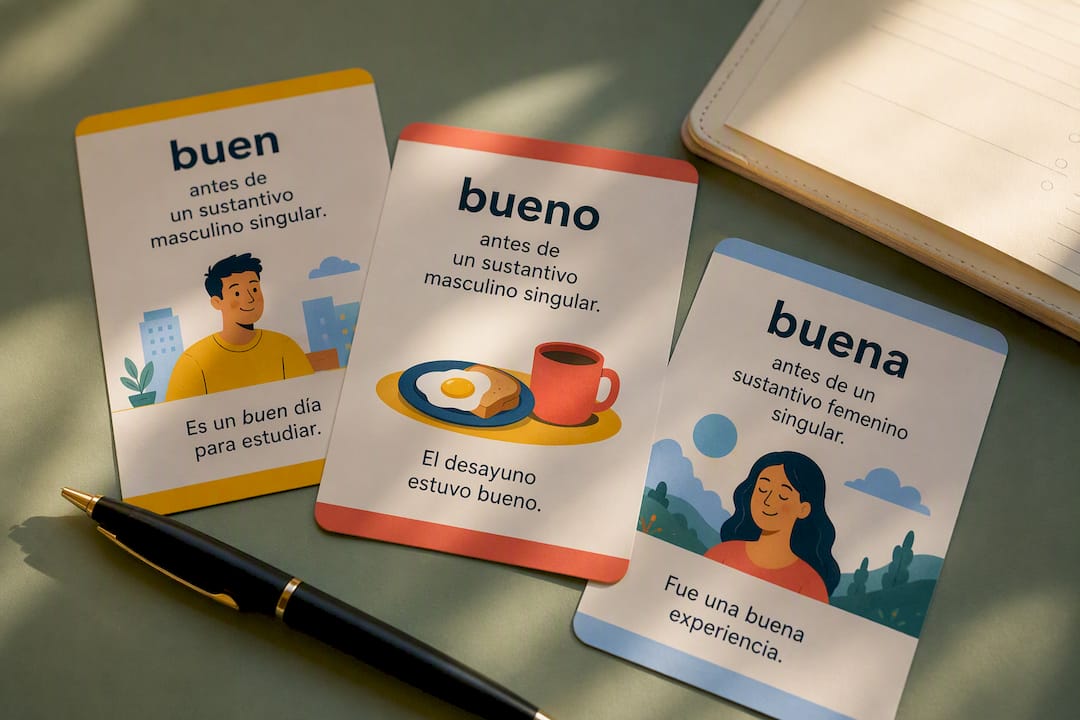
There’s one more wrinkle worth flagging: está bueno can describe a physical state, like food tasting good or, informally, a person’s looks, while es bueno describes character or inherent quality. Es bueno tells you someone is a good person. Está bueno tells you the soup is good tonight. Same word, very different message depending on the verb standing next to it.
Common Bien vs Bueno Mistakes Every Learner Makes
Some errors show up so often that language teachers can practically predict them before the lesson starts. Here are the four biggest offenders, plus the fix for each one.
- “Soy bien” instead of “estoy bien.” This mistake usually comes from directly translating “I am well” using ser, the verb of identity, when Spanish needs estar, the verb of state, to describe how you’re feeling right now. SpanishDict’s guide to common mistakes lists this exact ser/estar swap as one of the most frequent errors among English speakers.
- “Estoy bueno” when you mean “I’m doing well.” This one doesn’t just sound off, it changes the message entirely, since estoy bueno leans toward describing physical attractiveness or, in some contexts, flirtation. Stick with estoy bien for wellbeing.
- “Una comida bien” instead of “una comida buena.” Learners sometimes reach for bien to describe a noun because it “feels” like the word for good. But nouns need adjectives, and adjectives need agreement, so it has to be buena, matching the feminine singular comida.
- Dropping agreement altogether, saying bueno for every noun regardless of gender or number. This flattens Spanish’s grammar into English’s simpler system, and native speakers notice immediately.
Language teaching resources consistently note that swapping bien and bueno rarely blocks basic communication, but it does mark speech as noticeably less fluent, and it’s exactly the kind of pattern that sticks around for years if it isn’t corrected early.
| Incorrect | Correct | Why |
|---|---|---|
| Soy bien | Estoy bien | Wellbeing uses estar, not ser |
| Estoy bueno (meaning “I’m fine”) | Estoy bien | Bueno signals attraction/taste, not wellbeing |
| Una comida bien | Una comida buena | Nouns need agreeing adjectives, not adverbs |
A Three-Step Method for Choosing Bien or Bueno on the Spot
Grammar rules only help if you can apply them in real time, mid conversation, without pausing to translate. This three-step check gets you there.
- Ask: is it describing an action? If yes, reach for bien. Actions and verbs, no exceptions.
- Ask: is it describing a noun or a person’s quality? If yes, you need a form of bueno, and you’ll need to match its gender and number to that noun.
- Ask: is that adjective sitting right before a masculine singular noun? If yes, shorten it to buen.
Two micro-drills turn that checklist into instinct. First, a timed fill-in-the-blank drill: write ten sentences with a blank where bien or bueno/buena/buen belongs, set a sixty-second timer, and fill them in without overthinking. Second, spoken substitution practice: say a sentence with bien, then immediately convert it to use a form of bueno describing the same subject, out loud, back to back. Habla bien becomes es un buen hablante in one breath.
Set aside two to five minutes a day for this, and track a simple goal, something like ten correct uses of bien or bueno in real conversation each week. That’s a small enough target to hit consistently, and consistency is what actually rewires the instinct.
Pro Tip: Say your drill sentences out loud, not silently. Spanish grammar sticks faster when your mouth practices the pattern, not just your eyes.
Why Drills, Not Just Rules, Make Bien vs Bueno Automatic
Reading a grammar explanation teaches you the rule. Repetition under time pressure is what makes that rule fire automatically when you’re mid sentence and don’t have three seconds to think about gender agreement.
This is the exact gap Gramanator was built to close. Instead of another article to read, Gramanator gives you structured drills built around real minimal pairs like bien and bueno, timed so you have to react rather than analyze.
- A typical workout might present ten sentences in sixty seconds, each requiring you to choose between bien, bueno, buena, or buen based on context, exactly the kind of contrast drilled in the sections above.
- Every drill sits inside a real-life context, workplace conversations, travel scenarios, everyday exchanges, so you’re practicing the grammar the way you’ll actually need it.
- Mistake-focused repetition means the system resurfaces the specific pattern you got wrong until it stops being a decision and starts being a reflex.
- Progress tracking shows you which grammar points, including adjective/adverb pairs like this one, still need work.
If you want to move past knowing the rule and start reacting naturally, Gramanator’s structured grammar training is built for exactly that kind of practice.